From genes and glucose in biology to gravity and gluons in physics, science words that start with G appear a lot. This guide collects 149+ terms across five fields biology, chemistry, physics, astronomy, and Earth science and pairs each one with a plain-English definition and a sample sentence.
You will find everyday staples like gene, galaxy, glacier, and Gibbs free energy alongside rarer terms such as gnotobiotic and gyrochronology. Each definition matches how the term is used in textbooks and papers, so whether you are revising for an exam, building a study list, or prepping a lesson, the entries below are ready to use straight away.
How to use this guide: Scan the tables for a quick definition, or read the surrounding paragraphs for context. Each section opens with a short overview so you can jump straight to the field you need. If you are working through lists for other letters too, you will notice a fair bit of overlap with this one. G shares more ground with other letters than most people expect just like science words that start with H and I.
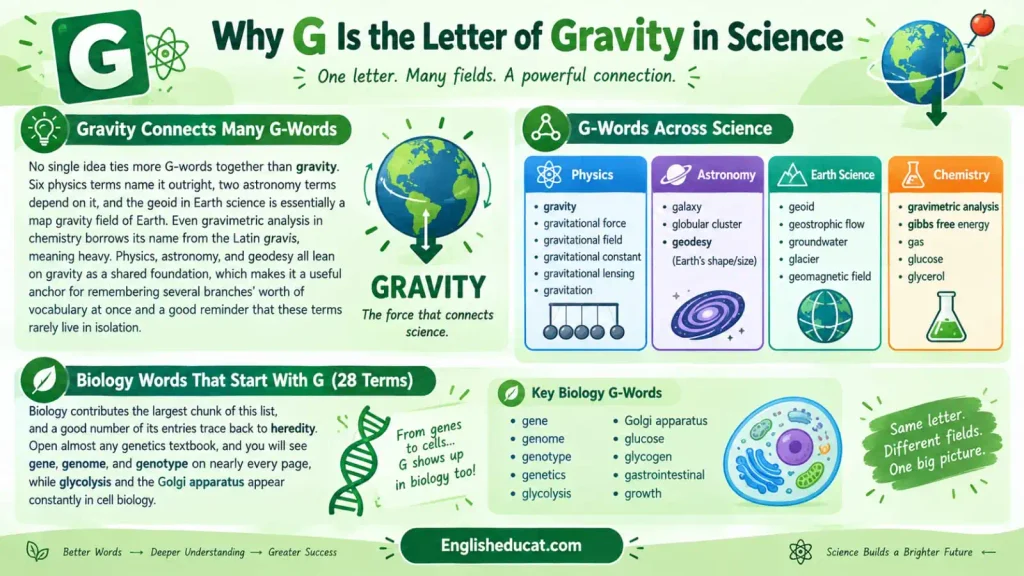
Why G Is the Letter of Gravity in Science
No single idea ties more G-words together than gravity. Six physics terms name it outright, two astronomy terms depend on it, and the geoid in Earth science is essentially a map gravity field of Earth. Even gravimetric analysis in chemistry borrows its name from the Latin gravis, meaning heavy. Physics, astronomy, and geodesy all lean on gravity as a shared foundation, which makes it a useful anchor for remembering several branches’ worth of vocabulary at once and a good reminder that these terms rarely live in isolation.
Biology Words That Start With G (28 Terms)
Biology contributes the largest chunk of this list, and a good number of its entries trace back to heredity. Open almost any genetics textbook, and you will see gene, genome, and genotype on nearly every page, while glycolysis and the Golgi apparatus appear constantly in cell biology.
| Term | Definition | Example Sentence |
| Gene | A stretch of DNA that carries the instructions for a specific trait | One gene can influence eye color. |
| Genome | The full set of genetic material an organism carries | The human genome was sequenced in 2003. |
| Genetics | The branch of biology concerned with how traits are inherited and vary | She studies genetics to understand inherited diseases. |
| Genotype | The particular combination of genes an organism has | Plants sharing a genotype can still look different. |
| Gamete | A sex cell that combines with another during reproduction | Sperm and egg cells are gametes. |
| Guanine | A nitrogen-containing base found in DNA, always paired with cytosine | Guanine always pairs with cytosine. |
| Gene pool | The full collection of genes present across a population | A larger gene pool boosts resilience. |
| Gene expression | The process by which a gene’s instructions get converted into a working protein | Gene expression can be switched on or off. |
| Genetic drift | A random change in how common certain alleles are within a population | Genetic drift acts strongly in small populations. |
| Genetic engineering | Deliberately altering an organism’s DNA to change its traits | Genetic engineering produced pest-resistant crops. |
| Genetic mutation | An alteration in a DNA sequence | A genetic mutation can cause hereditary disease. |
| Glucose | A simple sugar that serves as a primary energy source for cells | Muscle cells burn glucose for energy. |
| Glycogen | The form in which animals store excess glucose | The liver releases glycogen when blood sugar drops. |
| Glycolysis | The metabolic pathway that breaks glucose down to release energy | Glycolysis occurs in the cytoplasm. |
| Golgi apparatus | A cell structure that finishes and ships out proteins made elsewhere in the cell | The Golgi apparatus modifies proteins before secretion. |
| Granulocyte | A category of white blood cell identifiable by small granules inside it | Granulocytes help fight infection. |
| Gland | A body structure built to produce and release substances | The thyroid gland regulates metabolism. |
| Growth hormone | A hormone that drives growth and prompts cells to reproduce | Growth hormone peaks during deep sleep. |
| Gastric | Having to do with the stomach | Gastric acid helps break down food. |
| Gill | The organ fish use to pull oxygen from water | Fish breathe underwater through gills. |
| Gizzard | A muscular chamber in a bird’s digestive tract that grinds up food | A gizzard often holds swallowed pebbles. |
| Ganglion | A grouping of nerve cell bodies located outside the brain | Pain signals pass through a ganglion. |
| Gestation | The span of time an embryo or fetus develops before birth | Human gestation lasts about nine months. |
| Gastrulation | An early embryonic stage that establishes the three basic layers of the body | Gastrulation sets the basic body plan. |
| Germination | The point at which a seed starts growing into a plant | Germination begins when the seed absorbs water. |
| Grafting | Attaching tissue from one plant onto another so the two grow as a single plant | Orchardists use grafting to combine fruit varieties. |
| Green algae | Aquatic organisms that photosynthesize | Green algae bloom in warm ponds. |
| Genus | A taxonomic level grouping closely related species together | Lions and tigers share the genus Panthera. |
Chemistry Words That Start With G (28 Terms)
Chemistry brings elements, gas laws, and lab techniques into the mix. Gibbs free energy, named after American scientist J. Willard Gibbs, tells you whether a reaction will happen on its own, and gel electrophoresis is something you will see in almost any DNA lab.
| Term | Definition | Example Sentence |
| Gas | A state of matter with no fixed shape or volume | Helium is a gas lighter than air. |
| Gas constant | A fixed value connecting a gas’s pressure, volume, and temperature | It appears in the ideal gas law. |
| Gay-Lussac’s Law | The principle that a gas’s pressure rises with temperature when volume stays constant | It explains why tire pressure rises as the air inside warms. |
| Gauge pressure | Pressure measured against normal atmospheric pressure rather than a true zero | A tire gauge reads gauge pressure. |
| Gibbs free energy | The portion of a system’s energy that’s actually available to do useful work | Negative Gibbs free energy signals a spontaneous reaction. |
| Ground state | The lowest possible energy level an atom can occupy | Electrons return to the ground state after emitting light. |
| Group (periodic table) | A vertical column on the periodic table containing elements with similar properties | Elements in one group react alike. |
| Gallium | A metal with a melting point low enough to liquefy near room temperature | Gallium melts in your palm. |
| Gadolinium | A rare earth element used in contrast agents for MRI scans | Gadolinium sharpens MRI scans. |
| Germanium | A metalloid that behaves as a semiconductor | Early transistors used germanium. |
| Gold | A dense, corrosion-resistant metal with atomic number 79 | Gold resists tarnish and corrosion. |
| Graphite | A soft, layered crystal form of carbon | Pencil “lead” is actually graphite. |
| Galena | A mineral made of lead sulfide | Galena is the main lead ore. |
| Glycerol | A thick, sweet-tasting alcohol used in many products | Soap makers add glycerol to keep skin moist. |
| Glycol | An organic compound carrying two hydroxyl groups | Ethylene glycol is used in antifreeze. |
| Grain alcohol | Ethanol produced by distilling grain | Some disinfectants contain grain alcohol. |
| Grignard reagent | A magnesium-containing compound chemists use to build new carbon bonds | Chemists use it to form carbon-carbon bonds. |
| Geometric isomer | One of two molecules sharing the same formula but differing in spatial arrangement | Cis and trans fats are geometric isomers. |
| Gauche conformation | A molecular arrangement with a roughly 60-degree twist between bonds | It is usually less stable than the anti form. |
| Gel | A semi-solid substance formed from a liquid trapped in a network of particles | Hair gel is a household example. |
| Gel electrophoresis | A lab method that sorts molecules by size as they move through a gel under an electric field | It sorts DNA fragments by length. |
| Gas chromatography | A method for separating and identifying compounds that vaporize easily | It identified trace contaminants in the sample. |
| Gravimetric analysis | A quantitative technique based on carefully weighing a substance | It confirmed the sample’s purity. |
| Green chemistry | An approach to chemistry aimed at cutting down on hazardous materials and waste | Green chemistry designs safer industrial processes. |
| Galvanization | Coating a metal, usually steel, with a layer of zinc to resist rust | Galvanization protects steel fences. |
| Galvanic cell | A setup that generates electricity from a chemical reaction | A galvanic cell powers a simple battery. |
| Gram | A metric unit used to measure mass | A paperclip weighs about one gram. |
| Gray (unit) | The SI unit for measuring absorbed radiation dose | One gray equals one joule per kilogram. |
Physics Words That Start With G (26 Terms)
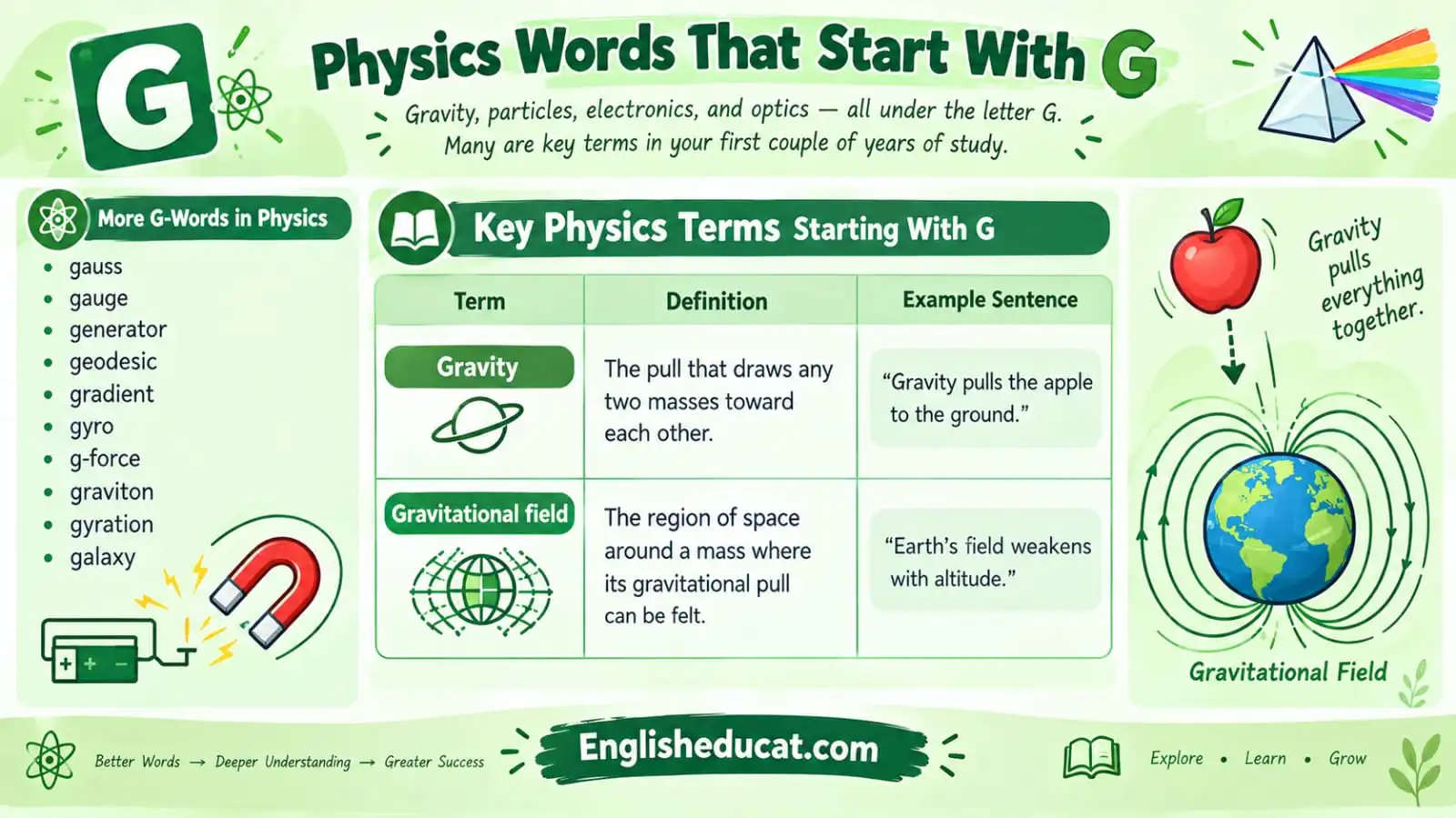
Gravity dominates this section, but physics also brings in particles, electronics, and optics under the letter G. Most undergraduates meet these terms within their first couple of years, from gauss in electromagnetism to geodesics in relativity.
| Term | Definition | Example Sentence |
| Gravity | The pull that draws any two masses toward each other | Gravity pulls the apple to the ground. |
| Gravitational field | The region of space around a mass where its gravitational pull can be felt | Earth’s field weakens with altitude. |
| Gravitational constant | A fixed number that determines how strong gravity’s pull is | The gravitational constant is remarkably small. |
| Gravitational wave | A ripple in spacetime caused by massive objects accelerating | LIGO first detected gravitational waves in 2015. |
| Graviton | A theoretical particle thought to carry the force of gravity | No one has directly observed a graviton. |
| General relativity | Einstein’s theory describing gravity as the curving of spacetime itself | It predicts the bending of starlight. |
| Geodesic | The shortest possible route between two points on a curved surface | Light follows a geodesic through curved spacetime. |
| G-force | A measure of acceleration expressed as a multiple of normal gravity | Pilots feel high g-force in sharp turns. |
| Gauge boson | A particle responsible for transmitting one of the fundamental forces | The photon is electromagnetism’s gauge boson. |
| Gluon | The particle that holds quarks together via the strong force | Gluons bind quarks together inside protons and neutrons. |
| Gauge invariance | A property where physical laws stay unchanged under certain mathematical transformations | It underlies the Standard Model. |
| Grand unified theory | A proposed framework that would combine every fundamental force except gravity | Physicists still seek evidence for a grand unified theory. |
| Gamma ray | A form of electromagnetic radiation carrying extremely high energy | Gamma rays penetrate most materials. |
| Galvanometer | A device built to detect and measure small electric currents | The needle moved as current flowed. |
| Generator | A machine that converts motion into electrical energy | Wind turbines drive generators. |
| Grounding | An electrical connection to the earth that protects against dangerous buildup of charge | Grounding prevents dangerous charge buildup. |
| Gain | A measure of how much a signal’s power or strength is boosted | The amplifier’s gain boosted the weak signal. |
| Gauss | An older (CGS) unit for measuring magnetic field strength | A fridge magnet produces a few gauss. |
| Gigahertz | A frequency unit equal to a billion cycles per second | Modern processors run at several gigahertz. |
| Geometric optics | The branch of optics that treats light as straight-line rays | It explains how mirrors form images. |
| Grating (diffraction) | A surface etched with closely spaced lines that splits light into its component colors | A grating separates light into a spectrum. |
| Group velocity | The speed at which the overall shape of a wave packet travels | It can differ from phase velocity. |
| Gaussian distribution | A symmetric, bell-shaped curve describing how values cluster around an average | Measurement errors often follow one. |
| Gyroscope | A spinning device that resists changes to its orientation | A gyroscope stabilizes a drone. |
| Gyrocompass | A rotor-driven instrument that points to true north rather than magnetic north | Ships rely on a gyrocompass. |
| Geostationary orbit | An orbit positioned so a satellite stays fixed over the same point on Earth | Communication satellites often use it. |
Astronomy and Space Words That Start With G (26 Terms)
Astronomy stretches the G-list from planet-sized objects to the scale of the whole universe. Observatories and space agencies use these terms constantly, whether they are describing a distant cluster of galaxies or keeping a telescope locked on a single target.
Galaxies and Deep Space
A galaxy is a huge, gravity-bound collection of stars, gas, and dust; the Milky Way is the one we live in. Galactic simply describes anything related to a galaxy; galactic collisions, for instance, can trigger bursts of new star formation. At the galactic center, a supermassive black hole anchors the whole structure, and one galactic year the time it takes the Sun to orbit that center once lasts roughly 225 million Earth years.
A globular cluster is a tightly packed sphere of old stars, sometimes numbering in the hundreds of thousands, while a gaseous nebula is a cloud of gas and dust that frequently gives birth to new stars. A gamma-ray burst is an intensely energetic explosion, far off in space, that can briefly outshine an entire galaxy. Gravitational lensing bends and magnifies light from distant objects as it passes near something massive, and gravitational collapse, a body caving in under its own gravity, can end with the formation of a black hole.
Solar System and Sky Events
A gas giant is a large planet made almost entirely of hydrogen and helium, and Jupiter is the largest example in our solar system. Its four biggest moons Io, Europa, Ganymede, and Callisto are known as the Galilean moons, first spotted by Galileo back in 1610. A gibbous moon is more than half illuminated but not yet full.
A ghost crater is an old impact site that is mostly buried under later lava flows. The green flash is a fleeting green glint sometimes visible right at sunrise or sunset, and a geomagnetic storm is a disturbance in magnetic field of Earth triggered by solar activity, capable of interfering with satellites. Gemini, the constellation representing twins Castor and Pollux, is easiest to find during winter.
Orbits, Models, and Mapping
A geosynchronous orbit matches Earth’s rotation period, which is why many weather satellites are placed there. The geocentric model put Earth at the center of the universe until the heliocentric model eventually replaced it. A great circle is the largest circle that can be drawn on the surface of a sphere; the equator is one example.
The geoid describes Earth’s actual, irregular shape as defined by its gravity field. Engineers plot a satellite’s ground track, the path it traces across Earth’s surface, well before launch. The Gaia hypothesis suggests that Earth functions as a single, self-regulating system.
Observation and Timekeeping
A guide star is a reference point that helps keep a telescope steady while tracking, and a guidescope is the small secondary telescope astrophotographers mount for the same purpose. A gnomon is the part of a sundial that casts the shadow used to tell time. Gyrochronology estimates the age of a star from how fast it spins and what color it is.
Earth and Environmental Science Words That Start With G (26 Terms)
Earth science rounds out the list with rocks, water, and climate. You will run into these terms constantly in geology field reports, hydrology surveys, and climate assessments like those published by the Intergovernmental Panel on Climate Change.
Disciplines and Processes
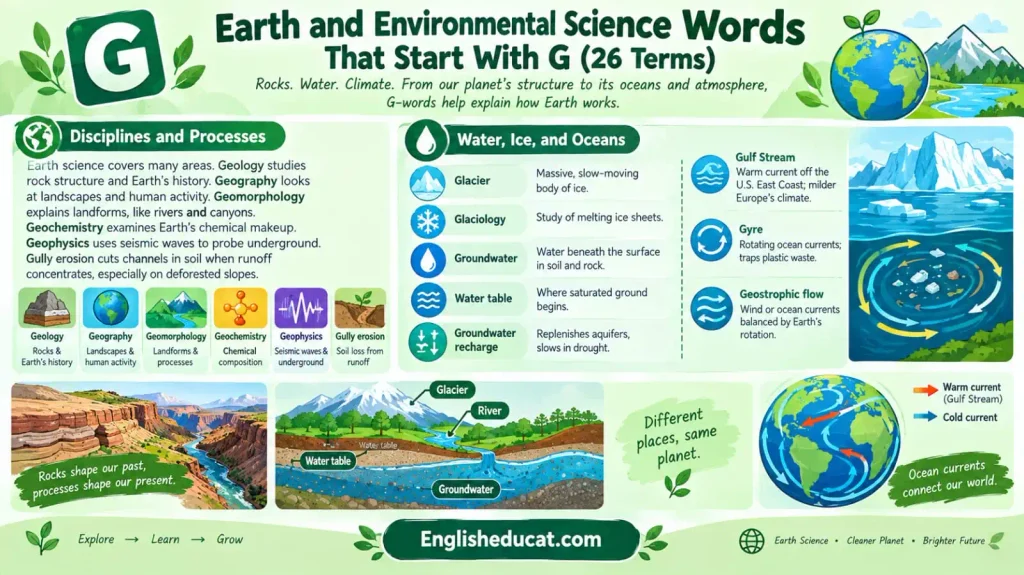
Geology covers the study of the structure of Earth and the processes that shape it, and a geologist is the specialist who reconstructs Earth’s history by reading its rocks. Geography looks at physical landscapes alongside human activity.
Geomorphology explains how landforms take shape, rivers carving out canyons, for example, while geochemistry studies what Earth is chemically made of, and geophysics applies physics, often through seismic waves, to probe what is happening deep underground. Gully erosion cuts sharp channels into soil wherever runoff concentrates, a problem especially common on deforested slopes.
Water, Ice, and Oceans
A glacier is a massive, slow-moving body of ice, and glaciology is the study of how quickly ice sheets are melting. Groundwater is water sitting beneath the surface, stored in soil and rock. The groundwater table, more commonly called the water table, marks where saturated ground begins, and groundwater recharge is the process of replenishing aquifers, which slows considerably during extended drought.
The Gulf Stream, a warm current running along the U.S. East Coast, helps keep Western Europe’s climate milder than its latitude would suggest. A gyre is a large system of rotating ocean currents, and one of the side effects is that floating plastic waste tends to accumulate inside them. Geostrophic flow describes wind or ocean currents balanced against the effect of Earth’s rotation.
Climate, Weather, and Ecosystems
Global warming refers to the long-term increase in Earth’s average surface temperature. It is driven by the greenhouse effect, the process by which certain atmospheric gases trap heat, and a greenhouse gas, such as methane, is any gas responsible for that trapping. A gale is a powerful wind, generally classified as 39 to 54 mph in U.S. forecasts, and a grassland is a biome where grasses dominate, and trees are scarce.
Rocks, Minerals, and Heat
Granite is a coarse-grained igneous rock rich in quartz and feldspar, popular for countertops. A geode is a hollow rock lined on the inside with crystals, and gravel is loose rock fragments, often deposited by rivers along their banks. The geosphere refers to Earth’s solid and non-living material. Geothermal describes anything related to Earth’s internal heat. Iceland famously taps it to heat homes, and a geyser is a hot spring that periodically erupts with water and steam.
Advanced Science Words That Start With G (7 Terms)
These seven terms mostly appear in upper-level biology, Earth science, and materials courses. They are rare in high school classrooms but common enough in journal abstracts.
| Term | Definition | Example Sentence |
| Gluconeogenesis | The metabolic pathway that builds new glucose from non-carbohydrate sources | It maintains blood sugar during fasting. |
| Gnotobiotic | Describing an organism raised in an environment free of other microbes | Gnotobiotic mice help microbiome researchers. |
| Galvanotaxis | The tendency of an organism to move in response to an electric current | Galvanotaxis appears in bacteria exposed to weak current. |
| Geochronology | The science of determining the age of rocks and geological events | It relies on radioactive decay. |
| Gigapascal | A unit of pressure equal to one billion pascals | Diamond forms above several gigapascals. |
| Gnomonic projection | A map projection on which every great circle appears as a straight line | Navigators once plotted routes with it. |
| Girdling | Stripping away a ring of bark, which cuts off a plant’s nutrient flow | Foresters use girdling to kill unwanted trees. |
Why Learn Science Words That Start With G?
Knowing a few roots unlocks whole families of vocabulary at once. Geo- (earth) appears in more than a dozen terms on this list, gluc- and glyc- (sweet) run through the sugar-related words, and grav- (heavy) anchors everything connected to gravity. Learn a root once, and you can often guess at an unfamiliar term the first time you see it.
Meanings also shift depending on the field. Gauge means something different in gauge pressure than it does in gauge boson; group refers to a periodic table column in chemistry but a wave property in physics; and geometric shows up in both optics and isomer chemistry with unrelated meanings. Keeping track of these overlaps will save you from mixing terms up on an exam.
These words also earn their place outside the classroom. Gene, gravity, glycolysis, and Gibbs free energy anchor introductory science courses, while gravitational waves, genetic engineering, and greenhouse gases regularly show up in the news. Try grouping your flashcards by shared root instead of alphabetically, and reuse the example sentences above as recall prompts; that combination tends to stick better than memorizing definitions in isolation.
For teachers and tutors, this list also works well as a weekly routine: assign one branch per day, quiz using the example sentences, and close the week with a mixed review. Meeting the same term in different contexts a table one day, a quiz the next, a lab report after that is what actually makes it stick.
Frequently Asked Questions
What are some science words that start with G?
Some of the most common ones are gene, genome, gravity, galaxy, glacier, glucose, gas, and geology. Between them, they cover biology, chemistry, physics, astronomy, and Earth science, which is part of why almost every school science course ends up using several of these terms.
What does G stand for in science?
It depends entirely on context: G can represent the gravitational constant in physics, Gibbs free energy in chemistry, guanine in a DNA sequence, or gauss as a unit of magnetic flux density. A lowercase g usually refers to grams or gravitational acceleration instead. Getting used to checking context first is a good habit for reading scientific notation generally.
What are biology words that start with G?
Common examples include gene, genome, genotype, gamete, gland, glucose, glycogen, and gestation. Most connect to heredity, cell chemistry, or development, and they typically appear early in any introductory biology course.
What are physics words that start with G?
Physics contributes terms like gravity, gluon, graviton, gamma ray, gyroscope, and general relativity. Some describe fundamental forces directly, while others, like the galvanometer and diffraction grating, for example, describe how electricity and light behave in instruments.
What is the difference between a gene and a genome?
A gene is one specific segment of DNA that codes for a particular trait, while a genome is the entire set of genetic material an organism carries. It helps to think of individual genes as single instructions and the genome as the complete instruction manual they are all part of.
What are some rare science words that start with G?
Less common examples include gluconeogenesis, gnotobiotic, galvanotaxis, geochronology, gigapascal, gnomonic projection, and girdling. These mostly show up in specialized biology, Earth science, and cartography texts rather than general coursework.
Conclusion
From the single gene that shapes one trait to the galaxy that holds billions of stars, the letter G covers an unusually wide stretch of scientific ground. This guide walked through 141 terms: the genetics behind who we are, the gases and gels of the chemistry lab, the gravity that bends light itself, the glaciers and geysers that reshape the planet, and specialist terms like gnotobiotic and gyrochronology for good measure.
These are not just vocabulary to memorize; each one is a starting point for understanding something bigger. The next time a lecture, article, or exam throws a G-word at you, there is a good chance you will already know it. Save this list, quiz yourself branch by branch, and pick five terms to actually use this week. Repetition is what turns a new word into a familiar one.

ESL Content Writer
Emily is a TESOL-certified writer who has taught English to international students for over 8 years. She loves breaking down idioms and everyday expressions into simple, relatable explanations that make sense to learners at any level.