
Short English phrases, usually idioms about truth, that describe honesty, falsehood, or hidden facts in non-literal terms.
Idioms about truth are fixed phrases that describe honesty, facts, and hidden things colorfully. You will find 18 of them here in this guide. Each one includes a word-by-word breakdown with its real meaning and simple examples. You will also see true origins where they exist, two handy tables, common learner mistakes, and answers to popular questions. Use these idioms about truth in school, at work, or in daily chat.
What Are Idioms About Truth?
Idioms about truth are phrases whose meaning is different from their separate words, and they talk about honesty, facts, and lies.
You can not guess most of them from the words alone. “The naked truth” is not related to clothes. Learners need to know the whole phrase, not just each word.
Some of these idioms about truth sound formal. Others sound relaxed. The table below shows the tone of each one, so you can pick the right phrase for the right moment. There are many other idioms just like Home and Change that you should also know and they will be very helpful in future.
Table 1: Tone and Formality of Idioms About Truth
| The truth will out | Neutral | Speaking or writing |
| Gospel truth | Positive | Casual or formal |
| Economical with the truth | Negative | Formal, news, politics |
| Bend / stretch the truth | Negative (mild) | Casual |
| Nothing could be further from the truth | Neutral | Any setting |
| Moment of truth | Neutral | Any setting |
| To tell the truth | Neutral | Casual |
| In truth | Neutral | Formal |
| If truth be told | Neutral | Formal, a bit old-fashioned |
| The ring of truth | Positive | Any setting |
| The naked truth | Neutral | Serious talk |
| The honest truth | Neutral | Casual |
| The truth hurts | Negative | Casual |
| Half-truth | Negative | Any setting |
| Home truth | Negative | Casual |
| Come clean | Neutral | Casual |
| Call a spade a spade | Neutral | Casual |
1. The Truth Will Out
“The truth will out” means hidden facts always come to light in the end.
Word by Word Meaning
“Truth” is that thing which is real. “Will” points to the future. “Out” means into the open. The grammar is old. Today we would say “will come out.”
Idiomatic Meaning
This expression says that secrets can not stay buried forever. Someone may hide a fact, but people will find it later.
Origin note: Shakespeare wrote a line very close to it in The Merchant of Venice. Whether he invented the phrase is not confirmed.
Examples
- He hid the mistake for months, but the truth will out.
- “Do not lie to your teacher,” Mom said. “The truth will out.”
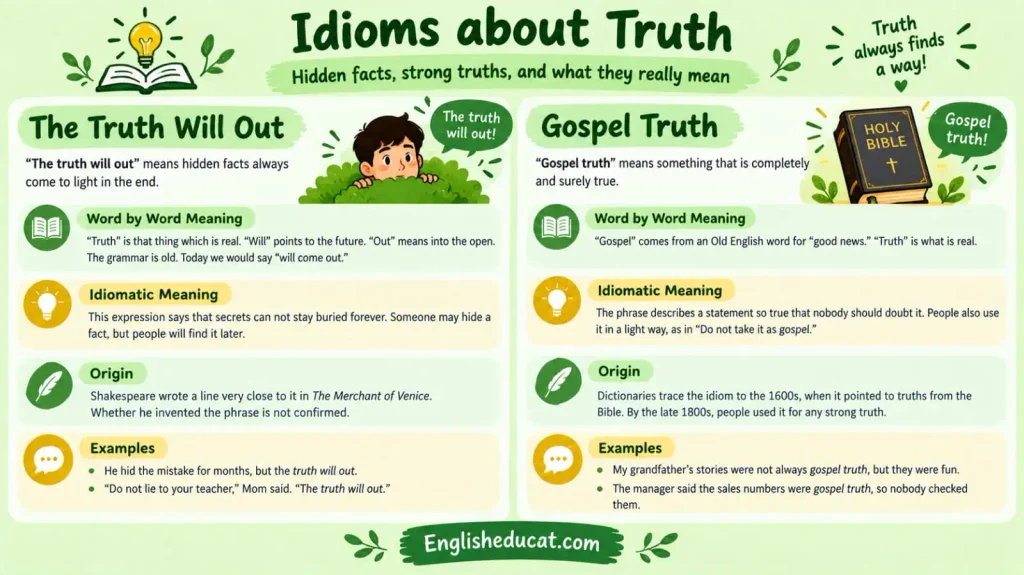
2. Gospel Truth
“Gospel truth” means something that is completely and surely true.
Word-by-Word Meaning
“Gospel” comes from an Old English word for “good news.” “Truth” is what is real.
Idiomatic Meaning
The phrase describes a statement so true that nobody should doubt it. People also use it in a light way, as in “Do not take it as gospel.”
Origin note: Dictionaries trace the idiom to the 1600s, when it pointed to truths from the Bible. By the late 1800s, people used it for any strong truth.
Examples
- My grandfather’s stories were not always gospel truth, but they were fun.
- The manager said the sales numbers were gospel truth, so nobody checked them.
3. Economical With the Truth
“Economical with the truth” means telling only part of the facts so people get a false picture.
Word-by-Word Meaning
“Economical” means careful with spending. Here, the speaker spends the truth like money and uses as little as possible.
Idiomatic Meaning
It is a polite way to say someone is not fully honest. The speaker avoids a direct lie but still misleads.
Origin note: The modern use is often linked to Sir Robert Armstrong, a British official, after a 1986 trial. Edmund Burke wrote about an “economy of truth” much earlier, but he meant it as a careful, kind habit. The modern idiom is negative.
Examples
- The company was economical with the truth about the problem with the product.
- At school, Dan was economical with the truth about his test score.
4. Bend the Truth
“Bend the truth” means to say something that is not quite true.
Word-by-Word Meaning
“Bend” means to curve something. The facts stay close to the real shape but are not straight.
Idiomatic Meaning
The phrase describes a small change to the facts, not a big lie. A person may do it to look better or avoid trouble.
Examples
- She bent the truth on her resume to get the interview.
- “I might bend the truth a little,” he said, “but I never lie about big things.”
5. Stretch the Truth
“Stretch the truth” means to make a story bigger or better than it really was.
Word-by-Word Meaning
“Stretch” means to pull something longer. The real story gets pulled until it grows.
Idiomatic Meaning
This one is close to “bend the truth,” but it focuses on exaggeration. Bending changes the facts. Stretching adds size.
Examples
- The fish was big, but he stretched the truth when he said it was a meter long.
- Ads often stretch the truth about how fast a product works.
6. Nothing Could Be Further From the Truth
“Nothing could be further from the truth” means a statement is completely false.
Word-by-Word Meaning
“Further” shows a long distance. The phrase pictures a claim that sits as far away from reality as possible.
Idiomatic Meaning
You use it to strongly deny what someone says or thinks. It adds weight to a no.
Examples
- “You think I do not like your cooking? Nothing could be further from the truth.”
- Some say the new boss is lazy. Nothing could be further from the truth.
7. Moment of Truth
“Moment of truth” means the time when something is finally tested or decided.
Word-by-Word Meaning
“Moment” is a short time. “Truth” is what becomes clear. So it is a short time when the real result shows.
Idiomatic Meaning
The phrase points to a key test, like an exam result, a match, or a hard choice. Nobody is lying here. The point is that the answer finally appears.
Examples
- The moment of truth came when the teacher opened the envelope.
- Before the final, the coach said, “This is our moment of truth.”
8. To Tell the Truth
“To tell the truth” means “honestly” and is used before saying what you really think.
Word-by-Word Meaning
“Tell” means to say. “The truth” is the real facts. Together they mean speaking honestly.
Idiomatic Meaning
People use it to introduce an honest opinion, often one that may surprise the listener.
Examples
- To tell the truth, I did not enjoy the movie.
- To tell the truth, I forgot your birthday.
9. In Truth
“In truth” means “really” or “in fact.”
Word-by-Word Meaning
“In” shows the state something is in. “Truth” is what is real. So the phrase means “in reality.”
Idiomatic Meaning
It sounds formal. A speaker uses it to set the real facts against what people may believe.
Examples
- In truth, the plan was never going to work.
- The house looks big, but in truth it has only two rooms.
10. If Truth Be Told
“If truth be told” means “to be honest.”
Word-by-Word Meaning
“Be told” is old grammar for “is told.” The phrase says, “if the real facts are spoken.”
Idiomatic Meaning
It opens an honest comment that may be a little awkward. It has an old-fashioned feel.
Examples
- If truth be told, I would rather stay home tonight.
- If truth be told, the team was never ready for the contest.
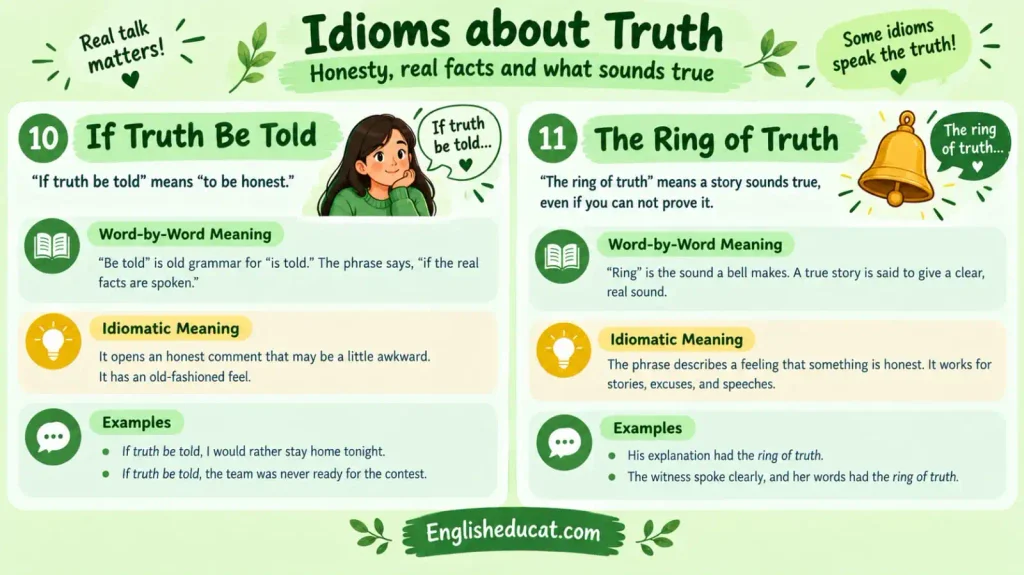
11. The Ring of Truth
“The ring of truth” means a story sounds true, even if you can not prove it.
Word-by-Word Meaning
“Ring” is the sound a bell makes. A true story is said to give a clear, real sound.
Idiomatic Meaning
The phrase describes a feeling that something is honest. It works for stories, excuses, and speeches.
Examples
- His explanation had the ring of truth.
- The witness spoke clearly, and her words had the ring of truth.
12. The Naked Truth
“The naked truth” means the plain facts with nothing hidden or softened.
Word-by-Word Meaning
“Naked” means with no clothes. The truth has no cover on it.
Idiomatic Meaning
This phrase suggests a fact told directly, even when it feels harsh. It does not add extra decoration.
Examples
- The doctor gave us the naked truth about the cost.
- You asked what I think. Here is the naked truth: the song is too long.
13. The Honest Truth
“The truth” means a strong way to say you are being fully honest.
Word-by-Word Meaning
“Honest” and “truth” both point to the same idea. Using both adds force.
Idiomatic Meaning
The speaker wants the listener to believe the next sentence. It is informal and often warm.
Examples
- The truth is I was scared to ask.
- I will give you the truth: I never read the book.
14. The Truth Hurts
“The truth hurts” means real facts can cause pain when you hear them.
Word-by-Word Meaning
“Hurts” means causes pain. The pain is in feelings, not in the body.
Idiomatic Meaning
People say it when a person hears a fact that stings. Sometimes they say it as a joke.
Examples
- “Your essay needs a lot of work.” “Ouch, but the truth hurts.”
- She knew the truth hurts, so she spoke gently.
15. Half-Truth
“A half-truth” means a statement that is only partly true and leaves out key facts.
Word-by-Word Meaning
“Half” means one part of two. So it is one part true and one part missing.
Idiomatic Meaning
It describes a message that can fool people without being a direct lie.
Examples
- The ad was a half-truth because it left out the extra fees.
- He told a half-truth to avoid an argument.
16. Home Truth
“A home truth” means a true but unpleasant fact about a person.
Word-by-Word Meaning
“Home” suggests something that hits close to you. “Truth” is the real fact.
Idiomatic Meaning
Usually someone else says it, and it is hard to hear. It often relates to a person’s flaws.
Examples
- Her sister told her a few home truths about her attitude.
- It was time for some home truths about the poor effort of a team.
17. Come Clean
“Come clean” means to admit the truth about something you hid.
Word-by-Word Meaning
“Come” means to move toward. “Clean” means free from dirt. A person moves from a hidden, “dirty” secret to an open one.
Idiomatic Meaning
The phrase suggests a person finally tells everything and stops hiding.
Examples
- The player came clean about the mistake.
- “Come clean,” said Dad. “Who ate the last cookie?”
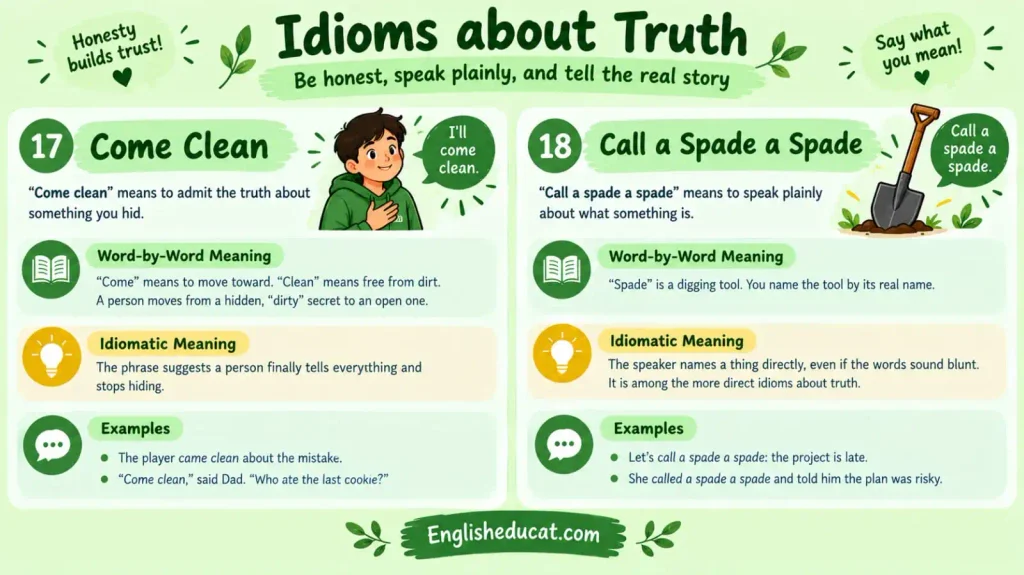
18. Call a Spade a Spade
“Call a spade a spade” means to speak plainly about what something is.
Word-by-Word Meaning
“Spade” is a digging tool. You name the tool by its real name.
Idiomatic Meaning
The speaker names a thing directly, even if the words sound blunt. It is among the more direct idioms about truth.
Examples
- Let’s call a spade a spade: the project is late.
- She called a spade a spade and told him the plan was risky.
How Idioms About Truth Compare
Idioms about truth sit on a line from fully true to hidden or false.
The second table shows that line. It helps you choose between close phrases such as “bend the truth” and “economical with the truth.”
Table 2: The Truth Spectrum
| Fully true | Gospel truth | Completely sure |
| Fully true | The naked truth | Plain and direct |
| Sounds true | The ring of truth | Feels honest |
| Partly true | Half-truth | Some facts missing |
| Slightly changed | Bend the truth | Small twist |
| Made bigger | Stretch the truth | Exaggerated |
| Hidden | Economical with the truth | Facts held back |
Common Mistakes With Idioms About Truth
The most common mistakes with idioms about truth are small word errors and mixing up close phrases.
- Dropping “the.” Say “tell the truth,” not “tell truth.”
- Changing the fixed words. “The truth will out” is correct. “The truth will come out” is fine in normal speech, but it is no longer the idiom.
- Mixing up bend and stretch. Bending changes the facts. Stretching makes them bigger.
- Using “in truth” in casual chat. It sounds stiff with friends. “To tell the truth” fits better.
- Calling “economical with the truth” a compliment. Today it is a polite criticism.
Frequently Asked Question
What does “the truth will out” mean?
It means hidden facts always become known in the end. People use it when someone is trying to keep a secret, and the speaker believes it will not last.
What does “gospel truth” mean?
It means something is completely and surely true. The idiom comes from the word “gospel,” which once meant “good news” and later pointed to biblical truths.
What does “economical with the truth” mean?
It means sharing only part of the facts so that listeners get a false picture. It is a polite way to say someone is not being fully honest.
What is the difference between “bend the truth” and “stretch the truth”?
“Bend the truth” means to change the facts a little, while “stretch the truth” means to make a story bigger than it was. The two overlap, but exaggeration is the key point of “stretch.”
Conclusion
Idioms about truth help you describe honesty, secrets, and half-truths in a few words. Pick the right tone, watch the small words, and use each phrase in its normal setting. Start with two or three from this list and add one new idiom each week.

Linguistics Specialist
James is a linguist with a Ph.D. in Applied Linguistics from Boston University. His work focuses on word origins, synonyms, and how language evolves over time. He has contributed to several academic journals on English semantics.