
Idioms for funny are fixed phrases that usually describe humor, laughter, or silly moments. They never mean exactly what the words say. Here you will find the meaning of each phrase, a short note on where it comes from, and examples that you can reuse. Some phrases describe a funny person. Others sound funny on their own. A few work best as jokes. Every entry also shows the tone, so you know when to use it.
Quick definition: A funny idiom is a set phrase with a playful or silly meaning. The words together usually point to something different from the words alone. For example, “a barrel of laughs” describes a very fun person, not a real barrel. Idioms for funny talk can describe humor or sound humorous themselves. These are very related to Heart idioms.
What Are Idioms for Funny?
Idioms for funny are set phrases that either describe humor or sound humorous themselves.
They fall into three groups. Each group works a little differently.
Idioms That Sound Funny
These phrases paint a silly picture, like a pig with wings.
Idioms That Describe Funny Things
These talk about jokes, laughter, and people who make others smile.
Idioms Used as Jokes
These are said with a wink. Sarcasm and teasing are common.
Idioms for Funny People, Jokes, and Laughter
The best idioms for funny people and jokes include “a barrel of laughs,” “a riot,” and “in stitches.”
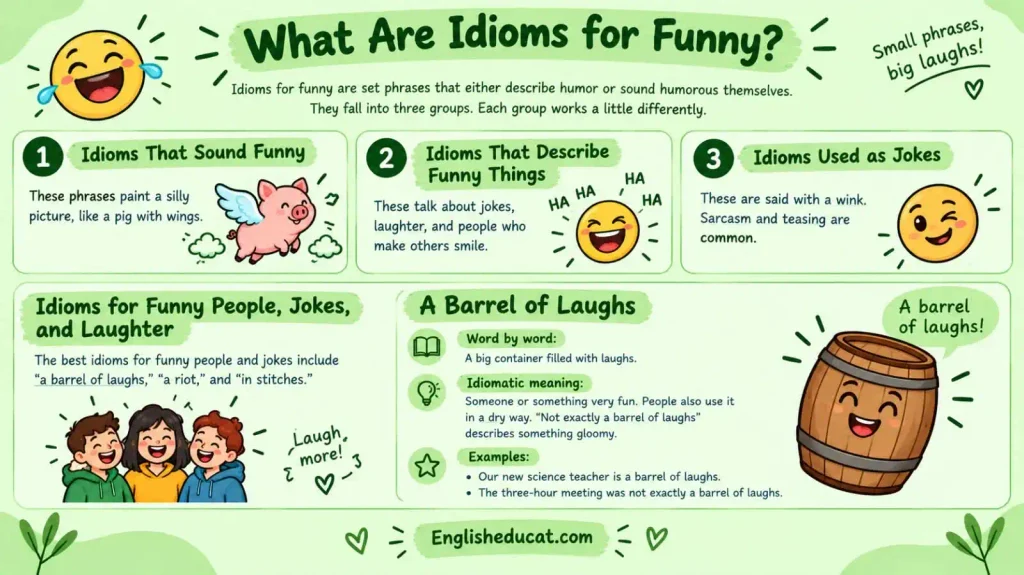
A Barrel of Laughs
Word by word:
A big container filled with laughs.
Idiomatic meaning:
Someone or something very fun. People also use it in a dry way. “Not exactly a barrel of laughs” describes something gloomy.
Examples:
- Our new science teacher is a barrel of laughs.
- The three-hour meeting was not exactly a barrel of laughs.
Tickle Your Funny Bone
Word by word:
Touch lightly the spot on your elbow that tingles when you bump it.
Idiomatic meaning:
Make you laugh. The name “funny bone” is often linked to a pun on the word “humerus,” though that link is not confirmed.
Examples:
- That cartoon really tickled my funny bone.
- Dad’s silly dance tickles everyone’s funny bone at dinner.
A Laugh a Minute
Word by word:
One laugh every sixty seconds.
Idiomatic meaning:
Nonstop fun, with jokes arriving all the time.
Examples:
- Grandma is a laugh a minute at family dinners.
- Our team trip was a laugh a minute.
Crack a Joke
Word by word:
Break a joke open, like a nut.
Idiomatic meaning:
Tell a joke, often quickly and casually.
Examples:
- He cracked a joke to calm everyone before the test.
- Maya cracks a joke whenever her boss looks stressed.
Crack Up
Word by word:
Break into pieces.
Idiomatic meaning:
Burst out laughing, or make someone else laugh.
Examples:
- The photo made me crack up in the middle of class.
- Her impression of the principal cracked us all up.
In Stitches
Word by word:
Inside sewn threads.
Idiomatic meaning:
Laughing so hard you can barely stop. The phrase likely connects to the sharp side pain, called a stitch, that hard laughing can cause. That link is a guess, not a fact.
Examples:
- The comedian had the whole room in stitches.
- We were in stitches after Dad’s story about the runaway goat.
Knee-Slapper
Word by word:
Something that makes you slap your own knee.
Idiomatic meaning:
A very funny joke or story. It is mostly American and sounds a little old-fashioned.
Examples:
- Grandpa’s fishing story was a real knee-slapper.
- Not every joke in the speech was a knee-slapper.
Class Clown
Word by word:
A circus clown sitting in a classroom.
Idiomatic meaning:
A student who jokes around to get laughs. It can sound fond or slightly critical.
Examples:
- Teachers liked Leo, even though he was the class clown.
- My cousin was the class clown until she found stand-up comedy.
A Riot
Word by word:
A loud, wild crowd.
Idiomatic meaning:
Someone or something extremely funny. Here the word has nothing to do with violence.
Examples:
- Your sister is a riot at parties.
- The school play was a riot, especially the dancing tree.
Laugh Like a Drain
Word by word:
Laugh the way water gurgles down a pipe.
Idiomatic meaning:
Laugh loudly and freely. This one is British.
Examples:
- He laughed like a drain at the old sitcom.
- Mum laughs like a drain whenever her favorite show comes on.
Funny-Sounding Idioms With Strange Pictures
Funny-sounding idioms use odd pictures, like flying pigs or headless chickens, to describe everyday ideas.
There are many idioms for funny situations that borrow their images from animals, food, body parts, and household items.
Animal Idioms
Animals make the silliest pictures, so they appear in many of these phrases.
When Pigs Fly
Word by word:
At the moment pigs grow wings.
Idiomatic meaning:
Never. Speakers use it to say something would not happen.
Examples:
- Our dog will learn to drive when pigs fly.
- She says she will love Mondays when pigs fly.
Get Someone’s Goat
Word by word:
Take a person’s pet goat.
Idiomatic meaning:
Annoy someone.
Examples:
- Slow walkers on the sidewalk really get my goat.
- His constant humming gets my goat at work.
Run Around Like a Headless Chicken
Word by word:
Dash about with no head, like a chicken.
Idiomatic meaning:
Rush around in a panicked, messy way.
Examples:
- Before the school fair, we ran around like headless chickens.
- Mom ran around like a headless chicken, hunting for her keys.
Cock-and-Bull Story
Word by word:
A tale about a rooster and a bull.
Idiomatic meaning:
A story or excuse nobody believes.
Examples:
- He gave me a cock-and-bull story about why his homework was late.
- Do not feed me a cock-and-bull story about the missing cake.
Wild Goose Chase
Word by word:
Running after a goose that lives in the wild.
Idiomatic meaning:
A useless search for something hard or impossible to find.
Examples:
- Checking every folder for that file was a wild goose chase.
- The fake treasure map turned our afternoon into a wild goose chase.
Food Idioms
Food phrases are friendly, familiar, and easy to remember.
Cool as a Cucumber
Word by word:
As chilled as a cucumber.
Idiomatic meaning:
Very calm, even when things get stressful. An 18th-century poem by John Gay is often cited as an early use.
Examples:
- The pilot stayed cool as a cucumber during the bumpy flight.
- Dad was cool as a cucumber when the power went out.
Couch Potato
Word by word:
A potato sitting on a sofa.
Idiomatic meaning:
A person who sits and watches TV for hours. It is mildly teasing.
Examples:
- After exam week, I turned into a couch potato.
- My brother is a couch potato on rainy Sundays.
In a Pickle
Word by word:
Sitting in a jar of pickling liquid.
Idiomatic meaning:
In a tricky spot.
Examples:
- I am in a pickle because I booked two meetings at 3 p.m.
- We were in a pickle when the bus broke down.
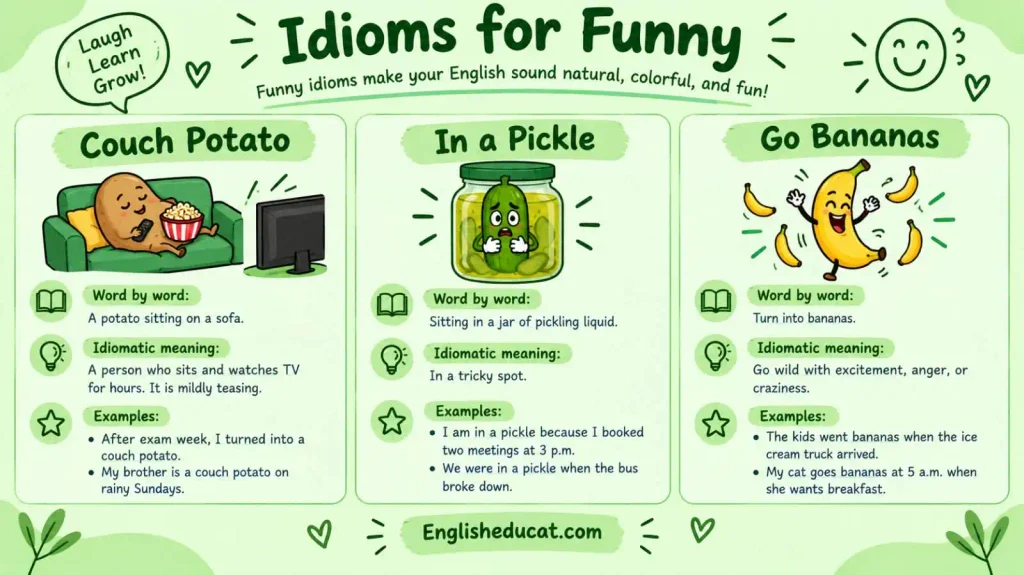
Go Bananas
Word by word:
Turn into bananas.
Idiomatic meaning:
Go wild with excitement, anger, or craziness.
Examples:
- The kids went bananas when the ice cream truck arrived.
- My cat goes bananas at 5 a.m. when she wants breakfast.
Sell Like Hot Cakes
Word by word:
Hot pancakes that vanish from the plate.
Idiomatic meaning:
Sell very fast.
Examples:
- The cookies sold like hot cakes at the school fair.
- Tickets for the show are selling like hot cakes.
Body-Part Idioms
Body parts turn simple ideas into odd, memorable images.
Pull Someone’s Leg
Word by word:
Tug on another person’s leg.
Idiomatic meaning:
Tease someone with a harmless fib.
Examples:
- You got the lead role? Stop pulling my leg!
- He pulled my leg about a surprise test, and I almost panicked.
Cost an Arm and a Leg
Word by word:
Be paid for with body parts.
Idiomatic meaning:
Be very expensive. Its origin is unclear.
Examples:
- Fixing the old car cost us an arm and a leg.
- Front-row concert tickets cost an arm and a leg.
Put Your Foot in Your Mouth
Word by word:
Push your own foot between your lips.
Idiomatic meaning:
Say something embarrassing by accident.
Examples:
- I put my foot in my mouth and called her aunt “grandma.”
- He put his foot in his mouth by joking about the boss’s tie.
Wet Behind the Ears
Word by word:
Ears that are still damp.
Idiomatic meaning:
New and inexperienced. It can sound a bit rude.
Examples:
- The new intern is wet behind the ears, but she learns fast.
- I was wet behind the ears on my first day at the bakery.
By the Skin of Your Teeth
Word by word:
With only the skin that covers your teeth. Teeth have no skin.
Idiomatic meaning:
Barely; by a tiny margin.
Examples:
- I finished the quiz by the skin of my teeth, just as the bell rang.
- We won the match by the skin of our teeth.
Household Idioms
Everyday objects make these phrases easy to picture.
The Pot Calling the Kettle Black
Word by word:
A dark pot says the kettle is dark.
Idiomatic meaning:
Blaming someone for a flaw you share.
Examples:
- Jan told Sam to stop being late. Sam laughed and said, “That is the pot calling the kettle black.”
- You scold me for texting at dinner? Pot, meet kettle.
Everything but the Kitchen Sink
Word by word:
All the items, minus the sink.
Idiomatic meaning:
Nearly everything, even useless things.
Examples:
- Her backpack held everything but the kitchen sink, even a lamp.
- He ordered a pizza with everything but the kitchen sink.
A Wet Blanket
Word by word:
A soggy cover.
Idiomatic meaning:
A person who spoils the fun.
Examples:
- I hate being a wet blanket, but the pool closes at six.
- Ted turned our picnic gloomy by being a wet blanket.
Not the Sharpest Tool in the Shed
Word by word:
Not the keenest tool in the garden shed.
Idiomatic meaning:
Not very smart. It is teasing but unkind.
Examples:
- My cousin is not the sharpest tool in the shed, but he is kind.
- Keep this one away from your boss.
Put a Sock in It
Word by word:
Stuff a sock inside something.
Idiomatic meaning:
Be quiet. It is rude and mostly British.
Examples:
- Put a sock in it, you two. I am trying to read.
- “Put a sock in it, I can not hear the game,” Ben joked to his brother.
Idioms People Say as a Joke
Some idioms for funny moments are jokes themselves, said with a smile or a sarcastic tone.
Tongue in Cheek
Word by word:
The tongue pressed inside the cheek.
Idiomatic meaning:
Said as a joke, not seriously.
Examples:
- His post calling himself “the world’s best cook” was tongue-in-cheek.
- The poster’s warning about “deadly cuteness” was tongue-in-cheek.
Don’t Give Up Your Day Job.
Word by word:
Keep your regular work.
Idiomatic meaning:
A sarcastic hint that you are not good at something.
Examples:
- After seeing my first drawing, my brother grinned and said, “Do not give up your day job.”
- Nice dance moves, but do not give up your day job!
Fat Chance
Word by word:
A big, wide opportunity.
Idiomatic meaning:
No chance at all. The tone is sarcastic.
Examples:
- “Will Dad let me stay up late?” “Fat chance!”
- Fat chance of finishing this report before noon.
Elvis Has Left the Building
Word by word:
A famous singer has walked out of the venue.
Idiomatic meaning:
The show is over, or someone has gone.
Examples:
- The last cookie vanished. Elvis has left the building.
- After the boss walked out, my coworker whispered, “Elvis has left the building.”
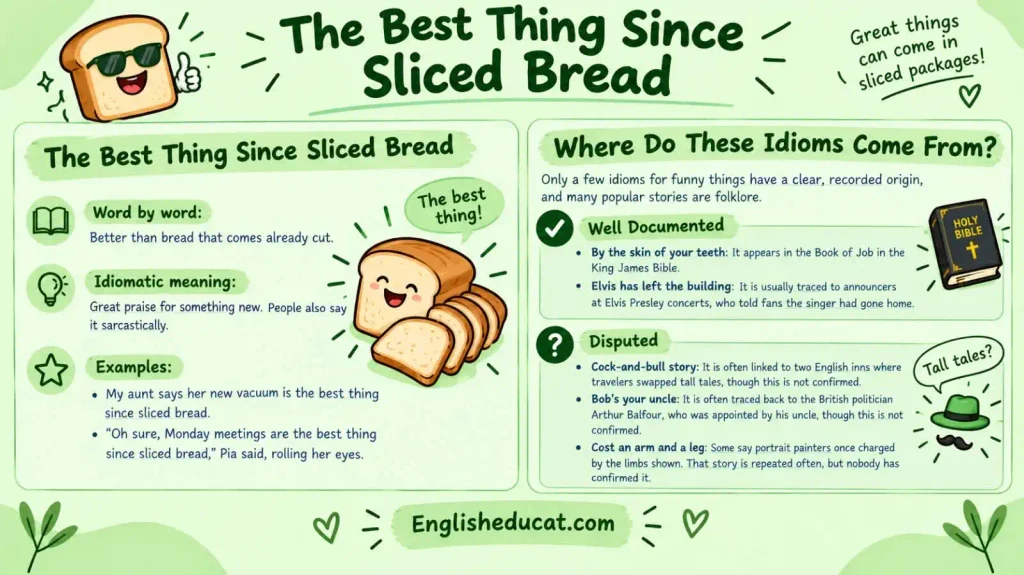
The Best Thing Since Sliced Bread
Word by word:
Better than bread that comes already cut.
Idiomatic meaning:
Great praise for something new. People also say it sarcastically.
Examples:
- My aunt says her new vacuum is the best thing since sliced bread.
- “Oh sure, Monday meetings are the best thing since sliced bread,” Pia said, rolling her eyes.
Where Do These Idioms Come From?
Only a few idioms for funny things have a clear, recorded origin, and many popular stories are folklore.
Well Documented
- By the skin of your teeth: It appears in the Book of Job in the King James Bible.
- Elvis has left the building: It is usually traced to announcers at Elvis Presley concerts, who told fans the singer had gone home.
Disputed
- Cock-and-bull story: It is often linked to two English inns where travelers swapped tall tales, though this is not confirmed.
- Bob’s your uncle: It is often traced back to the British politician Arthur Balfour, who was appointed by his uncle, though this is not confirmed.
- Cost an arm and a leg: Some say portrait painters once charged by the limbs shown. That story is repeated often, but nobody has confirmed it.
Tone Check: Friendly, Neutral, or Rude?
Most idioms for funny talk are friendly, but a few sting, so check the tone before you use them.
| A barrel of laughs | Friendly | Praising a fun friend or coworker |
| Pull someone’s leg | Playful | People you know well |
| Crack up | Neutral | Any casual talk |
| Class clown | Mixed | Describing a joker; a teacher may sound critical |
| Wet blanket | Negative | Light teasing between friends |
| Wet behind the ears | Mildly rude | Avoid about coworkers |
| Not the sharpest tool in the shed | Unkind | Better skipped |
| Do not give up your day job | Sarcastic | Close friends who laugh with you |
| Put a sock in it | Rude | Siblings or friends, never a boss |
| Fat chance | Sarcastic | Casual talk |
UK vs US Funny Idioms
Some idioms for funny moments belong to British English, while others sound more American.
| Bob’s your uncle | UK | “And that’s it” |
| Laugh like a drain | UK | Laugh loudly |
| Put a sock in it | UK | Be quiet |
| Get your knickers in a twist | UK | Get upset over nothing |
| As useful as a chocolate teapot | UK | Totally useless |
| Knee-slapper | Mostly US | A very funny joke |
| Go bananas | Both | Go wild |
Common Mistakes With Funny Idioms
The most common mistake is changing the words inside a set phrase.
Learners who study idioms for funny conversations often slip in four ways.
- Changing a word. Wrong: “a barrel of laugh.” Right: “a barrel of laughs.” Wrong: “tickle my laugh bone.” Right: “tickle my funny bone.”
- Mixing up two meanings of “funny.” Sometimes the word means “odd,” not “humorous.” “The soup tastes funny” is a warning, not a joke.
- Missing the tone. Telling a manager “you are not the sharpest tool in the shed” will land badly.
- Stacking idioms. “I was in stitches, cool as a cucumber, busy as a bee” sounds forced. One idiom per sentence is plenty.
Frequently Asked Questions
What is an example of a funny idiom?
“A barrel of laughs” is a common example of a funny idiom. It describes someone or something very fun, as in “Our uncle is a barrel of laughs at weddings.”
What is an idiom for a funny person?
“A riot” and “a barrel of laughs” are both idioms for a funny person. “A laugh a minute” also works for someone who jokes all day.
What is an idiom for fun?
“Have a ball” is a common idiom for fun, and it describes enjoying yourself a lot. For example: “We had a ball at the lake last weekend.”
Why do idioms sound funny when translated word for word?
They sound funny because each word keeps its normal meaning while the whole phrase points somewhere else. Translate “pull someone’s leg” word for word, and you picture a real tug.
Conclusion
Idioms for funny moments add color to everyday talk. Pick two or three you like, and try them this week. Watch the tone, keep the wording fixed, and save the sharp ones for close friends.

ESL Content Writer
Emily is a TESOL-certified writer who has taught English to international students for over 8 years. She loves breaking down idioms and everyday expressions into simple, relatable explanations that make sense to learners at any level.