

Idioms for Beach are short phrases that use sand, sea, and shore to describe everyday life. Some guides only describe rest and fun. Others point to wasted effort or ignored problems. This guide covers the meaning, origin, and use of each phrase, with easy examples you can reuse at work, at school, or at home. You will also find a tone chart, a list of common mistakes, a short quiz, and answers to common questions.
Quick definition: An idiom is a phrase whose meaning differs from its words. “Life is a beach” says nothing about sand. It describes life as easy and fun.
Five idioms for beach you will hear most:
- Life is a beach: life feels easy and fun.
- Hit the beach: go to the beach.
- Beach bum: a person who spends most days at the beach.
- Bring sand to the beach: do something pointless.
- Bury your head in the sand: ignore a problem.
What Counts as One of the Idioms for Beach?
An idiom counts as a beach idiom when the phrase itself names the beach, sand, or the shoreline. Many lists mix in ship and fish phrases, like “in the same boat.” Those are sea idioms. This guide sticks to phrases with beach or sand in them, plus a few shoreline sayings such as “make waves.”
A beach is the sandy or pebbly part of the land beside the water. The seashore is the land next to the sea, so it can be rocky too. The word “beach” itself is old. It first meant loose, water-worn pebbles in the 1530s. It probably comes from the Old English word bece, which meant “stream.” Also learn other idioms that start with Funny and it will be very helpful for you in future.
Quick Guide to Idioms for Beach
The table below shows each phrase with its meaning, tone, and level of formality.
| Life is a beach | Life is easy and fun | Joking, positive | Informal |
| Hit the beach | Go to the beach (or land on one in war) | Neutral | Informal |
| Catch some rays | Sunbathe | Positive | Informal |
| Soak up the sun | Enjoy the sunshine | Positive | Neutral |
| Beach bum | Someone who lives for beach time | Playful, once an insult | Informal |
| Beach bunny | A young woman who hangs out at the beach | Dated | Informal |
| Beachcomber | A person who searches the shore | Neutral | Neutral |
| Bring sand to the beach | Do something pointless | Negative | Informal |
| Bury your head in the sand | Ignore a problem | Negative | Neutral |
| Draw a line in the sand | Set a firm limit | Firm | Neutral |
| Build castles in the sand | Make plans with no solid base | Negative | Neutral |
| Not the only pebble on the beach | Other people or options exist | Neutral | Informal |
| A day at the beach | Something easy (mostly used in the negative) | Mixed | Informal |
| Make waves | Stir things up | Positive or negative | Neutral |
Relaxing and Summer Idioms for Beach Days
These idioms for beach days describe rest, sun, and a slower pace.
Life is a Beach
Word by word:
“Life” is your everyday existence. “A beach” is a sandy strip beside the water.
Idiomatic meaning:
Life is easy, relaxed, and fun.
Origin:
No documented origin found. The phrase is a pun. It twists a rude saying that begins the same way and swaps in a friendlier last word.
Examples:
- “The work is done, the sun is out, and it is Friday. Life is a beach!”
- “My sister swung in the hammock and sighed, ‘Life is a beach.’”
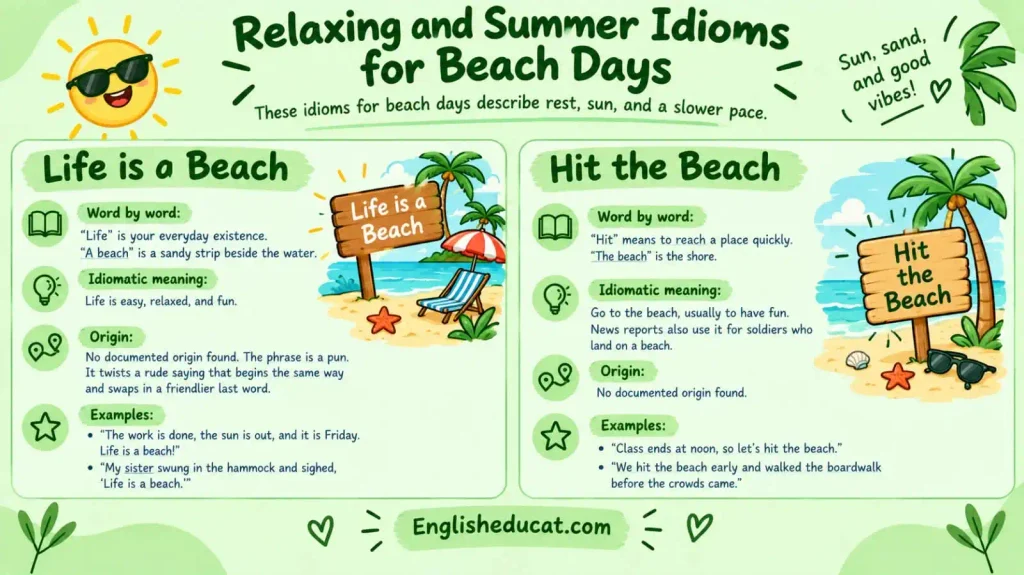
Hit the Beach
Word by word:
“Hit” means to reach a place quickly. “The beach” is the shore.
Idiomatic meaning:
Go to the beach, usually to have fun. News reports also use it for soldiers who land on a beach.
Origin:
No documented origin found.
Examples:
- “Class ends at noon, so let’s hit the beach.”
- “We hit the beach early and walked the boardwalk before the crowds came.”
Catch Some Rays and Soak Up the Sun
Word by word:
“Catch” means to grab. “Rays” are beams of sunlight. “Soak up” means to take in, like a sponge.
Idiomatic meaning:
Both phrases describe lying in the sun to enjoy the warmth. Sunbathe is the plain word for it.
Origin:
No documented origin found.
Examples:
- “I am taking my lunch break outside to catch some rays.”
- “Grandpa likes to soak up the sun on the porch after dinner.”
Idioms for Beach Life That Describe People
Three idioms for beach life describe a type of person: the beach bum, the beach bunny, and the beachcomber.
Beach Bum
Word by word:
A “bum” is slang for someone who loafs around. A “beach bum” loafs at the beach.
Idiomatic meaning:
A person who spends most of their time at the beach, often carefree and without a steady job.
Origin:
Dates are tangled here, so here is what the records show:
- A 1944 Saturday Evening Post citation uses the phrase.
- A 1950 Life magazine citation follows.
- One dictionary says it was first recorded in 1960–65. Another says it was in use by 1950.
- An older claim says the phrase began in Australia in the 1960s. The earlier magazine citations do not support that.
Tone:
It started as a mild insult. Now many people use it as a proud self-description. Dictionary.com links that friendly modern use to Jimmy Buffett and Margaritaville.
Examples:
- “After he quit his job, Dan spent the whole summer as a beach bum.”
- “Give me sand and a good book. I am a beach bum at heart.”
Beach Bunny
Word by word:
A “bunny” is a young rabbit. Slang turned it into a cute word for a young woman.
Idiomatic meaning:
A young woman who spends lots of time at the beach, often seen as part of the surf scene.
Origin:
No documented origin found. It is often tied to California surf culture, though that link is not confirmed.
Tone:
The phrase now sounds dated. It can also sound unfair, since it judges a woman by how she looks. Skip it at work or in formal writing.
Example:
- “My aunt jokes that she was a beach bunny back in her teens.”
Beachcomber
Word by word:
To “comb” is to search carefully, the way a comb moves through hair. A “beachcomber” combs the beach.
Idiomatic meaning:
A person who walks the shore looking for shells, driftwood, or useful things.
Origin:
Word-history records place the term in 1840. Early sources include Dana’s Two Years Before the Mast and a Century Dictionary from 1889.
Examples:
- “At low tide, a beachcomber found an old glass bottle.”
- “My daughter is a keen beachcomber. Her shelf is full of shells.”
Sand Idioms for Beach Talk About Wasted Effort and Limits
The sand-based idioms for beach talk usually describe wasted effort, ignored problems, or firm limits.
Bring Sand to the Beach
Word by word:
“Bring” means to carry something to a place. A beach already has more sand than anyone could count.
Idiomatic meaning:
Do something pointless because there is already plenty. You may also hear “take sand to the beach.”
Origin:
No documented origin found, even though the saying is easy to explain.
Examples:
- “Giving Maya another novel is like bringing sand to the beach. She owns hundreds.”
- “Adding one more meeting this week would be bringing sand to the beach.”
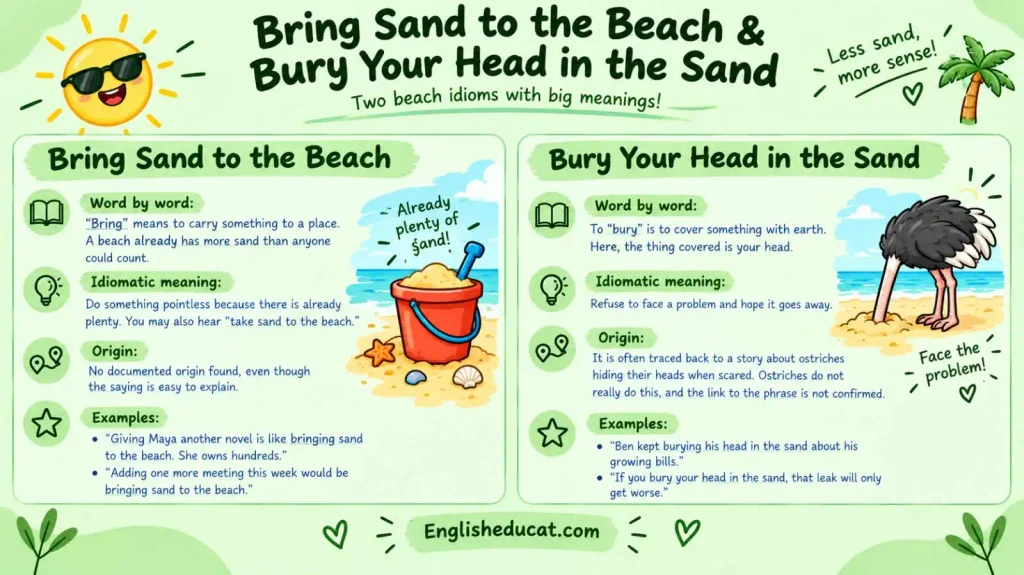
Bury Your Head in the Sand
Word by word:
To “bury” is to cover something with earth. Here, the thing covered is your head.
Idiomatic meaning:
Refuse to face a problem and hope it goes away.
Origin:
It is often traced back to a story about ostriches hiding their heads when scared. Ostriches do not really do this, and the link to the phrase is not confirmed.
Examples:
- “Ben kept burying his head in the sand about his growing bills.”
- “If you bury your head in the sand, that leak will only get worse.”
Draw a Line in the Sand
Word by word:
To “draw” is to make a mark. The “sand” is the ground you mark.
Idiomatic meaning:
Set a firm limit and refuse to go past it.
Origin:
No documented origin found.
Examples:
- “My manager drew a line in the sand: no more late reports.”
- “Mom drew a line in the sand about phones at the dinner table.”
Build Castles in the Sand
Word by word:
“Build” means to put together. A castle made of sand falls apart when the first wave arrives.
Idiomatic meaning:
Make plans with no solid base, so they are likely to fall apart.
Origin:
No documented origin found.
Examples:
- “Planning a big trip with no savings is building castles in the sand.”
- “His business plan was a castle in the sand.”
Idioms for Beach That Talk About Options and Importance
“Not the only pebble on the beach” reminds a person that other people and other choices exist.
Not the Only Pebble on the Beach
Word by word:
A “pebble” is a small stone. A beach holds millions of them.
Idiomatic meaning:
You are one of many, so do not act as if you are the only one who matters. People also use it as comfort after a loss.
Variants:
Some sources say “pebble” and others say “fish.” The “fish” version sits close to “plenty more fish in the sea,” the better-known saying.
Origin:
No documented origin found.
Examples:
- “Do not worry about that rejection. You are not the only pebble on the beach. Other firms are hiring.”
- “Tom thinks the team can not work without him, but he is not the only pebble on the beach.”
Idioms for Beach That Change Meaning
A few idioms for beach shift meaning depending on who speaks and what they want to say.
“Hit the beach” is one of them. It can mean a fun day out or a military landing, as covered above. Two more are worth a closer look.
A Day at the Beach
Word by word:
A “day” is one stretch of time. “At the beach” is where it happens.
Idiomatic meaning:
Something easy and pleasant. In real speech, it mostly appears in the negative. “No day at the beach” means a task is hard.
Origin:
No documented origin found.
Examples:
- “Moving house with three kids was no day at the beach.”
- “Her first week at the new job was not a day at the beach.”
Make Waves
Word by word:
“Make” means to cause. “Waves” are moving ridges of water.
Idiomatic meaning:
Shake things up. The tone depends on the speaker. It can praise a bold newcomer or warn someone against causing trouble.
Origin:
It is a shoreline and sea phrase, and no documented origin has been found.
Examples:
- “The new designer is making waves with her fresh ideas.”
- “Do not make waves before the audit is over.”
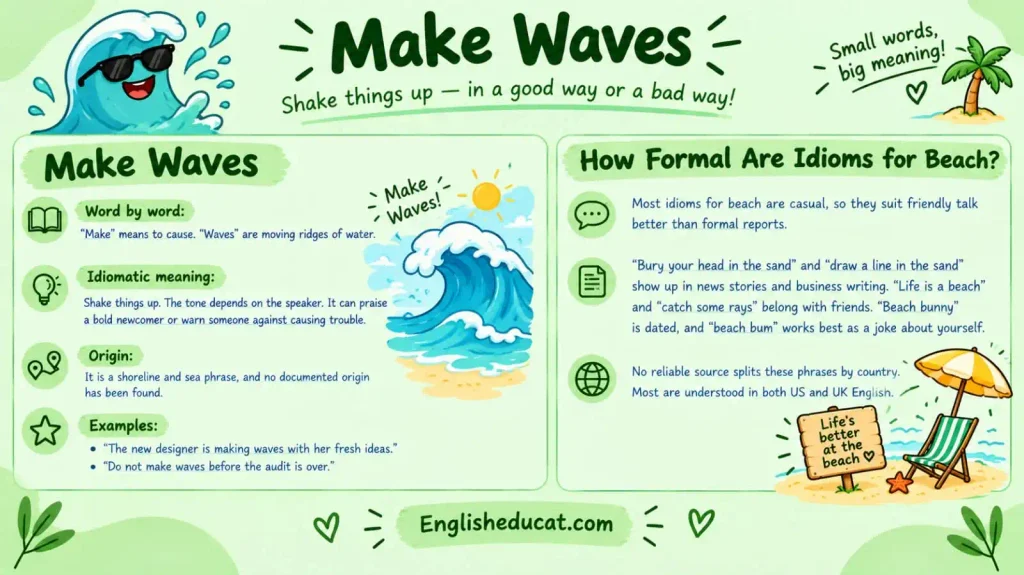
How Formal Are Idioms for Beach?
Most idioms for beach are casual, so they suit friendly talk better than formal reports.
“Bury your head in the sand” and “draw a line in the sand” show up in news stories and business writing. “Life is a beach” and “catch some rays” belong with friends. “Beach bunny” is dated, and “beach bum” works best as a joke about yourself.
No reliable source splits these phrases by country. Most are understood in both US and UK English.
Easily Confused Beach Phrases
Each pair below looks alike on the surface, but the two phrases do different jobs.
| Bury your head in the sand vs. draw a line in the sand | The first ignores a problem. The second sets a limit. | “She buried her head in the sand about the late rent.” / “Then she drew a line in the sand and called her landlord.” |
| Life is a beach vs. a day at the beach | The first jokes that life is easy. The second is mostly used to say a task is not easy. | “Pizza and a movie? Life is a beach!” / “Cleaning the garage was no day at the beach.” |
| Bring sand to the beach vs. plenty of fish in the sea | The first is about doing too much. The second is about having other choices. | “Another pen is bringing sand to the beach.” / “She will find another job. There are plenty of fish in the sea.” |
Common Mistakes with Idioms for Beach
The most common mistake with idioms for beach is changing one word and losing the meaning.
- Swapping the verb. Wrong: “He drew his head in the sand.” Right: “He buried his head in the sand.”
- Mixing the two sand phrases. You bury your head to ignore a problem. You draw a line to set a limit.
- Using “a day at the beach” as a plain compliment. It mostly appears with “no” or “not,” so the negative form sounds more natural.
- Dropping the pun. Keep the short form “life is a beach.” The joke works best that way.
- Skipping the tone check. “Beach bunny” can sound unfair. “Beach bum” can sound rude if aimed at someone else.
Frequently Asked Questions
What are some common idioms for beach?
Common idioms for beach include life is a beach, hit the beach, beach bum, bring sand to the beach, and bury your head in the sand. The first three talk about leisure and people. The last two describe wasted effort and avoiding problems.
What does “life is a beach” mean, and is it a real idiom?
“Life is a beach” means life is easy and fun. It is a pun more than an old saying, since it twists a ruder phrase, and no documented origin has turned up. It works well in casual talk and jokes.
Where does “beach bum” come from?
“Beach bum” appeared in print by the 1940s, with a 1944 Saturday Evening Post citation and a 1950 Life magazine citation. Dictionaries disagree on the first date. The claim that it began in Australia in the 1960s does not match the earlier citations.
Can beach idioms be used in formal writing, and are they British or American?
A few can, but most are too casual. “Bury your head in the sand” and “draw a line in the sand” fit news and business writing. No reliable source splits these phrases by country, and most are understood in both US and UK English.
Conclusion
Idioms for beach add colour to everyday speech. Use the relaxed ones with friends and the sand ones when you need to make a point. Pick one phrase today and try it in a real sentence.

Linguistics Specialist
James is a linguist with a Ph.D. in Applied Linguistics from Boston University. His work focuses on word origins, synonyms, and how language evolves over time. He has contributed to several academic journals on English semantics.