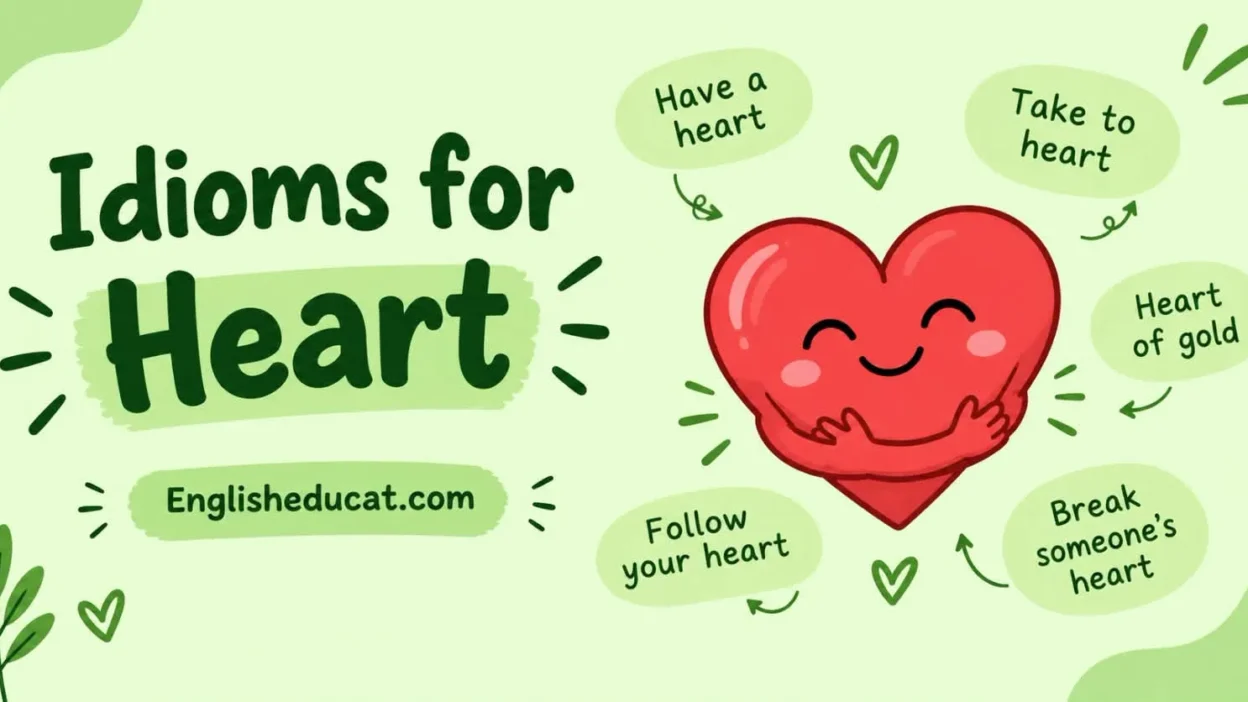
Idioms for heart are fixed phrases that usually use the word heart to describe feelings, kindness, courage, and memory. They rarely mean what the words say. 30 words are explained in this guide. For each, you will find the word-by-word meaning, the real meaning, and simple examples. You will also learn where a few of them came from, how formal or casual each one sounds, and which mistakes to avoid.
Idioms for heart: phrases built around the word “heart” whose real meaning is about emotion, character, courage, or memory, not the body part. Example: “a heart of gold” describes a very kind person.
Why Do Idioms for Heart Exist in English?
English has many idioms for heart because people long ago believed the heart, not the brain, was the home of thought and feeling.
The Greek thinker Aristotle called the heart the organ of sensation. The Old English word was heorte, and it already carried ideas like courage, memory, and emotion. Most of the figurative senses we use today were already in place then. Also learn other idioms that are about Teamwork and Peace.
Science later showed that the brain thinks. The old phrases stayed anyway. That is why you “learn by heart” and not “by brain,” and why a brave person “has heart.” Many idioms for heart trace back to that old belief.
10 Idioms for Heart Every Learner Should Know
Every learner should start with heart of gold, heart of stone, change of heart, by heart, take to heart, lose heart, heart-to-heart, wear your heart on your sleeve, from the bottom of my heart, and heart in the right place.
The table shows what each one refers to and how it sounds.
| Idiom | Meaning | Tone |
| Heart of gold | A very kind, generous person | Positive |
| Heart of stone | A cold person with no pity | Negative |
| Change of heart | A new opinion or decision | Neutral |
| By heart | From memory | Neutral |
| Take to heart | Take something seriously, often criticism | Neutral |
| Lose heart | Give up hope | Negative |
| Heart-to-heart | An honest, private talk | Warm |
| Wear your heart on your sleeve | Show feelings openly | Neutral |
| From the bottom of my heart | With deep sincerity | Sincere, a bit formal |
| Heart in the right place | Good intentions | Positive |
Idioms for Heart About Love and Affection
These six idioms for heart cover falling in love, being loved, and feeling close to someone. They are given below with examples:
1. Steal Someone’s Heart
Word by word:
To steal is to take something that belongs to another person. The heart is the body’s pump and the old symbol of love.
Idiomatic meaning:
The phrase refers to making someone fall in love with you. “Win someone’s heart” works the same way.
Examples:
- The shy waiter stole her heart with one kind joke.
- That puppy stole the whole office’s heart in a day.
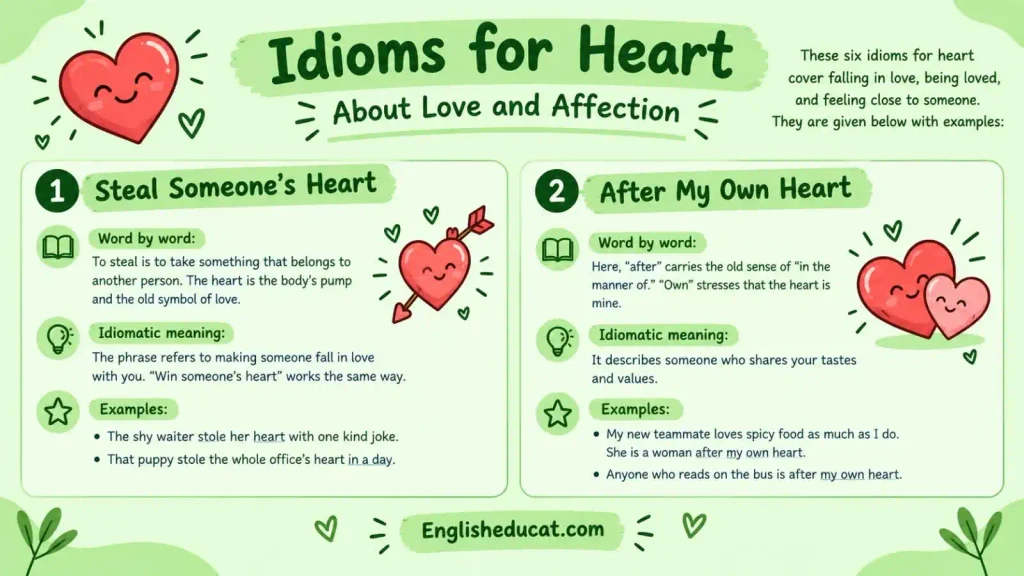
2. After My Own Heart
Word by word:
Here, “after” carries the old sense of “in the manner of.” “Own” stresses that the heart is mine.
Idiomatic meaning:
It describes someone who shares your tastes and values.
Examples:
- My new teammate loves spicy food as much as I do. She is a woman after my own heart.
- Anyone who reads on the bus is after my own heart.
3. Lose Your Heart to Someone
Word by word:
To lose is to stop having something. The heart stands for love, so you hand it over without planning to.
Idiomatic meaning:
It names the moment of falling in love. Dictionaries label it formal.
Examples:
- He lost his heart to a girl he met on a train.
- She lost her heart to the little town and never left.
4. Close to My Heart
Word by word:
“Close” tells you how near something is. The heart is the center of feeling.
Idiomatic meaning:
It signals something or someone you care about deeply. “Dear to my heart” and “near to my heart” are close cousins.
Examples:
- Clean water is a cause close to my heart.
- This old guitar is close to my heart because it was my dad’s.
5. The Way to Someone’s Heart
Word by word:
A way is a path. The heart is the place at the end of it.
Idiomatic meaning:
It names the best method for winning a person’s affection or favor.
Examples:
- Kind words are the way to my grandmother’s heart.
- Good coffee is the way to my boss’s heart.
6. Heart Skips a Beat
Word by word:
A beat is one pulse of the heart. To skip is to jump over something.
Idiomatic meaning:
It captures a quick jolt of excitement, surprise, or fear. “Heart misses a beat” is a variant.
Examples:
- My heart skipped a beat when I saw my name on the winners’ list.
- Her heart skipped a beat as the car swerved.
Heart Idioms About Kindness and Cruelty
Six heart expressions tell you how gentle, generous, or cold a person is. They are given below:
7. A Heart of Gold
Word by word:
Gold is a shiny, precious metal. The phrase pictures a heart made of it.
Idiomatic meaning:
It paints a person as very kind and generous.
Examples:
- Our bus driver grumbles a lot, but he has a heart of gold.
- My aunt feeds every stray cat on her street. She has a heart of gold.
8. A Heart of Stone
Word by word:
Stone is hard and cold. Nothing soft can live inside it.
Idiomatic meaning:
It points to a person who feels no pity.
Examples:
- Only someone with a heart of stone could ignore that crying child.
- The boss seemed to have a heart of stone when he refused the day off.
9. Have a Heart!
Word by word:
Here, “heart” stands for the part of us that feels pity.
Idiomatic meaning:
It works as a plea for kindness, like “Please be fair.” Dictionaries mark it as informal.
Examples:
- Have a heart! I only need two more days to finish the report.
- “Have a heart,” he laughed when his friend teased him again.
10. Bleeding Heart
Word by word:
To bleed is to lose blood. A bleeding heart is a heart in pain.
Idiomatic meaning:
People use it for someone seen as too soft and too quick to feel sorry for others. It often lands as a mild insult.
Examples:
- Do not be such a bleeding heart. He can pay for his own lunch.
- My brother calls me a bleeding heart because I adopt every sad-looking dog.
11. Harden Your Heart
Word by word:
To harden is to turn something stiff and tough.
Idiomatic meaning:
It suggests you have stopped letting yourself feel pity or care.
Examples:
- After years of lies, she hardened her heart against him.
- Doctors sometimes harden their hearts so they can cope with sad news.
12. Heart in the Right Place
Word by word:
A place is a position. The “right place” is the correct spot.
Idiomatic meaning:
It speaks of a person with good intentions, even when the result goes wrong.
Examples:
- His cake was burnt, but his heart was in the right place.
- The new intern made mistakes. Still, her heart is in the right place.
Idioms for Heart About Sadness and Sympathy
Six idioms for heart describe sorrow, disappointment, and the wish to comfort someone else. They are explained below:
13. A Heavy Heart
Word by word:
Heavy describes something hard to lift. Here, sadness is the weight.
Idiomatic meaning:
It expresses deep sadness, often when you must do something unpleasant. You will often hear it in formal announcements.
Examples:
- With a heavy heart, the coach told the team the season was over.
- I said goodbye to my school friends with a heavy heart.
14. Break Someone’s Heart
Word by word:
To break is to split something into pieces.
Idiomatic meaning:
It refers to causing deep emotional pain, often by ending a relationship. Sad news can break a heart too.
Examples:
- It broke her heart to sell the family farm.
- The loss broke the fans’ hearts.
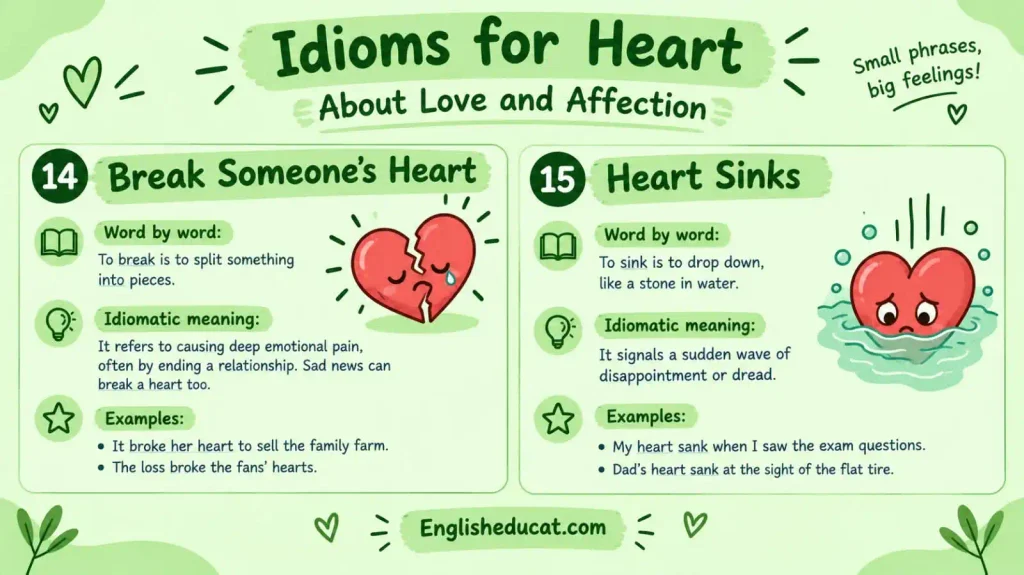
15. Heart Sinks
Word by word:
To sink is to drop down, like a stone in water.
Idiomatic meaning:
It signals a sudden wave of disappointment or dread.
Examples:
- My heart sank when I saw the exam questions.
- Dad’s heart sank at the sight of the flat tire.
16. Sick at Heart
Word by word:
Sick means unwell. In this phrase, the illness sits in the feelings.
Idiomatic meaning:
It marks deep sadness, worry, or disgust. Dictionaries label it formal.
Examples:
- She felt sick at heart when she read the news.
- He was sick at heart over leaving his village.
17. My Heart Bleeds (for You)
Word by word:
A heart cannot really bleed from sadness. The words picture sorrow as a wound.
Idiomatic meaning:
Today it usually sounds sarcastic. The speaker is saying, “I do not feel sorry for you.” Dictionaries label it ironic. For real sympathy, say “my heart goes out to you” instead.
Example:
- “You have to wait ten minutes for your free coffee? My heart bleeds.”
18. Your Heart Goes Out to Someone
Word by word:
To go out is to travel away. Your feeling travels toward another person.
Idiomatic meaning:
It expresses sincere sympathy. You will see it in cards and kind messages.
Examples:
- Our hearts go out to everyone hurt in the storm.
- My heart goes out to my cousin. He lost his job this week.
Heart Idioms for Courage, Fear and Comfort
These six expressions cover bravery, nerves and the warm feeling of being comforted. These are explained below:
19. Take Heart
Word by word:
To take is to receive. Here, heart means courage.
Idiomatic meaning:
It tells someone to feel braver or more hopeful.
Examples:
- Take heart. The first week at a new job is always the hardest.
- She took heart from her teacher’s kind words.
20. Lose Heart
Word by word:
To lose is to stop having something. Again, heart means courage.
Idiomatic meaning:
It describes giving up hope or growing discouraged.
Examples:
- Do not lose heart if your first try fails.
- The runners lost heart when the steep hill came into view.
21. Faint of Heart
Word by word:
Faint means weak or dim.
Idiomatic meaning:
It names a person who lacks courage and scares easily. You will mostly hear it in the negative: “not for the faint of heart.”
Examples:
- This roller coaster is not for the faint of heart.
- Starting a business is hard work and not for the faint of heart.
22. Not Have the Heart to Do Something
Word by word:
Here, heart means the will to do something unkind.
Idiomatic meaning:
It refers to being unable to say or do something that would hurt another person.
Examples:
- I did not have the heart to tell her the cake was dry.
- The manager did not have the heart to cancel the party.
23. Heart in Your Mouth
Word by word:
Picture the heart jumping up into your throat.
Idiomatic meaning:
It points to fear or nervous excitement.
Examples:
- I had my heart in my mouth as the plane landed in strong wind.
- Her heart was in her mouth while she waited for the test results.
24. Warm the Cockles of Your Heart
Word by word:
To warm is to make something less cold. A cockle is a small shellfish, but in this phrase, “cockles of the heart” stands for your deepest feelings.
Idiomatic meaning:
It describes something that fills you with comfort and happiness.
Examples:
- Watching the neighbors help each other warmed the cockles of my heart.
- A hot bowl of soup and a kind note warmed the cockles of his heart.
Idioms for Heart About Honesty and Sincerity
Six idioms for heart show how people share real feelings, make promises, and speak the truth. These are explained below:
25. Wear Your Heart on Your Sleeve
Word by word:
A sleeve covers your arm. Imagine your heart pinned there for everyone to see.
Idiomatic meaning:
It portrays a person who shows feelings openly.
Examples:
- Maya wears her heart on her sleeve, so you always know when she is upset.
- In team meetings, Omar wears his heart on his sleeve, and nobody minds.
26. From the Bottom of My Heart
Word by word:
The bottom is the lowest point. So the feeling comes from the deepest place inside you.
Idiomatic meaning:
It marks a thank-you, wish, or apology as completely sincere.
Examples:
- I thank you from the bottom of my heart for helping my family.
- She said sorry from the bottom of her heart.
27. Pour Your Heart Out
Word by word:
To pour is to let a liquid flow from a container. Here, your feelings flow out.
Idiomatic meaning:
It refers to sharing your deepest feelings with someone.
Examples:
- After the match, he poured his heart out to his coach.
- I poured my heart out to my sister over tea.
28. A Heart-to-Heart
Word by word:
Two hearts face each other, with nothing in between.
Idiomatic meaning:
It names an honest, private talk about real feelings.
Examples:
- Mom and I had a long heart-to-heart before I moved away.
- The manager asked for a heart-to-heart with the worried employee.
29. Cross My Heart
Word by word:
To cross is to draw an X or a cross shape. People often trace one over their chest.
Idiomatic meaning:
It works as a promise that you are telling the truth. The full form is “cross my heart and hope to die.” Dictionaries label it informal, and kids use it a lot.
Examples:
- I will return your book tomorrow, cross my heart.
- Did you really finish your homework? Cross my heart.
30. In Your Heart of Hearts
Word by word:
The phrase doubles the word “heart” to point to the innermost core.
Idiomatic meaning:
It refers to what you truly feel or believe, even if you never say it aloud.
Examples:
- In my heart of hearts, I knew I should apologize.
- She said she was fine, but in her heart of hearts she was nervous.
Where Do Idioms for Heart Come From?
Idioms for heart come from old beliefs about the body, from poets and playwrights, and from daily speech, and only some of them have clear written records.
Wear Your Heart on Your Sleeve
The phrase appears in Shakespeare’s play Othello, so it was in use by at least 1604. A popular story ties it to medieval jousting. That story is often repeated, though it is not confirmed.
Warm the Cockles of Your Heart
Its first written use dates to 1671. Nobody has settled where “cockles” comes from. One theory links it to the cockle shell, which looks a bit like a heart. Another points to Latin words for the heart’s chambers. A third points to a Latin word for “little heart.”
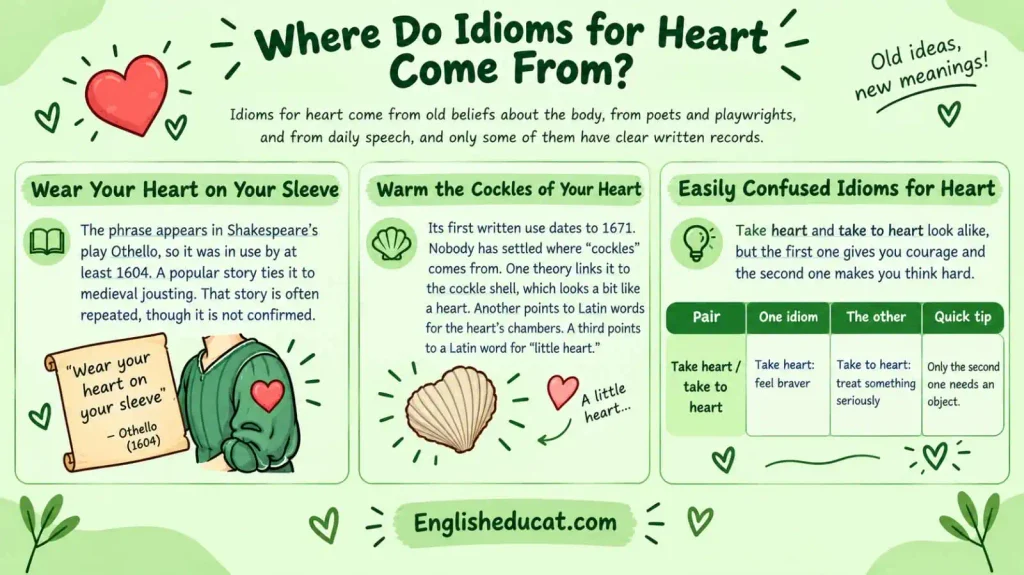
Easily Confused Idioms for Heart
Take heart and take to heart look alike, but the first one gives you courage and the second one makes you think hard.
| Pair | One idiom | The other | Quick tip |
| Take heart / take to heart | Take heart: feel braver | Take to heart: treat something seriously | Only the second one needs an object |
| By heart / by rote | By heart: known from memory | By rote: repeated without much thought | Rote leans toward plain repetition |
| Heart of gold / heart of stone | Gold: very kind | Stone: cold and unfeeling | Same pattern, opposite pictures |
| Heart in your mouth / heart sinks | Mouth: nervous fear | Sinks: sudden disappointment | Match the phrase to the feeling |
| My heart bleeds / my heart goes out to you | Bleeds: usually sarcastic | Goes out: sincere sympathy | Choose “goes out” for real comfort |
Common Mistakes with Idioms for Heart
Learners most often slip on word order, tone, and fixed wording when they use idioms for heart.
- Mixing up “take heart” and “take to heart.” Wrong: “She took heart his advice.” Right: “She took his advice to heart,” or “She took heart from his advice.”
- Using “my heart bleeds for you” to comfort someone. It usually sounds sarcastic. Say “my heart goes out to you” instead.
- Using “eat your heart out” as sympathy. Today it is a playful boast, as in “I won two tickets. Eat your heart out!”
- Changing the fixed wording. Say “a heart of gold,” not “a golden heart.” The phrase works best in its set form.
- Setting your heart on a person. Use “set your heart on” for goals and things, like a job or a trip. For a person, try “lose your heart to” instead.
- Overdoing “from the bottom of my heart.” It sounds too big for tiny favors. Save it for real thanks and real apologies.
Frequently Asked Questions
What are the most common idioms for heart?
Well-known idioms for heart include heart of gold, change of heart, by heart, take to heart, and lose heart. Each one has its own entry above, with a word-by-word meaning and examples.
What does “wear your heart on your sleeve” mean, and where does it come from?
To wear your heart on your sleeve is to show your feelings openly. The phrase appears in Shakespeare’s Othello, so it dates to at least 1604, but the popular jousting story behind it is not confirmed.
Why do we say “learn by heart” instead of “by brain”?
People once believed the heart was the home of thought and memory, so “by heart” became the phrase for remembering. It appears in Middle English as early as the 1300s.
Is “my heart bleeds for you” sincere or sarcastic?
Today it is usually sarcastic, and dictionaries label it ironic. To show real sympathy, say “my heart goes out to you.”
Conclusion
Idioms for heart let you talk about feelings in a few vivid words. Start with the ten in the table. Use each one in a sentence of your own. Watch the tone, because a sarcastic “my heart bleeds” can sting a friend. Then add a few more from each theme.

Senior English Content Editor
Sarah has over 10 years of experience teaching English as a Second Language in Chicago public schools. She specializes in vocabulary building and simplifying complex word meanings for everyday learners. Sarah holds a Master’s degree in English Education from the University of Illinois.