
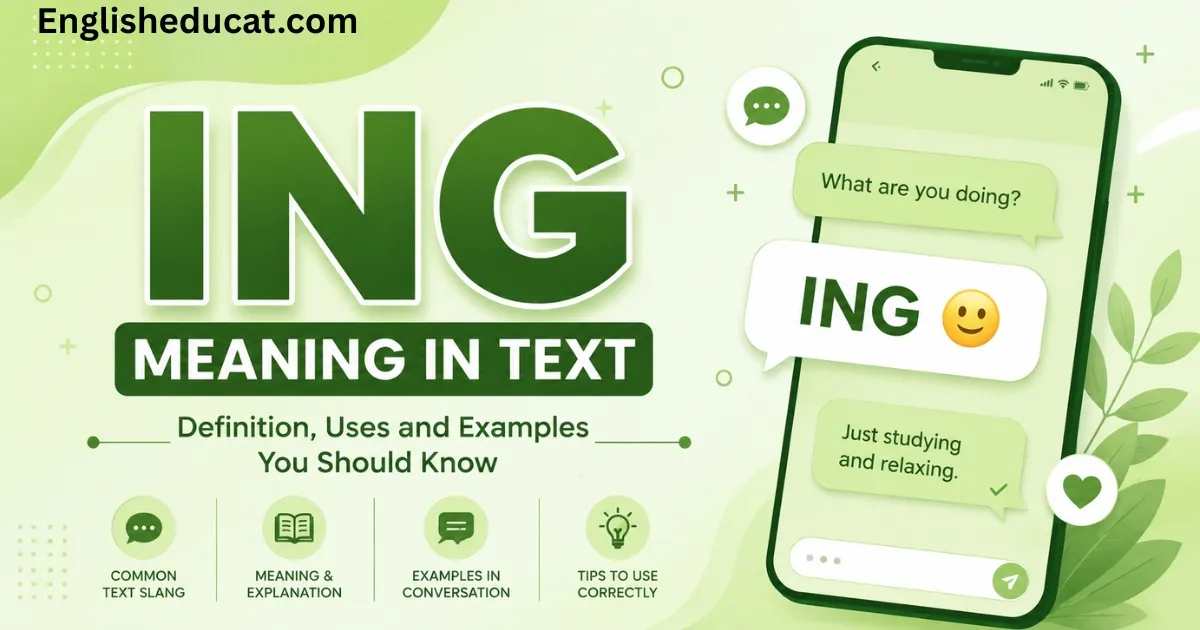
By the end of this context, you will know exactly what someone means when they text you “ing.” What does “ing” mean in a text? In short, “ing” means one of two things: the normal “-ing” grammar ending, or fun internet slang. The ing meaning in text depends on how the word is used.
This guide breaks down both meanings and also a few other real definitions you might run into.
What Does ING Mean in Text? (Quick Answer)
In most messages, “ing” means one of two things. It is either the “-ing” ending that shows an action happening right now, like running or eating. Or it can be a slang term that stands alone. People use this slang as a joke, without a full verb attached.
There are five real answers when people search for the ing meaning in text. Here are the most common meanings:
- The grammar ending “-ing” (running, talking, eating)
- Slang “ing” used alone as a joke (bro is ing)
- Gamer shorthand for “in-game”
- The acronym “It is Not Good”
- Other names, like ING Group (a bank) or a character from a video game
Most people who search for the ing meaning in text want the first two answers. So let’s explain them.
The 2 Main Meanings of “ING” in Texting
Meaning no 1: The Grammar “-ing” Suffix
“-ing” is a normal part of English grammar. Writers add it at the end of a verb. This shows that something is happening right now.
Here are some examples:
- “I am studying.”
- “She is texting her friend.”
- “They are gaming all night.”
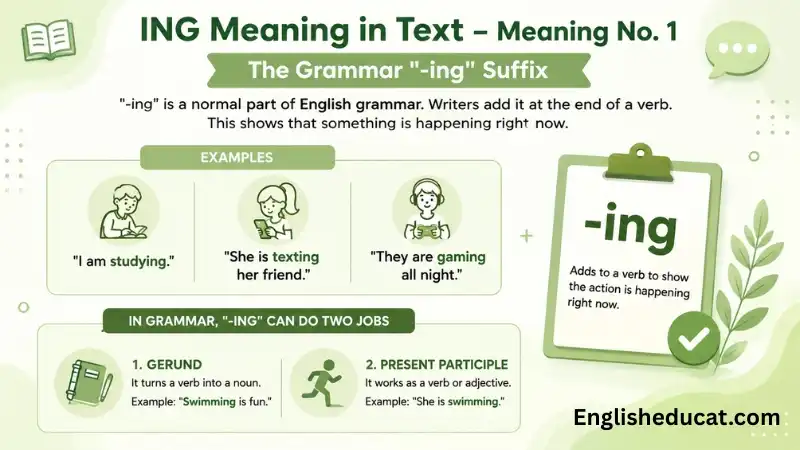
In grammar terms, “-ing” can do two jobs. As a gerund, it turns a verb into a noun. For example: “Swimming is fun.” As a present participle, it works as a verb or adjective. For example: “She is swimming.”
This ending is very old. It comes from Old English words like -ung and -ing. Hundreds of years ago, English speakers shaped it into the “-ing” that we use today. Merriam-Webster’s dictionary confirms this history and lists “-ing” as a true suffix, not slang.
So when someone uses “-ing” in a normal sentence, then they are just using standard and correct English.
Meaning no 2: “ing” as Standalone Internet Slang
The second part of the ing meaning in text is very new. People started using it on it’s on online. They did not attach it to a verb.
Here is an example:
- Friend A: “Why is he acting so weird today?”
- Friend B: “Bro is just ing 😭”
In this case, “ing” does not point to one clear action. That is the whole joke. The person leaves the action on purpose. That missing detail is what makes the reply funny.
As someone who writes about internet slang and tracks Gen Z trends, I remember the exact moment “bro is ing” appeared in front of me. I was scrolling through the comments under a cooking video on TikTok. Many of the replies just said “ing” and nothing else. At first, it looked like a typo or a broken comment. After scrolling through a few more videos, I saw the same word reply on totally unrelated videos. That is when I thought: this was not a mistake. It was a joke everyone already knew, and I was just watching them.
That is the real story behind the modern ing meaning in text. It is a small, funny inside joke. It spread fast because it was very easy to copy and drop into any comment section.
Slang like this works because it contains fewer words. A full sentence like “he is acting strange, and I do not want to explain why” gets replaced by one word. The joke only works if the reader already knows the shortcut. That is how internet slang spreads. It does not come from a big announcement. It spreads through repetition of comment after comment, until it feels normal.
Where You’ll See “ing” Used
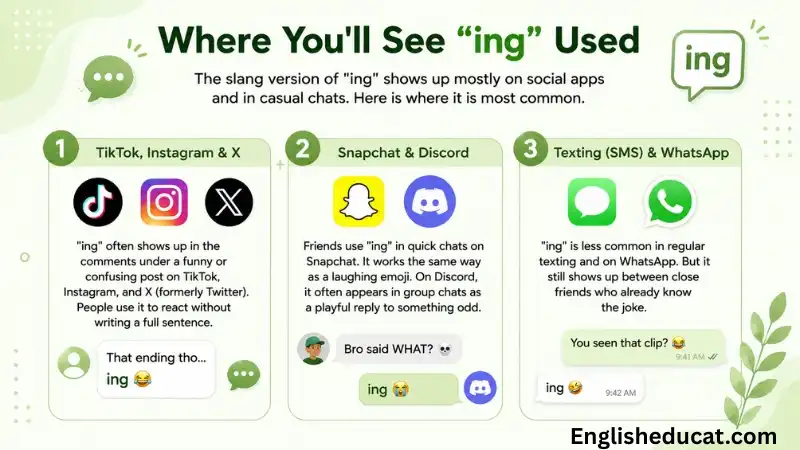
The slang version of “ing” shows up mostly on social apps and in casual chats. Here is where it is most common.
TikTok, Instagram & X
“ing” often shows up in the comments under a funny or confusing post on TikTok, Instagram, and X (formerly Twitter). People use it to react without writing a full sentence.
Snapchat & Discord
Friends use “ing” in quick chats on Snapchat. It works the same way as a laughing emoji. On Discord, it often appears in group chats as a playful reply to something odd.
Texting (SMS) & WhatsApp
“ing” is less common in regular texting and on WhatsApp. But it still shows up between close friends who already know the joke.
Gaming Chats: “ing” as Gamer Shorthand
There is a second slang meaning that many guides do not tell. In gaming chats, players sometimes use “ing” as a short form of “in-game.” For example, someone might text “write ing” to confirm they are already playing and ready to go.
This gaming sense of “ing” is different from the meme joke. It is more direct. It simply means “I am currently playing” or “I am ready.”
ING Meaning in Text: Real Examples in Conversation
Seeing “ing” used in real chats can help you know its meaning faster. Here are some short examples.
Normal grammar use:
- A: “What are you doing?”
- B: “Studying right now 📚”
Meme slang use:
- A: “Why is she acting like that?”
- B: “She is just ing 💀”
Casual action:
- A: “Where are you?”
- B: “Driving home.”
Gaming shorthand:
- A: “You joining tonight?”
- B: “Yeah, ing already.”
Playful reply:
- A: “What’s wrong with him?”
- B: “Idk, he’s just ing 😂”
Each example shows a different side of the same short word. Context always tells you which meaning will be used.
How to Reply When Someone Texts You “ing”
Let a friend text you “ing.” And you are not sure what they mean. Do not worry, this happens to a lot of people, even those who use slang every day.
Try a simple reply like “ing what? lol” or “wait, ing about what.” This usually gets you an answer fast. Many people are happy to tell jokes when you ask.
Was there no other context in the message? Then it is likely the meme-style slang, not the grammar rule. Grammar “-ing” almost always attaches to a full verb. A lone “ing” by itself is your biggest clue that it is a joke, not a typo.
When to Use (and Avoid) Slang “ing”
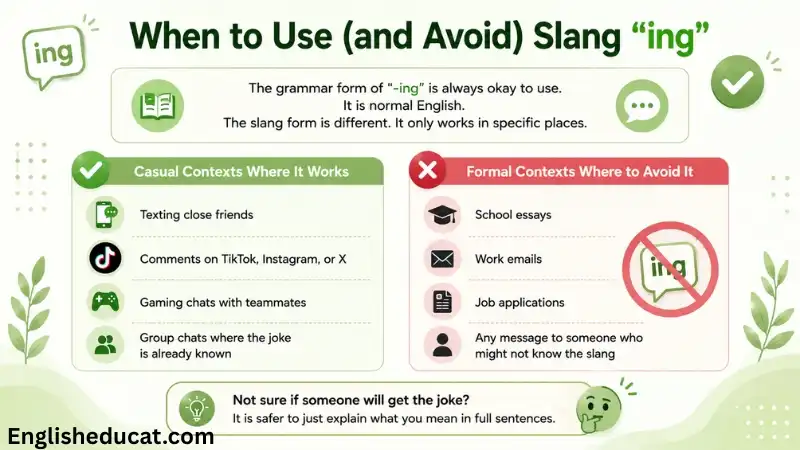
The grammar form of “-ing” is always okay to use. It is normal English. The slang form is different. It only works in specific places.
Casual Contexts Where It Works
- Texting close friends
- Comments on TikTok, Instagram, or X
- Gaming chats with teammates
- Group chats where the joke is already known
Formal Contexts Where to Avoid It
- School essays
- Work emails
- Job applications
- Any message to someone who might not know the slang
Not sure if someone will get the joke? It is safer to just explain what you mean in full sentences.
Other Things “ING” Can Stand For
Not every “ING” is about grammar or slang. A few other meanings exist. They are less common in everyday texting.
- “It is Not Good” Some older internet slang explains “ING” as short for this phrase. It is much less common today than the meme-style “ing.”
- ING Group: This is a real Dutch bank. If you see “ING” in a business or finance context, this is likely what it means.
- Military and group names: “ING” has also been used for things like the Iraqi National Guard or the Isaac Newton Group. These uses mostly appear in formal or specialized writing.
- A video game character: In the game Metroid Prime 2, “the Ing” are a race of enemy creatures. Gamers may recognize this use.
These meanings are worth knowing. But they are not what most people mean when they text “ing” to a friend.
Similar Internet Slang to Know
Once you understand the ing meaning in text, these related slang terms are easy to pick up too.
| LOL | Laughing out loud |
| BRB | Be right back |
| NGL | Not gonna lie |
| FR | For real |
| AFK | Away from keyboard |
| Vibing | Relaxing or enjoying the moment |
Frequently Asked Questions
What does ing mean in text?
In most texts, “ing” is short for the “-ing” verb ending that shows an action happening right now, like “watching” or “studying.” Online, people also use “ing” by itself as playful slang for something vague or unexplained, as in “bro is ing again.” Context tells you which meaning applies.
What does ing mean in texting slang?
As slang, “ing” is used alone, without a specific verb attached. It humorously suggests someone is doing something the speaker won’t spell out, and the joke depends on that vagueness. It’s most common in comment sections and casual group chats among friends.
Why do people say “bro is ing”?
“Bro is ing” is internet humor that leaves the action unfinished on purpose. This makes the sentence sound random and funny, since the listener never learns exactly what “ing” refers to. The joke only works if the reader already expects the shortcut.
Is ing an abbreviation or acronym?
Not in its most common modern use. The slang “ing” comes from the English “-ing” ending, not an acronym. Separately, “ING” has also stood for “It’s Not Good” in older slang dictionaries, though that use is much rarer today than the meme-style meaning.
What does ing mean in gaming or Discord?
In gaming chats, “ing” can be shorthand for “in-game,” letting someone confirm they’re already playing or ready to join. This is a more literal meaning than the meme-style “ing” used elsewhere online, and it rarely confuses once you know the gaming context.
Is ing formal or informal?
The grammar ending “-ing” is fully formal and appears in professional writing, such as “I am preparing the report.” The slang use of “ing” by itself is informal. Save it for casual chats with friends, not for school or work messages.
Can ing have more than one meaning?
Yes. “Ing” can be the standard “-ing” grammar suffix, internet slang for a vague action, gamer shorthand for “in-game,” or the acronym “It’s Not Good.” The right meaning depends entirely on the context where it appears, so always check the surrounding message first.
Quick Reference
The word “ing” is small, but it contains a lot of meaning. Most of the time, it is simply the “-ing” ending of the sentence doing its normal grammar job. Other times, it is playful internet slang that is used to get a laugh.
Once you know the ing meaning in text, you will spot it everywhere. Comment sections, group chats, gaming lobbies, and everyday texts all use it differently. The next time a friend replies with just “ing,” you do not need to guess. You will already know exactly what is going on.
Internet slang moves fast, and this word could shift again in a year or two. But the core idea behind the ing meaning in text will likely remain the same: a short, vague word that says a lot by saying almost nothing at all.

ESL Content Writer
Emily is a TESOL-certified writer who has taught English to international students for over 8 years. She loves breaking down idioms and everyday expressions into simple, relatable explanations that make sense to learners at any level.
[…] is a short and casual way to say you do not like something. But IDL also has a second, less common slang meaning, and it can stand for a few unrelated words outside of […]