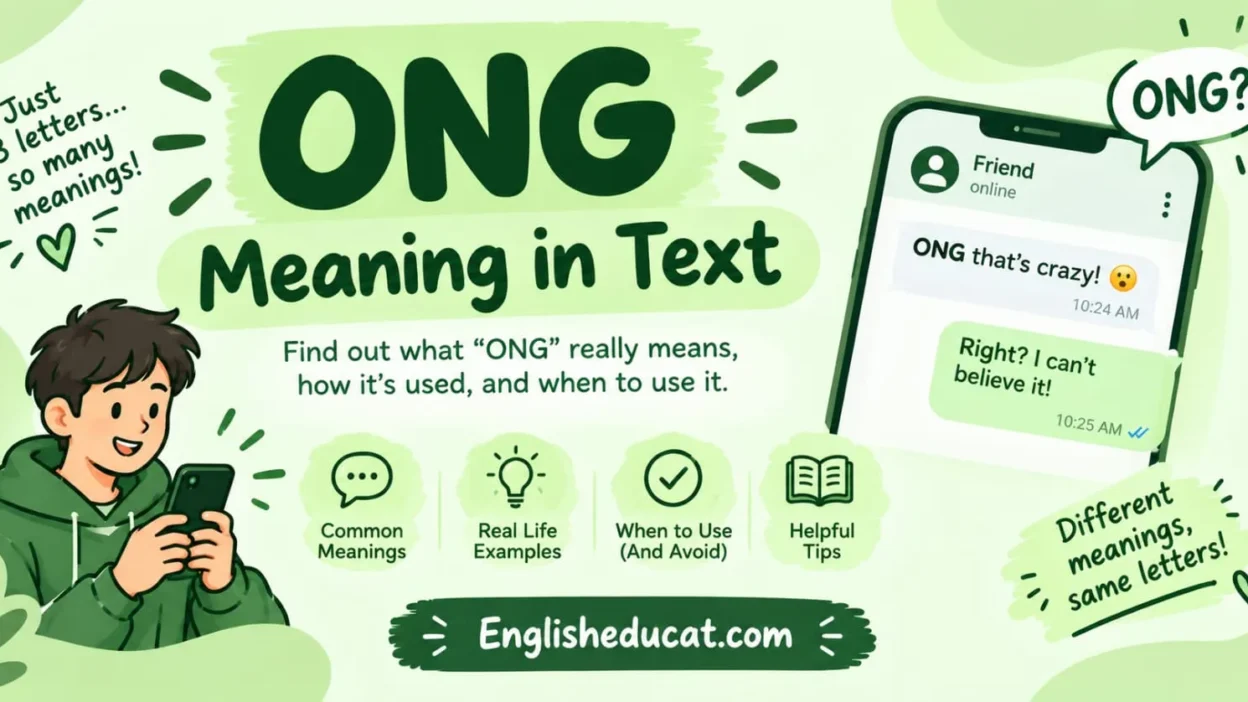
ONG meaning in text is simple: it stands for “on God.” People use it to show that they are telling the truth. It works the same as saying “I swear” or “for real.”
You have probably seen ONG appear in a text, a TikTok comment, or a Snapchat reply. At first sight, it can be confusing, especially if you mix it up with OMG. This guide breaks down the full ONG meaning in text, where it came from, and how to use it in the right way.
By the end, you will know the exact ONG meaning in text messages, on social media, and in everyday chats. You will also learn a usage trick that most guides miss completely. Understanding the correct ONG meaning in text also helps you avoid one of the most common mix-ups in casual messaging today.
What Does ONG Mean in Text? (Quick Answer)
The ONG meaning in text is “on God.” It is a short way of swearing that something is true. People usually add it to the end of a sentence to show that they really mean it.
Here is a simple example:
- This burger is so good, ong.
That sentence means the person is not exaggerating. They think that burger is really good. The full ONG meaning in text lines up closely with older phrases like “I swear to God” or “cross my heart.” It is just a short word and easy to type. There are other similar slang terms like Ash and YHU.
Is ONG Short for Something Else?
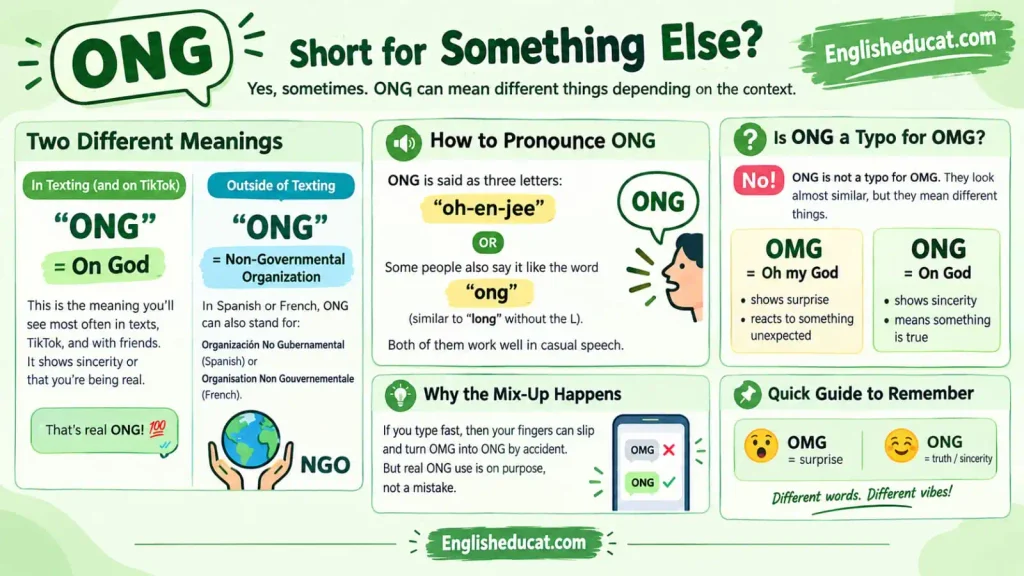
Yes, sometimes. Outside of texting slang, ONG can also stand for a non-governmental organization, especially in Spanish or French (Organización No Gubernamental or Organisation Non Gouvernementale). This is a totally different meaning. But in a text message, on TikTok, or in a text from a friend, ONG mostly means “on God.” That is the version this guide covers.
How to Pronounce ONG
ONG is said as three letters: “oh-en-jee.” Some people also just say it like the word “ong,” similar to how you would say “long” without the L. Both of them work well in casual speech.
Is ONG a Typo for OMG?
No, ONG is not a typo for OMG. They look almost similar, but they mean different things. OMG stands for “oh my God,” and this word shows surprise. ONG stands for “on God,” and this word shows sincerity. This mix-up happens a lot. If you type fast, then your fingers can slip and turn OMG into ONG by accident. But real ONG use is on purpose, not a mistake.
Here is the easiest way to remember it: OMG usually reacts to something surprising. ONG is usually used to show that something is true.
ONG vs. OMG at a Glance
| Term | Full Meaning | Shows | Example |
| ONG | On God | Sincerity, truth | “I studied all night, ong.” |
| OMG | Oh My God | Surprise, shock | “OMG, I can’t believe that happened!” |
Where Does ONG Come From?
The ONG meaning in text has roots that go back further than most people think. It comes from African American Vernacular English (AAVE), which is a form of English with its own words, grammar, and rhythm.
The AAVE and “On God” Oath Tradition
The phrase “on God” is an old way of swearing an oath. Saying something “on God” means you are putting your honesty on the line. It is similar to how people say “I swear on my life.”
After some time, this phrase got shortened. “On God” became “ong,” and it moved from spoken slang into texting and social media.
When Did ONG Go Viral?
ONG started appearing in texts and on social media in the late 2010s. It grew fast on platforms like Twitter and Instagram before exploding on TikTok in 2020 and 2021.
Different sources give slightly different starting points. Slang usually spreads long before anyone tracks it closely. What we do know is this: by the early 2020s, the ONG meaning in text was locked in as a top slang term among Gen Z and other young internet users.
How to Use ONG (Statement vs. Question)
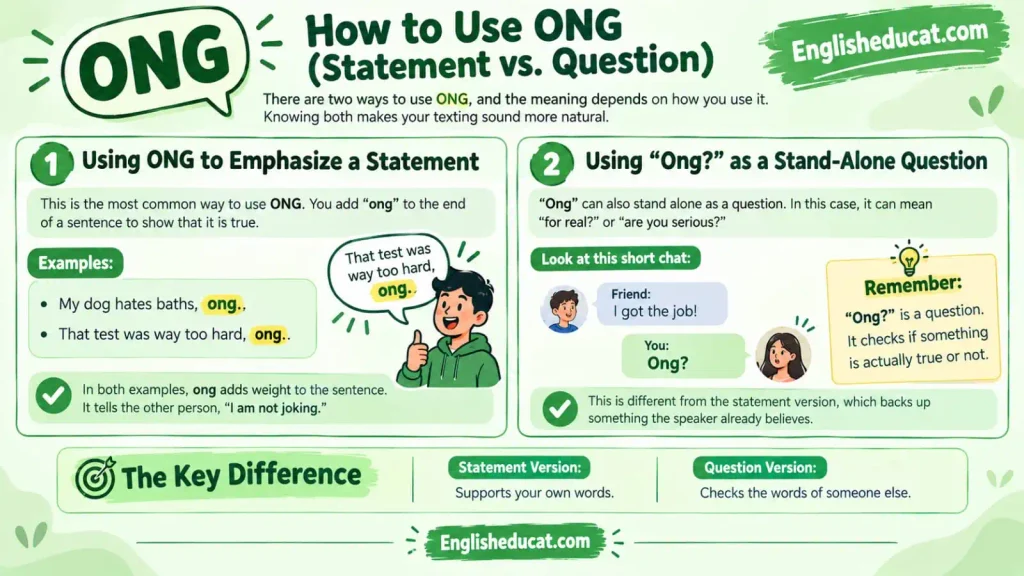
Many guides only show you one way to use ONG. But there are two ways to use it, and the correct ONG meaning in text depends on which one you can pick. Knowing both makes your usage feel more natural.
Using ONG to Emphasize a Statement
This is the most common way to use ONG. You add “ong” to the end of a sentence to show that it is true.
- My dog hates baths, ong.
- That test was way too hard, ong.
In both examples, ong adds weight to the sentence. It tells the other person, “I am not joking.”
Using “Ong?” as a Stand-Alone Question
Here is the part most articles skip. “Ong” can also stand alone as a question. In this case, it can mean “for real?” or “are you serious?”
Look at this short chat:
- Friend: “I got the job!”
- You: “Ong?”
Here, “ong?” is a question. The speaker is checking if something is actually true or not. That is different from the statement version, which backs up something the speaker already believes.
This is a small but important difference. The statement version supports your own words. The question version checks the words of someone else.
Does Capitalization Matter?
No, capitalization usually does not matter. You will see ONG written as “ONG,” “Ong,” or “ong.” All three are read the same way. Most people default to lowercase in casual texts and save all caps for extra emphasis.
ONG Meaning in Text by Platform
The ONG meaning in text stays the same everywhere. How it gets used can change a little depending on the app.
- TikTok: ONG appears a lot in comments and captions, often reacting to something shocking or relatable.
- Snapchat: People use it in chats and story replies to show strong agreement.
- Instagram: ONG appears in comment sections when a post really hits home.
- Discord: In group chats, ong backs up claims during casual conversation.
- Twitter/X and Reddit: ONG is common in replies and threads, especially when someone wants to stress that a story or opinion is genuine.
Unlike some slang that changes meaning app by app, ONG keeps the same job everywhere. It backs up a true statement, no matter where you see it.
ONG vs. Similar Slang
ONG is not the only word people use to sound sincere. A few other terms also do the same job.
| Term | Meaning | Best For |
| ONG | On God | Backing up a strong statement |
| No cap | Not lying | Stressing honesty, more casual |
| Fr | For real | Quick agreement or confirmation |
| Deadass | Seriously, for real | Strong emphasis, often blunt tone |
These words often get used together, like “ong, no cap” or “fr fr.” Stacking them adds even more emphasis, though the core ONG meaning in text stays the same no matter what it is paired with.
Why the Real ONG Meaning in Text Actually Matters
Slang moves fast, and it is easy to guess wrong. Someone who reads “ong” as a typo for “omg” can miss the point of a message. A friend saying “I failed my test, ong” is not shocked. They are being honest, maybe even a little upset, and they want you to take it seriously.
That mix-up matters more than it seems. Parents and older readers are often the ones most likely to misread ong as a typo, since OMG has been around much longer. Knowing the real ONG meaning in text closes that gap and helps two generations understand each other’s messages correctly. It is a small piece of knowledge that prevents real confusion.
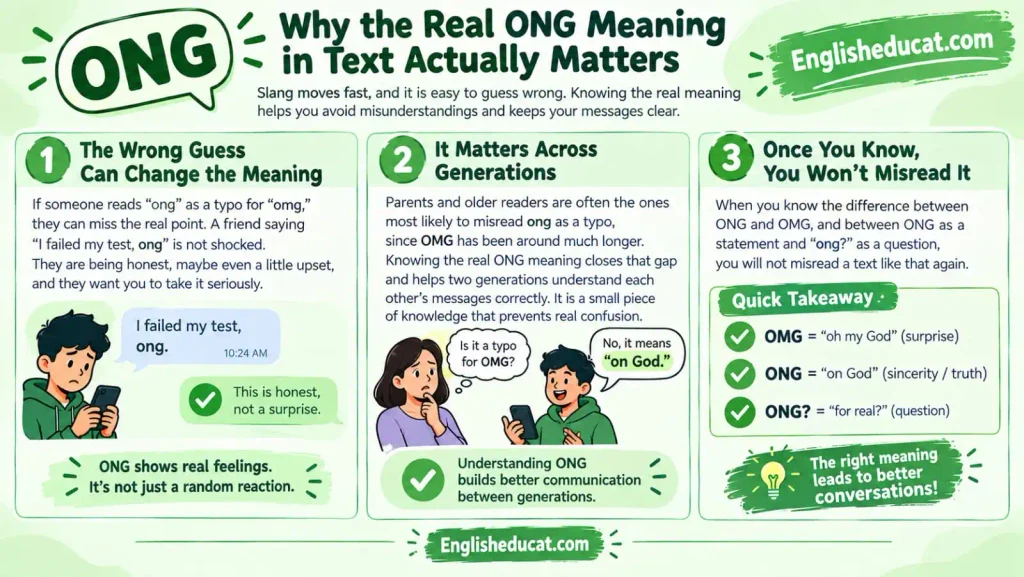
Once you know the difference between ONG and OMG, and between ONG as a statement and “ong?” as a question, you will not misread a text like that again.
Is It Okay to Say ONG?
For most casual chats, yes, it can be okay. ONG is common and harmless slang used by millions of people every day. A few situations call for more care.
Around Religious or Formal Audiences
ONG uses the word “God” in a casual and oath-style phrase. Some religious communities may find this disrespectful, even when no offense is meant. It is smart to skip ONG around highly religious audiences or in formal settings.
At School or Work
ONG is casual slang, not professional language. Save it for texts with friends. In an email, a school essay, or a work message, use plain words like “seriously” or “honestly” instead.
Other Meanings of ONG
Slang is not the only place you will see “ONG.” Here are a few other meanings tied to the same letters:
- NGO (Non-Governmental Organization): In Spanish and French, ONG is the standard short form for an NGO.
- Oh No God: A rare and joking alternate reading, mostly used in memes.
- Ong Bak: The title of a well-known Thai action movie.
These meanings depend heavily on context. In a text from a friend, the ONG meaning in text is mostly “on God,” so context is your best clue when the letters could mean something else.
Frequently Asked Questions
What does ONG mean in a text message?
ONG is text slang that stands for “on God.” It is used to emphasize that a statement is true or sincere, similar to saying “I swear” or “for real.”
Is ONG a typo for OMG?
No. ONG and OMG are different terms that are sometimes confused because they look similar. OMG means “oh my God” and expresses surprise, while ONG means “on God” and expresses sincerity or emphasis.
Where did ONG come from?
ONG has roots in African American Vernacular English (AAVE) and the older phrase “on God,” used as an oath-style affirmation. It gained widespread popularity through TikTok and other social platforms in the late 2010s and early 2020s.
Can you use “ong” as a question?
Yes. On its own, “ong?” can function as a question meaning “for real?” or “are you serious?” distinct from using “ong” at the end of a statement to emphasize it.
Is it disrespectful to say ONG?
It can feel casual or dismissive to some religious audiences, since it uses God’s name in an everyday phrase. Most people use it without any religious intent, but it is worth avoiding in formal or highly religious settings.
What does ONG mean on TikTok and Snapchat?
On TikTok and Snapchat, ONG is used the same way as in texting to stress that something is true or that the speaker feels strongly about what they are saying.
What else can ONG stand for?
Outside of slang, ONG can also stand for “Organización No Gubernamental” or “Organisation Non Gouvernementale,” the Spanish and French terms for a non-governmental organization (NGO).
Conclusion
The ONG meaning in text is “on God,” used this word to swear that something is true. It is not a typo for OMG; the two words carry completely different tones. ONG can work as a statement-ender or stand alone as a question, and it appears across every major app, from TikTok to Discord. Once you know the full ONG meaning in text, you will never have to guess this text again.

ESL Content Writer
Emily is a TESOL-certified writer who has taught English to international students for over 8 years. She loves breaking down idioms and everyday expressions into simple, relatable explanations that make sense to learners at any level.