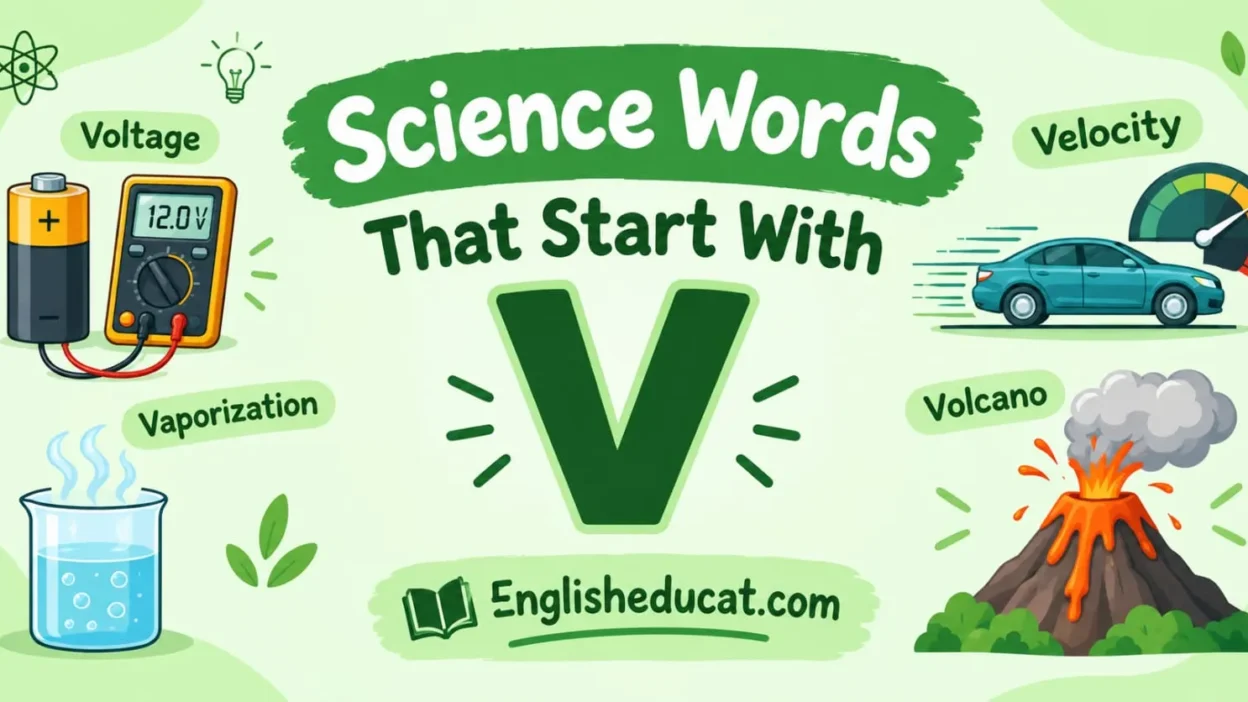
Many letters carry only a handful of niche scientific terms, but science words that start with V are different. It sits underneath some of the most heavily used ideas of science: a vacuum defines space, a vaccine trains the immune system, and a vector appears in a physics classroom one week and a biology lecture on disease the next. Teachers build vocabulary tests around V-words, students hunt for them ahead of exams, and writers reach for them when everyday English is not precise enough.
This guide collects 100 essential V-words, sorted into five branches: biology, chemistry, physics, astronomy, and earth science, and also a short set of advanced terms for readers past the basics. Each entry gets a plain-language definition and a sentence showing the word in use, roughly as it would appear in a textbook, a research abstract, or a teacher’s whiteboard explanation. There are also other science words that you must know with W, V and so on.
Why V Punches Above Its Weight in Science Vocabulary
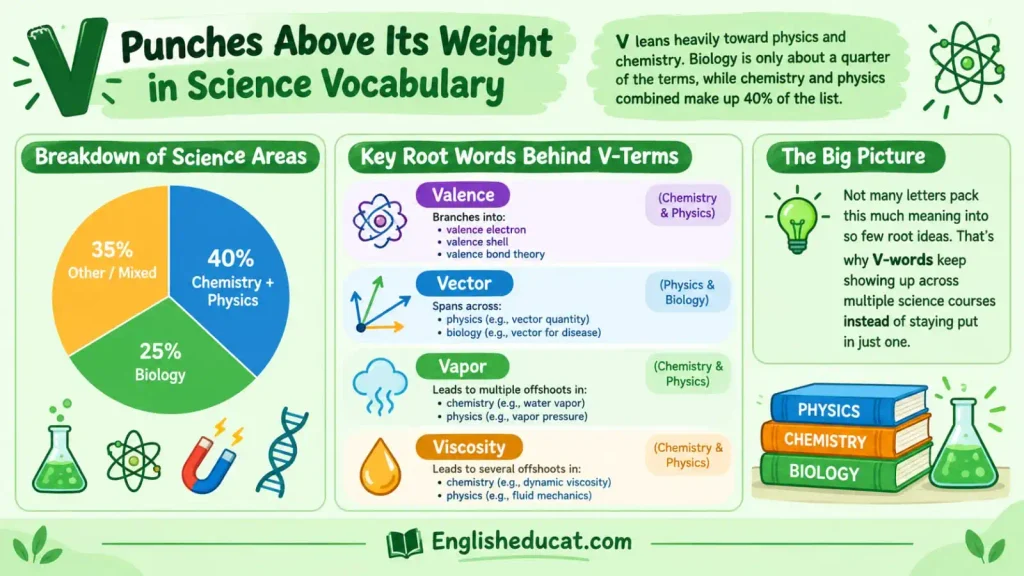
V leans unusually hard toward physics and chemistry. Biology accounts for only about a quarter of the terms below, while chemistry and physics combined make up 40 percent of the list for science words that start with V, and that skew traces back mostly to three root words. “Valence” alone branches into valence electron, valence shell, and valence bond theory. “Vector” does something similar, splitting across physics and biology with two different meanings. “Vapor” and “viscosity” each spawn several chemistry and physics offshoots. Not many letters pack this much meaning into so few root ideas, and that is a big part of why V-words keep resurfacing across multiple science courses instead of staying put in just one.
Biology Words That Start With V
Biology contributes the biggest chunk of this list for science words that start with V: 27 terms in all are gathered around three areas: cellular activity, human anatomy, and how living things get classified and studied.
Cell & Molecular Biology
| Term | Definition | Example |
| Vacuole | A fluid-filled compartment inside a cell that holds water, waste, or stored nutrients. | Botany students often note how a plant cell’s large vacuole keeps the whole structure rigid. |
| Vaccine | A prepared substance that teaches the immune system to recognize a specific pathogen before real exposure occurs. | Public health researchers track how quickly a new vaccine reaches vulnerable populations. |
| Valine | One of the amino acids the body can’t synthesize on its own and must get from food, used in building muscle protein. | Nutrition labels sometimes list valine content for high-protein foods. |
| Vesicle | A tiny membrane pouch that moves cargo, proteins, enzymes, waste from one part of a cell to another. | A cell biology diagram usually shows a vesicle budding off the Golgi apparatus. |
| Villi | Small, finger-shaped folds lining the small intestine that boost the surface area available for absorbing food. | Increased surface area from the villi is why nutrient absorption happens so efficiently there. |
| Virion | A fully assembled, infectious virus particle, complete and functional outside of any host cell. | Electron microscopy lets researchers photograph an individual virion in striking detail. |
| Virology | The branch of science devoted to viruses, how they are structured, how they spread, and what illnesses they cause. | A career in virology often starts with lab work identifying which strain is circulating. |
| Virulence | How aggressively a pathogen attacks its host, measured by the severity of the disease it produces. | Scientists monitor how a pathogen’s virulence shifts as it mutates over successive outbreaks. |
| Virus | A stripped-down infectious particle that has no way to reproduce on its own and hijacks a host cell’s machinery instead. | Unlike bacteria, a virus depends entirely on its host’s cellular machinery to reproduce. |
Human Anatomy & Physiology
| Term | Definition | Example |
| Vagus Nerve | The long cranial nerve that helps control heart rate, digestion, and other functions the body runs without conscious input. | Clinicians sometimes stimulate the vagus nerve as a treatment for certain seizure disorders. |
| Vascular Tissue | The xylem-and-phloem network inside plants that moves water and dissolved nutrients from root to leaf and back. | Vascular tissue is what separates ferns and trees from simpler plants like moss. |
| Vein | Any blood vessel whose job is to carry blood back toward the heart. | A phlebotomist locates a suitable vein before drawing a blood sample. |
| Ventricle | One of the pumping chambers of the heart, or a fluid-filled cavity within the brain. | The heart’s left ventricle does the heaviest lifting, pumping oxygenated blood to the entire body. |
| Vertebra | A single bony segment of the spine, stacked with others to form the backbone. | An injured vertebra can press on nearby nerves, causing pain that radiates outward. |
| Vertebral Column | The full stack of vertebrae running from skull to tailbone. | The vertebral column protects the spinal cord while also supporting the body’s weight. |
| Viscera | A collective term for the internal organs, especially those packed into the abdomen. | A veterinary necropsy involves a careful examination of the animal’s viscera. |
| Vasodilation | The relaxing and widening of blood vessels, which lets more blood flow through. | Exposure to heat triggers vasodilation as the body works to cool itself down. |
| Vasoconstriction | The tightening of blood vessels, which cuts down on blood flow. | Cold temperatures cause vasoconstriction in the skin, helping the body conserve core heat. |
| Vermiform Appendix | The narrow, worm-shaped pouch branching off the large intestine, best known for becoming inflamed and needing removal. | Surgeons remove the vermiform appendix once it becomes inflamed, a procedure known as an appendectomy. |
Organisms, Traits & Classification
| Term | Definition | Example |
| Vascular Plant | Any plant built with internal piping for moving fluid, which is what separates it from mosses and their relatives. | Ferns count as vascular plants because they have true roots, stems, and internal transport tissue. |
| Vector (Biology) | A living carrier — often an insect — that passes a pathogen from one host to the next. | A mosquito acts as a vector for several serious diseases, including malaria and dengue. |
| Vertebrate | Any animal built around an internal backbone. | Fish, amphibians, birds, and mammals are all classified as vertebrates. |
| Viviparous | A term for species that give birth to developed young instead of laying eggs. | Most mammals, humans included, are viviparous, though a few notable exceptions exist. |
| Vestigial Structure | A leftover body part that no longer does much for the organism carrying it, a holdover from an ancestor that needed it. | The human appendix is frequently cited as a vestigial structure, though its exact role is still debated. |
| Variation | The natural range of differences among individuals of the same species. | Genetic variation is what gives a population the raw material it needs to adapt over time. |
| Venom | A toxin an animal delivers by bite or sting to disable prey or fend off a threat. | A snake’s venom can immobilize small prey within seconds of a bite. |
| Viable | Able to survive, grow, or develop under the right conditions. | After months in storage, only a fraction of the seed batch proved viable. |
Chemistry Words That Start With V
Chemistry contains more than 20 science words that start with V, most of them tied to three ideas: how atoms link up, how matter shifts between states, and the gear chemists use to measure it all. If you have sat through an intro chemistry course, “valence” is probably already familiar; it is the gateway word for this whole section.
Bonding & Atomic Structure
| Term | Definition | Example |
| Valence | A number describing how many bonds an atom typically forms, based on its available outer electrons. | Oxygen typically has a valence of two in the compounds it forms. |
| Valence Electron | Any electron sitting in an outer shell of atom, available to pair up in a chemical bond. | Carbon’s four valence electrons are the reason it can form such a wide variety of compounds. |
| Valence Shell | An atom’s outermost electron shell, the one that actually participates in bonding. | Elements within the same group of the periodic table share similar valence shell configurations. |
| Valence Bond Theory | A bonding model that treats chemical bonds as the overlap of two atomic orbitals. | Valence bond theory gives chemists a useful framework for predicting simple molecular shapes. |
| VSEPR Theory | A rule of thumb for predicting a molecule’s 3D shape based on electron pairs pushing away from each other. | VSEPR theory is the standard explanation for why a water molecule is bent rather than linear. |
| Van der Waals Forces | Faint attractions between neighboring molecules, weak individually but significant in large numbers. | Van der Waals forces are strong enough, in aggregate, to let a gecko’s feet grip a smooth wall. |
States of Matter & Physical Properties
| Term | Definition | Example |
| Vapor | A substance in gas form that is normally found as a liquid or solid at room temperature. | Water vapor rises visibly from a kettle that is been left on the stove too long. |
| Vaporization | The shift from liquid to gas, whether it happens gradually or all at once. | Vaporization of sweat on the skin is one of the body’s main cooling mechanisms. |
| Vapor Pressure | The pressure a liquid’s vapor exerts once the two phases reach a balance. | Vapor pressure rises with temperature, which is why a sealed bottle can bulge in the heat. |
| Viscosity | A fluid’s built-in resistance to flowing, caused by drag between its own molecules. | Honey’s high viscosity is obvious the moment you try to pour it in cold weather. |
| Volatile | Quick to evaporate at ordinary room temperature. | Gasoline is volatile enough that its fumes are a recognized fire hazard. |
| Vitrification | A rapid cooling process that locks a material into a glassy solid instead of letting it crystallize. | Rapid cooling during vitrification prevents the ice crystal formation that would otherwise damage tissue. |
Laboratory Technique & Applied Chemistry
| Term | Definition | Example |
| Vacuum Distillation | A distillation method that lowers pressure so a compound boils and separates at a gentler temperature. | Vacuum distillation is the go-to method for purifying compounds that break down at high heat. |
| Vacuum Filtration | A filtration setup that pulls liquid through a filter faster using reduced pressure below it. | The lab used vacuum filtration to isolate the crystals in a fraction of the usual time. |
| Volumetric Analysis | A lab method for figuring out a solution’s concentration by carefully measuring how much of it reacts. | Volumetric analysis underlies most titration experiments taught in an introductory chemistry lab. |
| Volumetric Flask | Glassware manufactured to hold one exact liquid volume, no more and no less. | She used a volumetric flask to prepare a solution with an exact, repeatable concentration. |
| Vinyl Group | A reactive carbon-based unit that links up repeatedly during polymer formation. | The vinyl group is what allows individual monomer units to link into long polymer chains. |
| Voltaic Cell | A simple setup that turns a chemical reaction directly into usable electric current. | A basic voltaic cell can be assembled in a classroom using little more than copper, zinc, and a citrus fruit. |
| Vanadium | A silvery-gray metal commonly mixed into steel to toughen it. | Vanadium increases the strength and durability of the steel used in tool manufacturing. |
| Vulcanization | A heat-and-sulfur treatment that turns soft, gummy rubber into something firm and long-lasting. | Vulcanization transformed rubber from a novelty material into something durable enough for tires. |
Physics Words That Start With V
Physics usually builds two of its core concepts, vectors and velocity, right into V, and branches out from there into optics, electricity, and fluid behavior. This branch runs 20 terms deep.
Motion & Vectors
| Term | Definition | Example |
| Vector (Physics) | A quantity defined by both size and direction, not size alone. | Force qualifies as a vector because it has both a size and a specific direction. |
| Vector Quantity | A catch-all term for any measurement that needs a direction attached to mean anything. | Velocity is a vector quantity, which sets it apart from plain speed. |
| Vector Addition | The process of combining two or more directional quantities into a single resultant. | Vector addition determined the plane’s true ground speed once the wind’s effect was factored in. |
| Velocity | Speed with a direction attached how fast something moves, and which way it’s headed. | The car’s velocity climbed steadily as it accelerated down the on-ramp. |
| Velocity-Time Graph | A plot tracking how an object’s velocity shifts as time passes. | The slope of a velocity-time graph tells you the object’s acceleration at any given moment. |
Electricity & Energy
| Term | Definition | Example |
| Volt | The unit used to measure electric potential difference. | A typical AA battery supplies about 1.5 volts. |
| Voltage | The electrical “push” that drives current from one point in a circuit to another. | Higher voltage pushes more current through a circuit, assuming resistance stays constant. |
| Voltmeter | A meter built to read the voltage across any two points in a circuit. | The technician connected a voltmeter to confirm the battery was still holding a full charge. |
| Van de Graaff Generator | A machine that piles up static charge to extremely high voltage using a moving belt. | A Van de Graaff generator is a classic classroom demonstration, famous for making students’ hair stand on end. |
| Valence Band | The band of electron energies in a solid’s outer shell that decides how well it conducts. | Electrons occupying the valence band largely determine whether a material conducts electricity well. |
Optics, Waves & Fluids
| Term | Definition | Example |
| Virtual Image | An image your eye perceives even though the light rays forming it never actually converge at that spot. | A flat mirror always produces a virtual image that seems to sit behind the glass itself. |
| Virtual Particle | A fleeting particle predicted by quantum theory to flicker briefly into existence during field interactions. | Virtual particles are theorized to pop in and out of existence even within otherwise empty space. |
| Visible Spectrum | The slice of light wavelengths human eyes are actually built to detect. | A rainbow displays the entire visible spectrum stretched out across the sky. |
| Vibration | Fast back-and-forth movement centered on a resting point. | The vibration of a plucked guitar string is what produces its audible tone. |
| Vertex | The shared point where two lines, edges, or rays meet. | Light rays converge at the vertex of a converging lens. |
| Vortex | A spinning column of fluid or air, often swirling with some turbulence. | A small vortex formed in the sink as the water drained. |
| Venturi Effect | A pressure drop that occurs when fluid speeds up while squeezing through a narrower channel. | The Venturi effect explains how a carburetor mixes fuel and air in older engine designs. |
| Volume (Physics) | The three-dimensional space something takes up. | A gas will expand until it fills the entire volume of whatever container holds it. |
| Van Allen Belts | Doughnut-shaped bands around Earth where charged particles get trapped by the planet’s magnetic field. | Satellite engineers add extra shielding to protect electronics passing through the Van Allen belts. |
| Variable Resistor | A resistor built so its resistance can be dialed up or down as needed. | Turning the dial on a variable resistor gradually dims the connected light. |
Astronomy & Space Science Words That Start With V
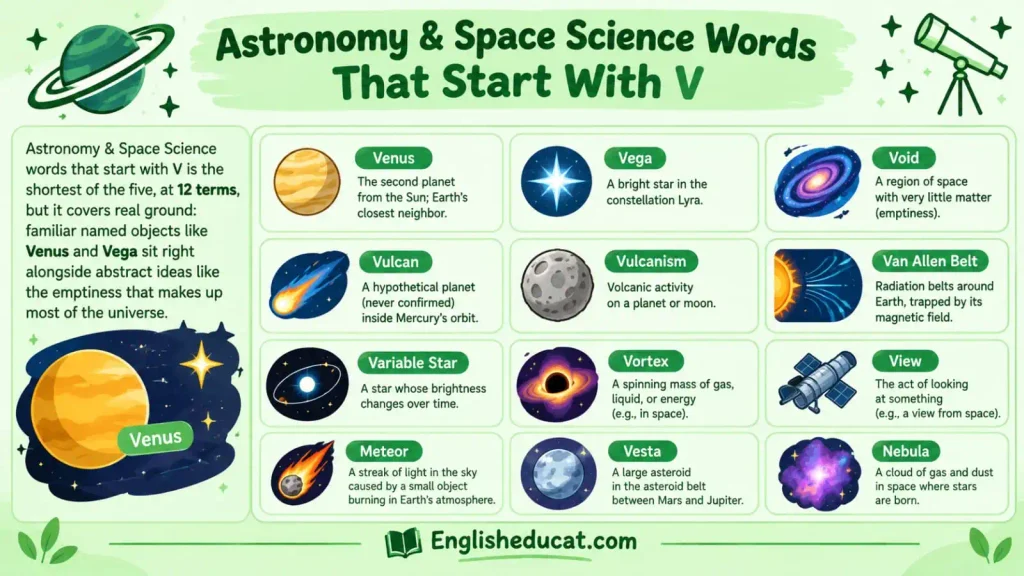
Astronomy & Space Science words that start with V is the shortest of the five, at 12 terms, but it covers real ground: familiar named objects like Venus and Vega sit right alongside abstract ideas like the emptiness that makes up most of the universe.
| Term | Definition | Example |
| Vacuum of Space | The near-total emptiness that fills the region beyond Earth’s atmosphere. | Astronauts must wear pressurized suits to survive the vacuum of space during a spacewalk. |
| Variable Star | A star whose light output rises and falls noticeably over time rather than staying constant. | Astronomers use certain variable stars as reliable tools for measuring cosmic distances. |
| Vega | A bright star in Lyra that once held the title of Earth’s North Star. | Vega will become Earth’s pole star again in roughly 12,000 years, due to axial precession. |
| Venus | The second planet out from the Sun, wrapped in a thick atmosphere that traps heat relentlessly. | Venus reaches surface temperatures hot enough to melt lead, despite not being the closest planet to the Sun. |
| Vernal Equinox | The calendar moment when day and night run almost exactly equal, kicking off spring. | The vernal equinox is widely used as the astronomical marker for the beginning of spring. |
| Very Large Array (VLA) | A radio observatory made of dozens of linked dish antennas working as one instrument. | The Very Large Array has captured remarkably detailed images of galaxies far beyond our own. |
| Visual Magnitude | A numeric scale for how bright a celestial object looks from Earth, regardless of its true brightness. | A star’s visual magnitude made it easy to pick out with the naked eye. |
| Void (Cosmic Void) | An enormous stretch of nearly empty space wedged between galaxy clusters. | Astronomers have mapped cosmic voids spanning hundreds of millions of light-years across. |
| Voyager Probe | Either of two NASA spacecraft sent out decades ago to survey the solar system’s outer planets. | A Voyager probe returned the first close-up images ever taken of Neptune. |
| Vulcan (Hypothetical Planet) | A planet 19th-century astronomers proposed near Mercury’s orbit to explain an anomaly later solved by relativity. | Astronomers eventually ruled out Vulcan’s existence using predictions from Einstein’s theory of general relativity. |
| Velocity Dispersion | How widely individual star speeds vary within a galaxy or cluster. | High velocity dispersion within the cluster hinted at the presence of a massive, unseen core. |
| Viewing Window | The limited stretch of time during which a sky event is actually observable from a given location. | The eclipse’s viewing window lasted just under three minutes before totality ended. |
Earth & Environmental Science Words That Start With V
Sixteen V-words appear in earth science, and most of them circle back to one subject: volcanoes. This branch traces the whole arc from the vent where magma first breaks through to the fertile soil left behind decades later, with a few landform and climate terms rounding things out.
Volcanology Terms
| Term | Definition | Example |
| Vent (Volcanic) | The opening in Earth’s crust that lava, ash, or gas escapes through. | Steam rose continuously from the volcano’s main vent for several days before the eruption. |
| Volcanic Ash | Powdery fragments of pulverized rock and glass hurled skyward during an eruption. | Volcanic ash grounded regional flights for nearly a week after the eruption. |
| Volcanic Eruption | A sudden burst of magma, gas, and debris breaking out from a volcano. | The volcanic eruption forced thousands of nearby residents to evacuate on short notice. |
| Volcanic Rock | Rock that forms when lava or other molten volcanic material cools and hardens. | Volcanic rock covers much of the island’s rugged coastline. |
| Volcanism | The broad category of geological processes tied to erupting magma. | Volcanism has shaped much of the region’s mountainous terrain over millions of years. |
| Volcano | A landform, usually a mountain, built up around a spot where magma reaches the surface. | The dormant volcano hadn’t erupted in over two centuries before recent activity resumed. |
| Volcanology | The field of geology focused specifically on volcanoes and how they behave. | She pursued a career in volcanology after visiting an active crater as a graduate student. |
| Volcanic Belt | A string of volcanoes lined up along a tectonic plate boundary. | The Pacific volcanic belt is commonly referred to as the Ring of Fire. |
| Volcanic Crater | The bowl-like dip carved into the summit of a volcano. | Rainwater collected inside the volcanic crater, eventually forming a small lake. |
| Volcanic Soil | Rich soil built up from broken-down volcanic ash and rock over time. | Volcanic soil supports unusually productive vineyards in several wine-growing regions. |
Landforms, Soil & Climate
Advanced and Rare Science Words That Start With V
These five sit a notch above intro coursework words, more likely to turn up in a graduate seminar, a research paper, or a genuinely difficult crossword.
| Term | Field | Definition | Example |
| Vicariance | Biology (biogeography) | A split in a species’ range caused by a geographic barrier, which can push the separated groups toward different evolutionary paths. | Vicariance helps explain why closely related species end up living on opposite sides of a mountain range. |
| Vernier Scale | Physics / Metrology | A secondary sliding scale on an instrument that lets you read measurements down to a small fraction of a unit. | A lab technician uses the vernier scale on a caliper to read measurements down to a tenth of a millimeter. |
| Van der Waals Radius | Chemistry | A measurement of how close two non-bonded atoms can get before their electron clouds start to repel each other. | Comparing van der Waals radii across elements helps chemists predict how densely molecules will pack in a solid. |
| Vela Supernova Remnant | Astronomy | The still-expanding wreckage of an ancient stellar explosion, closely watched by pulsar researchers. | Researchers have studied X-ray emissions from the Vela supernova remnant for decades. |
| Ventifact | Earth Science | A rock reshaped over long stretches of time by wind-blown sand and grit, often left with distinct flat faces. | The desert ventifact displayed multiple flat faces, each carved by wind blowing from a different direction over time. |
Why Learn V Science Words?
There is a practical reason to spend time with a list like this beyond passing a vocabulary quiz. Take “vector”: once the physics definition clicks, the biology one an organism that spreads disease follows almost immediately, because both rest on the same underlying idea of carrying something from one point to another. That kind of crossover is rare in science vocabulary, and V offers more of it than most letters do.
It is also a testing issue. Words like valence, velocity, and vertebrate keep resurfacing across middle and high school curricula, so a term a student first meets in one unit tends to reappear months later in a completely different one.
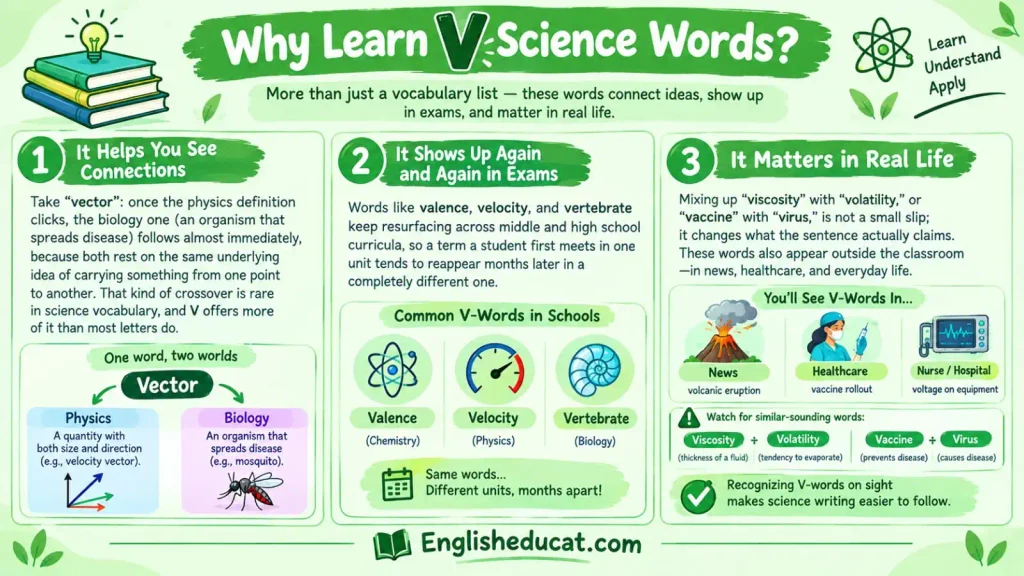
And outside the classroom, precision still matters. Mixing up “viscosity” with “volatility,” or “vaccine” with “virus,” is not a small slip; it changes what the sentence actually claims. Plenty of these words also appear in ordinary life without any classroom involved: a news report on a volcanic eruption, a nurse mentioning voltage on a piece of equipment, a public health update on vaccine rollout. Recognizing the words on sight, instead of half-remembering them, makes that kind of everyday science writing easier to follow.
Frequently Asked Questions
What is a good science word that starts with V?
Vector is a strong pick; it carries distinct, important meanings in physics (a quantity with both size and direction), biology (an organism that spreads disease), and math, which makes it unusually versatile for one word.
What are some science words that start with V related to the human body?
Vein, ventricle, vertebra, vagus nerve, and villi are common ones; they cover the circulatory system, the heart, the spine, and the digestive tract.
What is the most commonly used science word that starts with V?
Vaccine and virus get the most everyday use, thanks to their constant presence in medical and public health news; vector and velocity are not far behind in classroom settings.
How many science words start with the letter V?
This guide documents 100 core terms: 27 in biology, 20 in chemistry, 20 in physics, 12 in astronomy, 16 in earth science, and 5 additional advanced or rare terms.
What is a chemistry word that starts with V?
Valence is the foundational one; it describes an atom’s bonding capacity and anchors a family of related terms, including valence electron and valence shell.
What is an astronomy word that starts with V?
Venus, the second planet from the Sun, and variable star, a star whose brightness shifts noticeably over time, are two of the most frequently referenced V-words in astronomy.
Conclusion
Look across all five branches together, and it is clear how much ground a single letter can cover. In just 100 words, V runs from the inside of a living cell to the emptiness between galaxies, from the bond between two atoms to the birth of a volcano, from a pulse along the vagus nerve to a reading on a hospital voltmeter. Not many letters carry that kind of range, and fewer still do it with words this frequently used.
That range is exactly why these are worth learning properly. They are not obscure entries picked to pad out a list; they are the vocabulary scientists reach for by default, because nothing else says it as precisely. Get comfortable with “vector,” “valence,” and “velocity,” and you have picked up tools that will keep earning their place long after this page is closed. Bookmark this list, come back to it before your next exam, and the next time volcano, virus, or Venus comes up in conversation, you will know exactly what is meant and why it is the right word for the job.

ESL Content Writer
Emily is a TESOL-certified writer who has taught English to international students for over 8 years. She loves breaking down idioms and everyday expressions into simple, relatable explanations that make sense to learners at any level.