Every letter carries weight in scientific language, but few carry as much as S. Open any biology textbook, chemistry manual, physics syllabus, or astronomy article, and S will appear almost immediately: species, solution, speed, star, sediment. Science words that start with S span nearly every branch of the natural sciences, making this one letter a surprisingly efficient entry point into scientific vocabulary.
This guide collects 134 science words that start with S for you: 127 core terms across five branches (biology, chemistry, physics, astronomy, and earth science) and also 7 advanced bonus terms. Each entry gives a clear, classroom-ready definition and a real-world example. Whether you are studying for an exam, building a vocabulary list to teach, solving a crossword, or just curious about precise language, this list is built to be scanned and searched. You should also learn other science words.
Why S Appears So Often in Science
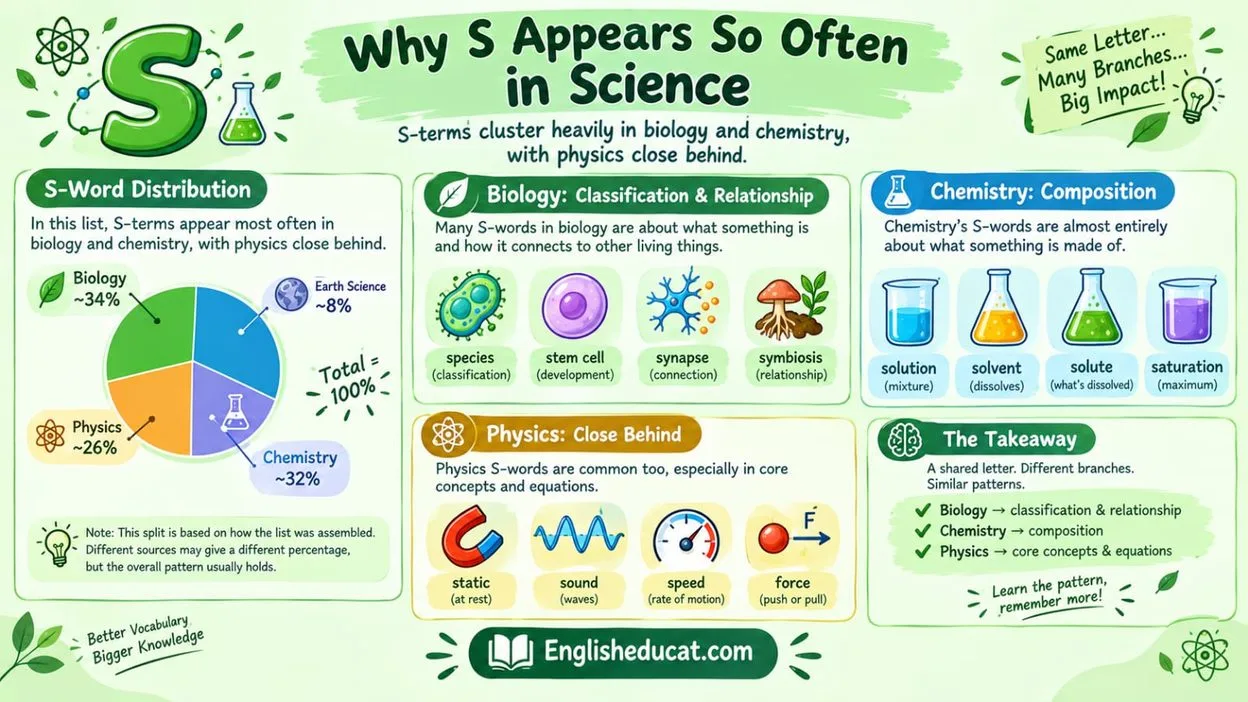
Across the five branches that are covered here, S-terms cluster heavily in biology and chemistry, with physics close behind; together these three account for the large majority of entries. That is specific to how this list was assembled (see the methodology note above); a different set of source textbooks could shift the exact split, but the general pattern tends to hold across most introductory curricula.
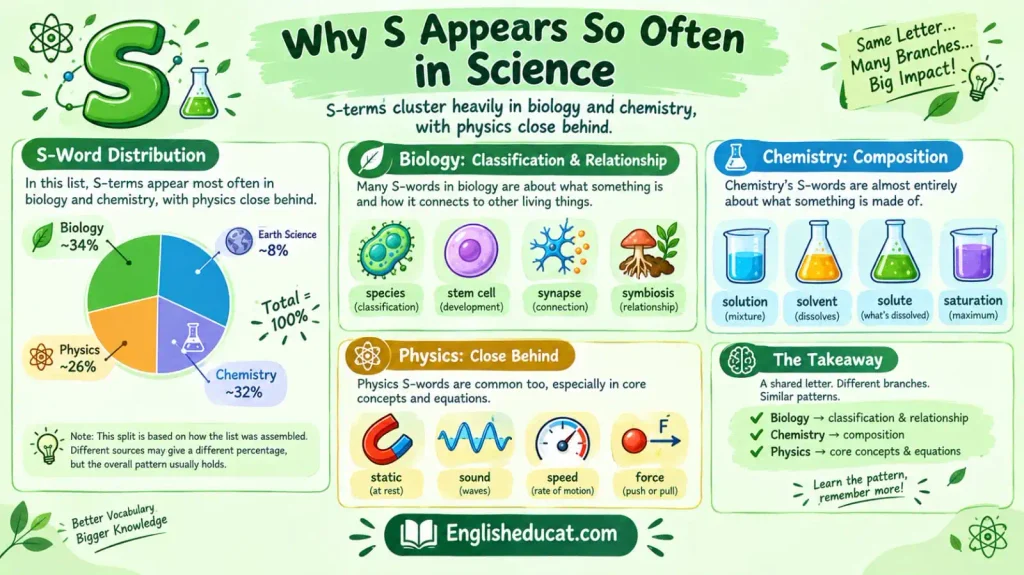
A pattern emerges when you look at what those words describe. S words in Biology species, stem cell, synapse, symbiosis are mostly about classification and relationship: what something is and how it connects to other living things. Chemistry’s S-words solution, solvent, solute, saturation are almost entirely about composition: what something is made of. That is a useful lens for remembering these terms.
S Words Of Biology: From Cells to Ecosystems (30 Terms)
Biology contributes the largest single share of science words that start with S, covering everything from molecular processes inside one cell to the behavior of whole ecosystems. For the full set of life-science vocabulary, see the biology terms A–Z guide.
Reproduction, genetics, and classification
- Species: organisms that can interbreed and produce fertile offspring; biology’s basic unit of classification (lions and tigers are separate species).
- Speciation: the evolutionary process by which new species form.
- Selection (natural): the process favoring survival and reproduction of better-adapted organisms, as with moths that darkened in polluted environments.
- Sperm: the male reproductive cell that fertilizes an egg.
- Stamen: the pollen-producing male part of a flower.
- Sepal: the outer part of a flower that protects the bud before it opens.
- Spore: a reproductive cell that can grow into a new organism; a single mushroom can release billions.
- Sporophyte: the spore-producing diploid phase of a life cycle of plants, dominant in ferns.
Cells and tissue
- Stem cell: an unspecialized cell able to develop into many cell types, central to regenerative medicine.
- Somatic cell: any body cell other than a reproductive one.
- Sarcomere: the basic contractile unit of striated muscle.
- Sarcoplasm: the cytoplasm around muscle fibers, through which calcium triggers contraction.
- Secretion: release of a substance from a cell or gland, such as saliva.
The nervous system
- Synapse: the junction where a nerve impulse passes to another cell via neurotransmitters.
- Stimulus: any detectable change that triggers a response in an organism.
- Sensory receptor: a cell built to detect a specific input, like a photoreceptor for light.
- Sensory neuron: a nerve cell carrying signals from sense organs to the brain.
- Serotonin: a neurotransmitter regulating mood, appetite, and sleep; low levels are linked to mood changes.
Ecology and interaction
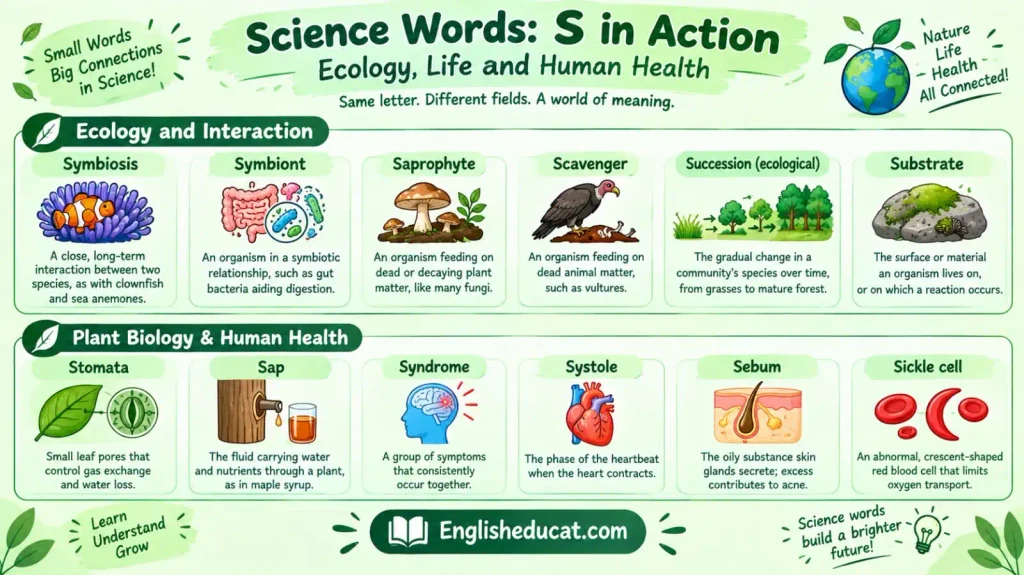
- Symbiosis: a close, long-term interaction between two species, as with clownfish and sea anemones.
- Symbiont: an organism in a symbiotic relationship, such as gut bacteria aiding digestion.
- Saprophyte: an organism feeding on dead or decaying plant matter, like many fungi.
- Scavenger: an organism feeding on dead animal matter, such as vultures.
- Succession (ecological): the gradual change in a community’s species over time, from grasses to mature forest.
- Substrate: the surface or material an organism lives on, or on which a reaction occurs.
Plant biology & human health
- Stomata: small leaf pores that control gas exchange and water loss.
- Sap: the fluid carrying water and nutrients through a plant, as in maple syrup.
- Syndrome: a group of symptoms that consistently occur together.
- Systole: the phase of the heartbeat when the heart contracts.
- Sebum: the oily substance skin glands secrete; excess contributes to acne.
- Sickle cell: an abnormal, crescent-shaped red blood cell that limits oxygen transport.
S Words Of Chemistry: Solutions, Reactions, and Elements (25 Terms)
Among science words that start with S, chemistry contributes the second-largest share, leaning heavily toward mixtures, reactions, and elements. See the following table to understand its definitions:
| Solution | Homogeneous mixture where a solute is fully dissolved in a solvent | Salt water |
| Solvent | The substance doing the dissolving | Water, the “universal solvent” |
| Solute | The substance being dissolved | Salt |
| Solubility | How much solute a solvent can hold | Sugar dissolves better in hot water |
| Saturation | The point where a solution holds the maximum dissolved solute | A saturated sugar solution |
| Suspension | A mixture with undissolved particles that eventually settle | “Shake before use” medicines |
| Standard solution | A solution whose exact concentration is precisely known | Used to titrate unknowns |
| Sol | A colloidal suspension of solids in a liquid | Fresh paint before it dries |
| Synthesis (chemical) | A reaction combining simple substances into a complex compound | Hydrogen and oxygen forming water |
| Saponification | The reaction between a fat and a base that produces soap | Traditional soap-making |
| Sigma bond | A covalent bond formed by direct, head-on orbital overlap | Present in every single bond |
| Strong acid | An acid that ionizes completely in water | Hydrochloric acid |
| Superacid | An acid stronger than pure sulfuric acid | Fluoroantimonic acid |
| Salt | An ionic compound formed from an acid-base reaction | Table salt |
| Silicate | A silicon-oxygen compound found in minerals | Quartz |
| Sulfate | An ion of sulfur bonded to four oxygen atoms | Blue copper sulfate crystals |
| Sulfide | Sulfur in its lowest oxidation state | Hydrogen sulfide’s smell |
| Sodium | A highly reactive alkali metal (Na) | Reacts violently with water |
| Sulfur | A pale yellow nonmetal | Tied to volcanic odors |
| Stannum | The Latin root behind tin’s chemical symbol | Sn |
| Semiconductor | A material with conductivity between a conductor and insulator | Silicon in computer chips |
| Sublimation | A solid changing directly into a gas | Dry ice at room temperature |
| Stoichiometry | Calculating exact reactant and product quantities in a reaction | Balancing chemical equations |
| Spectroscopy | Studying how light interacts with matter to identify substances | Astronomers analyzing stars |
| Scalar (chemistry) | A quantity with magnitude but no direction | Temperature |
Physics S-Terms: Motion, Waves, and Energy (25 Terms)
Physics rounds out the top three disciplines represented in this list. See the following table to know the S words of physics:
| Speed | Distance traveled per unit time, regardless of direction | A car’s speedometer reading |
| Scalar | A quantity with magnitude alone | Mass (unlike force) |
| Stress (physics) | Internal force per unit area within a material | Key to bridge design |
| Strain (physics) | The deformation resulting from stress | A cable stretching under load |
| Shear force | A force causing material layers to slide sideways | Scissors cutting paper |
| Simple harmonic motion | Repetitive back-and-forth movement around equilibrium | A swinging pendulum |
| Spring constant | A measure of a spring’s stiffness | Force per unit extension |
| Specific gravity | The ratio of a substance’s density to water’s | Below one means it floats |
| Sound wave | A pressure vibration traveling through air, water, or a solid | Voice, music |
| Superposition | How overlapping waves combine into one | Interference patterns |
| Standing wave | A stationary-looking wave pattern | A plucked guitar string |
| Sonic boom | The loud sound produced when an object exceeds sound’s speed | A supersonic jet |
| Static electricity | Charge that builds up on a surface instead of flowing | Hair standing up |
| Superconductor | A material conducting electricity with zero resistance | MRI magnets |
| Specific heat | Energy needed to raise one gram of a substance by one degree | Water moderates ocean temperature |
| Spin (particle) | An intrinsic form of angular momentum in particles | Electrons |
| Subatomic particle | Any particle smaller than an atom | Protons, neutrons |
| S-orbital | The spherical region where an electron is most likely found | Every atom’s innermost shell |
| Spectrum (physics) | The full range of electromagnetic wavelengths | Visible light is one slice |
| Spectrometer | An instrument measuring the wavelength or intensity of light | Lab and telescope instruments |
| Speed of light | The constant speed of light in a vacuum | Nothing with mass can exceed it |
| Systematic error | A consistent measurement error from a flaw in equipment or method | An uncalibrated scale |
| Second (unit) | The SI base unit of time | Defined by cesium atom vibration |
| Sievert | The unit measuring the biological effect of a radiation dose | Radiation safety limits |
S-Words in Astronomy and Space Science (20 Terms)
Astronomy spans everything from stellar life cycles to the history of space exploration. Explore more in the given table:
| Star | A massive, luminous sphere of plasma held together by gravity | The Sun |
| Stellar evolution | The life cycle a star moves through, from formation to death | Main sequence to red giant |
| Supernova | The explosive death of a massive star | Briefly outshines a galaxy |
| Sunspot | A temporary dark region on the Sun caused by magnetic activity | Visible in solar cycles |
| Star cluster | A group of stars born together from the same gas cloud | The Pleiades |
| Solar wind | The stream of charged particles the Sun continuously releases | Produces auroras |
| Solar flare | A sudden radiation burst from the Sun | Can disrupt radio signals |
| Solar system | The Sun and every object gravitationally bound to it | Planets, moons, asteroids |
| Solstice | The point when the Sun reaches its highest or lowest point in the sky | Summer/winter solstice |
| Solar eclipse | When the Moon blocks sunlight from reaching part of Earth | Total solar eclipse |
| Space-time | The four-dimensional framework of space and time | Bent by mass, felt as gravity |
| Singularity | The point inside a black hole where density becomes infinite | Center of a black hole |
| Spiral galaxy | A galaxy with curved arms of stars | The Milky Way |
| Spectral line | A specific wavelength absorbed or emitted by an element | Identifying distant objects |
| Sidereal (day) | Time measured relative to distant stars | ~4 minutes shorter than solar day |
| Satellite | Any object, natural or artificial, orbiting a larger body | The Moon |
| Sputnik | The first artificial satellite | Launched in 1957 |
| Space probe | An uncrewed spacecraft sent to study objects beyond Earth | Voyager missions |
| Space weather | Space conditions that can disrupt satellite communications | Solar storms |
| Spectrohelioscope | An instrument built to observe the Sun at one precise wavelength | Solar observatories |
Earth Science S-Terms: Rocks, Water, and Atmosphere (20 Terms)
The final branch covers the planet itself. See the following glossary to know every S word in Earth Sciences.
Rocks and formations
- Sediment: particles of rock or organic matter deposited by water, wind, or ice.
- Sedimentary rock: rock formed when sediment layers compact and cement together.
- Sandstone: sedimentary rock made of compacted sand grains.
- Shale: sedimentary rock from compressed clay, often tapped for natural gas.
- Stratum/strata: a single rock layer, or a full cross-section of layers, as seen in canyon walls.
- Stalactite: a mineral formation hanging from a cave ceiling.
- Stalagmite: the corresponding formation rising from a cave floor.
- Sinkhole: a sudden depression from underlying rock collapse.
Plate tectonics, water, and atmosphere
- Seismic wave: a vibration traveling through Earth after an earthquake.
- Seismology: the study of earthquakes and how their waves move.
- Subduction: one tectonic plate sliding beneath another, often triggering earthquakes.
- Seafloor spreading: new oceanic crust forming at mid-ocean ridges, pushing plates apart.
- Salinity: the concentration of dissolved salt in water; ocean salinity averages about 3.5%.
- Sea level: the ocean’s average surface height relative to land.
- Storm surge: seawater pushed onshore by a major storm, flooding coastal areas.
- Snowpack: compacted layers of accumulated snow that feed spring rivers.
- Soil erosion: topsoil removal by wind, water, or human activity.
- Stratosphere: the atmospheric layer above the troposphere, containing the ozone layer.
- Smog: polluted air formed when smoke and fog combine.
- Sustainability: meeting present needs without compromising future generations’ resources.
Advanced / Rare S-Words (Bonus Section)
Beyond the 127 core terms, these seven advanced words appear mainly in upper-level coursework and research writing. Following are some rare science words:
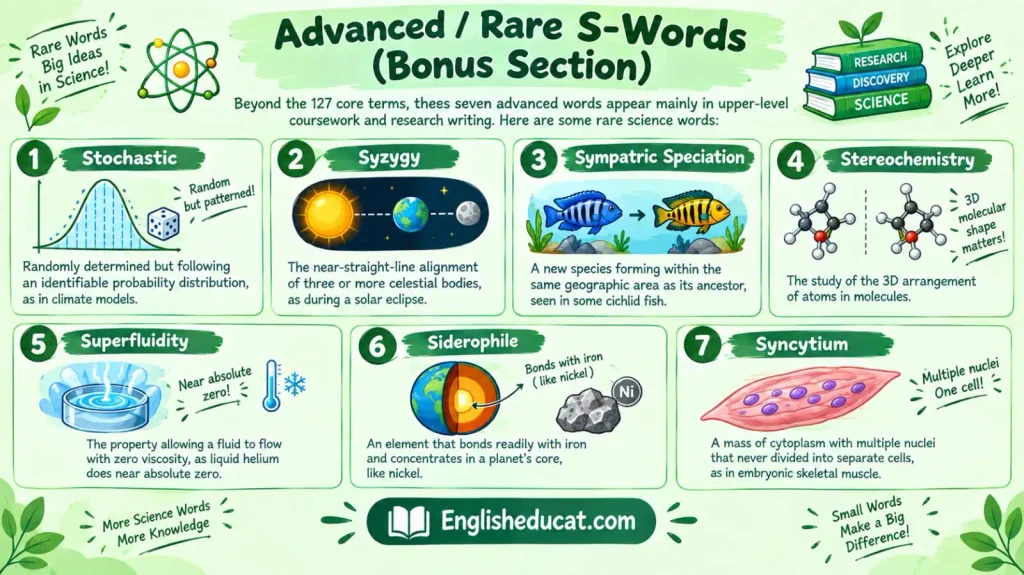
- Stochastic: randomly determined but following an identifiable probability distribution, as in climate models.
- Syzygy: the near-straight-line alignment of three or more celestial bodies, as during a solar eclipse.
- Sympatric speciation: a new species forming within the same geographic area as its ancestor, seen in some cichlid fish.
- Stereochemistry: the study of the 3D arrangement of atoms in molecules.
- Superfluidity: the property allowing a fluid to flow with zero viscosity, as liquid helium does near absolute zero.
- Siderophile: an element that bonds readily with iron and concentrates in a planet’s core, like nickel.
- Syncytium: a mass of cytoplasm with multiple nuclei that never divided into separate cells, as in embryonic skeletal muscle.
Why Learn S Science Words?
There is a practical case for spending real time learning science words that start with S, beyond having a longer vocabulary reference to point to.
They give you breadth fast. Because S-words usually belongs to every major branch of science, learning even a fraction of this list builds cross-disciplinary literacy that focusing on a single subject can not. Knowing species, solution, speed, star, and sediment already gives you one foothold in each of the five branches.
Shared roots make retention easier. Many of these terms trace back to the same Latin or Greek roots. Sol-, meaning “sun” or “alone,” runs through solution, solar, and solitary. Spec-/spectr-, meaning “to see,” connects spectrum, spectroscopy, and spectrometer. Spotting these roots turns memorization into pattern recognition.
They are useful outside the classroom, too. Teachers use lists like this to build vocabulary units and quizzes. Writers and science communicators check precise terminology before publishing, since a misused term like solute versus solvent can undercut an otherwise well-researched piece. Crossword and Scrabble players mine it for high-value words. ESL/EFL learners use it as a structured way into English-language science content, where technical vocabulary often causes more friction than grammar does. The Science Vocabulary for ESL Learners guide goes deeper on that use case.
Frequently Asked Questions
What are some science words that start with S?
Common examples include species and stem cell in biology, solution and sodium in chemistry, speed and superconductor in physics, star and satellite in astronomy, and sediment and stratosphere in earth science, spanning all five major branches of natural science.
What is the most important S-word in biology?
Species is arguably the most important biology term starting with S, since it is the basic unit of biological classification: a group of organisms able to interbreed and produce fertile offspring.
What is a common S-word in chemistry?
Solution: A homogeneous mixture in which a solute is fully dissolved in a solvent is one of the most frequently used chemistry terms starting with S, and it underlies related concepts like solubility and saturation.
What S-word is used in astronomy?
Star and satellite are two of the most common. A star is a massive, luminous sphere of plasma held together by gravity; a satellite is any object, natural or artificial, that orbits a larger body.
How many science words start with the letter S?
This guide includes 134 total: 127 core terms across biology, chemistry, physics, astronomy, and earth science, plus 7 advanced bonus terms.
What is a rare or advanced science word starting with S?
Syzygy, the near-straight-line alignment of three or more celestial bodies, as during a solar eclipse, and stochastic, something randomly determined but following a predictable probability pattern, are two of the rarer entries on this list.
Conclusion
Step back from the individual definitions, and something bigger comes into focus: this list of science words that start with S is a compressed map of the natural sciences themselves. In a single letter, you have traveled from inside a living cell to the surface of a dying star, from a beaker of saturated sugar water to a subducting tectonic plate. Few letters offer that kind of range.
That is the real value of learning science words that start with S: these terms don not just fill in a worksheet or win a crossword square; they hand you working fluency across five scientific disciplines at once. So the next time species, solution, speed, star, or sediment comes up in a textbook or conversation, you will know exactly which branch of science it belongs to, and why.

ESL Content Writer
Emily is a TESOL-certified writer who has taught English to international students for over 8 years. She loves breaking down idioms and everyday expressions into simple, relatable explanations that make sense to learners at any level.