Few letters carry as much scientific weight as R. Flip through a biology textbook, a chemistry lab manual, or an astronomy course syllabus, and you will find science words that start with R everywhere, which is describing everything from how a cell repairs itself to how light bends through a lens.
This guide brings together 136 science words that start with R, that is sorted into five major branches: biology, chemistry, physics, astronomy, and earth science, and also a bonus set of advanced terms for readers who want to go further. Students preparing for an exam, teachers building a vocabulary unit, and writers who need precise scientific language will all find something useful here in this guide, since the goal is a reference accurate enough to actually cite, not just a casual word list. Also see science words that start with S.
Why the Letter R Dominates Scientific Vocabulary
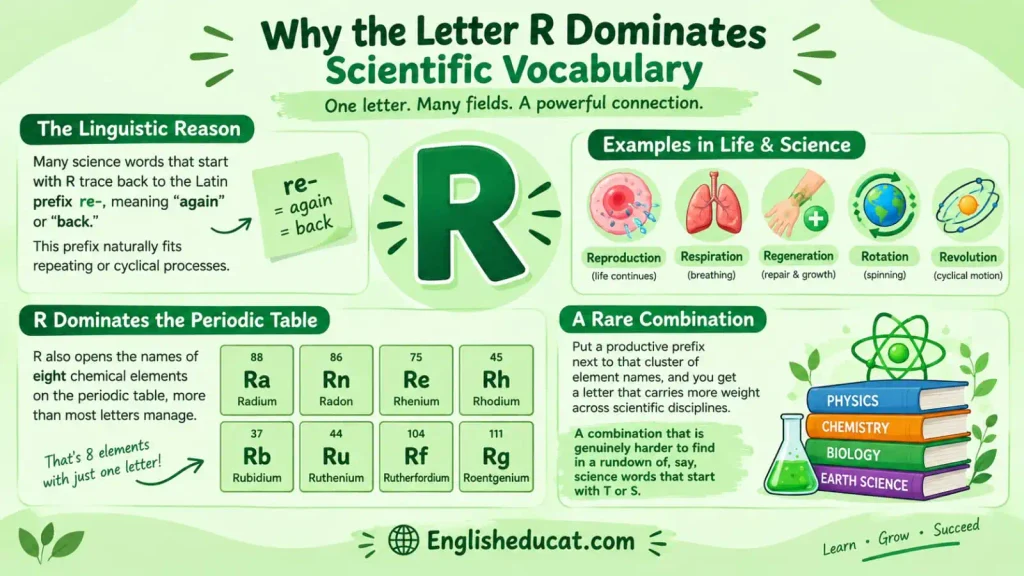
Science words that start with R are unusually plentiful, and there is a linguistic reason. Many trace back to the Latin prefix re-, meaning “again” or “back,” a root that naturally fits repeating or cyclical processes. Reproduction, respiration, regeneration, rotation, and revolution are all science words that start with R.
R also opens the names of eight chemical elements on the periodic table, more than most letters manage: radium, radon, rhenium, rhodium, rubidium, ruthenium, rutherfordium, and roentgenium. Put a productive prefix next to that cluster of element names, and you get a letter that carries more weight across scientific disciplines, a combination that is genuinely harder to find in a rundown of, say, science words that start with T or S.
Biology Words That Start With R
Biology leans on R heavily for the vocabulary of cells, anatomy, and heredity, terms that appear constantly in both high school and university coursework. Here are some words explained with definitions. Take the ribosome: it builds proteins from amino acids by translating messenger RNA, a mechanism every introductory biology course covers when explaining cell structure.
Reproduction is how organisms generate offspring, and respiration is the cellular process that turns nutrients and oxygen into usable energy inside the mitochondria. When a receptor, a protein tuned to detect a specific stimulus, picks up a signal, the result can be a reflex, the automatic, involuntary response that pulls a hand back from a hot stove before conscious thought even catches up.
Some organisms are better at repairing themselves than others. Starfish, for example, are known for regeneration, the ability to regrow tissue that has been lost or damaged entirely. A reptile is defined by cold blood, scaled skin, and typically egg-laying reproduction, while the retina, the light-sensitive layer lining the back of the eye, is where an image actually comes into focus before the brain interprets it.
Plants and fungi have their own R-rooted anatomy: a rhizome is an underground stem, like ginger’s, that sends out both roots and shoots, and a rhizoid does similar anchoring work for mosses that never developed true roots. Genetics adds two more: RNA, the molecule carrying instructions for protein synthesis, and ribose, the five-carbon sugar in its backbone that sets it apart from DNA.
A handful of more specialized terms round things out. Cattle digestion depends on the rumen, the first of several stomach chambers where bacteria break down tough plant fiber, which is exactly why cows, sheep, and deer are classified as ruminant animals that chew regurgitated cud. Vision in dim light relies on the rod cell, a type of photoreceptor, while recombination shuffles genetic material between chromosomes during reproduction, which is a major source of variation between offspring.
In the kidneys, reabsorption recovers useful substances from filtered fluid back into the bloodstream, a process central to renal physiology. The Root of plants anchors it in soil and draws up water, and before any of that growth happens, the radicle, the embryonic root, is the first structure to emerge from a germinating seed. A few last entries round out the branch:
| Reproductive system | Organs involved in producing offspring. | Covered in every anatomy course. |
| Rigor mortis | Muscle stiffening after death. | Used to estimate time of death. |
| Radula | A mollusk’s rasping feeding organ. | Lets a snail scrape algae off rocks. |
| Rennin | Curdles milk protein in infants. | Distinct from rennet used in cheesemaking. |
| Ratite | Flightless bird with a flat breastbone. | The ostrich is its largest member. |
| Rabies | Viral disease of the nervous system. | Requires pet vaccination in many countries. |
Chemistry Words That Start With R
If any branch tests students on R-vocabulary most often, it is chemistry, since so many core concepts start with the letter. A reaction is simply the process by which substances transform into new products; the reactant is whatever goes in, as hydrogen and oxygen do when they combine to form water. A reagent is a substance added to trigger or detect a reaction, something every lab technician reaches for regularly, and reagent-grade describes a purity level clean enough for accurate analytical work.
Electron transfer is where a lot of this vocabulary lives. Redox reactions pair oxidation with reduction happening at once, and reduction, specifically, means a substance gains electrons and its oxidation state drops. A radical carries an unpaired electron, which makes it reactive and, inside a living cell, potentially damaging.
How readily something changes chemically is its reactivity, and the reactivity series ranks metals by exactly that quality, with potassium sitting near the top. Reduction potential, meanwhile, measures how easily a given species picks up electrons in the first place.
Several chemical elements begin with R. Rubidium is a soft alkali metal that reacts violently on contact with water; rhodium, rare and silvery, is valued as an industrial catalyst; radon is a radioactive noble gas homeowners routinely test for in basements; and rutherfordium and roentgenium are synthetic, highly unstable elements that exist only briefly inside particle accelerators.
Beyond the periodic table, a working vocabulary of chemists includes recrystallization, a purification method that grows cleaner crystals out of solution, and reflux, a technique for boiling a liquid while its vapor condenses back in, keeping the volume steady. A reversible reaction, like ammonia synthesis, runs in both directions at once, while racemization turns an optically active compound into an inactive mixture, sometimes weakening a pharmaceutical drug in the process. The rate law ties reaction speed to reactant concentration, and a reactor is any vessel designed to hold a controlled reaction, nuclear reactors being the highest-stakes example. A few terms close out the chemistry list:
| Resin | Sticky substance from trees and plants. | Base for many adhesives and coatings. |
| Rare earth elements | Metals with similar chemical properties. | Essential to smartphone and battery components. |
| Ring compound | Molecule with atoms in a closed loop. | Benzene is the classic six-carbon example. |
| Ripening (chemical) | How fruit softens as sugars develop. | Ethylene gas speeds this up in bananas. |
Physics Words That Start With R
Physics gives us some of the most visually obvious science words that start with R, ones you can actually watch play out. Radiation is energy moving as waves or particles, sunlight being the everyday example, while refraction bends a wave crossing between two media, the reason a straw looks bent in a glass of water. Reflection happens when light or sound bounces off a surface instead of passing through it, and resistance is what a material offers against the flow of electric current; the low resistance of copper is precisely why it is the standard choice for wiring.
Motion and vibration form another cluster. Resonance amplifies vibration once a frequency lines up with a natural rate of the system, which is how, in extreme cases, sound alone can shatter a wine glass. Rotation is spinning around an internal axis, the reason Earth cycles through day and night, and revolution is one body orbiting another, the reason a full trip around the Sun takes Earth roughly 365 days.
Rotational inertia is a spinning resistance of object to changing that spin; pull the arms in, and a skater rotates faster, and rotational motion covers any object turning on a fixed axis more broadly. A restoring force, like the pull of a stretched spring back toward its resting length, is what drags a displaced system back to equilibrium.
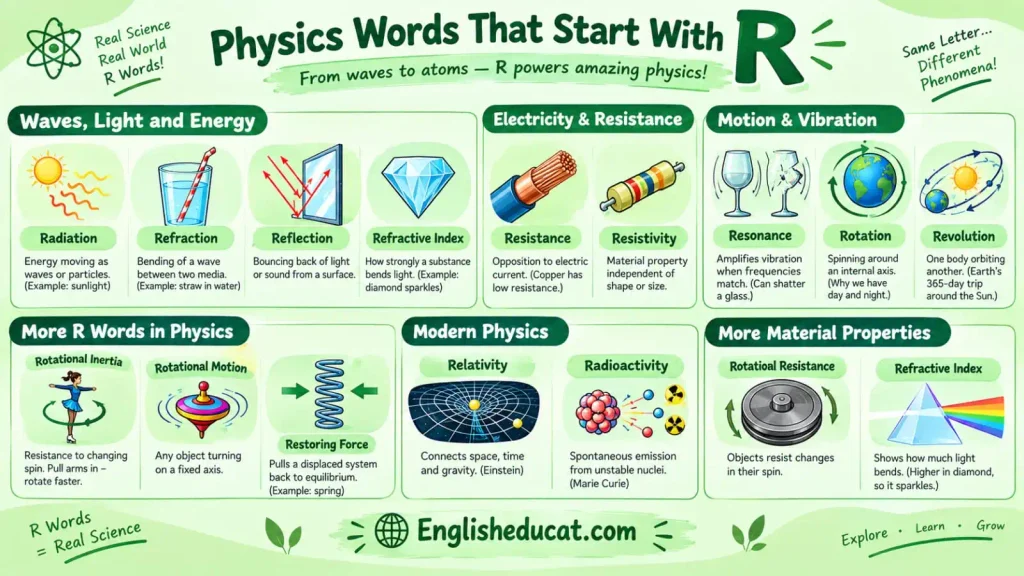
Einstein’s relativity ties space, time, and gravity together, reshaping how physicists model the universe at every scale, while radioactivity, the spontaneous emission of particles from unstable nuclei, is the phenomenon Marie Curie spent much of her career studying. Resistivity is a material property independent of shape or size, and the refractive index measures how strongly a substance bends light passing through it, which explains why diamond, with an unusually high index, sparkles the way it does.
A radian measures angles based on a radius of a circle rather than degrees, and rest mass is what an object weighs when it is not moving, unaffected by how fast it later travels. Engineers often treat a rigid body as an object that never deforms under force, a useful simplification for modeling a spinning wheel, and ray optics models light as straight lines to explain how a lens brings an image into focus.
A handful of terms complete the branch: radiant energy, transmitted through space as electromagnetic waves; reaction force, the response every applied force produces under Newton’s third law; radiation pressure, the gentle push that nudges solar sail spacecraft forward; reference frame, the coordinate system used to describe motion; radiant heat, the warmth felt standing near a campfire; rarefaction, the stretched-out region in a sound wave; radiant intensity, used to gauge how strong a laser beam actually is; and the Rydberg constant, essential for calculating the emission spectrum of hydrogen.
Astronomy and Space Words That Start With R
Space is where this vocabulary turns genuinely dramatic, since so many R-terms describe entire chapters of the life of a star or a motion of planets. Our own sun will one day become a red giant, the late-life stage in which a star swells and cools. Mars appears to move backward across the sky every couple of years, a phenomenon called retrograde motion, and redshift, the stretching of light toward longer wavelengths as its source moves away, is a major piece of evidence that the universe is expanding.
Saturn’s famous ring system is a band of ice, dust, and rock circling the planet, and it likely formed near the Roche limit, the minimum orbital distance before tidal forces rip a body apart into exactly that kind of debris. Planetary surfaces carry their own R-vocabulary. Apollo astronauts left visible bootprints in the moon’s regolith, the loose dust and rock covering its surface, and the moon’s rilles, long narrow depressions, may have formed from ancient lava flows.
How long a body takes to spin once is its rotation period (Jupiter’s, under ten hours, is the fastest of any planet), while its revolution period measures a full orbit, which for Earth defines a calendar year. Mercury, Venus, Earth, and Mars all qualify as rocky planets, worlds built mainly from rock and metal, and a rocky exoplanet is that same category of world found beyond our solar system, occasionally orbiting inside a habitable zone of a star.
Instruments and forces fill out the rest. A radio telescope picks up radio waves from deep space, sometimes catching signals from a distant pulsar, and measuring radial velocity how fast an object moves toward or away from an observer has revealed unseen exoplanets by their gravitational tug. The radiant of a meteor shower is the point in the sky the meteors seem to stream from, which is how the Perseids got their name from the constellation Perseus. A red dwarf is small, cool, and slow-burning, making it the most common type of star in the galaxy, while the radiative zone inside a star is where energy crawls outward so slowly that a photon can take thousands of years to escape.
Several more terms fit here: radiant flux, the total emitted power of the Sun; ram pressure, which strips gas from galaxies falling into a cluster; right ascension, one half of a celestial coordinate system; the runaway greenhouse effect, responsible for extreme surface heat of Venus; the radiation belt, where the magnetic field of planets traps charged particles; the Roche lobe, the region of space gravitationally bound to a star; a radio galaxy, distinguished by its powerful jets; and the rotation curve, whose unexpected flatness became early evidence for dark matter.
Earth and Environmental Science Words That Start With R
Earth science hands us some of the most familiar science words that start with R, the ones describing landscapes and water systems most people encounter without ever naming them. The rock cycle describes rock continuously reforming, igneous rock slowly becoming sedimentary rock over long stretches of time, while rock weathering is the physical or chemical breakdown that grinds rock into smaller particles.
A river basin, the Amazon being the largest example, is the land drained by a river and its tributaries, and together, rainfall and the rain gauge used to measure it determine what a region can realistically grow. Tectonic forces bring their own terminology. A mid-ocean ridge marks the seam where plates are pulling apart, driven by ridge push, and a rift valley, like East Africa is, forms wherever the crust stretches thin enough to sink. Over millions of years, erosion sculpts a rock formation out of layered stone, and radiometric dating, which relies on radioactive decay rates, has dated some meteorites to billions of years old.
Water systems and ecosystems close out the branch. A reservoir stores water for later use, while runoff carries rainwater into rivers and streams, sometimes turning into runoff pollution when fertilizer or other contaminants hitch a ride. A rain shadow is the dry zone that forms on a leeward side of mountains, and the riparian zone is vegetated land bordering a river that filters pollutants before they ever reach the water. Underground, recharge is how rainwater slowly refills an aquifer, and above ground, a reef built from coral or rock can support an outsized share of marine biodiversity.
A final set of terms belongs here too: renewable resources, like solar power; recycling, which turns waste back into usable material; the rainforest and its uppermost layer, the rainforest canopy; reclamation, the restoration of degraded land; remote sensing, used to track deforestation from satellites; rock salt, mined from ancient evaporated seas; a rip current, the narrow, fast-moving current that pulls swimmers away from shore; and the Ring of Fire, the Pacific belt responsible for a large share of the planet’s earthquakes and volcanic eruptions.
Advanced and Rare Science Words Starting With R
A smaller set of specialized science words that start with R appears mostly in advanced coursework and research papers, useful for anyone who wants to go a step past the basics.
| Rheology | How matter flows and deforms under force. | Guides paint formulation for the right viscosity. |
| Radiolarian | Marine organism with a silica shell. | Fossils help date ocean sediment. |
| Retroviral | Viruses converting RNA into DNA in a host. | HIV is the best-known example. |
| Rubisco | Enzyme driving photosynthesis via carbon fixation. | The most abundant protein on Earth. |
| Radiolysis | Breakdown triggered by ionizing radiation. | Generates free radicals in reactors. |
| Reynolds number | Value predicting fluid flow behavior. | Shows if pipe flow is smooth or turbulent. |
| Regolith breccia | Lunar rock from fused impact fragments. | Sampled by Apollo missions. |
| Rankine scale | Absolute temperature scale in engineering. | Relates to Fahrenheit as Kelvin does to Celsius. |
Why Learn Science Words That Start With R?
There is more to gain from science words that start with R than a longer vocabulary list. Because these terms are spread so thickly across biology, chemistry, physics, astronomy, and earth science, learning even a portion of them will make scientific writing easier to follow in almost any context, whether that is a research abstract or a museum placard. Exam-takers benefit from the sheer density of testable terms packed into a single letter, teachers get a ready-made focus for a vocabulary unit, and science writers gain the precision needed to avoid vague or misleading language.
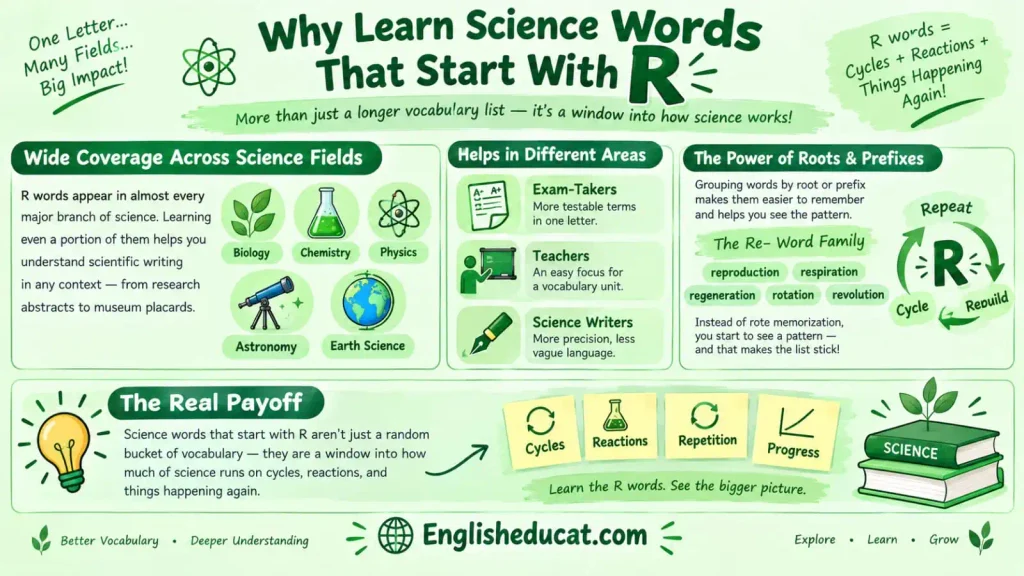
One practical tip is worth passing along: group these words by root or prefix instead of memorizing them in isolation. Once you notice how many re- words describe something repeating or cycling back- reproduction, respiration, regeneration, rotation, revolution- the list stops feeling like rote memorization and starts feeling like a pattern worth recognizing. That, ultimately, is the real payoff of working through science words that start with R as a connected set: the letter is not just a random bucket of vocabulary; it is a window into how much of science runs on cycles, reactions, and things happening again.
Frequently Asked Questions
What are some science words that start with R?
Common examples include radiation, reproduction, resistance, respiration, and redshift, drawn from physics, biology, and astronomy, respectively. The full list above organizes 136 science words that start with R across five branches of science, from cellular biology to planetary astronomy.
How many science words start with the letter R?
This guide covers 136 science words that start with R in total: 128 core terms split across five branches (26 in biology, 25 in chemistry, 26 in physics, 25 in astronomy, and 26 in earth science), plus 8 advanced or rare terms for deeper study.
What is a key R word in biology, chemistry, and physics?
In biology, the ribosome stands out, since it is the structure that builds every protein a cell needs to function. In chemistry, the reaction is the basic unit of chemical change, underlying everything from rusting metal to digestion. In physics, radiation covers such a wide range of phenomena, from sunlight to nuclear decay, that it is arguably the most far-reaching R-term in the field.
What R words relate to space and astronomy?
Space-related science words that start with R include redshift, retrograde motion, red giant, rocket, and the Roche limit. Together, these describe how stars age, how planets appear to move across the sky, and the physical limits that decide whether a moon holds together or breaks apart into a ring system. See the full astronomy section above for the complete list.
What is a rare or advanced science word starting with R?
Rheology, Rubisco, and the Reynolds number all qualify as advanced science words that start with R. Rheology examines how matter flows, Rubisco is the enzyme that makes photosynthesis possible, and the Reynolds number predicts whether fluid flow will stay smooth or turn turbulent.
Why do so many science terms start with R?
Much of it comes down to the Latin prefix re-, meaning “again” or “back,” which naturally describes repeating processes like reproduction, respiration, and rotation. R also opens the names of eight chemical elements, including rubidium, radon, and rhodium, adding even more density to a single letter’s worth of science words that start with R.
Conclusion
Work through this list twice, and something shifts: the letter R stops looking like an arbitrary starting point and starts looking like a map of science itself, cycles that repeat, reactions that transform, forces that pull things apart and then pull them back together again. That is the real reward of studying science words that start with R as a complete set instead of picking them up one at a time.
A single letter links a ribosome quietly assembling proteins inside a cell to a red giant swelling in a galaxy light-years away, and once that connection clicks, the vocabulary stops feeling like something to memorize and starts feeling like something to notice, in textbooks, in the news, in the natural world just outside the window. Keep this list within reach, revisit whichever branch challenges you most, and let R become the letter that makes the rest of science just a little easier to read.

Linguistics Specialist
James is a linguist with a Ph.D. in Applied Linguistics from Boston University. His work focuses on word origins, synonyms, and how language evolves over time. He has contributed to several academic journals on English semantics.