
Q sits near the bottom of almost every list of tricky vocabulary letters; fewer words begin with Q than with any other letter in the English language, science included. That scarcity, though, works in its favor. Because so few terms exist, the ones that do carry outsized weight: quantum, quark, and quasar alone touch physics, chemistry, and astronomy in ways that shape how scientists describe the universe at its smallest and largest scales.
This guide gathers more than 120 science words that start with Q, sorted into five branches biology, chemistry, physics, astronomy, and earth science each defined in plain language and used in a sentence you would actually encounter in a classroom or research paper. Whether you are studying for a test, building a vocabulary list for students, or simply chasing curiosity down an alphabetical rabbit hole, every entry here reflects real scientific usage rather than filler. You should also learn other science words that start with R and S.
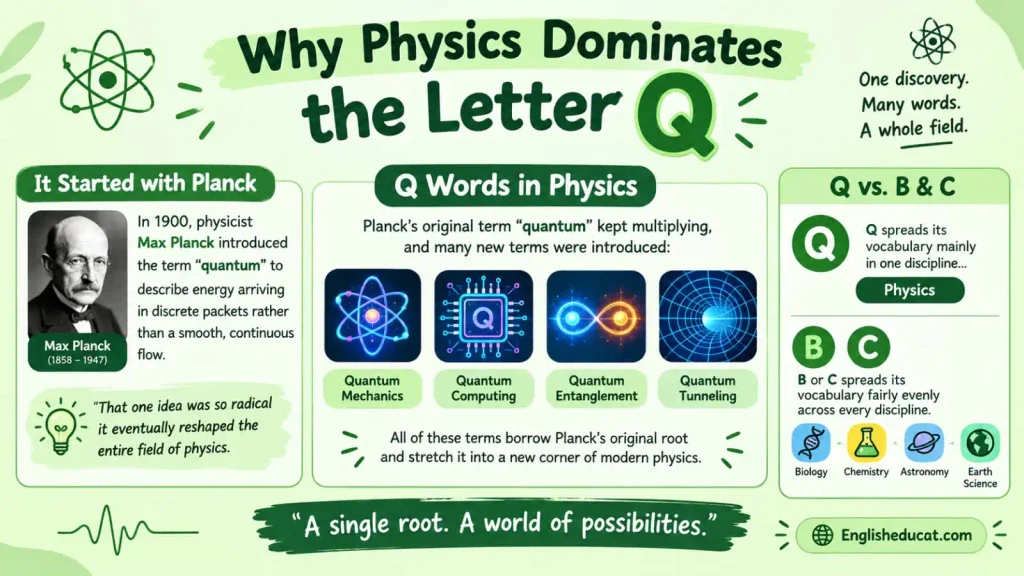
Why Physics Dominates the Letter Q
Nearly a quarter of all science words that start with Q live inside a single branch, physics, and almost every one of them traces back to a single root word. In 1900, physicist Max Planck introduced the term “quantum” to describe energy arriving in discrete packets rather than a smooth, continuous flow, a proposal so radical it eventually reshaped the entire field.
That one idea kept multiplying, and many new terms were introduced: quantum mechanics, quantum computing, quantum entanglement, and quantum tunneling all borrow Planck’s original root and stretch it into a new corner of modern physics. A letter like B or C spreads its vocabulary fairly evenly across every discipline; Q does the opposite. This is a letter shaped almost entirely by one discovery, now well over a century old.
Biology Science Words That Start With Q
Q words of Biology lean toward cellular processes, ecological measurement, and disease terminology; vocabulary you will meet anywhere from an introductory textbook to a graduate microbiology seminar. Quorum sensing, in particular, describes a mechanism researchers are still actively investigating in labs today, which explains why it keeps turning up in newer biology curricula.
| Term | Definition | Example Sentence |
| Quorum Sensing | How bacteria coordinate group behavior by releasing and detecting chemical signals as their numbers grow. | The biofilm formed once bacteria reached quorum sensing threshold. |
| Quiescent (cell) | Describes a living cell that has paused division rather than stopped it permanently. | Stem cells often remain quiescent until triggered to divide. |
| Quiescence | A dormant, low-activity phase an organism or cell enters until conditions favor resuming activity. | The seed entered quiescence during the dry winter months. |
| Quadriceps | The four-muscle group running down the front of the thigh, central to knee extension. | Runners rely heavily on strong quadriceps for sprinting power. |
| Quagga | A now-extinct zebra subspecies once native to southern Africa, notable for its partial stripe pattern. | Scientists sequenced DNA from a preserved quagga hide. |
| Quail | A small, ground-nesting bird frequently chosen as a model organism in genetics studies. | Researchers bred quail to study inherited feather patterns. |
| Queen Bee | The single fertile female whose egg-laying sustains an entire honeybee colony. | The queen bee lays nearly all eggs in the hive. |
| Quill | The hollow shaft running through the center of a feather, giving it structure without adding weight. | The quill’s hollow structure keeps feathers lightweight yet strong. |
| Quaternary Structure | The way separate protein subunits fold together into one working molecular complex. | Hemoglobin’s quaternary structure allows four oxygen molecules to bind. |
| Quinone | A compound that ferries electrons along the chain of reactions inside cellular respiration. | Quinone shuttles electrons across the mitochondrial membrane. |
| Quercetin | An antioxidant pigment found across many fruits, vegetables, and plant tissues. | Onions contain quercetin, which may help reduce inflammation. |
| Quadrat | A fixed-size square frame ecologists lay down to count organisms within a defined patch of habitat. | She placed a quadrat in the meadow to count wildflowers. |
| Quiescent Center | A cluster of slow-dividing cells near a plant’s root tip that keeps the surrounding stem cells in reserve. | The quiescent center helps maintain the root’s stem cell niche. |
| Quorum Quenching | A strategy for interrupting bacterial chemical signaling before it can trigger coordinated behavior. | Quorum quenching enzymes could offer a new antibacterial strategy. |
| Quadrivalent Vaccine | A single vaccine formulated to guard against four distinct strains of a disease. | The clinic offered a quadrivalent flu vaccine this season. |
| Quickening | The point in pregnancy, usually mid-term, when the fetus’s movements first become noticeable. | She described quickening as a light fluttering sensation. |
| Quadruped | Any animal built to walk primarily on four limbs. | Horses and dogs are both quadrupeds. |
| Quoll | A spotted, carnivorous marsupial native to Australia and New Guinea. | The quoll hunts insects and small mammals after dark. |
| Quillwort | A small, grass-like plant that roots in shallow water along pond edges. | Quillwort grows along the muddy edges of the lake. |
| Q Fever | An infection caused by the bacterium Coxiella burnetii, typically picked up from livestock. | Farm workers face higher risk of contracting Q fever. |
| Quasispecies | A cloud of genetically varied but closely related viral particles circulating within one infection. | The virus persists as a quasispecies, complicating vaccine design. |
| Queen Substance | A pheromone secreted by the queen bee that keeps worker bees from developing functioning ovaries. | Queen substance suppresses ovary development in worker bees. |
| Quadrant (Anatomy) | One of four zones used to map and describe a location on the body, most often the abdomen. | The pain was localized to the lower right quadrant. |
| Quaternary Consumer | An organism at the very top of a food chain, feeding on tertiary-consumer predators. | Orcas often act as quaternary consumers in marine ecosystems. |
| Quintan Fever | A fever pattern with a spike recurring every fourth day, historically tied to louse-borne infection. | Quintan fever was common among soldiers in World War One trenches. |
| Quotidian Fever | A daily-recurring fever pattern sometimes associated with malaria infection. | The patient’s quotidian fever pointed doctors toward a malaria diagnosis. |
| Quiescent Stem Cell | A stem cell held in reserve outside the division cycle until injury or need calls it into action. | Quiescent stem cells can reactivate rapidly after tissue injury. |
Chemistry Science Words That Start With Q
Q vocabulary of Chemistry is tighter and more technical, drawn largely from lab procedure, materials science, and pharmacology. A few entries, like quinine and quicklime, predate modern chemistry by centuries, and you will likely recognize several from safety labels or the glossary at the back of a high school textbook.
| Term | Definition | Example Sentence |
| Quantitative Analysis | Lab work aimed at pinning down exactly how much of a substance a sample contains. | Quantitative analysis revealed the sample contained 12% sulfur. |
| Qualitative Analysis | Lab work focused on figuring out which substances are present, without measuring amounts. | Qualitative analysis confirmed chlorine ions in the solution. |
| Quenching | Cooling a heated material very quickly to lock in a particular hardness or microstructure. | Quenching the hot steel in oil increased its hardness. |
| Quicklime | The common name for calcium oxide, a compound that reacts vigorously when it meets water. | Quicklime is used to make cement and mortar. |
| Quaternary Carbon | A carbon atom whose four bonds all connect to other carbon atoms. | The molecule’s stability comes from its central quaternary carbon. |
| Quaternary Ammonium Compound | A nitrogen-based salt widely used as an active ingredient in disinfectants. | The cleaning spray contained a quaternary ammonium compound. |
| Quinoline | A ring-shaped, nitrogen-containing compound serving as a starting material for dyes and drugs. | Quinoline serves as a building block for several drug compounds. |
| Quinine | A bitter compound drawn from cinchona bark, historically valued as a malaria treatment. | Quinine gives tonic water its distinctive bitter taste. |
| Quinhydrone | A paired mixture of quinone and hydroquinone once used in electrodes for measuring acidity. | The lab used a quinhydrone electrode to check solution acidity. |
| Quasicrystal | A solid whose atoms follow an orderly pattern that, unlike a normal crystal, never repeats exactly. | Quasicrystals earned Dan Shechtman the 2011 Nobel Prize in Chemistry. |
| Quantum Yield | A ratio showing how much of the light a substance absorbs actually goes on to drive a chemical reaction. | The dye’s low quantum yield limited its use in solar cells. |
| Quaternary Alloy | A metal blend combining exactly four distinct elements. | Engineers tested a quaternary alloy for improved corrosion resistance. |
| Quicksilver | An older, everyday name for the metal mercury. | Quicksilver was once used in thermometers before safety concerns emerged. |
| Quinol | Another name for hydroquinone, the reduced counterpart of quinone. | Quinol is used in some photographic developing solutions. |
| Quaternary Phosphonium Salt | A compound in which a phosphorus atom is bonded to four separate organic groups. | Quaternary phosphonium salts are studied for antimicrobial coatings. |
| Quantitation | The act of pinning a measurement down to a specific numerical value. | Accurate quantitation of the protein required careful calibration. |
| Quantum Chemistry | The use of quantum-mechanical principles to predict how molecules bond and behave. | Quantum chemistry helped predict the molecule’s stable geometry. |
| Qualitative Test | A lab procedure designed to flag whether a specific substance is present at all. | The qualitative test confirmed starch was present in the sample. |
| Quasi-Equilibrium | A system that looks stable on the surface while still shifting slowly underneath. | The reaction reached quasi-equilibrium before conditions shifted again. |
| Quintal | A historical mass unit equal to 100 kilograms, still used in some agricultural markets. | The harvest was recorded in quintals rather than kilograms. |
| Quenchant | The liquid or gas bath used to rapidly cool metal during heat treatment. | Water is a faster quenchant than oil for hardening steel. |
| Quinacrine | A yellow dye once applied to chromosomes to reveal distinctive banding patterns under a microscope. | Quinacrine staining revealed distinct bands along the chromosome. |
| Quasi-Reversible Reaction | An electrochemical reaction that falls somewhere between fully reversible and fully irreversible. | The electrode showed quasi-reversible behavior during the voltammetry scan. |
| Quantitative Yield | The actual percentage of product a reaction produces, measured against the theoretical maximum. | The synthesis gave a quantitative yield of nearly 98 percent. |
Physics Science Words That Start With Q
No branch claims more Q vocabulary than physics does, and the reason traces straight back to Planck’s original quantum. What follows is the largest table in this guide: thirty-one terms ranging from foundational quantum-mechanics vocabulary to specialized particle-physics language you would encounter in an upper-level university course or a peer-reviewed research abstract. This section alone accounts for over a quarter of all science words that start with Q covered here.
| Term | Definition | Example Sentence |
| Quantum | The smallest indivisible unit in which energy or matter can be exchanged. | A photon represents a single quantum of light energy. |
| Quark | One of the fundamental building blocks that combine, in groups, to form protons and neutrons. | Protons contain two up quarks and one down quark. |
| Quanta | The plural of quantum — multiple discrete packets of energy considered together. | Light energy arrives in discrete quanta, not a continuous stream. |
| Quantum Mechanics | The physics framework built to explain how particles behave at atomic and subatomic scales. | Quantum mechanics explains why electrons do not spiral into the nucleus. |
| Quantum Entanglement | A connection between particles so tight that measuring one instantly determines the state of a distant partner. | Quantum entanglement puzzled Einstein, who called it “spooky action.” |
| Quantum Tunneling | The counterintuitive ability of a particle to cross an energy barrier it should not classically be able to surmount. | Quantum tunneling allows nuclear fusion to occur inside the sun. |
| Quantum Superposition | The condition of a particle holding several possible states simultaneously until it is actually measured. | Schrödinger’s cat illustrates quantum superposition in a thought experiment. |
| Quantum Field Theory | A framework that treats particles as ripples, or excitations, in underlying fields spread through space. | Quantum field theory unifies quantum mechanics with special relativity. |
| Quantum Number | One of four values that together pin down an electron’s precise state within an atom. | Each electron in an atom has a unique set of quantum numbers. |
| Quantum State | A full snapshot describing everything measurable about a particle’s current physical condition. | Measuring a system can change its original quantum state. |
| Quantum Leap | An electron’s abrupt jump from one fixed energy level to another, with no in-between step. | The electron’s quantum leap released a photon of specific energy. |
| Quantum Spin | A built-in form of angular momentum every subatomic particle carries, independent of its motion. | Electron quantum spin underlies the behavior of magnets. |
| Quantum Vacuum | Space stripped of all matter that, even so, still buzzes with fluctuating background energy. | Virtual particles constantly appear and vanish within the quantum vacuum. |
| Quantum Foam | A proposed churning, bubbling texture of spacetime that would only appear at unimaginably small scales. | Quantum foam may reveal itself only near the Planck length. |
| Quantum Optics | The subfield examining how light’s quantum properties can be measured and manipulated. | Quantum optics research led to advances in secure communication. |
| Quantum Computing | A computing approach that stores and processes information using quantum states rather than plain binary bits. | Quantum computing could someday break current encryption methods. |
| Qubit | The fundamental information unit of a quantum computer, capable of representing more than one value at once. | A single qubit can represent 0 and 1 simultaneously. |
| Quantum Cryptography | An encryption approach built on quantum physics, designed so any eavesdropping attempt leaves a detectable trace. | Quantum cryptography detects any attempt to intercept a message. |
| Quantum Chromodynamics | The theory that accounts for the strong force binding quarks together inside protons and neutrons. | Quantum chromodynamics explains why quarks are never found alone. |
| Quark-Gluon Plasma | A superheated, ultra-dense state of matter in which quarks briefly move freely rather than staying bound together. | Particle colliders briefly recreate quark-gluon plasma from the early universe. |
| Quantum Decoherence | The process by which contact with the surrounding environment erodes a system’s quantum behavior. | Quantum decoherence is a major obstacle in building stable quantum computers. |
| Quantum Gravity | The still-unfinished project of reconciling gravity with the rules of quantum mechanics. | Physicists still lack a complete theory of quantum gravity. |
| Quasi-particle | A pattern of disturbance within a material that acts, for practical purposes, like a genuine particle. | Electrons moving through a crystal can form quasi-particles. |
| Q-Factor | A number describing how efficiently an oscillating system holds onto its energy before losing it. | A high Q-factor means the tuning fork rings for longer. |
| Quadrupole | A charge or field layout built around four alternating poles. | The magnet’s quadrupole configuration focused the particle beam. |
| Quantization | The rule that certain physical properties can only take specific, separated values rather than any value at all. | Planck’s quantization of energy launched modern quantum theory. |
| Quantum Dot | A nanometer-scale semiconductor crystal whose color output shifts depending on its size. | Quantum dots produce vivid colors in some modern television screens. |
| Quantum Efficiency | The share of incoming photons a detector actually manages to convert into a usable signal. | The camera sensor’s high quantum efficiency improved low-light photos. |
| Quasi-Static Process | A change carried out so gradually that the system remains essentially in equilibrium at every point along the way. | Engineers modeled the compression as a quasi-static process. |
| Quantum Electrodynamics | The theory covering how light and charged particles interact, considered one of physics’ most rigorously tested ideas. | Quantum electrodynamics is among the most precisely tested theories in physics. |
| Quantum Hall Effect | A phenomenon in which electrical resistance jumps in precise, discrete steps under a strong magnetic field. | The quantum Hall effect is now used to define electrical resistance standards. |
Astronomy & Space Science Words That Start With Q
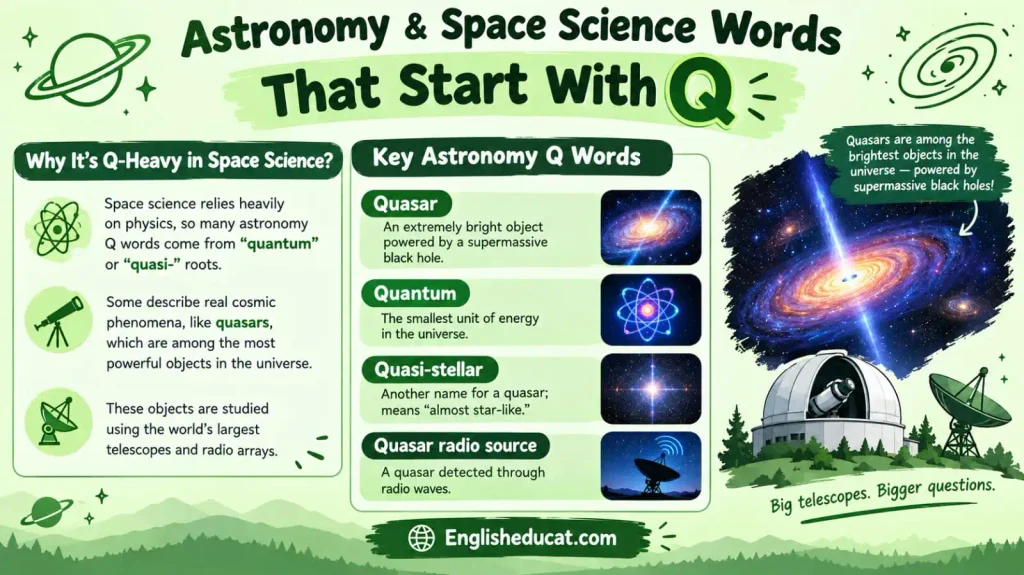
Space science leans heavily on physics vocabulary, so it is no surprise that several astronomy Q words also carry a “quantum” or “quasi-” root. Others describe genuinely strange cosmic objects, quasars especially, that astronomers still study using the world’s largest telescopes and radio arrays.
| Term | Definition | Example Sentence |
| Quasar | The blazingly bright core of a distant galaxy, lit by a supermassive black hole feeding on surrounding matter. | This quasar shines brighter than an entire galaxy of stars. |
| Quasi-Stellar Object | The formal designation astronomers use for what is more commonly called a quasar. | Early telescopes mistook the quasi-stellar object for an ordinary star. |
| Quarter Moon | The lunar phase in which exactly half of the visible face catches sunlight. | The quarter moon rose just after sunset last night. |
| Quadrature | The moment a celestial body sits at a 90-degree angle from the sun, as viewed from Earth. | Mars reaches quadrature when it is best positioned for viewing. |
| Quintessence | A proposed, variable form of dark energy offered as an alternative explanation for cosmic acceleration. | Some cosmologists propose quintessence instead of a fixed cosmological constant. |
| Quiet Sun | A stretch of solar activity marked by unusually few sunspots or flares. | During the quiet sun phase, auroras become noticeably rarer. |
| Quasi-Periodic Oscillation | A repeating but slightly irregular flicker of brightness or X-rays coming from a compact object. | Astronomers detected a quasi-periodic oscillation near the black hole’s edge. |
| Q Band | A slice of the radio spectrum telescopes tune into when searching for molecular gas in space. | The observatory scanned the Q band for signs of star formation. |
| Quaoar | A sizable dwarf-planet candidate orbiting the sun well beyond Neptune. | Quaoar orbits the sun once every 288 years. |
| Quantum Cosmology | An attempt to apply quantum rules to the universe is very first moments of existence. | Quantum cosmology attempts to describe conditions before the Big Bang. |
| Quasi-Satellite | A body that seems to circle a planet from Earth’s vantage point but is actually tracing its own path around the sun. | Earth has at least one known quasi-satellite trailing its orbit. |
| Quiet Zone | A protected area where radio transmissions are restricted to keep sensitive telescopes free of interference. | The observatory sits inside a strict radio quiet zone. |
| Quintuple Star System | A rare configuration of five stars all held together by mutual gravity. | The newly confirmed quintuple star system surprised astronomers with its stability. |
| Quiescent Prominence | A stable arc of solar plasma capable of hanging above the sun’s surface for weeks at a stretch. | The quiescent prominence hovered above the sun’s surface for days. |
| Quadrantids | A meteor shower that returns every January, known for a sharp, short-lived peak. | The Quadrantids produced over a hundred meteors per hour at their peak. |
| Quantum Fluctuation | A momentary, random shift in energy thought to have planted the seeds of large-scale cosmic structure. | Quantum fluctuations in the infant universe may explain galaxy formation. |
| Quiescent Nova | A nova system caught in the dim, dormant stretch between eruptions. | The quiescent nova showed only faint, steady brightness through the telescope. |
| Quadrant (Instrument) | A historical navigation tool sailors used to gauge a star’s angle above the horizon. | Sailors once used a quadrant to calculate their ship’s latitude. |
| Quasi-Periodic Eruption | Recurring flashes of X-rays traced to the cores of certain galaxies. | Astronomers are still debating what triggers quasi-periodic eruptions near black holes. |
| Quasar Jet | A narrow, high-velocity stream of particles blasted outward from a quasar’s central engine. | The quasar jet stretched millions of light-years across the sky. |
Earth & Environmental Science Words That Start With Q
Earth and environmental science supplies a more hands-on set of Q words describing everything from earthquakes to ancient water-engineering systems still functioning after thousands of years. This is arguably the most tactile of the five branches, made up of words you can often observe directly, without a microscope or telescope, rounding out the full set of science words that start with Q covered in this guide.
| Term | Definition | Example Sentence |
| Quake | An abrupt shaking of the ground triggered by movement along the Earth’s crust. | The quake registered a magnitude of 5.4 on the seismic scale. |
| Quaternary Period | The most recent chapter of geologic time, spanning roughly the last 2.6 million years. | Woolly mammoths lived during the early Quaternary Period. |
| Quarry | A surface pit dug to extract stone, sand, or other mineral material. | Workers blasted limestone from the quarry for construction material. |
| Quicksand | Sand so saturated with water that it loses its ability to support weight. | The hiker sank slowly after stepping into hidden quicksand. |
| Quagmire | Wet, spongy ground that gives way underfoot instead of holding firm. | Heavy rain turned the trail into a muddy quagmire. |
| Quartzite | A tough metamorphic rock produced when heat and pressure transform sandstone. | The mountain ridge is capped with resistant quartzite. |
| Quaternary Sediment | Material laid down by glaciers, rivers, or wind sometime within the Quaternary Period. | Geologists dated the quaternary sediment layer to ten thousand years ago. |
| Quaternary Ice Age | A long stretch of repeated glacial advances and retreats that reshaped landscapes over the past 2.6 million years. | The Quaternary Ice Age carved out much of today’s Great Lakes basin. |
| Quota (Fisheries) | A regulated cap on how much of a fish stock can legally be caught in a given period. | Regulators lowered the cod quota to protect the declining population. |
| Qanat | An ancient gravity-fed tunnel system engineered to move groundwater across arid terrain. | The qanat carried mountain snowmelt to villages across the desert. |
| Q10 Coefficient | A ratio expressing how sharply a biological or chemical reaction speeds up for every 10°C rise in temperature. | A high Q10 coefficient means the reaction speeds up sharply with heat. |
| Quiescent Volcano | A volcano that hasn’t shown eruptive activity in recent memory but has not been declared extinct. | The quiescent volcano last erupted more than two centuries ago. |
| Quartz | An abundant silicon-and-oxygen mineral that turns up in a huge range of rock types. | Quartz gives beach sand much of its sparkle and hardness. |
| Quaking Bog | A mat of vegetation floating over open water, unstable enough to wobble when someone walks across it. | Visitors were warned not to step onto the fragile quaking bog. |
| Quaternary Fauna | Animals that lived and roamed during the Quaternary geological period. | Fossils of Quaternary fauna included saber-toothed cats and giant sloths. |
| Quaternary Geology | The field devoted to reconstructing Earth’s environmental history over the last 2.6 million years. | Quaternary geology helps scientists reconstruct past ice age climates. |
| Quake Swarm | A cluster of numerous small earthquakes striking the same area within a short window of time. | The quake swarm near the fault line worried local seismologists. |
| Quaternary Volcanism | Volcanic eruptions and activity dated specifically to the Quaternary Period. | Quaternary volcanism formed several of the region’s youngest cinder cones. |
Advanced & Rare Science Words That Start With Q
These seven entries sit a step beyond the core list. They are not typically taught at an introductory level, but each is legitimate, actively used vocabulary the kind you would meet in a journal abstract rather than a middle-school glossary.
| Term | Branch | Definition | Example Sentence |
| Quasicrystal | Chemistry | A solid whose atoms follow an orderly pattern that, unlike a normal crystal, never repeats exactly. | Quasicrystals earned Dan Shechtman the 2011 Nobel Prize in Chemistry. |
| Quantum Chromodynamics | Physics | The theory that accounts for the strong force binding quarks together inside protons and neutrons. | Quantum chromodynamics explains why quarks are never found alone. |
| Quark-Gluon Plasma | Physics | A superheated, ultra-dense state of matter in which quarks briefly move freely rather than staying bound together. | Particle colliders briefly recreate quark-gluon plasma from the early universe. |
| Quaoar | Astronomy | A sizable dwarf-planet candidate orbiting the sun well beyond Neptune. | Quaoar orbits the sun once every 288 years. |
| Quasi-Periodic Eruption | Astronomy | Recurring flashes of X-rays traced to the cores of certain galaxies. | Astronomers are still debating what triggers quasi-periodic eruptions near black holes. |
| Quorum Quenching | Biology | A strategy for interrupting bacterial chemical signaling before it can trigger coordinated behavior. | Quorum quenching enzymes could offer a new antibacterial strategy. |
| Quintan Fever | Biology | A fever pattern with a spike recurring every fourth day, historically tied to louse-borne infection. | Quintan fever was common among soldiers in World War One trenches. |
Why Learn Q Science Words?
Beyond trivia value, there is a practical reason to know these terms. Quantum vocabulary now appears well outside physics departments in tech coverage of quantum computing breakthroughs, in medical journals weighing quantitative against qualitative research methods, and in earthquake-preparedness guides that use “quake” and “Quaternary” as casually as more familiar words. Recognizing these terms on sight saves time whether you are reading a textbook, a science news article, or a peer-reviewed abstract.
Students in particular will run into several of these entries repeatedly on school science tests: qualitative and quantitative are staples of nearly every lab report, quadrant appears in both math class and anatomy, and quarantine became common vocabulary well beyond any biology unit in recent years. Teachers building a spelling or vocabulary list will likely find the biology and earth science sections most useful for younger grades, while the physics section suits older students tackling quantum theory for the first time.
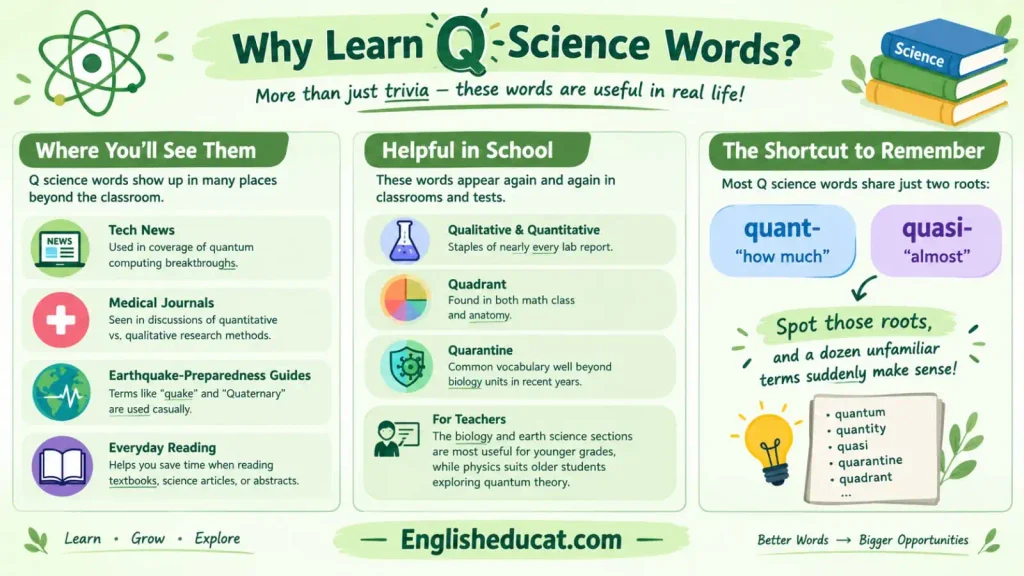
There is also a shortcut worth remembering: most science words that start with Q share just two roots: quant-, meaning “how much,” and quasi-, meaning “almost.” Once you spot those roots, a dozen unfamiliar terms suddenly start to make sense on their own.
Frequently Asked Questions
What are some science words that start with Q?
Some of the most common science words that start with Q include quantum, quark, quasar, quartz, quadrant, and qualitative. These terms span physics, astronomy, earth science, and chemistry, and many appear frequently in school science curricula and vocabulary tests.
Why are there so few science words that start with Q?
Q is one of the rarest starting letters in English, so it naturally produces fewer scientific terms too. Most existing science words that start with Q trace back to Latin roots like quantum (“how much”) or quasi (“almost”), which explains why so many cluster around physics.
What does “quantum” mean in science?
In science, a quantum is the smallest discrete unit of energy or matter involved in a physical interaction. The term underlies quantum mechanics, quantum physics, and quantum computing, and was introduced by physicist Max Planck in the early 1900s.
Is a quasar a star?
No, a quasar isn’t a star. It’s the extremely luminous, energetic core of a distant galaxy, powered by a supermassive black hole actively consuming surrounding matter. Early astronomers mistook quasars for stars because of their point-like appearance through telescopes, which is where the “quasi-stellar” name comes from.
What’s the difference between qualitative and quantitative in science?
Qualitative analysis identifies what substances or qualities are present, while quantitative analysis measures how much of something exists using numerical data. Noting that a sample smells like sulfur is qualitative; measuring that it contains 3.2 mg/L of sulfur is quantitative.
Which branch of science has the most Q words?
Physics contains the largest share of science words that start with Q, largely because so many terms build on the root word quantum, including quantum mechanics, quantum entanglement, quantum computing, and quark-related particle physics terms.
Conclusion
Q rarely gets to lead. It appears last in spelling bees, gets skipped in word games, and rarely opens a chapter title. Yet work through the 120 plus science words that start with Q in this guide, and a different picture forms one where a single letter quietly carries some of the heaviest ideas in modern science. Quantum mechanics rewired how physicists understand reality itself. Quasars reveal some of the most violent, luminous objects in the observable universe. Quorum sensing shows that even bacteria “talk” to one another before acting as a group. Quarantine, a word most people now know from headlines rather than textbooks, has shaped public health policy for centuries.
Rarity and importance, in other words, are not opposites; a word does not need to be common to be consequential. Keep this list close by for your next exam, crossword, or trivia night: whatever Q word comes up, you will have dozens of answers ready, each tied to a real discovery, a real laboratory, or a real corner of the universe still being explored.

Senior English Content Editor
Sarah has over 10 years of experience teaching English as a Second Language in Chicago public schools. She specializes in vocabulary building and simplifying complex word meanings for everyday learners. Sarah holds a Master’s degree in English Education from the University of Illinois.