

Science words that start with F contain every major branch of science, from fauna in biology to fusion in physics and fossil in earth science. This guide pulls together 137 of them: 130 core terms plus 7 advanced picks sorted by field so you can search by topic instead of scrolling through one long, unsorted alphabet dump.
Students prepping for exams, teachers building vocabulary units, word-game players hunting for science-themed answers, and anyone who just wants a quick and reliable definition will all find something useful here. There are many other science words that start with G and H. Each entry below includes a definition and a natural example sentence, so you can see the word in action rather than sitting alone on a flashcard.
Why F Is One of Science’s Busiest Letters
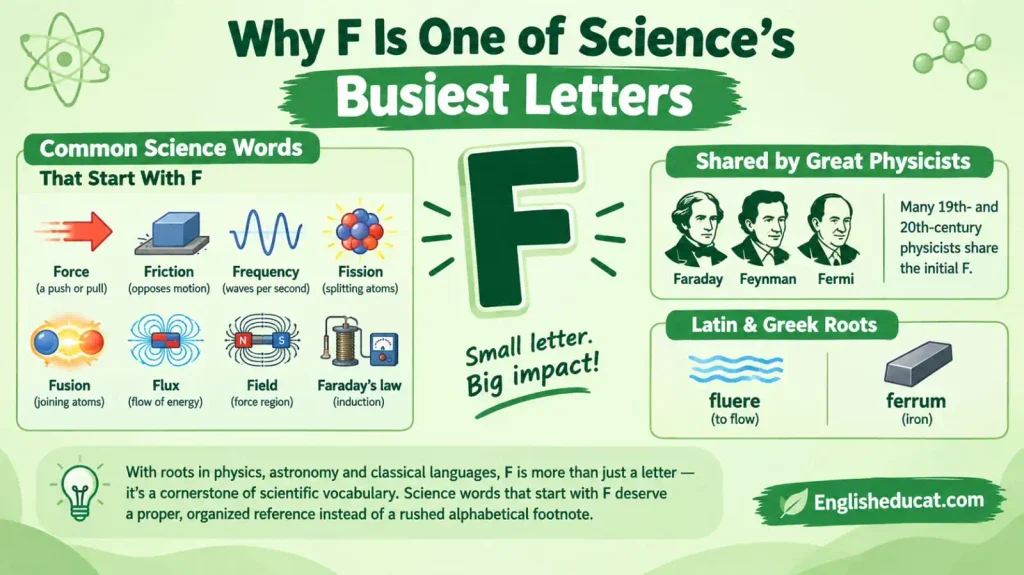
Open a physics glossary and F practically takes it over: force, friction, frequency, fission, fusion, flux, field, Faraday’s law. Few letters carry this much weight in physics and astronomy vocabulary, and for good reason. A cluster of foundational 19th- and 20th-century physicists share the initial, and so do key Latin and Greek roots fluere (“to flow”) and ferrum (“iron”) among them. Call F the letter of physicists if you like; it is a small and citable fact most generic word lists skip entirely, and one more reason science words that start with F earn a proper, organized reference instead of a rushed alphabetical footnote.
Biology Words That Start With F
Biology’s F-vocabulary covers a wide range of words: microscopic structures involved in reproduction (fertilization, follicle) at one end, whole-ecosystem concepts (fauna, food web) at the other. That breadth is part of why these science words that start with F appear in coursework ranging from introductory anatomy to full ecology units.
| Term | Definition | Example Sentence |
| Fauna | All the animal species living in a given place or time period | Researchers cataloged the fauna of the coral reef over three field seasons. |
| Flora | The full range of plant life native to a region or era | The botanist’s survey documented flora unique to the alpine slopes. |
| Fertilization | The joining of sperm and egg that kicks off embryonic development | Fertilization in frogs typically occurs externally, in water. |
| Fungus | An organism, like a mushroom or mold, that feeds by breaking down organic matter | The mushroom is just the visible fruiting body of an underground fungus. |
| Flagellum | A whip-shaped tail that propels a cell through liquid | Sperm cells swim using a single flagellum. |
| Fetus | The developmental stage of a mammal after the embryonic phase, before birth | By the second trimester, the fetus shows recognizable limb structures. |
| Follicle | A small pouch-like structure in tissue, such as the one hair grows from | Each strand of hair grows out of an individual follicle in the skin. |
| Food web | The tangle of overlapping food chains within an ecosystem | Removing one predator can destabilize an entire food web. |
| Frond | A large, feathery leaf typical of ferns and palms | The fern’s fronds unfurl in a distinctive spiral pattern. |
| Fibula | The slender outer bone of the lower leg | A stress fracture in the fibula sidelined the runner for weeks. |
| Fascia | A sheet of connective tissue wrapping muscles and internal organs | Tight fascia around the calf limited her range of motion. |
| Foramen | A natural passage through bone that nerves or vessels travel through | The optic nerve threads through a foramen in the skull. |
| Fecundity | A measure of how many offspring an organism is capable of producing | Fecundity in insects is often gauged by eggs laid per generation. |
| Facultative | Capable of switching between different modes depending on conditions | Facultative anaerobes survive whether or not oxygen is present. |
| Filial | Having to do with offspring, especially across generations in genetics | Geneticists tracked the trait across three filial generations. |
| Filament | A slender, thread-like part, such as the stalk of a flower’s stamen | Pollen develops at the tip of the flower’s filament. |
| Fibrin | A stringy protein that helps blood form a clot | Fibrin strands weave together to stabilize a clot. |
| Feral | Having reverted to a wild state after escaping domestication | Feral cat colonies have reshaped bird populations on the island. |
| Frugivore | An animal whose diet consists mainly of fruit | Fruit bats are frugivores that help disperse seeds across forests. |
| Fibroblast | A cell type responsible for producing connective tissue | Fibroblasts rush to a wound site to begin repairing tissue. |
| Follicle-stimulating hormone | A hormone that drives egg or sperm development | Follicle-stimulating hormone triggers egg development in the ovaries. |
| Fission (binary) | A form of asexual reproduction where one organism splits into two | Amoebas reproduce through binary fission rather than mating. |
| Femur | The single bone running through the thigh — the longest bone in the human body | The femur bears most of the body’s weight while standing. |
| Filter feeder | An organism that sifts tiny food particles out of water | Baleen whales are filter feeders that consume tiny krill. |
| Food chain | A single-line path showing which organism eats which | Algae sit at the base of most aquatic food chains. |
| Fitness (biological) | How well an organism’s traits translate into surviving offspring | Natural selection favors traits that boost biological fitness. |
Chemistry Words That Start With F
Chemistry pulls its F-words from opposite ends of the discipline: an actual periodic table element in fluorine, and hands-on lab techniques like filtration and fractional distillation. Anyone working through general chemistry runs into this batch of science words that start with F almost immediately.
| Term | Definition | Example Sentence |
| Fluorine | A pale-yellow, extremely reactive halogen element | Fluorine is added to drinking water in trace amounts to prevent tooth decay. |
| Filtration | A separation technique that traps solids while liquid passes through | Filtration removed the sand particles from the murky sample. |
| Formula | A shorthand notation showing which elements make up a compound and in what ratio | The formula for table salt is written as NaCl. |
| Functional group | A specific atom arrangement that gives an organic molecule its chemical behavior | A hydroxyl functional group defines alcohols in organic chemistry. |
| Flammability | How readily a material ignites and burns | Gasoline’s high flammability makes it dangerous to store near heat. |
| Free radical | A short-lived, highly reactive molecule missing an electron partner | Free radicals are linked to cellular aging and oxidative damage. |
| Fractional distillation | A process that separates a liquid mixture based on differing boiling points | Fractional distillation splits crude oil into gasoline, diesel, and other fractions. |
| Flash point | The lowest temperature at which a substance gives off enough vapor to ignite | Diesel fuel has a noticeably higher flash point than gasoline. |
| Fermentation | A metabolic process that breaks down sugar without needing oxygen | Fermentation converts grape sugars into alcohol during winemaking. |
| Fume | Visible airborne particles or gas released during a chemical reaction | Toxic fumes formed the moment the two cleaning products mixed. |
| Ferric | Describing iron in its +3 oxidation state | Ferric oxide gives rust its characteristic reddish color. |
| Ferrous | Describing iron in its +2 oxidation state | Ferrous sulfate is a common iron supplement for anemia. |
| Fixation (nitrogen) | The conversion of inert atmospheric nitrogen into a usable chemical form | Bacteria living in root nodules carry out nitrogen fixation for the plant. |
| Foam | A material formed when gas bubbles get trapped inside a liquid or solid | Fire crews used foam to smother the chemical blaze. |
| Flocculation | The clumping together of fine particles suspended in a liquid | Flocculation clarifies water by clumping stray impurities together. |
| Fischer projection | A flattened, two-dimensional drawing convention for three-dimensional molecules | Students use a Fischer projection to compare sugar stereoisomers. |
| Formaldehyde | A sharp-smelling, colorless gas commonly used to preserve tissue | Formaldehyde is used to preserve biological specimens in labs. |
| Fatty acid | A long-chain carboxylic acid that’s a building block of fats | Fatty acids link together to form triglycerides in the body. |
| Fusion (chemical) | The melting of a solid substance, sometimes to combine it with another | Fusing the two metal samples together produced a new alloy. |
| Faraday constant | A fixed value representing the electric charge carried by one mole of electrons | The Faraday constant is essential for calculating electroplating reactions. |
| Freezing point depression | The drop in freezing temperature that occurs when a solute is dissolved in a liquid | Freezing point depression is why salted roads resist icing over. |
| Filler (chemical) | A non-reactive additive used to bulk up a manufactured product | Calcium carbonate is a common filler in plastic manufacturing. |
| Ferroelectric | Describing a material that holds a reversible electric polarization on its own | Ferroelectric ceramics show up in some computer memory devices. |
| Ferment | To convert sugars chemically without oxygen, or to undergo that process | Cabbage will ferment into sauerkraut over several weeks. |
| Fluorescence | Light given off by a substance shortly after it absorbs radiation | Fluorescence under UV light helped identify the mineral sample. |
| Fume hood | A ventilated workstation designed to vent hazardous vapors away from the user | The technician handled the acid inside a fume hood. |
Physics Words That Start With F
Some of the most recognizable science words that start with F belong to physics: force, friction, frequency, and the closely related but opposite processes of fission and fusion. None of these are niche terms; they surface in introductory courses and stay relevant straight through graduate-level study.
| Term | Definition | Example Sentence |
| Force | An interaction capable of speeding up, slowing down, or redirecting an object’s motion | Enough applied force can overcome an object’s inertia. |
| Friction | The resistance generated when two surfaces slide or press against each other | Friction between the tires and road brought the car to a stop. |
| Frequency | How many complete wave cycles pass a point each second | Higher frequency sound waves produce higher-pitched tones. |
| Fission (nuclear) | The splitting of a large atomic nucleus, which releases energy | Nuclear fission powers most commercial reactors today. |
| Fusion (nuclear) | The merging of small atomic nuclei into a larger one, releasing energy | Fusion inside the sun turns hydrogen into helium. |
| Flux | A measure of how much of a field passes through a given surface | Magnetic flux through the coil induced an electric current. |
| Free fall | Movement governed by gravity alone, with no other forces resisting it | A skydiver experiences free fall before the parachute opens. |
| Focal point | The spot where light rays bend and converge after passing through a lens | The magnifying glass concentrated sunlight at its focal point. |
| Farad | The standard unit used to measure electrical capacitance | A capacitor rated at one farad can store a substantial electric charge. |
| Field | An invisible region of space where a force, like gravity or magnetism, exerts influence | Earth’s magnetic field deflects most incoming solar radiation. |
| Frame of reference | The vantage point or coordinate system used to measure an object’s motion | Velocity depends entirely on the observer’s frame of reference. |
| Frequency modulation | A method of encoding information by varying a signal’s frequency | FM radio relies on frequency modulation to transmit sound. |
| Fundamental frequency | The lowest, base frequency a vibrating object naturally produces | Plucking the guitar string produces its fundamental frequency first. |
| Fresnel lens | A thin, ridged lens that focuses light using concentric grooves instead of solid glass | Lighthouses use a Fresnel lens to project light over long distances. |
| Fermi level | The energy threshold at which an electron has an even chance of being present | The Fermi level helps predict how well a material conducts electricity. |
| Free body diagram | A simplified sketch isolating an object and every force acting on it | Drawing a free body diagram simplifies solving the physics problem. |
| Faraday’s law | A principle stating that a changing magnetic field generates an electric voltage | Faraday’s law explains how generators produce electricity. |
| Force constant | A number describing how stiffly a spring resists stretching or compressing | A higher force constant means the spring pushes back harder. |
| Fluid dynamics | The branch of physics studying how liquids and gases behave in motion | Fluid dynamics informs the design of airplane wings. |
| Fermion | A category of particle that follows the Pauli exclusion principle | Electrons and protons both fall into the fermion category. |
| Feynman diagram | A visual shorthand physicists use to map out particle interactions | Physicists sketch a Feynman diagram to trace subatomic collisions. |
| Fine structure constant | A dimensionless number that sets the strength of electromagnetic interactions | The fine structure constant turns up throughout quantum electrodynamics. |
| Free energy | The portion of a system’s energy that’s actually available to do work | Gibbs free energy determines whether a reaction happens spontaneously. |
| Frequency spectrum | The full range of frequencies contained within a signal | Analyzing the frequency spectrum revealed hidden background noise. |
| Foucault pendulum | A long, freely swinging pendulum that demonstrates Earth’s rotation over time | A Foucault pendulum gradually shifts its swing direction throughout the day. |
| Flywheel | A heavy rotating wheel that stores rotational energy for later use | The flywheel smooths out engine power delivery. |
Astronomy and Space Words That Start With F
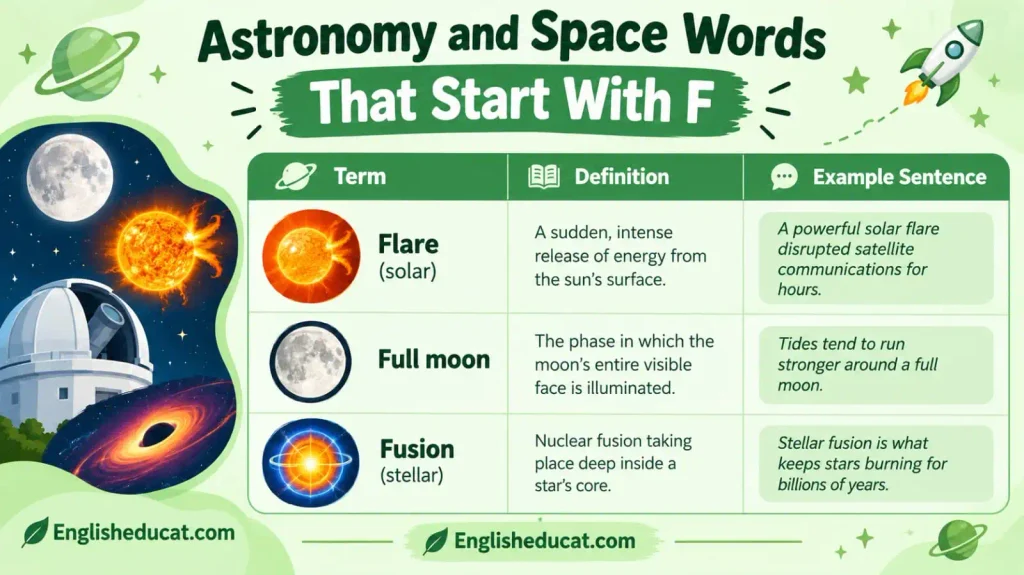
Astronomy’s F-words range from routine lunar phases the full moon, the first quarter to genuine unsolved cosmic puzzles like the Fermi paradox. This branch produces some of the more evocative science words that start with F, largely because so many of them describe things you can actually watch happen overhead.
| Term | Definition | Example Sentence |
| Flare (solar) | A sudden, intense release of energy from the sun’s surface | A powerful solar flare disrupted satellite communications for hours. |
| Full moon | The phase in which the moon’s entire visible face is illuminated | Tides tend to run stronger around a full moon. |
| Fusion (stellar) | Nuclear fusion taking place deep inside a star’s core | Stellar fusion is what keeps stars burning for billions of years. |
| Flyby | A spacecraft maneuver that passes close to a celestial body without entering orbit | The probe’s flyby of Jupiter delivered close-up images of its moons. |
| First quarter (moon) | The phase when exactly half the moon’s visible surface is lit | The first quarter moon rises around midday and sets near midnight. |
| Faint young sun paradox | The unresolved question of how early Earth stayed warm despite a dimmer, younger sun | The faint young sun paradox complicates simple climate models of early Earth. |
| Fireball (meteor) | An unusually bright meteor visible over a broad stretch of sky | Witnesses across three states reported the same fireball. |
| Filament (solar) | A ribbon of cooler, denser gas suspended above the sun’s surface | A collapsing filament can trigger a solar eruption. |
| Focal length (telescope) | The internal distance light travels before forming a focused image | A longer focal length telescope magnifies distant objects more. |
| Field of view | The full extent of sky visible through an instrument at once | A wide field of view helps astronomers scan for comets. |
| Fraunhofer lines | Dark gaps in the sun’s spectrum caused by elements absorbing specific wavelengths | Fraunhofer lines reveal which elements exist in the sun’s atmosphere. |
| Fragmentation (cloud) | The splintering of a large gas cloud into several smaller star-forming clumps | Fragmentation within the nebula gave rise to multiple new stars. |
| Faculae | Bright, patchy regions that appear on the sun’s surface | Faculae often show up near sunspots before they fully form. |
| Fixed star | An older astronomical term for stars that appear locked in place relative to each other | Ancient astronomers charted the fixed stars to track the seasons. |
| Free-floating planet | A planet drifting through space with no star holding it in orbit | A free-floating planet wanders through interstellar space alone. |
| Frame dragging | The warping and twisting of spacetime caused by a massive rotating body | Frame dragging near a black hole was confirmed by satellite data. |
| Fermi paradox | The tension between the high statistical odds of alien life and the total absence of evidence for it | The Fermi paradox asks why we haven’t detected other civilizations. |
| Far side (of the moon) | The lunar hemisphere permanently hidden from Earth’s view | The far side of the moon was first photographed in 1959. |
| Falling star | The everyday name for a meteor burning up in the atmosphere | Kids love spotting a falling star during meteor showers. |
| Flux (stellar) | The amount of a star’s light energy that reaches a given point, like a telescope | Measuring stellar flux lets astronomers calculate a star’s true brightness. |
| Fusion crust | The scorched, glassy outer layer a meteorite develops entering the atmosphere | The meteorite’s fusion crust showed clear signs of heat exposure. |
| Frost line | The distance from a star past which volatile compounds can freeze solid | Gas giants tend to form beyond a system’s frost line. |
| Field star | A star that isn’t part of any recognizable cluster or structure | The telescope image included several unrelated field stars. |
| Filamentary structure | The web-like network of galaxies stretched across the largest scales of the universe | Filamentary structure connects galaxy clusters across vast distances. |
| Faint galaxy | A galaxy so distant or dim it barely registers in observations | Deep-field imaging revealed thousands of faint galaxies. |
| Forbidden line | A spectral signature that only appears in extremely low-density gas | A forbidden line in the spectrum pointed to an extremely diffuse gas cloud. |
Earth and Environmental Science Words That Start With F
Earth science pairs geological formations a fault and a fjord with pressing modern concerns like food security and fire ecology, and together these science words that start with F map both the physical structure of planets and the challenges of living on them responsibly.
| Term | Definition | Example Sentence |
| Fossil | Preserved physical evidence of ancient life, from bones to footprints | The fossil embedded in the rock was over 60 million years old. |
| Fault | A break in rock where the two sides have shifted relative to each other | Movement along the fault triggered a moderate earthquake. |
| Fjord | A deep, narrow coastal inlet carved out by ancient glaciers | The fjord’s steep cliffs plunge directly into deep water. |
| Floodplain | Low-lying land beside a river that regularly floods during high water | Farmers rely on the floodplain’s fertile soil after seasonal flooding. |
| Foliation | Banded or layered texture seen in certain metamorphic rocks | Foliation in the slate revealed the direction of past pressure. |
| Front (weather) | The dividing line between two air masses of different temperature or density | A cold front moved through, dropping temperatures overnight. |
| Fracture (mineral) | The irregular way a mineral breaks when it lacks a clean cleavage plane | Quartz shows a distinctive conchoidal fracture pattern. |
| Fumarole | A vent in the ground that releases steam and volcanic gases | Sulfur crystals formed around the edge of the fumarole. |
| Fossil fuel | Energy-rich material, like coal or oil, formed from long-dead organic matter | Burning fossil fuel releases carbon stored away for millions of years. |
| Fragmentation (habitat) | The splitting of a once-continuous habitat into smaller, isolated patches | Habitat fragmentation threatens species that need large territories. |
| Fen | A wetland fed by mineral-rich groundwater rather than acidic rainwater | Rare orchids grow in the alkaline conditions of the fen. |
| Flash flood | A fast-moving, short-lived flood usually triggered by intense rainfall | A flash flood swept through the canyon within minutes. |
| Fluvial | Relating to the shaping effects of flowing river water | Fluvial erosion carved the deep canyon over millennia. |
| Frost | A thin coating of ice crystals that forms on cold surfaces in humid air | An early frost damaged the season’s remaining crops. |
| Föhn wind | A dry, warming wind that rushes down the sheltered side of a mountain range | The Föhn wind rapidly melted snow on the valley floor. |
| Fault scarp | A low, steep-sided ridge left behind by sudden movement along a fault | The fault scarp was clearly visible after the earthquake. |
| Freeze-thaw weathering | The gradual breakdown of rock caused by water repeatedly freezing and expanding in cracks | Freeze-thaw weathering steadily widens cracks in exposed mountain rock. |
| Food security | Consistent access to enough affordable, nutritious food | Climate change increasingly threatens food security in arid regions. |
| Fire ecology | The study of how wildfire shapes and sustains ecosystems over time | Fire ecology research shows some forests actually depend on periodic burns. |
| Fertilizer runoff | Excess agricultural fertilizer carried by rain into nearby waterways | Fertilizer runoff contributed to algae blooms in the lake. |
| Forest canopy | The dense upper layer of branches and leaves that shades a forest floor | Sunlight barely reaches the ground beneath a dense forest canopy. |
| Freshwater | Water containing minimal dissolved salt, found in rivers, lakes, and streams | Freshwater ecosystems support very different species than the open ocean. |
| Faunal succession | The consistent, predictable order in which species appear throughout rock layers over time | Faunal succession helps geologists date rock layers accurately. |
| Fetch (oceanography) | The uninterrupted distance wind blows across open water, which affects wave height | A longer fetch produces larger waves during storms. |
| Fissure (volcanic) | An elongated crack in the ground that lava can erupt through | Lava poured steadily from the volcanic fissure for days. |
| Fugitive dust | Airborne particles released from an unconfined source, like a construction site | Construction sites are required to control fugitive dust emissions. |
Advanced F-Words (Bonus Section)
Readers who want to push past an introductory list will find these seven advanced science words that start with F genuinely useful for upper-level coursework or specialized reading.
| Term | Branch | Definition | Example Sentence |
| Fulgurite | Earth Science | A glassy, tube-shaped mineral formed when lightning instantly fuses sand or rock | The desert fulgurite marked the exact spot lightning had struck. |
| Ferrimagnetism | Physics | A magnetic effect that emerges when opposing magnetic moments in a material don’t fully cancel out | Ferrimagnetism explains the strong magnetic behavior of certain iron oxides. |
| Fluorophore | Chemistry/Biology | A molecule engineered or found to glow after absorbing light | Researchers tagged the protein with a fluorophore to track it under a microscope. |
| Femtosecond | Physics | A staggeringly brief time interval — one quadrillionth of a second | Femtosecond lasers can capture chemical reactions as they happen. |
| Fugacity | Chemistry | A corrected pressure value used to model how a gas actually behaves, rather than how an ideal gas would | Engineers use fugacity to model real, non-ideal gas behavior. |
| Frameshift mutation | Biology | A genetic error that shifts how DNA is read, scrambling everything downstream | A single frameshift mutation can drastically alter a protein’s structure. |
| Fast radio burst | Astronomy | An intense, split-second pulse of radio waves arriving from deep space | Astronomers are still debating what produces a fast radio burst. |
Why Learn Science Words That Start With F?
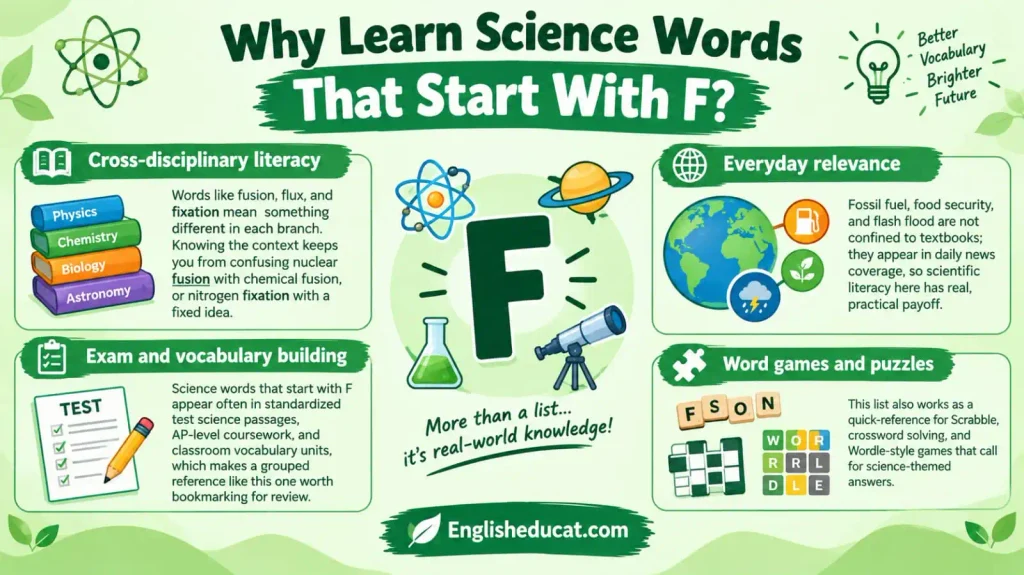
A grouped list like this pays off in a few practical ways beyond acing a vocabulary quiz.
- Cross-disciplinary literacy. Words like fusion, flux, and fixation mean something different in each branch. Knowing the context keeps you from confusing nuclear fusion with chemical fusion, or nitrogen fixation with a fixed idea.
- Exam and vocabulary building. Science words that start with F appear often in standardized test science passages, AP-level coursework, and classroom vocabulary units, which makes a grouped reference like this one worth bookmarking for review.
- Everyday relevance. Fossil fuel, food security, and flash flood are not confined to textbooks; they appear in daily news coverage, so scientific literacy here has real, practical payoff.
- Word games and puzzles. This list also works as a quick-reference for Scrabble, crossword solving, and Wordle-style games that call for science-themed answers.
Frequently Asked Questions
How many science words start with the letter F?
This list includes 137 science words that start with F: 130 core terms across five branches (biology, chemistry, physics, astronomy, and earth science) plus 7 advanced bonus terms.
What is a common science word that starts with F?
Force, fossil, and fusion rank among the most familiar science words starting with F, showing up in physics, earth science, and both chemistry and physics, respectively.
What biology words start with F?
Common biology words starting with F include fauna, flora, fertilization, fungus, femur, and food chain, spanning organisms, reproduction, and ecosystems.
What is the difference between fission and fusion?
Fission splits a heavy atomic nucleus apart to release energy, while fusion joins light nuclei, like the hydrogen atoms inside the Sun, together to release energy.
What astronomy terms start with F?
Astronomy terms starting with F include full moon, flyby, Fermi paradox, fireball (meteor), and frost line, covering lunar phases, spacecraft motion, and deep-space phenomena.
Why do so many physics terms start with F?
Physics ended up with an unusually large share of F-terms force, friction, frequency, flux, field partly because several foundational concepts and constants, like the Faraday constant, are named after 19th-century scientists whose names or associated terms happen to begin with F.
Conclusion
Few single letters open as many doors into the scientific world as F. Across five branches and 137 entries, science words that start with F carry you from fusion reactions lighting up distant stars all the way to fossils resting quietly underfoot, a reminder that one letter of the alphabet can stretch across the entire scale of existence, from femtoseconds to fjords. Keep this list in your mind for preparation for exams, a classroom vocabulary unit, a stubborn crossword clue, or just idle curiosity; it is built to be revisited, not read once and forgotten. Next time fission, fauna, or fossil fuel appear in conversation, you will not just recognize the word. You will know exactly where it belongs.

Linguistics Specialist
James is a linguist with a Ph.D. in Applied Linguistics from Boston University. His work focuses on word origins, synonyms, and how language evolves over time. He has contributed to several academic journals on English semantics.