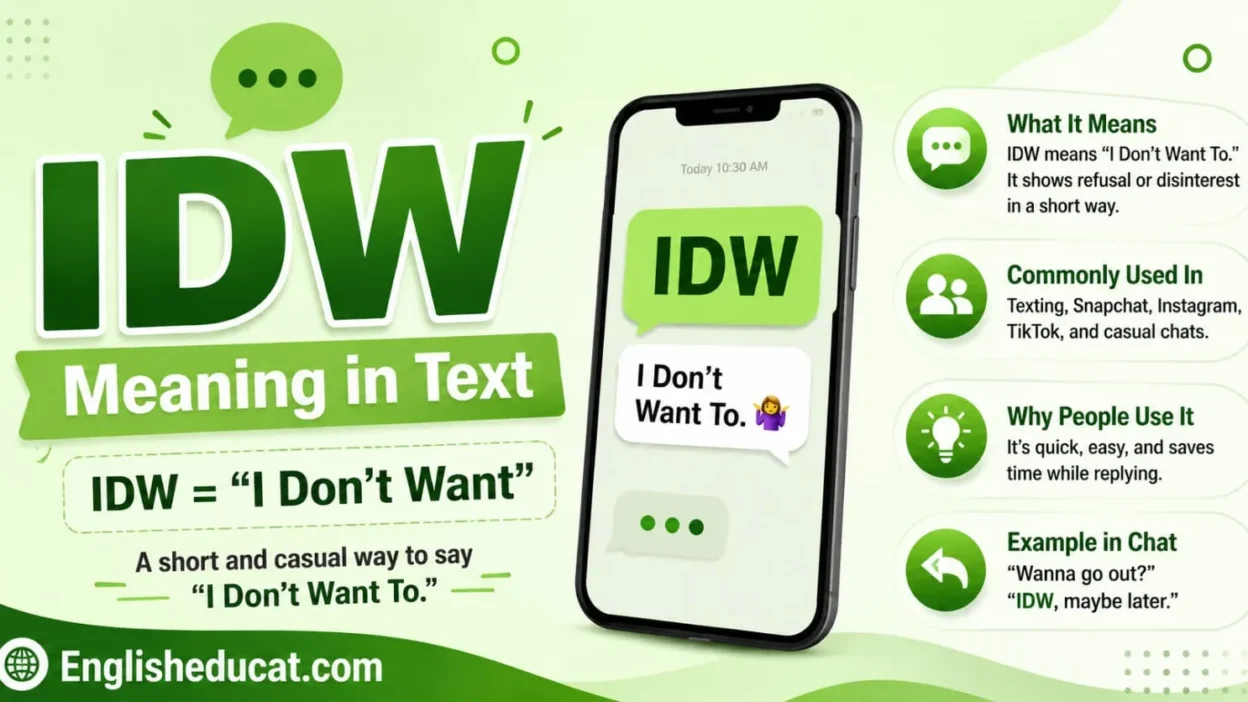
If you just got a text with “IDW” in it and now you are confused about what it means. That confusion is normal. IDW meaning in text is simple once you know it: it means “I do not want.”
People use IDW to say no to something quickly, without typing a full sentence. It is a common piece of internet slang that appears in texts, WhatsApp chats, Snapchat, and Instagram DMs.
IDW also has another common meaning online: “Intellectual Dark Web.” This guide will break down both meanings, show examples, and tell you when IDW might sound rude.
People search for IDW meaning in text for a few reasons. Some just got a confusing text and want a fast answer. Others saw the term online, in a comment or article, and want to know if it means something bigger. This guide covers both cases, so you leave with a clear answer either way.
IDW Meaning in Text (Quick Answer)
IDW meaning in text is “I do not want.” That is the short and direct answer.
Someone uses IDW when they want to say no to a plan, a food, or an idea, but do not want to type it all out. It saves time and keeps the message short.
Here is a simple example:
Friend: “Wanna grab pizza tonight?”
You: “idw pizza, let’s do tacos”
That is the core IDW meaning in text. It works the same way whether someone is turning down food, a plan, or an idea. The word after “idw” changes, but the meaning stays the same: “I do not want that.”
This abbreviation is not always about food or plans, though. Sometimes it points to something bigger, which we cover next.
IDW Also Means “Intellectual Dark Web”: Here’s the Difference
IDW meaning in text is not always “I do not want.” It appears online in comments, articles, and political posts; IDW can stand for “Intellectual Dark Web.”
This second meaning is very different from the first one. It has nothing to do with saying no to something. It is the name for a group of thinkers and speakers.
What Is the Intellectual Dark Web?
The Intellectual Dark Web is a name for a loose group of writers, podcasters, and academics. According to Wikipedia, Eric Weinstein coined the term. He used it to describe people who discuss controversial ideas. These are ideas that mainstream media and universities often leave out.
This group is not an official club. People are just grouped because they share similar views on free speech and open debate.
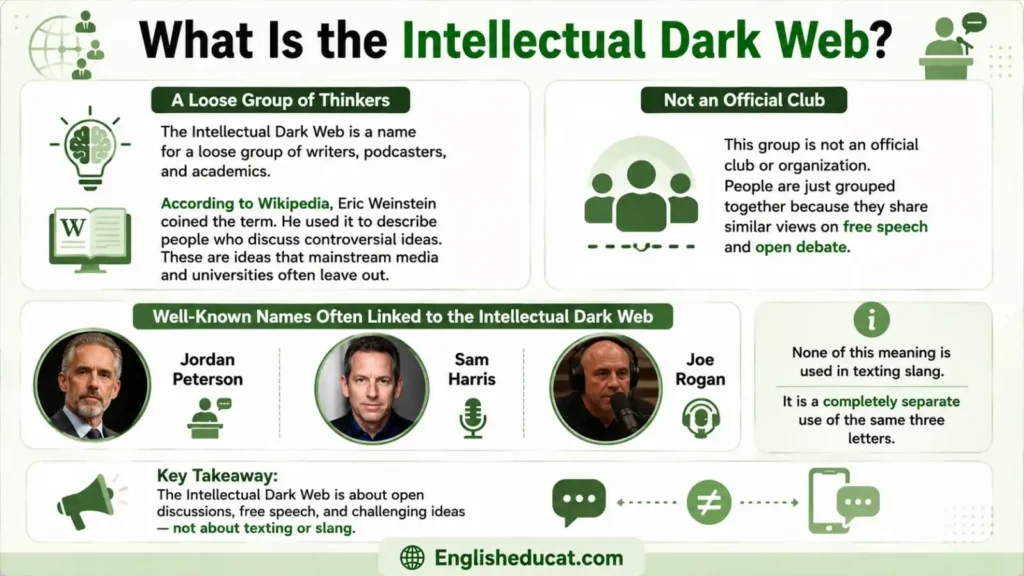
Well known names often linked to the Intellectual Dark Web include Jordan Peterson, Sam Harris, and Joe Rogan. None of this meaning is used in texting slang. It is a completely separate use of the same three letters.
How to Tell Which Meaning Someone Means
You can usually tell which IDW meaning in text is being used by looking at the context. Here is a simple rule:
- If someone is replying to a plan, a question, or a casual chat, IDW almost always means “I don’t want.”
- If IDW shows up next to a link, a political topic, or a serious discussion, it likely means “Intellectual Dark Web.”
This one small check will clear up all your confusion.
Other Meanings of IDW You Might Come Across
IDW meaning in text is not the only use of these three letters. A few other meanings exist outside of texting, even though they are less common.
- Idea and Design Works (IDW Publishing) a real comic book publishing company.
- Inverse Distance Weighting: a method used in maps and data science to estimate unknown values.
- Institut der Wirtschaftsprüfer: a German organization for auditors.
These meanings are unrelated to texting. You will rarely see them in a normal chat. They are included here only so you have the full picture.
If you search “IDW meaning in text” and land on a page about auditors or map data, then you are in the wrong spot. Those pages are talking about a different field entirely, not casual messaging.
IDW Meaning in Text: Real Conversation Examples
The best way to understand IDW meaning in text is to see it in action. Below are three short and real style examples from different apps.
Text message:
Mom: “Want me to save you dinner?” You: “idw dinner tonight, I already ate”
WhatsApp:
Friend: “Group project meeting at 6?” You: “idw meet online again, can we do it in person?”
Instagram DM:
Friend: “Should I post this pic?” You: “idw say no but maybe try a different one lol”
In every case, IDW meaning in text stays the same. It is a fast and casual way to express that you do not want something.
Notice how each example pairs IDW with a short reason or a follow up idea. That small habit makes the message feel warmer, even though it is still short. Just typing “idw” alone, with nothing else, can feel a bit flat by comparison.
Is IDW Rude to Text? (Tone Guide)
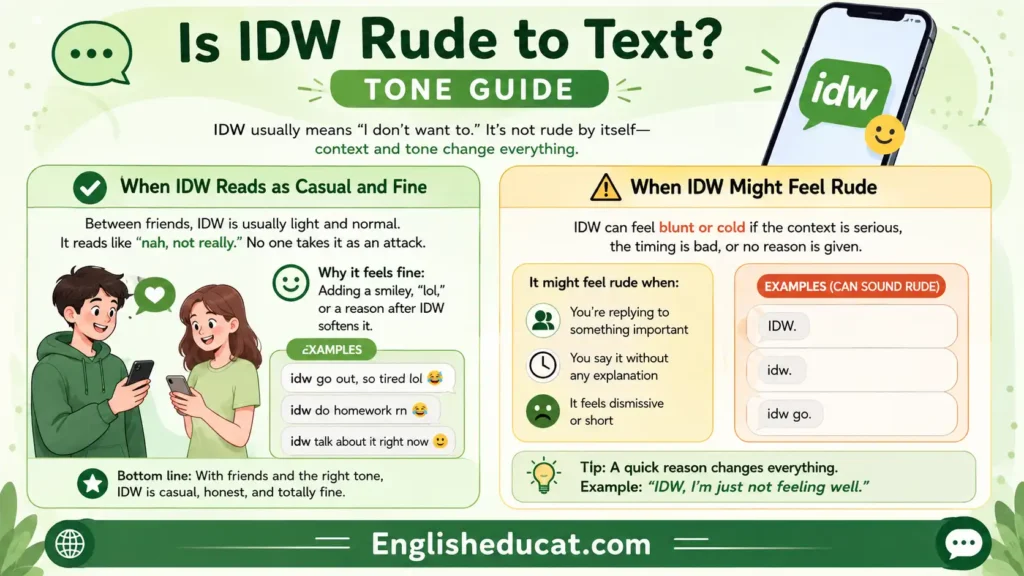
This is one of the most common questions about IDW meaning in text. The short answer is that it is not, but it depends on the context.
As someone who writes about texting slang for a living, I do not just guess at meanings from a dictionary. For this guide, I read through real replies using IDW on Reddit threads and Discord group chats, not just definition sites. This is the same process I use for every slang guide I write, and it shows something important about IDW: tone changes everything.
When IDW Reads as Casual and Fine
Between friends, IDW meaning in text usually feels light and normal. It reads the same as saying “nah, not really.” No one takes it as an attack. Adding a smiley, “lol,” or a reason after IDW softens it even more. For example, “idw go out, so tired lol” feels friendly and easy.
When IDW Can Come Across as Blunt or Dismissive
IDW can look cold in a few situations. If someone sends only “idw” with no reason and no emoji, it can feel short or annoyed.
It can also feel blunt in a formal chat. This includes a work group or a message to someone you do not know well. In those cases, a fuller sentence usually reads better than a quick “idw.”
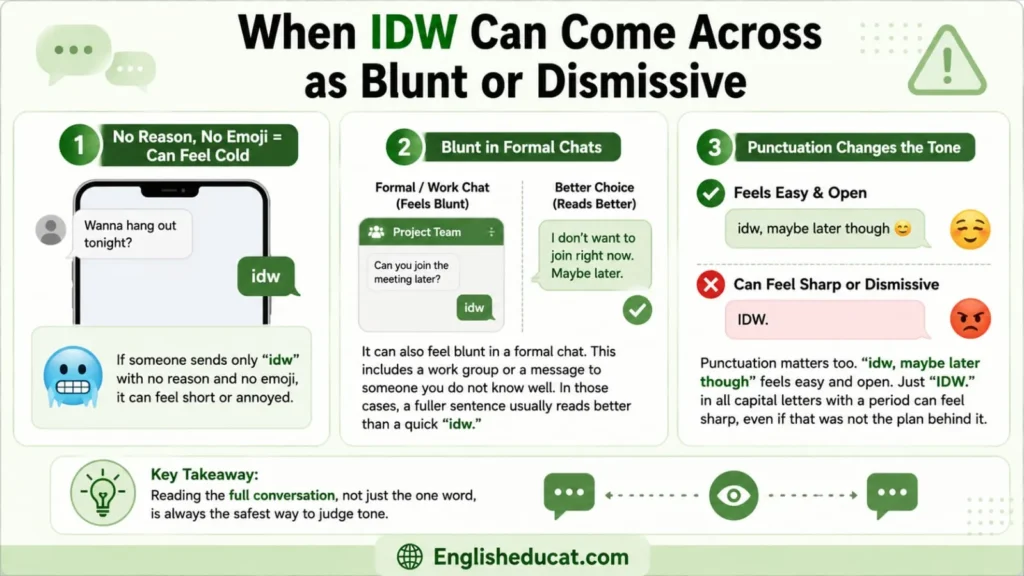
Punctuation matters too. “idw, maybe later though” feels easy and open. Just “IDW.” in all capital letters with a period can feel sharp, even if that was not the plan behind it. Reading the full conversation, not just the one word, is always the safest way to judge tone.
How to Reply When Someone Texts You “IDW”
If someone sends you IDW, you do not need to overthink it. A simple and relaxed reply works best.
- “No worries, okay!” is good for a casual, no-pressure response.
- “Okay, np” is short and easy and matches the same casual tone.
- “Why not?” or “You good?” Use this if the IDW feels a bit off or short, and you want to check in.
Matching their energy is usually the safest move.
IDW vs. IDC vs. IDK vs. IDGAF: What’s the Difference?
People often mix up IDW meaning in text with abbreviations that look similar. Here is a quick table to clear it up.
| IDW | I don’t want | Casual, direct refusal | “idw coffee today” |
| IDC | I don’t care | Neutral, indifferent | “idc what we watch” |
| IDK | I don’t know | Uncertain, unsure | “idk what time yet” |
| IDGAF | I don’t give a f*** | Strong, blunt | “idgaf what they think” |
The key difference is meaning, not just spelling. IDW is a refusal. IDC is indifference. IDK is uncertainty. IDGAF is a much stronger, more careless attitude. Mixing these up can send the wrong message, so it is always better to know exactly which one fits.
Similar Texting Abbreviations Worth Knowing
Once you understand IDW meaning in text, a few related abbreviations are worth learning too. They appear in the same kinds of casual chats.
- IRL In Real Life
- IMO In My Opinion [link to IMO meaning guide]
- TBH To Be Honest [link to TBH meaning guide]
- BRB Be Right Back
- FYI For Your Information
- JK Just Kidding
- LMK Let Me Know
- OMG Oh My God
- LOL Laughing Out Loud
- IMHO In My Humble Opinion
Learning a few of these makes reading fast paced group chats much easier.
Frequently Asked Questions
What does IDW mean in a text?
IDW means “I don’t want.” It is a quick way to say you do not want something without typing a full sentence. People use it in texts, group chats, and messaging apps to keep replies short and casual, especially when turning down a plan or an idea.
Is IDW rude to say?
Not usually. In casual texting between friends, IDW just reads as short and direct, similar to saying “nah.” It can come across as blunt if used in a serious or formal chat, sent with no reason attached, or written in all caps with no softening word like “lol.”
What’s the difference between IDW and IDC?
IDW means “I don’t want,” showing a clear preference against something specific. IDC means “I don’t care,” showing indifference instead of refusal. They look almost identical at a glance, but they send very different messages, so it helps to know which one actually fits your situation.
Does IDW always mean “I don’t want”?
In everyday texting, yes, that is the main IDW meaning in text. But online more broadly, IDW is also short for “Intellectual Dark Web,” a term for a loose group of commentators. Context makes it clear which one is meant.
How do you reply when someone texts you “IDW”?
A simple “no worries” or “okay, np” works well for a casual IDW. If the message feels more serious or short than usual, asking “why not?” or “you good?” keeps the conversation open. Matching the other person’s tone is usually the safest way to reply without sounding awkward.
What does IDW mean on Snapchat or Instagram?
It means the same thing as in regular texting: “I don’t want.” People use IDW the same casual way across SMS, Snapchat, Instagram DMs, and WhatsApp. The app does not change the meaning, only the setting where the message is sent.
What is the Intellectual Dark Web (IDW)?
The Intellectual Dark Web is a term for a loosely connected group of academics and commentators known for discussing controversial or debated topics outside mainstream media. Eric Weinstein coined the phrase. It is unrelated to the everyday texting use of “IDW,” which simply means “I don’t want.”
Quick Reference
IDW meaning in text comes down to one simple phrase: “I do not want.” It is short, casual, and easy to use once you know what it stands for.
Just remember the one exception. Outside of casual chats, especially near serious topics or links, IDW can mean “Intellectual Dark Web” instead. Context is your best clue every time. Next time IDW appears in your messages, you will know exactly what it means and how to reply.

ESL Content Writer
Emily is a TESOL-certified writer who has taught English to international students for over 8 years. She loves breaking down idioms and everyday expressions into simple, relatable explanations that make sense to learners at any level.