
An idiom for Home is a fixed phrase where “home” has a figurative meaning. Example: “close to home” means a topic feels personal.
Idioms for home use the word “home” to describe comfort, honesty, success, or consequences. They often point to feelings, not buildings. This guide covers 12 common ones. You will find each meaning, a word-by-word breakdown, the origin (when known), and real examples. You will also find a UK vs US table, a tone guide, and the most common mistakes learners make.
What Are Idioms for Home?
Idioms for home are phrases where “home” stands for comfort, family, honesty, or a finish line. Each phrase has a literal meaning and a figurative one. “Home free” does not describe a free house. It tells you that the hard part is over. Learning idioms for home helps you follow films, emails, and daily chat.
A house is a building. A home is a place that feels like yours. That gap explains why most phrases here use “home,” not “house.” These idioms are explain just like the idiom about change.
Quick Reference Table
This table contains 12 home idioms, with a short meaning and the tone each carries.
| Home sweet home | Glad to be back in a place you love | Positive |
| Make yourself at home | Relax and feel comfortable | Positive |
| Home is where the heart is | Home is where your loved ones are | Positive |
| There’s no place like home | Home is the best place to be | Positive |
| Home away from home | A place that feels like your own home | Positive |
| Close to home | A topic that feels personal | Uncomfortable |
| Home truth | An honest fact that is hard to hear | Neutral to negative |
| Chickens come home to roost | Past mistakes bring trouble | Negative |
| Nothing to write home about | Ordinary, not special | Mildly negative |
| Home free | Past the hard part, success is near | Positive |
| Drive something home | Make a point impossible to miss | Neutral |
| Charity begins at home | Help your family first | Neutral |
Tone changes with context. A host who says “make yourself at home” sounds warm. By contrast, a guest who acts that way without an invitation can seem to be rude.
Home Sweet Home
“Home sweet home” is what you say when you are happy to be back in a place you love.
Word-by-Word Meaning
“Home” is the place where you live. “Sweet” means pleasant and dear. Together, the words call home a pleasant place.
Idiomatic Meaning
The phrase expresses relief at returning to the comfort of home after a long time away. People also say it with a smile about a small or messy place.
Examples
- After ten hours on the train, Sara dropped her bag and sighed, “Home sweet home.”
- Our dorm room is tiny, but it is home sweet home to us.
Make Yourself at Home
Hosts say “make yourself at home” to tell a guest to relax and act as if the place is theirs.
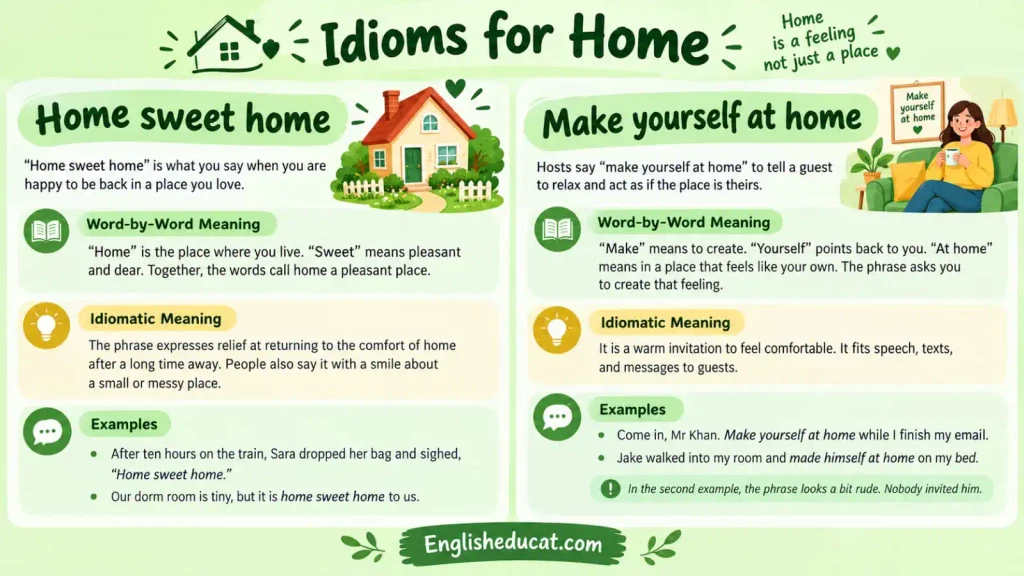
Word-by-Word Meaning
“Make” means to create. “Yourself” points back to you. “At home” means in a place that feels like your own. The phrase asks you to create that feeling.
Idiomatic Meaning
It is a warm invitation to feel comfortable. It fits speech, texts, and messages to guests.
Examples
- Come in, Mr Khan. Make yourself at home while I finish this email.
- Jake walked into my room and made himself at home on my bed.
In the second example, the phrase looks a bit rude. Nobody invited him.
Home Is Where the Heart Is
This proverb says home is wherever the people and places you love are.
Word-by-Word Meaning
“Home” is where you live. “Heart” stands for your feelings and love. “Where the heart is” means the place you care about most.
Idiomatic Meaning
Home is about love and belonging, not walls. Among idioms for home, this proverb sounds the most poetic. People use it when they move away or feel at ease in a new place.
Origin
Several websites credit the Roman writer Pliny the Elder, but that link is not confirmed. A phrase researcher at Phrase Finder leans toward 1820s America instead, citing an 1829 poem with a similar idea and the exact wording in an 1857 novel.
Examples
- Ali works abroad, but he still calls his mother’s kitchen home. Home is where the heart is.
- We moved five times, yet it always felt like home. Home is where the heart is, after all.
There is No Place Like Home
This saying means your own home is the most comfortable place in the world.
Word-by-Word Meaning
“There’s” is short for “there is.” “No place like” means no other spot is equal. “Home” is where you live. The words add up to this: nothing beats home.
Idiomatic Meaning
People say it after trips, long days, or bad weather. It is the sigh of someone glad to be back. Best known from The Wizard of Oz, Dorothy says it as she returns to Kansas. It is one of the best-known idioms for home on screen.
Examples
- The beach hotel was lovely, but there is no place like home.
- After a double shift at the restaurant, Maria kicked off her shoes. “There is no place like home,” she said.
Home Away From Home
A “home away from home” is a place that feels as comfortable as your own house.
Word-by-Word Meaning
“Home” is your house. “Away from” means not at. The second “home” repeats the idea. So the phrase means a second home in another spot.
Idiomatic Meaning
It describes a hotel, cafe, school, or friend’s house where you feel fully relaxed. A shorter form, “home from home,” also exists, and both forms appear in dictionaries.
Examples
- During exams, the library became my home away from home.
- Our small hotel in Rome was a real home from home.
Close to Home
When a remark or topic is “close to home,” it touches something personal or sensitive in your own life.
Word-by-Word Meaning
“Close” means near. “To home” points to your own life and feelings. So the topic sits near your own life.
Idiomatic Meaning
The phrase often describes a joke or comment that makes you uncomfortable because it matches your own problems. It can also mean a situation affects you directly. The usual pairing is “hit close to home”
Examples
- His joke about always being late hit close to home. I had missed three meetings that week.
- News about the factory closing felt close to home for our whole family.
Home Truth
A home truth is a plain fact that is honest but hard to hear.
Word-by-Word Meaning
“Home” suggests the fact reaches you personally. “Truth” means a fact. So it is a fact that lands close to you.
Idiomatic Meaning
Examples often use the plural: “a few home truths.” The speaker is honest, and the listener may not enjoy it. The tone runs from neutral to negative.
Examples
- After the match, the coach told the team a few home truths about their effort.
- My sister told me some home truths about my spending habits.
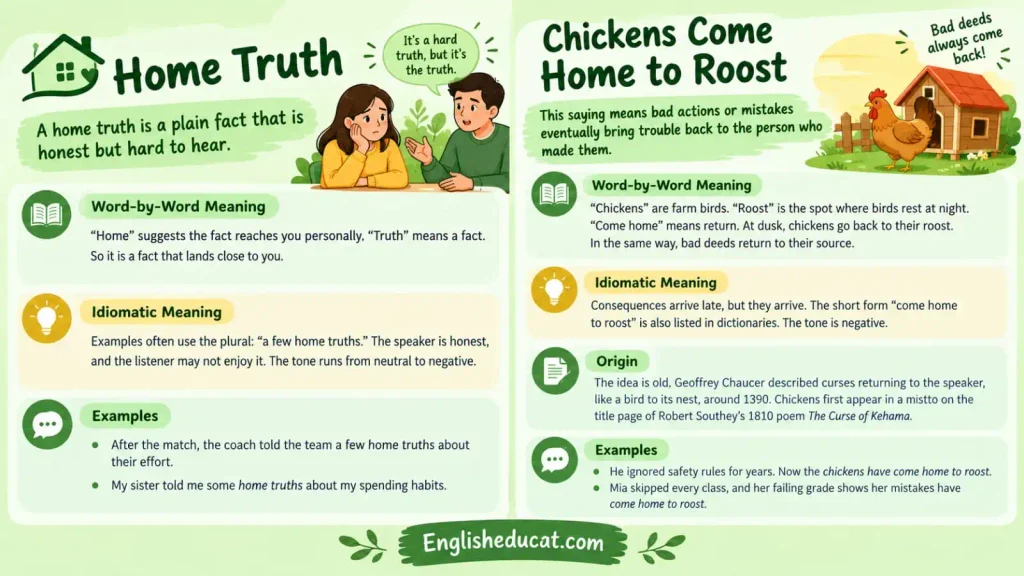
Chickens Come Home to Roost
This saying means bad actions or mistakes eventually bring trouble back to the person who made them.
Word-by-Word Meaning
“Chickens” are farm birds. “Roost” is the spot where birds rest at night. “Come home” means return. At dusk, chickens go back to their roost. In the same way, bad deeds return to their source.
Idiomatic Meaning
Consequences arrive late, but they arrive. The short form “come home to roost” is also listed in dictionaries. The tone is negative.
Origin
The idea is old. Geoffrey Chaucer described curses returning to the speaker, like a bird to its nest, around 1390. Chickens first appear in a motto on the title page of Robert Southey’s 1810 poem The Curse of Kehama.
Examples
- He ignored safety rules for years. Now the chickens have come home to roost.
- Mia skipped every class, and her failing grade shows her mistakes have come home to roost.
Nothing to Write Home About
Something that is “nothing to write home about” is ordinary and not exciting.
Word-by-Word Meaning
“Nothing” means not anything. “To write home about” means worth telling your family in a letter. The phrase pictures news too dull to mention.
Idiomatic Meaning
It is a mild, informal way to say “so-so.” Writers often explain it with the image of a traveller sending letters to family, but no firm origin turned up in the sources checked.
Examples
- The hotel breakfast was fine but nothing to write home about.
- My test score was nothing to write home about, so I will study harder.
Home Free
“Home free” means you have passed the hardest part and success is almost certain.
Word-by-Word Meaning
“Home” points to the finish line or goal. “Free” means with no more risk or blocks. So you reach the goal with nothing in your way.
Idiomatic Meaning
The phrase describes the moment after the hard part ends. The remaining work feels easy. British English uses “home and dry” for the same idea.
Examples
- Once the manager signs the report, we are home free.
- After the last exam, Zara felt home free.
Drive Something Home
To “drive something home” is to make a point so clear that nobody can miss it.
Word-by-Word Meaning
“Drive” means to push with force. “Something” stands for the point you want to make. “Home” means all the way in. Picture a nail pushed fully into wood.
Idiomatic Meaning
Speakers use it to stress an idea, often by repeating it. Related forms include “ram home” and “press home.” A close cousin is “bring something home to someone,” which means making them see how serious a problem is.
Examples
- The teacher repeated the rule three times to drive it home.
- The safety video drives home how fast accidents can happen.
Charity Begins at Home
This proverb says you should look after your family and close circle before helping strangers.
Word-by-Word Meaning
“Charity” means kindness and giving. “Begins” means starts. “At home” means within your own household. So giving starts inside your own house.
Idiomatic Meaning
Tone depends on who says it. It can sound caring, or it can sound like an excuse to skip giving elsewhere.
Examples
- I will donate next month, but first I need to help my cousin with school fees. Charity begins at home.
- Our manager said charity begins at home, so we trained our own team before hiring outside help.
Close to Home, Hit Home, Bring Home: What Is the Difference?
“Close to home” describes a personal topic, while “hit home” and “bring home” describe a message that finally sinks in.
These four idioms for home are easy to mix up. Here is how they differ:
- Close to home: the topic matches your own life. “The story was close to home.”
- Hit home: a message lands, and you understand it. “The coach’s speech hit home, and the team trained harder.”
- Bring home: something shows you the full size of a problem. “The storm brought home to us how weak the old roof was.”
- Home truth: the unwelcome fact itself.
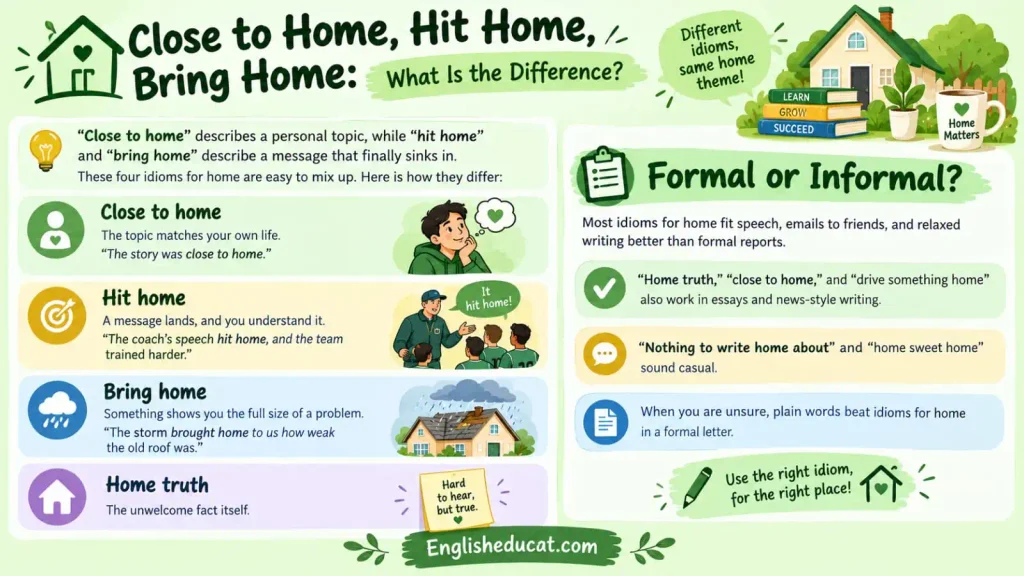
Formal or Informal?
Most idioms for home fit speech, emails to friends, and relaxed writing better than formal reports.
“Home truth,” “close to home,” and “drive something home” also work in essays and news-style writing. “Nothing to write home about” and “home sweet home” sound casual. When you are unsure, plain words beat idioms for home in a formal letter.
UK vs US: Which Form Should You Use?
Use “home free” for American readers and “home and dry” for British readers, since both mean the hard part is over.
Several idioms for home change with region. This table shows the main differences.
| Finished and safe | Home and dry | British English |
| Finished and safe | Home free | North American English |
| A place that feels like home | Home from home | Shorter form |
| A place that feels like home | Home away from home | Longer form; both are listed in dictionaries |
| Bad deeds come back | Curses, like chickens, come home to roost | Older full form, still common mainly in North America worldwidewords |
Common Mistakes Learners Make
The most common mistakes with idioms for home are scrambled word order, dropped words, and swapping “home” for “house.”
- Scrambled order. Wrong: “Heart is where home is.” Right: “Home is where the heart is.”
- Missing “about.” Wrong: “The trip was nothing to write home.” Right: “The trip was nothing to write home about.”
- “House” instead of “home.” Wrong: “There is no place like house.” Right: “There is no place like home.”
- Singular “chicken.” The standard form uses the plural: “the chickens came home to roost.”
- Missing verb. “Your comment was close to home” is understood, but “hit close to home” is the usual phrase.
Frequently Asked Questions
What are some idioms for home?
Common idioms for home include “home sweet home,” “make yourself at home,” “home is where the heart is,” and “close to home.” Others cover honesty (“home truth”), consequences (“chickens come home to roost”), and success (“home free”).
What does “home is where the heart is” mean?
It means home is wherever the people and places you love are. The wording is old, but its exact source is not confirmed.
Where does “chickens come home to roost” come from?
The idea goes back to Chaucer around 1390, and chickens first appear in print in 1810, in a motto on Robert Southey’s poem The Curse of Kehama.
What is the difference between “home free” and “home and dry”?
They mean the same thing: “home free” is the North American form and “home and dry” is the British form.
Conclusion
These 12 idioms for home cover comfort, honesty, success, and consequences. Pick three that fit your life and use them this week. Say one to a friend, write one in an email, and check the tone first. Practice turns a phrase on a page into a phrase you own.

ESL Content Writer
Emily is a TESOL-certified writer who has taught English to international students for over 8 years. She loves breaking down idioms and everyday expressions into simple, relatable explanations that make sense to learners at any level.