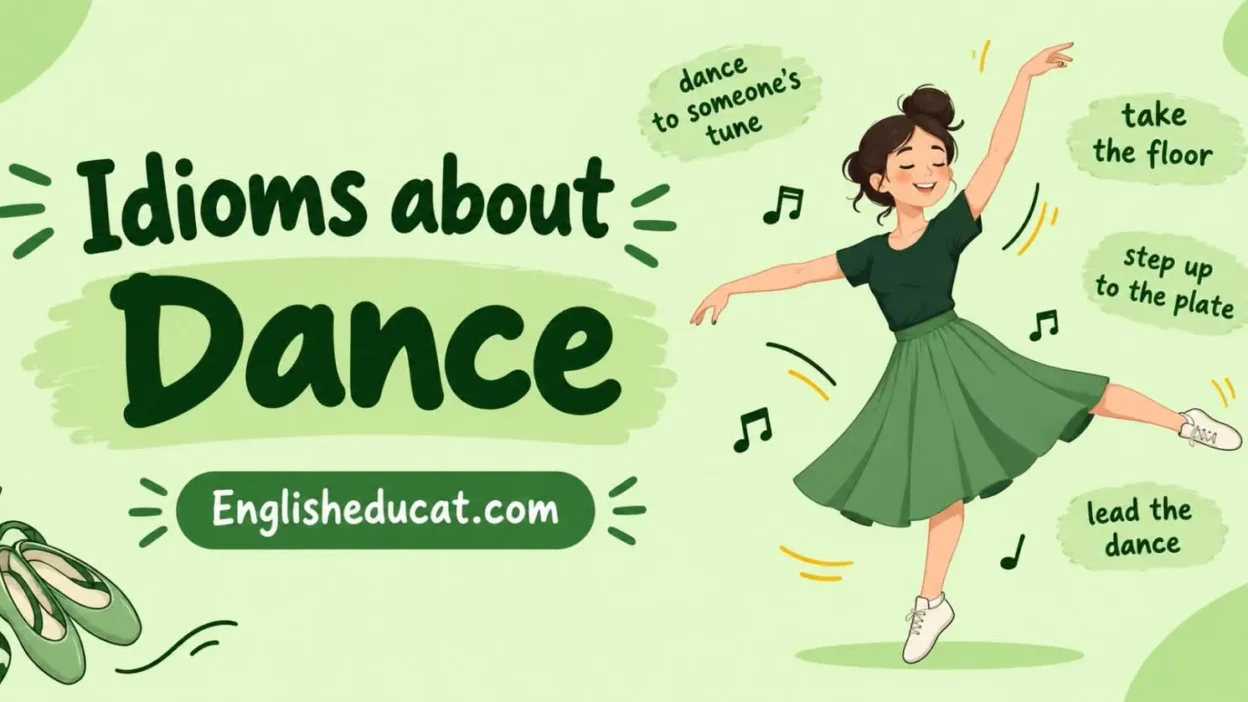
Idioms about dance use dancing words to describe things that are usually not dancing. “It takes two to tango” is a good case. It says two people share the blame. Below, you will find 16 of these phrases. Each one comes with a plain meaning, an example you can reuse, and a note on where it came from. Tone and usage tips follow. Some of the stories are confirmed. Others are folklore, and the article says which is which.
Idioms about dance: Short phrases that borrow dancing words to describe ideas that are far from the dance floor. For example, “two left feet” describes a clumsy person, whether or not music is playing.
What Are Idioms About Dance?
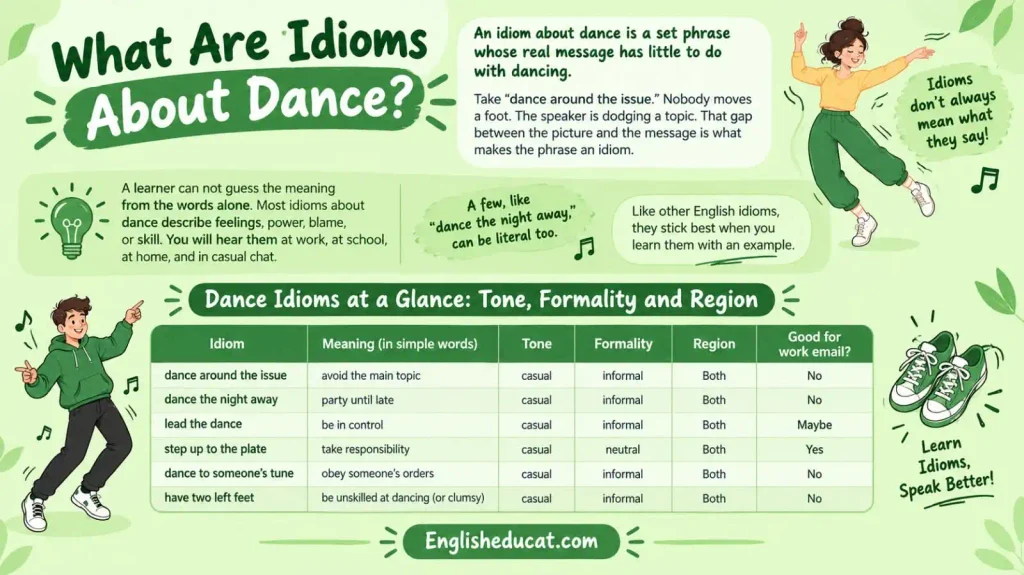
An idiom about dance is a set phrase whose real message has little to do with dancing. Take “dance around the issue.” Nobody moves a foot. The speaker is dodging a topic. That gap between the picture and the message is what makes the phrase an idiom. A learner can not guess the meaning from the words alone. Most idioms about dance describe feelings, power, blame, or skill. You will hear them at work, at school, at home, and in casual chat. A few, like “dance the night away,” can be literal too. Like other English idioms, they stick best when you learn them with an example. Idioms may contain science words so also learn science words.
Dance Idioms at a Glance: Tone, Formality and Region
Most idioms about dance look casual, and only a few carry a British or American label.
Use the table to pick the right phrase for the moment. The last column shows whether the idiom fits a work email. Where a phrase has no strong regional tag, the table says “Both.”
| Idiom | Meaning | Tone | Formality | Region | Work email? |
| it takes two to tango | both sides share blame or effort | neutral | casual | Both | Careful |
| dance to someone’s tune | do what another person wants | negative | casual | Both | Yes |
| call the tune | be in charge | neutral | neutral | Both | Yes |
| dance around the issue | avoid the main topic | mildly negative | neutral | Both | Careful |
| tap dance around | dodge a topic in a slippery way | negative | casual | Both | Careful |
| make a song and dance | fuss over something small | negative | casual | UK-leaning | No |
| lead someone a merry dance | cause trouble or waste time | negative | casual | UK | No |
| dance on air | feel very happy | positive | casual | Both | Careful |
| dance the night away | dance until late | positive | casual | Both | No |
| cut a rug | dance with lots of energy | playful | slang | US | No |
| kick up your heels | relax and have fun | positive | casual | Both | No |
| have two left feet | dance or move clumsily | playful | casual | Both | No |
| strut your stuff | show off your skills | positive | casual | Both | No |
| dance circles around someone | be far better than someone | admiring | casual | Both | Careful |
| dance with death | take a deadly risk | dramatic | neutral | Both | No |
| all singing, all dancing | packed with features | playful | casual | Both | No |
The 16 Idioms About Dance, One by One
Below, each of the 16 idioms about dance gets its own breakdown: what it literally says, what it actually means, an example, common errors people make with it, and where it is safe to use.
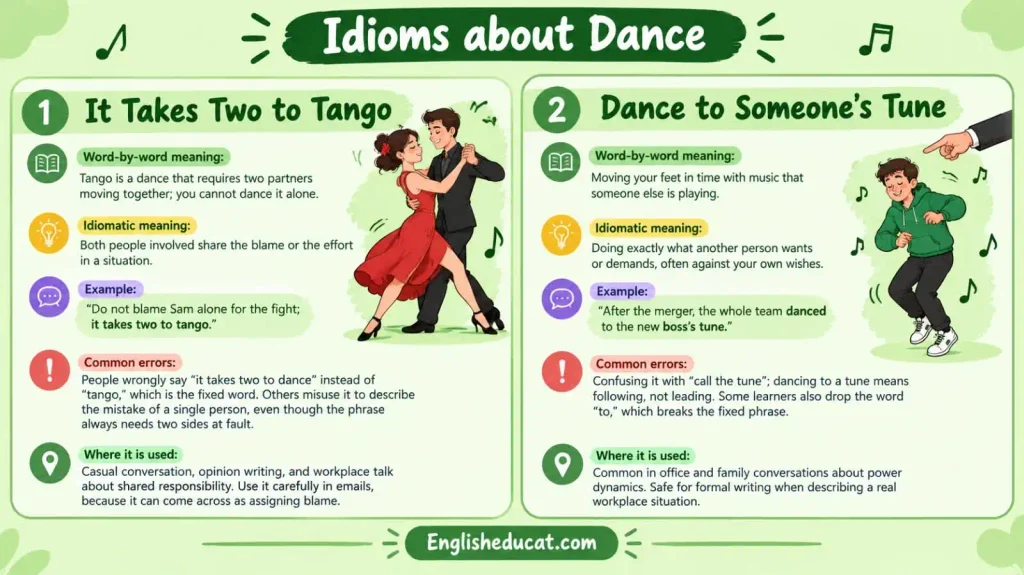
1. It Takes Two to Tango
Word-by-word meaning:
Tango is a dance that requires two partners moving together; you cannot dance it alone.
Idiomatic meaning:
Both people involved share the blame or the effort in a situation.
Example:
“Do not blame Sam alone for the fight; it takes two to tango.”
Common errors:
People wrongly say “it takes two to dance” instead of “tango,” which is the fixed word. Others misuse it to describe the mistake of a single person, even though the phrase always needs two sides at fault.
Where it is used:
Casual conversation, opinion writing, and workplace talk about shared responsibility. Use it carefully in emails, because it can come across as assigning blame.
2. Dance to Someone’s Tune
Word-by-word meaning:
Moving your feet in time with music that someone else is playing.
Idiomatic meaning:
Doing exactly what another person wants or demands, often against your own wishes.
Example:
“After the merger, the whole team danced to the new boss’s tune.”
Common errors:
Confusing it with “call the tune”; dancing to a tune means following, not leading. Some learners also drop the word “to,” which breaks the fixed phrase.
Where it is used:
Common in office and family conversations about power dynamics. Safe for formal writing when describing a real workplace situation.
3. Call the Tune
Word-by-word meaning:
Choosing which song or rhythm gets played.
Idiomatic meaning:
Being the person in charge who makes the decisions.
Example:
“At our house, Grandma calls the tune when it is time to cook.”
Common errors:
Mixing it up with “dance to someone’s tune”; calling the tune means leading, not following. It is also sometimes swapped with “call the shots,” a different idiom with a similar meaning but a different image.
Where it is used:
Business and family contexts describing leadership. Fine for formal or professional writing.
4. Dance Around the Issue
Word-by-word meaning:
Moving in a circle near something instead of walking straight to it.
Idiomatic meaning:
Avoiding the main topic and talking about smaller, less important details instead.
Example:
“Stop dancing around it, Mia. Did you eat the last cookie?”
Common errors:
Writing “dance about the issue” instead of “dance around the issue.” The preposition “around” is fixed.
Where it is used:
Meetings, family conversations, and journalism. Use it carefully in formal emails, since it can sound like an accusation.
5. Tap Dance Around
Word-by-word meaning:
Performing quick, light dance steps in a circle around something.
Idiomatic meaning:
Dodging a topic in a clever or slippery way, often to escape blame.
Example:
“The company tap danced around every question about the delay.”
Common errors:
Treating it as identical to “dance around the issue.” “tap dance around” carries a sharper, more deliberately evasive tone, closer to dishonesty than simple avoidance.
Where it is used:
News coverage of press conferences and corporate statements. Use it carefully in professional writing, since it implies the subject is being dishonest.
6. Make a Song and Dance About Something
Word-by-word meaning:
Turning a small moment into a full musical performance.
Idiomatic meaning:
Making an unnecessary fuss over something minor.
Example:
“He made a song and dance about waiting five minutes for his coffee.”
Common errors:
American speakers sometimes swap in “make a big deal,” which is fine in meaning but changes the regional flavor of the sentence.
Where it is used:
British casual speech and writing. Avoid it in formal emails or reports.
7. Lead Someone a Merry Dance
Word-by-word meaning:
Guiding someone through a lively, complicated dance.
Idiomatic meaning:
Causing someone trouble or wasting their time, often through trickery or constantly changing plans.
Example:
“The landlord led her a merry dance, changing his story every time she called.”
Common errors:
Confusing it with “merry-go-round,” a completely different image, or dropping the word “a,” which breaks the fixed phrase.
Where it is used:
Mostly British English, in casual storytelling and complaints. Not suited to formal writing.
8. Dance on Air
Word-by-word meaning:
Dancing while floating above the ground.
Idiomatic meaning:
Feeling extremely happy or elated.
Example:
“Ten-year-old Omar was dancing on air after his team won the science fair.”
Common errors:
Blending it with “walking on air” both describe joy, but the two fixed phrases should not be merged into something like “dancing on cloud nine.”
Where it is used:
Casual storytelling and personal writing. Use it carefully in professional contexts, since it is an emotional, informal image.
9. Dance the Night Away
Word-by-word meaning:
Dancing continuously until the night ends.
Idiomatic meaning:
Celebrating or enjoying oneself late into the night, often at a party.
Example:
“Neighbors danced the night away at the street festival.”
Common errors:
Using it outside a celebration context, where it can sound out of place; it works best with parties, weddings, or festivals.
Where it is used:
Casual and celebratory writing, invitations, and event recaps. Not used in formal emails.
10. Cut a Rug
Word-by-word meaning:
Slicing into a carpet with a blade.
Idiomatic meaning:
Dancing with a lot of energy and enthusiasm.
Example:
“Put on some music, and my sister and I will cut a rug in the kitchen.”
Common errors:
Assuming the phrase dates to the 1920s Jazz Age or comes from dancers wearing holes in rugs; its earliest recorded use is actually 1942, and neither story is confirmed.
Where it is used:
Casual American English, often said affectionately or with a wink. Not appropriate for formal writing.
11. Kick Up Your Heels
Word-by-word meaning:
Lifting your heels off the ground while moving.
Idiomatic meaning:
Relaxing and having fun, often after a period of hard work.
Example:
“It is Friday, so let’s kick up our heels and order pizza.”
Common errors:
Confusing it with “kick the bucket,” an unrelated idiom about death, due to the similar wording pattern.
Where it is used:
Casual conversation and light writing. Not for formal or professional contexts.
12. Have Two Left Feet
Word-by-word meaning:
Having two feet that are both shaped for the left side, making walking or dancing awkward.
Idiomatic meaning:
Being clumsy, especially while dancing, though it is also used for clumsiness in general.
Example:
“Dad has two left feet on the ice, so he holds the rail.”
Common errors:
Saying “two left legs” instead of “two left feet”; the fixed body part is feet.
Where it is used:
Casual, self-deprecating or teasing contexts. Not for formal writing.
13. Strut Your Stuff
Word-by-word meaning:
Walking with a proud, confident, showy step.
Idiomatic meaning:
Showing off your skills or talent with confidence.
Example:
“Tonight the school band gets to strut its stuff on the big stage.”
Common errors:
Overusing it in serious or formal contexts, where “showcase their talent” fits the tone better.
Where it is used:
Casual conversation, especially around entertainment, sports, and school events.
14. Dance Circles Around Someone
Word-by-word meaning:
Dancing in loops around another person while they stay still.
Idiomatic meaning:
Being far more skilled than someone else at a task.
Example:
“My little brother dances circles around me in chess.”
Common errors:
Treating it as fully interchangeable with “run circles around” without noticing the slightly different image and flavor each one carries.
Where it is used:
Casual conversation and light professional praise. Use it carefully in formal writing, since it can sound boastful about someone else’s failure.
15. Dance with Death
Word-by-word meaning:
Performing a dance where one partner is death itself.
Idiomatic meaning:
Taking a very dangerous risk that could result in serious harm.
Example:
“Driving fast on an icy road is dancing with death.”
Common errors:
Writing “dance with danger” instead of “dance with death”; most sources fix the second word as “death.”
Where it is used:
Dramatic and journalistic writing. Not typical in everyday casual talk.
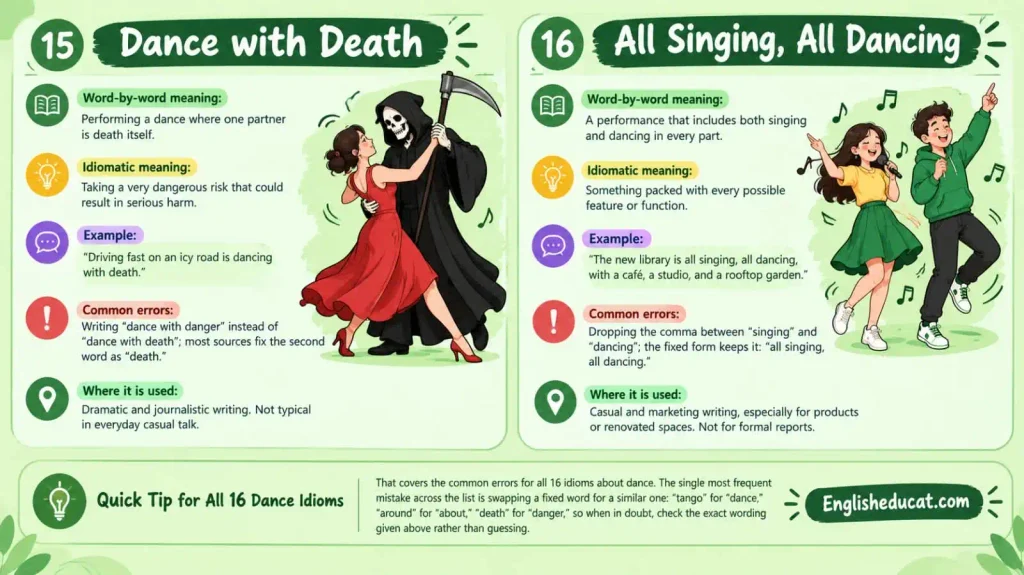
16. All Singing, All Dancing
Word-by-word meaning:
A performance that includes both singing and dancing in every part.
Idiomatic meaning:
Something packed with every possible feature or function.
Example:
“The new library is all singing, all dancing, with a café, a studio, and a rooftop garden.”
Common errors:
Dropping the comma between “singing” and “dancing”; the fixed form keeps it: “all singing, all dancing.”
Where it is used:
Casual and marketing writing, especially for products or renovated spaces. Not for formal reports.
That covers the common errors for all 16 idioms about dance. The single most frequent mistake across the list is swapping a fixed word for a similar one: “tango” for “dance,” “around” for “about,” “death” for “danger,” so when in doubt, check the exact wording given above rather than guessing.
Origin Fact-Check: Documented, Disputed or Folk Story?
Only some idioms about dance have a documented origin, and several popular stories about them are unconfirmed.
| Idiom | Common claim | Status | What the record shows |
| it takes two to tango | Comes from a 1952 song | Documented | Hoffman and Manning wrote it, and Pearl Bailey recorded it in 1952. |
| it takes two to tango | Reagan made it famous | Documented | He used it about U.S.-Soviet relations in November 1982. |
| it takes two to tango | Dates to the 1920s | Disputed | Some dictionaries say so. One word-history site found no printed use before 1952. |
| cut a rug | Born in the 1920s Jazz Age | Disputed | The earliest recorded use is from 1942. |
| cut a rug | Dancers wore out rugs | Folk story | No evidence backs it. |
| lead someone a merry dance | Dates to the 1500s | Documented | Origin sources place it in that century. |
| lead someone a merry dance | Linked to the Pied Piper | Folk story | It rests on a forum guess only. |
| all singing, all dancing | Began with 1929 film ads | Disputed | The ads used it, but the phrase was printed in 1895. |
Notice the pattern in the above table. A neat story spreads fast, and then other sites copy it. Dictionaries can repeat old claims too, so the name of a source alone is not proof. Trust a claim more when it names a date, a person, and something you can check.
Easily Confused Dance Idioms and Common Mistakes
The most common mistakes with idioms about dance are swapping look-alike phrases and changing fixed wording.
| Pair | The difference | Mini example |
| step on someone’s toes / keep someone on their toes | The first upsets a person by crossing into their job. The second keeps a person alert. | “I don’t want to step on your toes, but I fixed the file.” / “Our puppy keeps us on our toes.” |
| dance to someone’s tune / call the tune | The first follows orders. The second gives them. | “The client calls the tune, so we dance to it.” |
| dance on air / walking on air | Both describe joy. Keep each phrase whole and don’t blend them. | “She was dancing on air.” / “He was walking on air.” |
| dance around / tap dance around | Both avoid a topic. The tap version adds an evasive feel. | “She danced around it.” / “He tap danced around it.” |
| make a song and dance / make a big deal | Same idea. The first sounds British, and the second is common in the U.S. | “Don’t make a big deal of it.” |
Mistakes to avoid:
- Saying “it takes two to dance.” The fixed form uses “tango.”
- Using “it takes two to tango” for a mistake of one person. The phrase needs two sides.
- Writing “dance about the issue.” The usual form is “dance around.”
- Blending “lead someone a merry dance” with “merry-go-round.”
- Writing “dance with danger.” Most lists use “dance with death.”
Frequently Asked Questions
Is “it takes two to tango” only used for arguments?
No, people also use it for teamwork, deals, and healthy relationships. It often shares blame after a fight, which is why it can sound negative. The same idea works for good things. A friendship, a business deal, or a duet all need two willing sides.
Can you use “it takes two to tango” in formal writing?
It fits most work talk and news writing, but not legal or scholarly papers. In an email, it can sound blunt because it points at shared blame. When you need a softer tone, try “both sides played a part.”
Is “cut a rug” negative, or can it be sarcastic?
No, it is a light and playful phrase for dancing with energy. Speakers sometimes use it with a wink, as in “Look at Dad cut a rug!” to tease a wild dancer. It is slang, so save it for casual chats. The earliest recorded use dates to 1942.
What does “dance around the issue” mean?
It refers to avoiding the main topic instead of speaking about it directly. Someone might talk about small details, change the subject, or give vague answers. The phrase often sounds a little critical. You may hear it in meetings, in family talks, and in the news.
Conclusion
Idioms about dance turn a simple picture two feet, a tune, a rug into a shortcut for blame, joy, control, or risk, and that is exactly why these 16 phrases are worth keeping close: say “it takes two to tango” and you have spread the blame fairly in five words; say “dance circles around,” and you have paid a compliment without breaking stride, and each one carries a history worth checking rather than repeating blindly, since some origins here are documented fact and others are just folklore that spread online.
Start small: pick two or three idioms about dance that match moments you actually run into, like a stalled meeting, a friend who would not get to the point, or a night out worth remembering. Use them this week in a sentence that is genuinely yours, and once they feel natural, the related lists on music, happiness, parties, and blame above share the same borrowed-picture logic, so this list becomes an easy first step into all of them.

Linguistics Specialist
James is a linguist with a Ph.D. in Applied Linguistics from Boston University. His work focuses on word origins, synonyms, and how language evolves over time. He has contributed to several academic journals on English semantics.