

An idiom about trust is a fixed phrase that talks about belief, loyalty, or doubt without using those words directly. This guide covers 30 real idioms about trust, grouped by tone, with plain meanings, honest origin notes, and example sentences you can reuse today.
What Counts as a Real Trust Idiom?
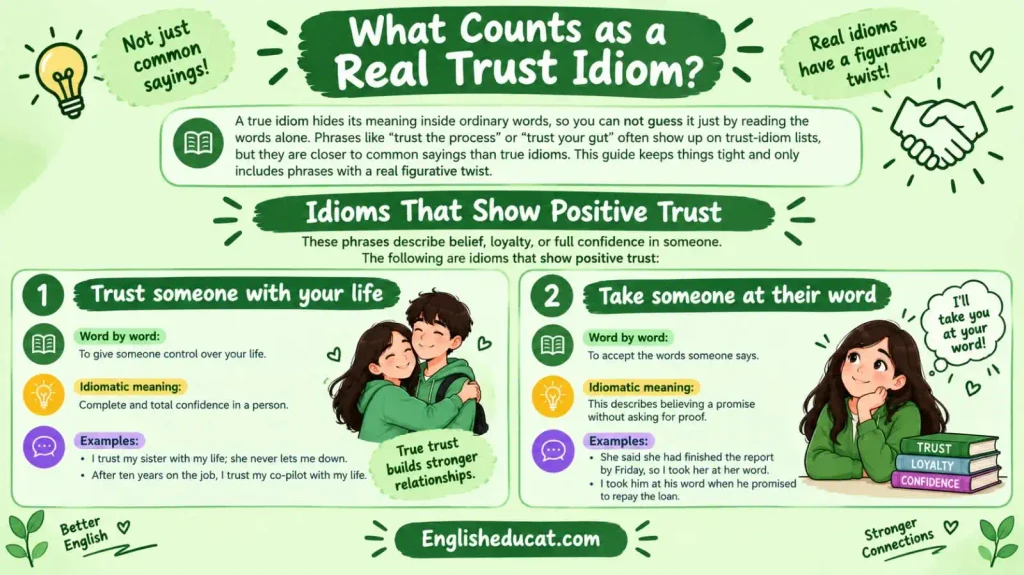
Idioms about trust hides its meaning inside ordinary words, so you can not guess it just by reading the words alone. Phrases like “trust the process” or “trust your gut” often show up on trust-idiom lists, but they are closer to common sayings than true idioms. This guide keeps things tight and only includes phrases with a real figurative twist. Also learn idioms about memory that must be helpful for you.
Idioms About Trust That Show Positive Trust
These phrases describe belief, loyalty, or full confidence in someone. The following are idioms that show positive trust:
Trust someone with your life:
Word by word:
To give someone control over your life.
Idiomatic meaning:
Complete and total confidence in a person.
Examples:
- I trust my sister with my life; she never lets me down.
- After ten years on the job, I trust my co-pilot with my life.
Take someone at their word:
Word by word:
To accept the words someone says.
Idiomatic meaning:
This describes believing a promise without asking for proof.
Examples:
- She said she had finished the report by Friday, so I took her at her word.
- I took him at his word when he promised to repay the loan.
Have faith in someone:
Word by word:
To hold belief in a person.
Idiomatic meaning:
It suggests confidence in someone’s skills or character, even under pressure.
Examples:
- My coach has faith in me, even after a rough season.
- We have faith in our new manager to fix the schedule.
Have someone’s back:
Word by word:
To stand behind a person, guarding them.
Idiomatic meaning:
It refers to supporting or defending someone when things get hard.
Examples:
- Do not worry about the meeting; I have got your back.
- Real friends have your back, even when you make mistakes.
A leap of faith:
Word by word:
A jump made without seeing where you will land.
Idiomatic meaning:
This describes a risky choice based on trust, not proof.
Examples:
- Moving to a new city for the job was a leap of faith.
- Starting a business often means taking a leap of faith.
Trust someone implicitly:
Word by word:
To trust without needing a reason.
Idiomatic meaning:
It points to total and unquestioning trust.
Examples:
- I trust my doctor implicitly; she has never steered me wrong.
- After years together, the partners trusted each other implicitly.
Give someone the benefit of the doubt:
Word by word:
To give someone credit before doubt is confirmed.
Idiomatic meaning:
This suggests choosing to believe someone when the facts are not clear yet.
Examples:
- He was late again, but I gave him the benefit of the doubt.
- Give your new teammate the benefit of the doubt this week.
Trust your gut:
Word by word:
To rely on a feeling in your stomach.
Idiomatic meaning:
It describes following instinct instead of pure logic.
Examples:
- Something felt off about the deal, so I trusted my gut and walked away.
- Trust your gut when a job offer seems too good.
Earn someone’s trust:
Word by word:
To work for a person’s belief in you.
Idiomatic meaning:
This refers to building confidence through actions over time.
Examples:
- It took months, but the new hire earned the team’s trust.
- You earn a child’s trust by keeping small promises.
Stand by someone:
Word by word:
To remain positioned next to a person.
Idiomatic meaning:
It suggests staying loyal, especially during hard times.
Examples:
- My parents stood by me through the whole court case.
- A good friend stands by you, win or lose.
A man of his word / a woman of her word:
Word by word:
A person tied closely to their spoken promise.
Idiomatic meaning:
This describes someone who always keeps promises.
Examples:
- You can count on Sam; he is a man of his word.
- She is a woman of her word; if she says 6 pm, she means it.
Trust goes both ways:
Word by word:
Trust travels in two directions, not one.
Idiomatic meaning:
It points to trust as something both sides must offer, not just one.
Examples:
- In a marriage, trust goes both ways.
- Good teamwork works only if trust goes both ways.
Trust is earned, not given:
Word by word:
Trust must be won through action, not handed over for free.
Idiomatic meaning:
This is a common saying rather than a classic idiom, and it reminds us that belief in someone builds slowly through proof, not promises.
Examples:
- After the lie, she told him trust is earned, not given.
- New managers learn fast: trust is earned, not given.
Idioms That Warn of Distrust or Betrayal
These phrases signal doubt, danger, or broken loyalty. The following are some idioms explained with meaning and examples:
Trust someone as far as you can throw them:
Word by word:
To trust someone only across the short distance you could physically throw them.
Idiomatic meaning:
This means you barely trust the person at all, or not even a little.
Examples:
- After he lied twice, I would not trust him as far as I could throw him.
- She is charming, but I do not trust her as far as I can throw her.
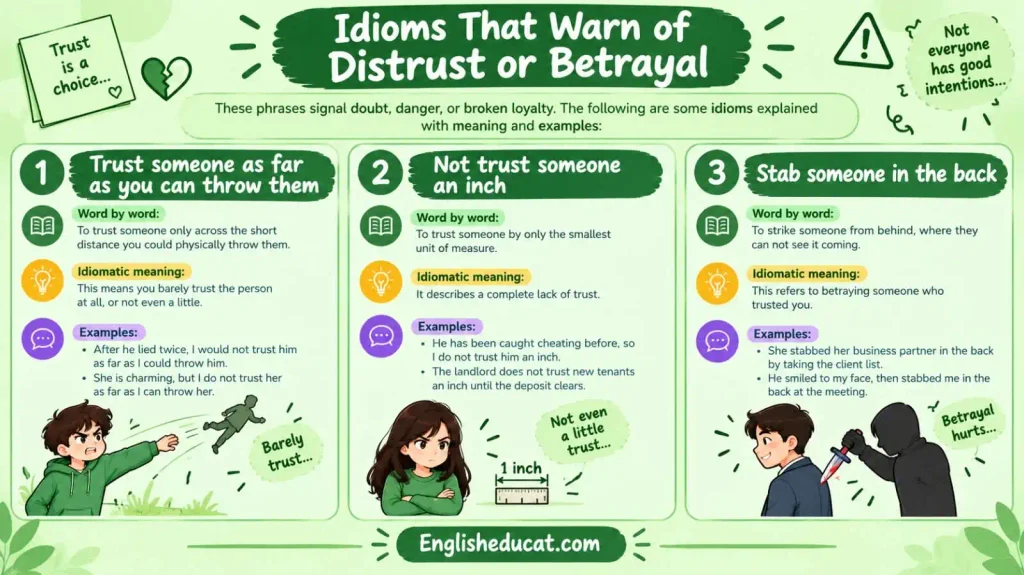
Not trust someone an inch:
Word by word:
To trust someone by only the smallest unit of measure.
Idiomatic meaning:
It describes a complete lack of trust.
Examples:
- He has been caught cheating before, so I do not trust him an inch.
- The landlord does not trust new tenants an inch until the deposit clears.
Stab someone in the back:
Word by word:
To strike someone from behind, where they can not see it coming.
Idiomatic meaning:
This refers to betraying someone who trusted you.
Examples:
- She stabbed her business partner in the back by taking the client list.
- He smiled to my face, then stabbed me in the back at the meeting.
Sell someone down the river:
Word by word:
To trade a person away downstream, out of sight.
Idiomatic meaning:
It points to betraying someone for personal gain.
Examples:
- The politician sold his supporters down the river once he got elected.
- Do not sell your team down the river just to save your own job.
Double-cross:
Word by word:
To cross a person twice, once in pretense and once in truth.
Idiomatic meaning:
This describes betraying someone who believed you were on their side.
Examples:
- The spy double-crossed both governments for money.
- He double-crossed his own brother in the business deal.
Throw someone under the bus:
Word by word:
To push a person into the path of a moving bus.
Idiomatic meaning:
It suggests blaming someone else to protect yourself.
Examples:
- When the project failed, he threw his intern under the bus.
- Do not throw your teammate under the bus in front of the boss.
Take something with a grain of salt:
Word by word:
To add a small pinch of salt while accepting a claim.
Idiomatic meaning:
This means treating a statement as possibly untrue or exaggerated.
Examples:
- Take his excuses with a grain of salt; he stretches the truth.
- I take online reviews with a grain of salt.
Go behind someone’s back:
Word by word:
To act while positioned out of a person’s sight.
Idiomatic meaning:
It describes doing something secret that breaks someone’s trust.
Examples:
- She went behind my back and told our boss the plan.
- Never go behind a friend’s back, even if you disagree.
Break someone’s trust:
Word by word:
To snap or damage a person’s belief in you.
Idiomatic meaning:
This refers to any action that ends someone’s confidence in you.
Examples:
- Lying about the money broke his trust for good.
- One mistake should not break years of trust.
Misplace one’s trust:
Word by word:
To put trust in the wrong place or person.
Idiomatic meaning:
It suggests trusting someone who did not deserve it.
Examples:
- Voters misplaced their trust in a leader who never delivered.
- I misplaced my trust in a friend who later gossiped about me.
Wolf in sheep’s clothing:
Word by word:
A dangerous animal dressed as a harmless one.
Idiomatic meaning:
This describes someone who seems safe but hides bad intentions.
Examples:
- The scam artist was a wolf in sheep’s clothing, all smiles at first.
- Watch out for him; he is a wolf in sheep’s clothing.
Neutral and Legal “Trust” Idioms
These phrases use “trust” in a formal, business, or legal sense. The following are some idioms explained:
In trust:
Word by word:
Kept inside someone’s protected care.
Idiomatic meaning:
It refers to money or property held by a guardian for someone else’s benefit.
Examples:
- The inheritance is held in trust until she turns 21.
- His grandfather left the land in trust for the whole family.
Brain trust:
Word by word:
A group whose collective mind is trusted.
Idiomatic meaning:
This points to a small group of expert advisors.
Examples:
- The mayor’s brain trust met to plan the new budget.
- Every startup needs a brain trust of experienced mentors.
On the level:
Word by word:
Flat and even, with nothing hidden below.
Idiomatic meaning:
It suggests something honest and free of tricks.
Examples:
- Check the contract carefully, but the offer seems on the level.
- Is this seller on the level, or is it a scam?
Above board:
Word by word:
Visible on top of a table, not hidden underneath.
Idiomatic meaning:
This describes actions that are open, legal, and honest.
Examples:
- The charity keeps its finances completely above board.
- Make sure the deal stays above board from the start.
Take something on trust:
Word by word:
To accept a claim purely through belief.
Idiomatic meaning:
It refers to believing something without demanding proof.
Examples:
- I took his story on trust, since I had no reason to doubt him.
- You will have to take my word on trust for now.
Tried and tested/tried and true:
Word by word:
Something already tested and proven to work.
Idiomatic meaning:
This describes a reliable method because it has worked before.
Examples:
- We used a tried and tested recipe for the wedding cake.
- Her advice is tried and true, even if it sounds old-fashioned.
Where Did These Idioms Come From?
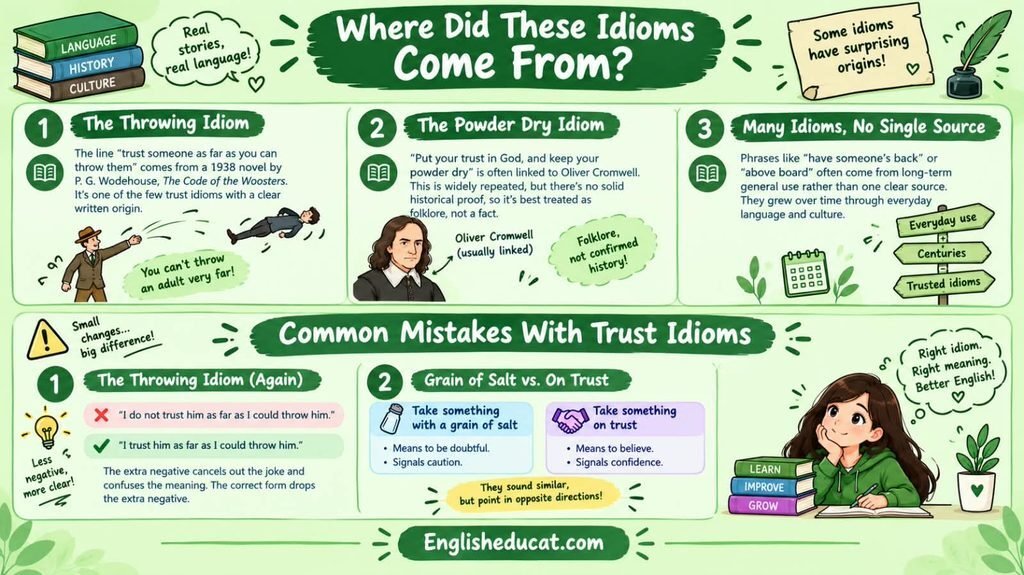
Most trust idioms grew from everyday images, not famous authors, so a documented origin is rare. One clear exception is “trust someone as far as you can throw them.” Language researchers point to a 1938 line from P. G. Wodehouse’s novel The Code of the Woosters as an early printed use of this joke. The line plays on a simple idea: since most people can not throw another adult very far, the “trust” being offered is nearly zero.
A popular story links “put your trust in God, and keep your powder dry” to Oliver Cromwell. This attribution is widely repeated online but is not confirmed by solid historical proof, so treat it as folklore rather than fact. Many other idioms in this list, like “have someone’s back” or “above board,” come from general use over centuries rather than one clear source.
Common Mistakes With Trust Idioms
One frequent error involves the throwing idiom above. Many speakers say “I do not trust him as far as I could throw him,” which cancels out the joke and confuses the meaning. The correct form drops the extra negative: “I trust him as far as I could throw him” already means you barely trust him at all.
Another mix-up happens with “take something with a grain of salt” and “take something on trust.” These sound similar but point in opposite directions: one signals doubt, the other signals belief. Pick the one that matches what you actually mean.
US vs UK Usage Notes
British speakers often say “tried and tested,” while American speakers usually say “tried and true,” though both mean the same thing. “On the level” and “above board” show up in both varieties of English equally, with no strong regional split. Legal terms like “in trust” and “brain trust” stay consistent across US and UK writing, since they come from shared legal and political history.
| Idiom | UK Version | US Version |
| Tried and tested/true | Tried and tested | Tried and true |
| On the level | Common in both | Common in both |
| Above board | Common in both | Common in both |
| In trust / brain trust | Same in both | Same in both |
Quick Reference Table
| Idiom | Meaning | Tone |
| Trust someone with your life | Total confidence | Positive |
| Take someone at their word | Believe without proof | Positive |
| Have someone’s back | Support and defend | Positive |
| A leap of faith | Risky choice based on trust | Positive |
| Earn someone’s trust | Build belief over time | Positive |
| Trust as far as you can throw them | Barely trust at all | Warning |
| Stab someone in the back | Betray a trusting person | Warning |
| Throw someone under the bus | Blame someone to save yourself | Warning |
| Wolf in sheep’s clothing | Hidden bad intent | Warning |
| In trust | Property held by a guardian | Neutral/legal |
| On the level | Honest, no tricks | Neutral/legal |
Frequently Asked Questions
What does “I do not trust you as far as I can throw you” mean?
This phrase means you do not trust the person at all, though the grammatically correct version drops the words “do not” for the same effect.
Is “trust is earned, not given” an idiom or a quote?
It is better described as a common saying rather than a true idiom, since the words carry their normal, literal meaning.
What is the difference between “trust” and “confidence”?
Trust usually points to instinctive belief in someone, while confidence often comes from clear evidence or past results.
What does “on the level” mean?
It describes a person or deal that is honest, straightforward, and free of hidden tricks.
Conclusion
Trust shapes how we speak about people every day, from close friends to strangers in business deals. These 30 idioms give you clear, natural ways to describe belief, doubt, and loyalty without repeating the same plain words. Practice a few in real conversations, and they will start to feel like second nature.

ESL Content Writer
Emily is a TESOL-certified writer who has taught English to international students for over 8 years. She loves breaking down idioms and everyday expressions into simple, relatable explanations that make sense to learners at any level.