
Idioms for darkness use night and shadow to talk about secrets, risks, and hard times. A phrase like “in the dark” rarely refers to a dim room. It points to not knowing something. Below, you will find the meaning, origin, examples, and usage tips for 20 popular phrases. Each one comes with a plain explanation and sentences you can copy into your own speech and writing. These are explained in a same way as idiom about Old is explained.
Definition: Idioms for darkness are usually fixed English phrases that use night, shadows, or missing light to describe secrets, ignorance, risks, and hard times.
What Are Idioms for Darkness?
Idioms for darkness are phrases that use night or shadow to describe ideas like secrets, risk, and trouble, not the dark itself.
An idiom carries a meaning its words do not show. “In the dark” looks like a place, yet it describes a person who lacks facts. Darkness works well for this job because you cannot see what hides inside it. Even the word dark is old. It comes from the Old English word deorc.
Idioms for Darkness at a Glance
Most idioms for darkness point to one of four things: not knowing, real darkness, hard times, or the hope that light brings.
| in the dark | not knowing | neutral | everyday |
| keep someone in the dark | hide facts | negative | everyday |
| a shot in the dark | a wild guess | neutral | casual |
| a stab in the dark | a wild guess | neutral | casual |
| a leap in the dark | a risky step | neutral | everyday |
| dark horse | a surprise talent or winner | positive | everyday |
| under cover of darkness | hidden by night | neutral | formal-leaning |
| keep something dark | keep a secret | neutral | casual, British |
| pitch dark | no light at all | neutral | everyday |
| black as night | very dark | neutral | everyday |
| after dark | once night falls | neutral | everyday |
| blackout | a power cut or fainting spell | neutral | everyday |
| darkest before the dawn | trouble before relief | hopeful | everyday |
| dark days | a hard period | negative | writing |
| cast a shadow | spoil with doubt | negative | neutral or formal |
| the dark side | the bad, hidden part | negative | everyday |
| whistling in the dark | acting calm while afraid | neutral | casual |
| see the light | finally understand | positive | everyday |
| come to light | become known | neutral | formal-leaning |
| light at the end of the tunnel | hope after a long struggle | hopeful | everyday |
Idioms for Darkness About Secrets and Not Knowing
These eight phrases use darkness to describe missing facts, hidden plans, guesses, and risky choices.
1. In the Dark
Word by word:
“In” places you inside something. “The dark” is a space with no light. Together, they usually picture a person standing where nothing can be seen.
Idiomatic meaning:
Not knowing something that others know.
Origin:
One idiom reference dates this “not knowing” sense to the 1600s.
Examples:
- The new hires stayed in the dark about their schedule until Monday.
- “Sorry, I am in the dark on the budget. Ask Priya.”
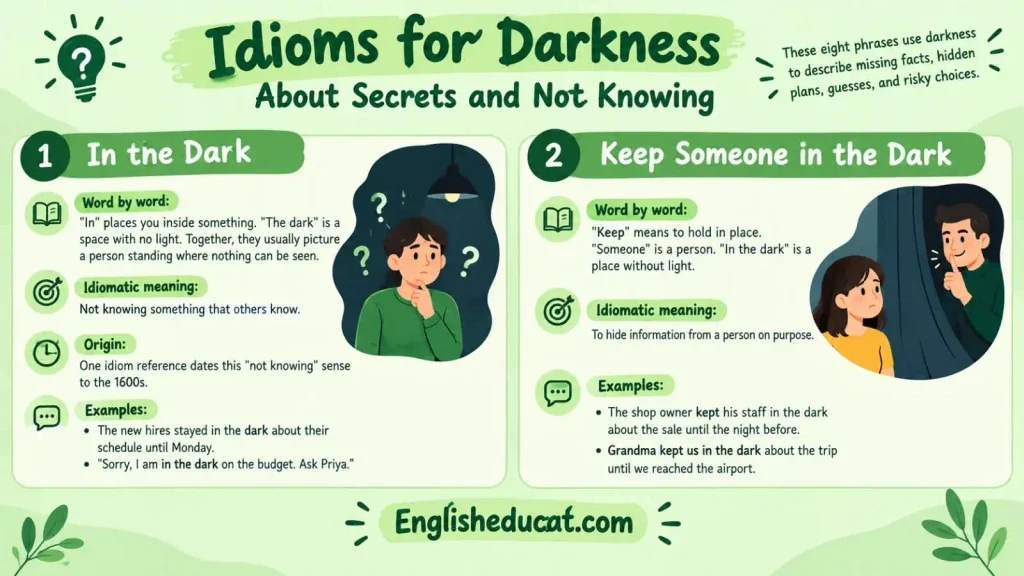
2. Keep Someone in the Dark
Word by word:
“Keep” means to hold in place. “Someone” is a person. “In the dark” is a place without light.
Idiomatic meaning:
To hide information from a person on purpose.
Examples:
- The shop owner kept his staff in the dark about the sale until the night before.
- Grandma kept us in the dark about the trip until we reached the airport.
3. A Shot in the Dark
Word by word:
“Shot” is an attempt, or a fired bullet. “The dark” means you cannot see the target.
Idiomatic meaning:
A guess made with almost no facts and little hope of being right.
Origin:
“Shot” has been slang for an attempt since the mid-1800s, and George Bernard Shaw seems to be the first to use the full phrase in a figurative way, in 1895.
Examples:
- I had no clue where my keys were, so checking the car was a shot in the dark.
- Calling every hotel in town was a shot in the dark, but one had her bag.
4. A Stab in the Dark
Word by word:
“Stab” is a quick jab. “In the dark” means aiming blind.
Idiomatic meaning:
It is a guess, just like the phrase above. Usage guides see no real difference between the two.
Examples:
- Take a stab in the dark: how old is this building?
- He made a stab in the dark at the password and got it right.
5. A Leap in the Dark
Word by word:
“Leap” is a big jump. “In the dark” means you cannot see where you will land.
Idiomatic meaning:
A risky step whose result you cannot predict.
Examples:
- Moving to a new city without a job lined up was a leap in the dark.
- Signing the contract felt like a leap in the dark.
6. Dark Horse
Word by word:
“Dark” can mean deep in color, or hidden. “Horse” is a racing animal. Together, they describe a horse nobody knows well.
Idiomatic meaning:
A person with hidden skills, or an unexpected winner.
Origin:
The phrase comes from Benjamin Disraeli’s 1831 novel The Young Duke, where a little-known horse wins a race by surprise. Wiktionary dictionary
Examples:
- Nobody knew Omar could sing, so the choir called him a dark horse.
- Our class had two strong teams and one dark horse.
7. Under Cover of Darkness
Word by word:
“Cover” is something that hides. “Darkness” is the lack of light.
Idiomatic meaning:
Doing something while night keeps you out of sight.
Examples:
- The kids crept downstairs under cover of darkness to find the cookies.
- The thieves left under cover of darkness.
8. Keep Something Dark
Word by word:
“Keep” means to hold. “Something” is a matter. “Dark” stands for hidden.
Idiomatic meaning:
To keep a matter secret. Oxford marks this one as informal British English.
Examples:
- Keep it dark for now. We announce the news on Friday.
- He kept his plans dark until the contract was signed.
Idioms for Darkness That Describe Night and Dim Places
Pitch dark, black as night, after dark, and blackout all describe real darkness, with little or no light. They are given below:
9. Pitch Dark (or Pitch Black)
Word by word:
“Pitch” is a thick, sticky, tar-like material. It was used to waterproof ships. “Dark” means no light.
Idiomatic meaning:
So dark that you cannot see anything.
Origin:
The black color of pitch explains the image. Some websites link the phrase to Homer’s Iliad. That claim is repeated online, but it is not confirmed.
Examples:
- The basement was pitch dark when the power cut out.
- We walked home along a pitch-black road.
10. Black as Night
Word by word:
“Black” is the darkest color. “Night” is the part of the day without sun.
Idiomatic meaning:
It usually means that it is extremely dark.
Examples:
- The cave stayed black as night, even with our small lamp.
- Her old cat is black as night and hard to spot in the hall.
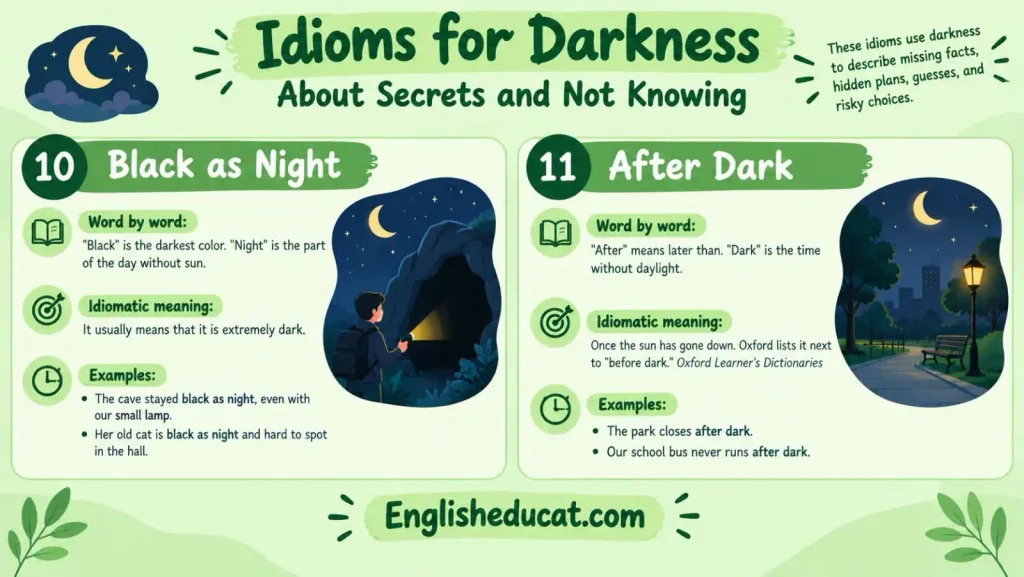
11. After Dark
Word by word:
“After” means later than. “Dark” is the time without daylight.
Idiomatic meaning:
Once the sun has gone down. Oxford lists it next to “before dark.” Oxford Learner’s Dictionaries
Examples:
- The park closes after dark.
- Our school bus never runs after dark.
12. Blackout
Word by word:
“Black” is the color of no light. “Out” means gone. The lights are gone.
Idiomatic meaning:
A power cut, or a short loss of awareness.
Examples:
- A blackout hit our street, so we ate dinner by candlelight.
- He had a blackout and forgot the last five minutes.
Idioms for Darkness That Describe Hard Times
Darkest before the dawn, dark days, cast a shadow, the dark side, and whistling in the dark all use darkness to describe sadness, trouble, or fear. They are given below:
13. Darkest Before the Dawn
Word by word:
“Darkest” is the least light. “Before the dawn” is just ahead of sunrise.
Idiomatic meaning:
Things often look worst right before they get better.
Examples:
- We lost five games in a row, but it is always darkest before the dawn.
- Her shop was nearly empty in March. Then the big order came.
14. Dark Days
Word by word:
“Dark” can mean gloomy. Dictionaries list this sense for words like “dismal.” “Days” is a stretch of time.
Idiomatic meaning:
A sad or hard period.
Examples:
- The company had dark days after the factory fire.
- Those were dark days for our family.
15. Cast a Shadow
Word by word:
“Cast” means to throw. A “shadow” is a dark shape made when something blocks the light.
Idiomatic meaning:
To bring doubt or gloom over something good. It usually appears as “cast a shadow over.”
Examples:
- The rumor cast a shadow over the win of a team.
- One bad grade cast a shadow over her whole week.
16. The Dark Side
Word by word:
“Dark” stands for hidden or bad. “Side” is a part.
Idiomatic meaning:
The bad or hidden part of a person, place, or thing.
Examples:
- Fame has a dark side that fans rarely see.
- Online games show a dark side when players are rude.
17. Whistling in the Dark
Word by word:
“Whistling” is making a tune with your lips. “In the dark” is a scary place.
Idiomatic meaning:
Acting calm or hopeful while you are really afraid, or while the odds look poor. The image is of someone whistling to calm their nerves.
Examples:
- Saying we can still win with three players is whistling in the dark.
- He called the exam easy, but that was whistling in the dark.
How Do Idioms for Darkness Connect to Light?
Light idioms are the other half of idioms for darkness, because they describe the moment someone learns the truth or finds hope. They are given below:
18. See the Light
Word by word:
“See” means to notice. “Light” is brightness.
Idiomatic meaning:
To finally understand, or to change your mind for the better.
Example:
After months of late nights, Jin saw the light and started going to bed early.
19. Come to Light
Word by word:
“Come” means to arrive. “Light” is where things can be seen.
Idiomatic meaning:
To become known after being hidden.
Example:
The mistake came to light when the auditor checked the accounts.
20. Light at the End of the Tunnel
Word by word:
A “tunnel” is a long, dark path. “Light at the end” is the exit.
Idiomatic meaning:
A sign that a long struggle is almost over.
Example:
With one exam left, Dana could finally see light at the end of the tunnel.
Are Idioms for Darkness Always Negative?
No, idioms for darkness are not always negative: some of them are neutral, a few look hopeful, and one praises hidden talent.
Cast a shadow, dark days, and the dark side lean negative. In the dark, pitch dark, and after dark are plain and neutral. Darkest before the dawn offers comfort. Dark horse is the odd one out, since it usually refers to a surprise skill.
How Do Look-Alike Idioms for Darkness Differ?
A shot in the dark and a stab in the dark are twins, while a leap in the dark is a risky action, and “in the dark” describes missing facts.
| in the dark | missing facts | be, stay | I’m in the dark about the new rules. |
| keep someone in the dark | hiding facts | keep | They kept us in the dark about the move. |
| a shot / stab in the dark | a guess | take, make | I took a shot in the dark and picked blue. |
| a leap in the dark | a risky choice | take | Changing careers at fifty was a leap in the dark. |
What Mistakes Do Learners Make With Idioms for Darkness?
Learners most often change the fixed wording, mix up look-alike phrases, or treat color idioms as if they were about darkness.
- Changing the wording. Say “in the dark,” not “in the darkness,” for not knowing. The fixed form sounds natural.
- Mixing two phrases. “He kept in the dark” is wrong. Say “He was kept in the dark” or “They kept him in the dark.”
- Hearing an insult in dark horse. The phrase is usually friendly. The dark side is the negative one.
- Counting every black phrase. Black sheep, black market, and black coffee relate to the color black, not to missing light.
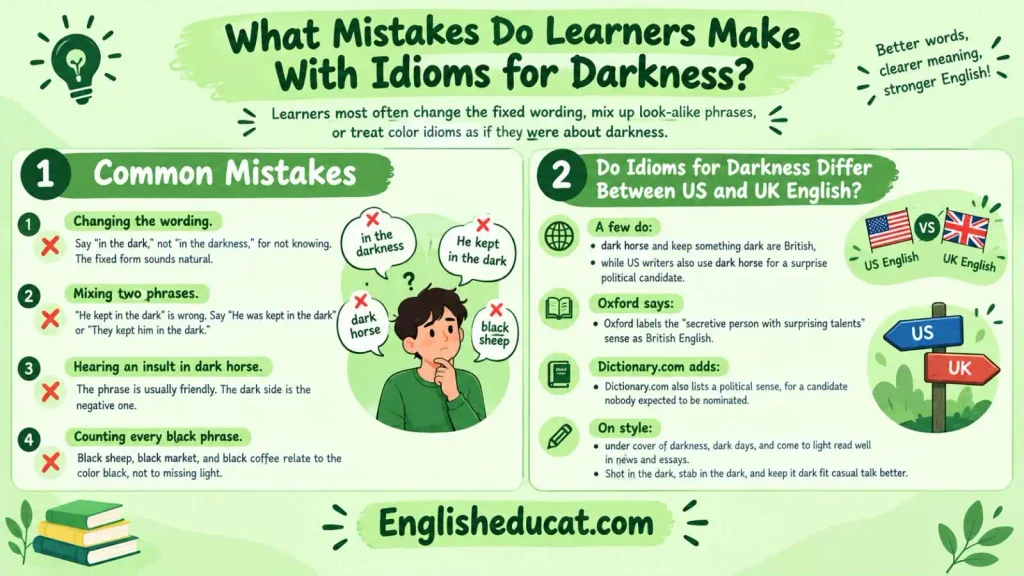
Do Idioms for Darkness Differ Between US and UK English?
A few do: dark horse and keep something dark are British, while US writers also use dark horse for a surprise political candidate.
Oxford labels the “secretive person with surprising talents” sense as British English. Dictionary.com also lists a political sense, for a candidate nobody expected to be nominated.
On style, under cover of darkness, dark days, and come to light read well in news and essays. Shot in the dark, stab in the dark, and keep it dark fit casual talk better.
Frequently Asked Questions
What does “in the dark” mean?
“In the dark” means not knowing about something that others know. You can be in the dark by accident, while “keep someone in the dark” describes hiding facts on purpose.
What is the origin of “dark horse”?
“Dark horse” comes from Benjamin Disraeli’s 1831 novel The Young Duke, where an unknown horse wins a race. The phrase later grew to cover any surprise contender.
What is the difference between a shot in the dark and a stab in the dark?
There is no real difference, since both describe a guess with little chance of being right.
Is “dark horse” a compliment?
“Dark horse” is usually a compliment, because it points to hidden talent or a surprise win.
Conclusion
Idioms for darkness turn a simple idea, missing light, into a way to talk about secrets, risks, and hard times. Start with three: “in the dark,” “a shot in the dark,” and “dark horse.” Use one in your next chat or email, and the rest will follow.

Senior English Content Editor
Sarah has over 10 years of experience teaching English as a Second Language in Chicago public schools. She specializes in vocabulary building and simplifying complex word meanings for everyday learners. Sarah holds a Master’s degree in English Education from the University of Illinois.