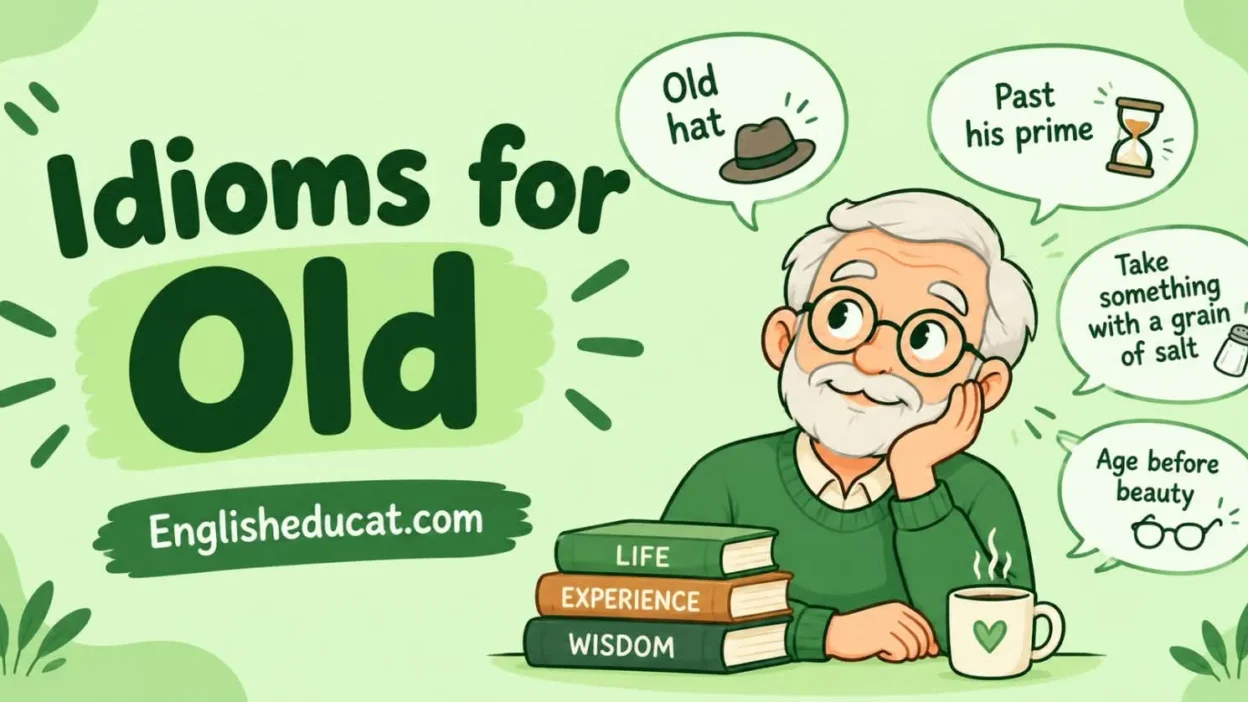
Idioms about old are fixed phrases that usually describe aging, older people, or things from long ago. This guide covers the meaning, origin, and real examples of 25 of them. Some sound kind, like “golden years.” Others tease, like “over the hill.” A short tone guide, a comparison table, and a list of common mistakes will help you pick the right phrase for the right moment.
Quick definition: Idioms about old are expressions that talk about age or oldness without using the words literally. For example, “over the hill” describes someone past their best years. It is very similar to idioms that are about Stupid, so you should also learn that.
Idioms about Old at a Glance
The table below contains twelve popular idioms about old with their meaning, tone, and best setting.
| Over the hill | Past one’s best years | Teasing | Informal |
| Long in the tooth | Rather old, or too old for something | Teasing | Informal |
| No spring chicken | Not young anymore | Light, humorous | Informal |
| Getting on in years | Becoming old | Gentle | Neutral |
| Golden years | Later life, often after work ends | Warm | Neutral |
| A ripe old age | Very old, in a good way | Warm | Neutral |
| Old soul | Wise beyond one’s years | Warm | Neutral |
| Old as the hills | Extremely ancient | Playful | Informal |
| Older than dirt | Extremely old | Joking | Very informal |
| Old hat | Outdated | Mildly negative | Informal |
| Old wives’ tale | An untrue folk belief | Dismissive | Informal |
| No fool like an old fool | An older person acting unwisely | Rude | Informal |
Idioms About Getting Older
These idioms about old age, such as “over the hill” and “no spring chicken,” describe a person who is no longer young. Some of them are given below:
Over the hill
Word-by-word meaning
“Over” shows that something has passed a point. “The” points to one particular hill. “Hill” is a raised piece of land. Together, they picture a walker who has crossed the top and now heads down.
Idiomatic meaning
The phrase describes that someone has passed their best years. People often use it as a joke, and it also fits athletes, singers, or machines that peaked long ago.
Examples
- My coworkers gave me a black balloon on my fortieth birthday and called me over the hill.
- The coach insists no striker is over the hill while he still trains hard.
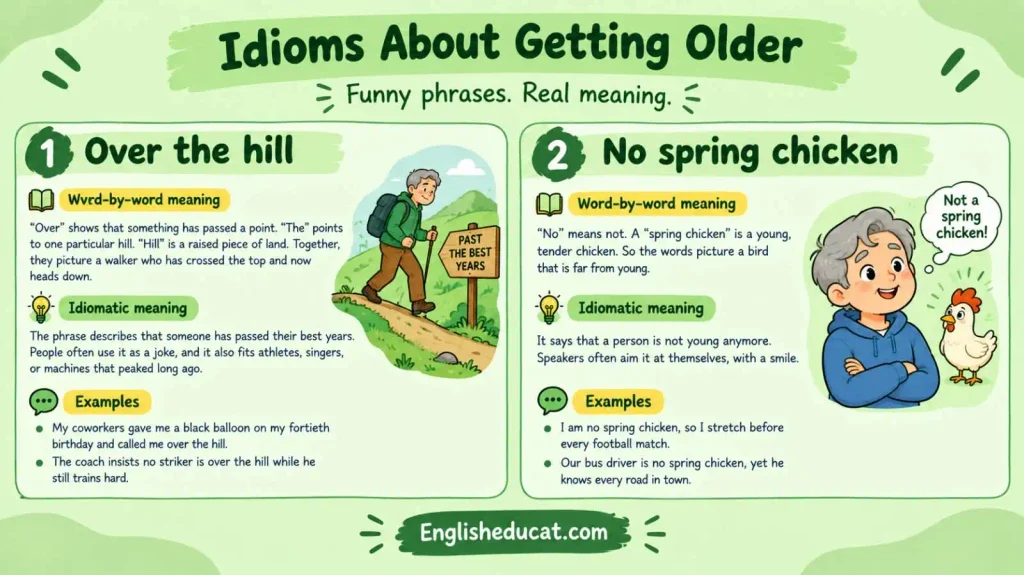
No spring chicken
Word-by-word meaning
“No” means not. A “spring chicken” is a young, tender chicken. So the words picture a bird that is far from young.
Idiomatic meaning
It says that a person is not young anymore. Speakers often aim it at themselves, with a smile.
Examples
- I am no spring chicken, so I stretch before every football match.
- Our bus driver is no spring chicken, yet he knows every road in town.
Long in the tooth
Word-by-word meaning
“Long” describes something with great length. “In the tooth” places that length on a tooth. The picture is a mouth with teeth that look stretched out.
Idiomatic meaning
This expression points to someone rather old, or may be too old for a certain task. It also works for objects, such as a worn-out gadget.
Examples
- Our printer is long in the tooth, so we are saving for a new one.
- At twenty-five, she felt long in the tooth for the youth team.
Getting on in years
Word-by-word meaning
“Getting” means becoming. “On” suggests moving forward. “In years” tells you that age is counted in years.
Idiomatic meaning
It describes a person who is growing old. The tone stays gentle, which makes it a safe choice around family and clients.
Examples
- Our landlord is getting on in years, so his son handles the repairs.
- My teacher is getting on in years, but she still runs the school choir.
Senior moment
Word-by-word meaning
“Senior” refers to an older person. “Moment” is a very short time. The words suggest a brief slip that belongs to older age.
Idiomatic meaning
A senior moment is a quick lapse of memory, mentioned with humor. It works best when you joke about yourself.
Examples
- I had a senior moment and sent the invitation for the wrong day.
- She stood in the kitchen, forgot why, and laughed about her senior moment.
Show your age
Word-by-word meaning
“Show” means let others see. “Your age” is the number of years you have lived.
Idiomatic meaning
The phrase points to looking or sounding older than you are. It can also describe a slip that reveals how long you have been around.
Examples
- Talking about cassette tapes really shows your age.
- After a double shift, he was clearly showing his age.
Warm Phrases for Later Life
The most pleasant idioms about old age, like “golden years,” present later life as calm and rewarding.
Golden years
Word-by-word meaning
“Golden” means made of gold, or very precious. “Years” are the time you live. The pair treats late life as something valuable.
Idiomatic meaning
It refers to the period after retirement, seen as peaceful and enjoyable.
Examples
- My aunt spends her golden years painting by the sea.
- The bank sells a savings plan for your golden years.
A ripe old age
Word-by-word meaning
“Ripe” describes fruit that is ready to eat. “Old age” is a late stage of life. The picture is a life that has fully matured.
Idiomatic meaning
It describes a very old age that someone reaches in good shape. You usually hear it as “live to a ripe old age.”
Examples
- My neighbour reached a ripe old age and still grew tomatoes at ninety.
- Everyone wished the old fisherman a ripe old age.
Twilight years
Word-by-word meaning
“Twilight” is the soft light after sunset. “Years” are time. The words suggest a life slowing down toward evening.
Idiomatic meaning
This phrase names the last stage of life. It sounds quieter, and a little sadder, than “golden years.”
Examples
- He spent his twilight years writing letters to old friends.
- The charity helps people stay at home during their twilight years.
Young at heart
Word-by-word meaning
“Young” is the opposite of old. “At” tells where the youth lives. “Heart” stands for feelings and spirit.
Idiomatic meaning
It describes an older person who still feels playful and energetic.
Examples
- Our headmaster is seventy and still joins the school dance. He is young at heart.
- You have to be young at heart to enjoy this video game with your grandchildren.
Age is just a number.
Word-by-word meaning
“Age” is how many years you have lived. “Just” means only. “A number” is a plain figure with no power.
Idiomatic meaning
The saying suggests that years should not limit what you try. People use it to cheer on late starters.
Examples
- She began college at sixty. Age is just a number.
- Our oldest runner in the club shows that age is just a number.
Old soul
Word-by-word meaning
“Old” means having lived long. “Soul” is the inner self. The words picture a spirit that has been around for ages.
Idiomatic meaning
An old soul is a person, often young, who seems calm and wise beyond their years.
Examples
- My ten-year-old cousin gives great advice. He is an old soul.
- Ayesha is an old soul who prefers poetry to parties.
Phrases for Very Old Things
Idioms about old things, such as “old as the hills,” describe something extremely ancient.
Old as the hills
Word-by-word meaning
“Old” means aged. “As… as” is a comparison. “The hills” have stood in place for a very long time.
Idiomatic meaning
It describes something extremely old, such as a custom, story, or joke.
Examples
- That riddle is old as the hills, but it still makes me laugh.
- The sewing machine in our shop is as old as the hills, yet it works perfectly.
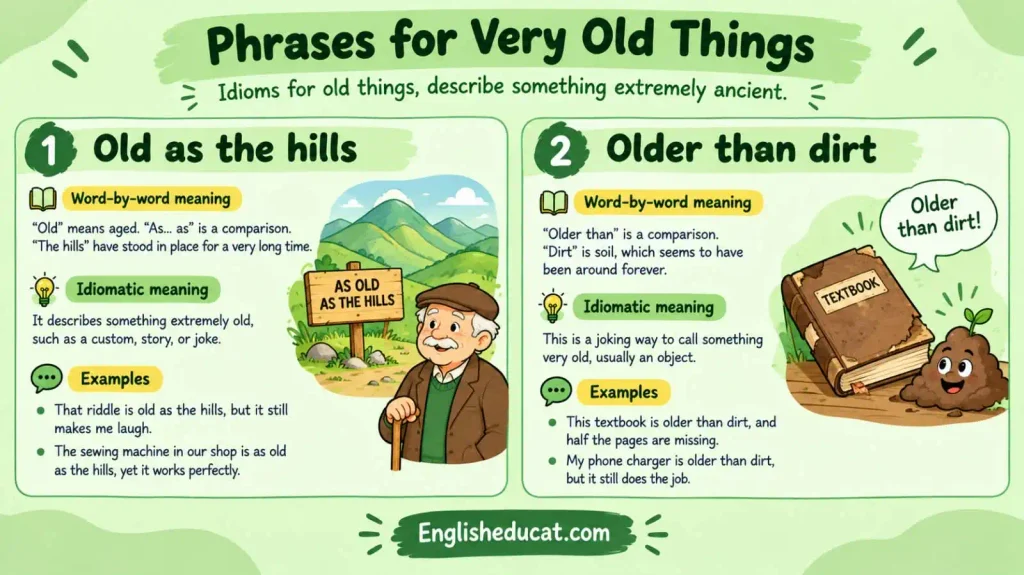
Older than dirt
Word-by-word meaning
“Older than” is a comparison. “Dirt” is soil, which seems to have been around forever.
Idiomatic meaning
This is a joking way to call something very old, usually an object.
Examples
- This textbook is older than dirt, and half the pages are missing.
- My phone charger is older than dirt, but it still does the job.
Old as Adam
Word-by-word meaning
“Old” means aged. “Adam” is the first man in the Bible and the Quran. So the phrase compares something to the earliest human.
Idiomatic meaning
It describes something extremely old. Dictionaries list it beside “old as the hills.”
Examples
- That joke is old as Adam.
- The rules of this card game are as old as Adam.
Old as time
Word-by-word meaning
“Old” means aged. “Time” is the endless passing of years.
Idiomatic meaning
The phrase points to something that has always existed. Speakers pick it for love, rivalry, and familiar stories.
Examples
- The quarrel between the two brothers is as old as time.
- Our teacher said the urge to ask big questions is old as time.
Phrases for Outdated Ideas and Experienced People
Some idioms about old ideas, like “old hat,” describe outdated methods, while others praise experience.
Old hat
Word-by-word meaning
“Old” means used for a long time. “Hat” is a head covering. Think of a style nobody wears now.
Idiomatic meaning
It refers to something outdated, no longer new or exciting.
Examples
- Paper maps are old hat now that everyone has a phone app.
- Dial-up internet sounds old hat to my students.
Old school
Word-by-word meaning
“Old” means from an earlier time. “School” here means a style or a way of doing things.
Idiomatic meaning
It describes a traditional approach. The phrase can carry respect, not just criticism.
Examples
- My uncle repairs radios the old school way, with a soldering iron and patience.
- The manager is old school and still writes thank-you notes by hand.
Old hand
Word-by-word meaning
“Old” means long-serving. “Hand” is a worker, as in “farmhand.”
Idiomatic meaning
An old hand is a person with plenty of experience in one field.
Examples
- Ask Imran. He is an old hand at tax forms.
- Sana is an old hand at planning school fairs.
Old guard
Word-by-word meaning
“Old” means long-standing. “Guard” is a group that holds its position.
Idiomatic meaning
The phrase names longtime members of a group who prefer the traditional way and may resist change.
Examples
- The old guard at the club voted against the new rules.
- A few of the old guard still send faxes.
The good old days
Word-by-word meaning
“Good” means pleasant. “Old” means long past. “Days” are a stretch of time.
Idiomatic meaning
It points to a past period remembered fondly, sometimes better than it truly was.
Examples
- In the good old days, we played cricket in the street until dark.
- Dad loves telling stories about the good old days of black-and-white television.
Phrases About Old Sayings and Habits
Phrases such as “old wives’ tale” and “same old story” point to beliefs and routines that keep repeating.
Old wives’ tale
Word-by-word meaning
“Old” means from long ago. “Wives” are married women. “Tale” is a story.
Idiomatic meaning
This expression names a traditional belief that is usually untrue or unproven.
Examples
- Going outside with wet hair does not give you a cold. That is an old wives’ tale.
- My cousin called the idea a silly old wives’ tale and checked the facts.
You can not teach an old dog new tricks.
Word-by-word meaning
“Teach” means pass on a skill. “Old dog” is an aged pet. “New tricks” are fresh skills.
Idiomatic meaning
The saying suggests that older people struggle to change habits. Plenty of people find it unfair, and plenty of older learners prove it wrong.
Examples
- My boss said you can not teach an old dog new tricks, but then mastered the new software in a week.
- Grandpa laughed at the proverb and learned to video call.
Same old story
Word-by-word meaning
“Same” means unchanged. “Old” means long familiar. “Story” is a sequence of events.
Idiomatic meaning
It describes a situation that keeps repeating.
Examples
- Late bus, wet shoes, same old story.
- The team missed the deadline again. Same old story.
No fool like an old fool
Word-by-word meaning
“No” means not any. “Fool” is a person acting without sense. The words say that a fool who is also old stands out most.
Idiomatic meaning
The saying suggests that an older person acting unwisely looks sillier, since age is supposed to bring good sense. It stings, so keep it away from the person it describes.
Examples
- He bought a sports car at seventy, and his brother muttered, “No fool like an old fool.”
- Her friends warned that falling for the scam proved there is no fool like an old fool.
Where Do Idioms about Old Come From?
Most have unclear origins, and only a few have a documented first use.
Long in the tooth
The earliest English citation found dates to 1852, in Thackeray’s The History of Henry Esmond, and it describes a woman, not a horse. Similar Latin sayings go back to the 16th century, but the long gap suggests the English phrase arose on its own.
The horse-teeth story is the version you will see most often. Horses show age through their teeth, so the idea sounds sensible. Still, it is a commonly repeated explanation that is not confirmed.
Over the hill
One dictionary’s word history records the “past one’s prime” sense first appearing in 1950. A popular story compares life to a climb up a hill, followed by a walk down. That picture fits the words well, though it is a folk explanation and not a proven origin.
Old as the hills and old as Adam
Dictionaries list both. Oxford’s learner’s entry, for example, includes “as old as the hills” with the meaning very old. A first use is not documented in the sources checked, so treat any exact date you see elsewhere with caution.
Positive, Neutral, or Rude: A Tone Guide
Golden years and old soul sound warm, while over the hill and long in the tooth can sting. Pick idioms about old age with the listener in mind.
- Warm: golden years, a ripe old age, young at heart, old soul, old hand
- Neutral or gentle: getting on in years, twilight years, old school, the good old days
- Playful with friends: no spring chicken, senior moment, old as the hills, older than dirt
- Risky: over the hill, long in the tooth, show your age.
- Rude: no fool like an old fool, you can not teach an old dog new tricks (when said to an older person)
Formal or Informal: Where Each Phrase Fits
Most idioms about old suit casual talk, so choose plain words in formal writing.
In a report, an email to a client, or a talk with an elder, skip jokes about age. Try these safer options instead:
- “older adults” or “senior colleagues”
- “in later life” or “getting on in years”
- “experienced” or “long-serving,” instead of “old hand”
- “traditional,” instead of “old school” or “old hat”
With friends, a light tease such as “no spring chicken” usually lands fine. Read the room first.
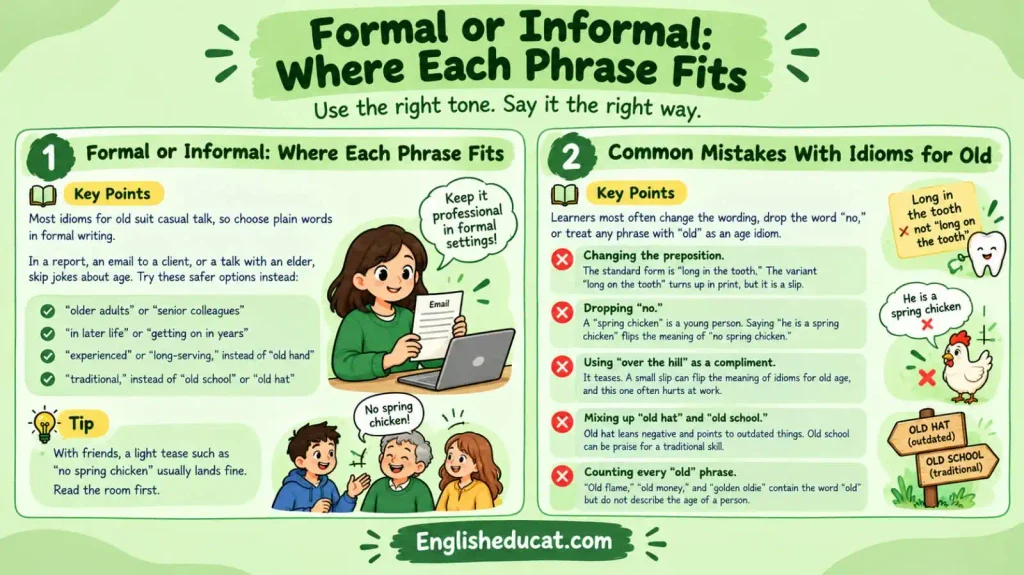
Common Mistakes With Idioms about Old
Learners most often change the wording, drop the word “no,” or treat any phrase with “old” as an age idiom.
- Changing the preposition. The standard form is “long in the tooth.” The variant “long on the tooth” turns up in print, but it is a slip.
- Dropping “no.” A “spring chicken” is a young person. Saying “he is a spring chicken” flips the meaning of “no spring chicken.”
- Using “over the hill” as a compliment. It teases. A small slip can flip the meaning of idioms about old age, and this one often hurts at work.
- Mixing up “old hat” and “old school.” Old hat leans negative and points to outdated things. Old school can be praise for a traditional skill.
- Counting every “old” phrase. “Old flame,” “old money,” and “golden oldie” contain the word “old” but do not describe the age of a person.
Similar Idioms Compared
Over the hill stresses a lost peak, long in the tooth stresses being too old for something, and no spring chicken simply says “not young.” The table helps you choose between the closest idioms about old age.
| Over the hill | Past one’s peak | Sports, birthday jokes | Can offend |
| Long in the tooth | Too old for a role or an object | Careers, gadgets | Can sound insulting |
| No spring chicken | Simply not young | Talking about yourself | Low |
| Getting on in years | Growing older | Polite, everyday talk | None |
Frequently Asked Questions
What is an idiom for being old?
Over the hill, long in the tooth, and no spring chicken are common idioms about old age. Each one hints that someone is past their youth, usually with a joking tone.
What does “long in the tooth” mean, and where does it come from?
“Long in the tooth” means rather old, or too old for something. The most repeated explanation links it to horses, whose teeth help show their age. That claim is unconfirmed, and the earliest English citation found, from 1852, describes a woman.
Is “over the hill” offensive?
“Over the hill” can be offensive, depending on who says it and to whom. Friends often use it as a birthday joke, but it can hurt at work or around elders.
What is a polite way to say someone is old?
“Getting on in years,” “older adult,” and “in later life” are polite ways to describe someone’s age. These choices carry no teasing, so they work in formal settings.
Conclusion
Idioms about old give English speakers a colorful way to talk about age, from warm phrases like “golden years” to sharp ones like “over the hill.” Match the tone to the listener, check the exact wording, and treat popular origin stories with care. Practice a few from each group, and they will soon feel natural in your own speech.

Linguistics Specialist
James is a linguist with a Ph.D. in Applied Linguistics from Boston University. His work focuses on word origins, synonyms, and how language evolves over time. He has contributed to several academic journals on English semantics.