
Idioms about Stupid are colorful phrases that describe someone who is not very smart, without using the word itself. Most are jokes, and a few are harsh. Below, you will find 11 popular ones with plain meanings, origins, real examples, and tone tips. Each one comes with simple examples you can reuse. You will also see which phrases suit work, which suit friends, and which are best left unsaid.
Quick definition: An idiom about stupid is a fixed phrase that figuratively describes someone as unintelligent. Example: “not the sharpest tool in the shed” suggests someone is slow to understand.
What Are the Most Common Idioms about Stupid?
Three idioms about stupid appear on almost every list: “not the sharpest tool in the shed,” “not playing with a full deck,” and “the lights are on, but nobody is home.” Also learn idioms about Sun.
Here is a quick view of all 11 in this guide.
| Not the sharpest tool in the shed | Not very smart | Mild |
| Slow on the uptake | Takes time to understand | Mild |
| A few sandwiches short of a picnic | Missing some common sense | Mild |
| A brick short of a load | Not quite all there | Mild |
| The lights are on but nobody’s home | Looks alert, isn’t thinking | Moderate |
| Not playing with a full deck | Mentally lacking | Moderate |
| Thick as two short planks | Very slow to understand | Moderate |
| Couldn’t pour water out of a boot with instructions on the heel | Hopeless, even with help | Moderate |
| Dumb as a box of rocks | Extremely stupid | Harsh |
| Dead from the neck up | Has no brainpower at all | Harsh |
| Fell out of the stupid tree and hit every branch on the way down | Wildly foolish | Harsh |
Check the tone column before you pick one. Some of these idioms about stupid are gentle teasing, while others cut deep.
Mild and Playful Idioms about Stupid
Mild idioms about stupid tease a person without looking cruel. Friends and family can often use them, especially about small mistakes.
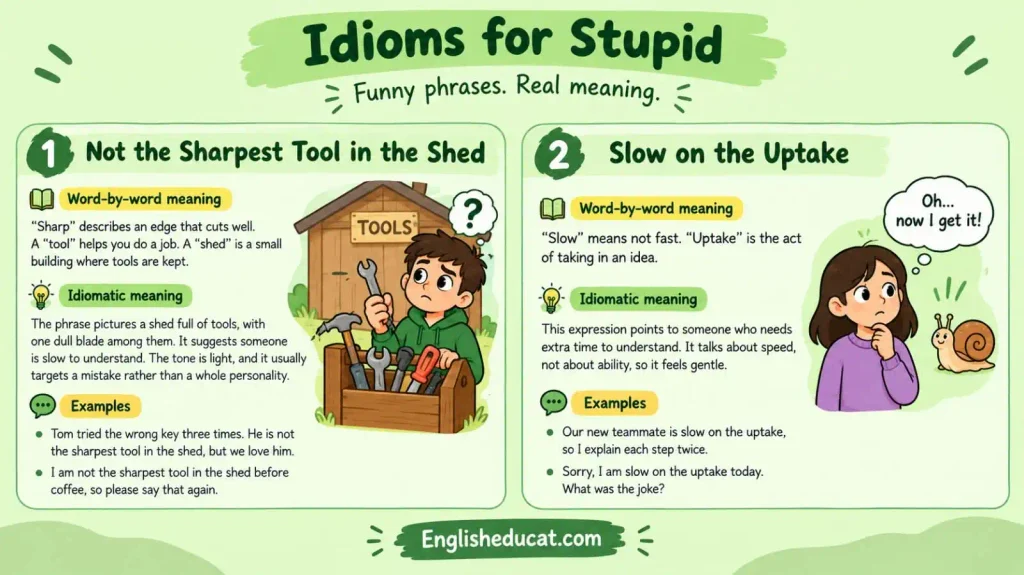
1. Not the Sharpest Tool in the Shed
Word-by-word meaning
“Sharp” describes an edge that cuts well. A “tool” helps you do a job. A “shed” is a small building where tools are kept.
Idiomatic meaning
The phrase pictures a shed full of tools, with one dull blade among them. It suggests someone is slow to understand. The tone is light, and it usually targets a mistake rather than a whole personality.
Examples
- Tom tried the wrong key three times. He is not the sharpest tool in the shed, but we love him.
- I am not the sharpest tool in the shed before coffee, so please say that again.
2. Slow on the Uptake
Word-by-word meaning
“Slow” means not fast. “Uptake” is the act of taking in an idea.
Idiomatic meaning
This expression points to someone who needs extra time to understand. It talks about speed, not about ability, so it feels gentle.
Examples
- Our new teammate is slow on the uptake, so I explain each step twice.
- Sorry, I am slow on the uptake today. What was the joke?
3. A Few Sandwiches Short of a Picnic
Word-by-word meaning
A picnic is a meal outside. “Short” means something is missing. So some of the food never arrived.
Idiomatic meaning
The phrase suggests a person is missing a bit of common sense. It belongs to a whole group of “something is missing” insults. You will also hear “one sandwich short” and “two sandwiches short.”
Examples
- He tried to pay the bus driver with a library card. He has a few sandwiches short of a picnic.
- That plan has no budget and no date. It is a few sandwiches short of a picnic.
4. A Brick Short of a Load
Word-by-word meaning
A truck carries a load of bricks. One brick is missing from the pile.
Idiomatic meaning
It describes a person who is not quite complete mentally. The longer form is “a few bricks short of a full load.” The idea matches the picnic phrase above.
Examples
- My cousin thinks the moon is a hole in the sky. He is a brick short of a load.
- Salt in the cake instead of sugar? You are a brick short of a load today!
Moderate Idioms about Stupid
Moderate idioms about stupid sound more pointed. Use them with people who know your sense of humor.
5. The Lights Are On, but Nobody’s Home
Word-by-word meaning
Lights in a house usually mean someone is inside. Here, “nobody’s home” says the house is empty.
Idiomatic meaning
This phrase refers to a person who looks awake but is not thinking or reacting. It can describe a blank, tired, or distracted moment, not only a lack of brains.
Examples
- I asked Maya three times. The lights were on, but nobody was home.
- After a double shift, he stared at the screen like the lights were on, but nobody was home.
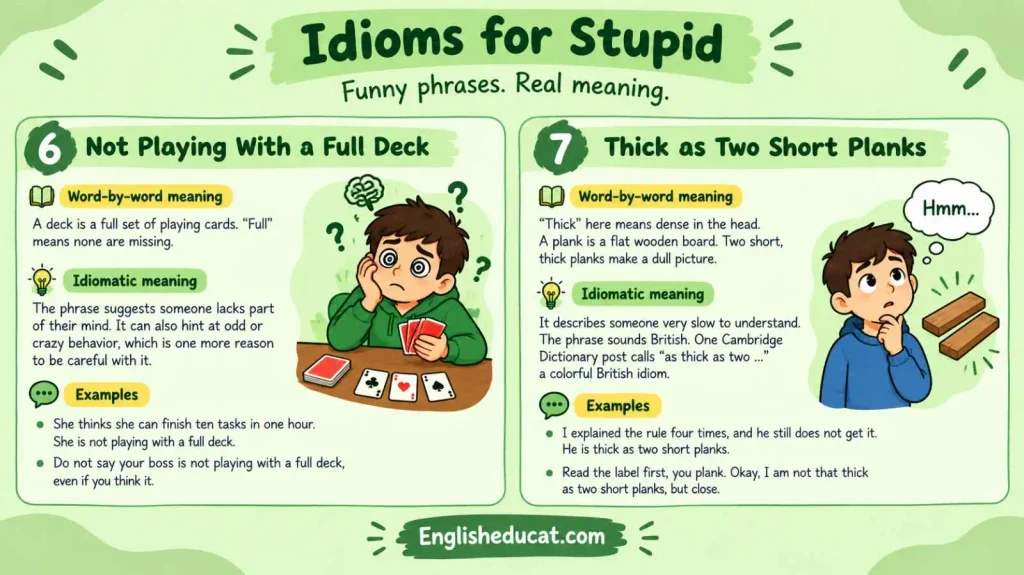
6. Not Playing With a Full Deck
Word-by-word meaning
A deck is a full set of playing cards. “Full” means none are missing.
Idiomatic meaning
The phrase suggests someone lacks part of their mind. It can also hint at odd or crazy behavior, which is one more reason to be careful with it.
Examples
- She thinks she can finish ten tasks in one hour. She is not playing with a full deck.
- Do not say your boss is not playing with a full deck, even if you think it.
7. Thick as Two Short Planks
Word-by-word meaning
“Thick” here means dense in the head. A plank is a flat wooden board. Two short, thick planks make a dull picture.
Idiomatic meaning
It describes someone very slow to understand. The phrase sounds British. One Cambridge Dictionary post calls “as thick as two …” a colorful British idiom.
Examples
- I explained the rule four times, and he still does not get it. He is thick as two short planks.
- Read the label first, you plank. Okay, I am not that thick as two short planks, but close.
8. Could not Pour Water Out of a Boot With Instructions on the Heel
Word-by-word meaning
A boot is a shoe. Pouring water out of it is an easy job, and the instructions are written right there.
Idiomatic meaning
This long joke suggests a person would fail at a simple task even with help. It is funny, but it can sting.
Examples
- Ask Greg to set up the printer? He could not pour water out of a boot with instructions on the heel.
- My brother can not follow a recipe. He could not pour water out of a boot with instructions on the heel.
Harsh Idioms about Stupid (Use With Care)
Harsh idioms about stupid are insults, and they can hurt. Save them for jokes about yourself or for fiction.
9. Dumb as a Box of Rocks
Word-by-word meaning
“Dumb” here means stupid. A box of rocks has no thoughts at all.
Idiomatic meaning
The phrase describes extreme stupidity. Close cousins include “dumb as a rock” and “dumb as a post.” One warning: “dumb” can also mean unable to speak, so avoid it for people.
Examples
- He locked his keys in the car twice in one day. Dumb as a box of rocks.
- Do not call your brother dumb as a box of rocks. Say sorry instead.
10. Dead From the Neck Up
Word-by-word meaning
“Dead” means without life. “Neck up” points to the head.
Idiomatic meaning
It suggests someone has no brainpower or no interest in thinking. The phrase is blunt, and it can be cruel.
Examples
- The manager nodded at every idea and asked no questions. He seemed dead from the neck up.
- By the third meeting, I felt dead from the neck up.
11. Fell Out of the Stupid Tree and Hit Every Branch on the Way Down
Word-by-word meaning
The “stupid tree” is an imaginary tree. Each branch you hit on the way down is another bad choice.
Idiomatic meaning
This joke points to someone who seems wildly foolish. It works best as a comic exaggeration.
Examples
- He argued with the GPS and drove into a pond. He fell out of the stupid tree and hit every branch.
- I forgot my own birthday. I must have fallen out of the stupid tree.
Where Do These Idioms Come From?
Most idioms about stupid have no documented origin, and a few have a partial paper trail.
The word stupid itself comes from the Latin stupere, and dictionaries date it in English to the 1500s. The “something is missing” insults, like the sandwich and brick phrases, appeared mostly in the second half of the 20th century, according to one phrase researcher.
For “not playing with a full deck,” the earliest example that researcher found is a George Carlin comedy routine on the Merv Griffin Show in 1965. That is the earliest known use, not proof of the first.
“Not the sharpest tool in the shed” has no confirmed origin. One online idiom dictionary points to a 1994 newspaper, while another says only that the first printed use is uncertain. Treat the 1994 date as commonly repeated but unconfirmed.
Be wary of neat stories, such as “tools must be sharp to work.” They sound logical, but nothing shows they are true.
Formal vs. Informal Use: Are Idioms about Stupid Rude?
Idioms about stupid are informal, and many can offend, so they do not belong in formal writing or in feedback about a coworker.
At work, describe the problem instead of the person. The Cambridge Dictionary blog notes that English often softens criticism with words like “a bit” or “rather.” Try these swaps.
| He is not the sharpest tool in the shed. | He is still learning this system. |
| She is a few bricks short of a load. | She is missing some key facts. |
| That idea is dumb as a box of rocks. | That idea needs more thought. |
| He is slow on the uptake. | He needs a bit more time. |
Joking about yourself is usually safe. “I am not the sharpest tool in the shed today” gets a smile, while the same line about a teammate may start an argument.
Common Mistakes With Idioms about Stupid
Learners most often slip on grammar, tone, and mixed-up phrases when using idioms about stupid.
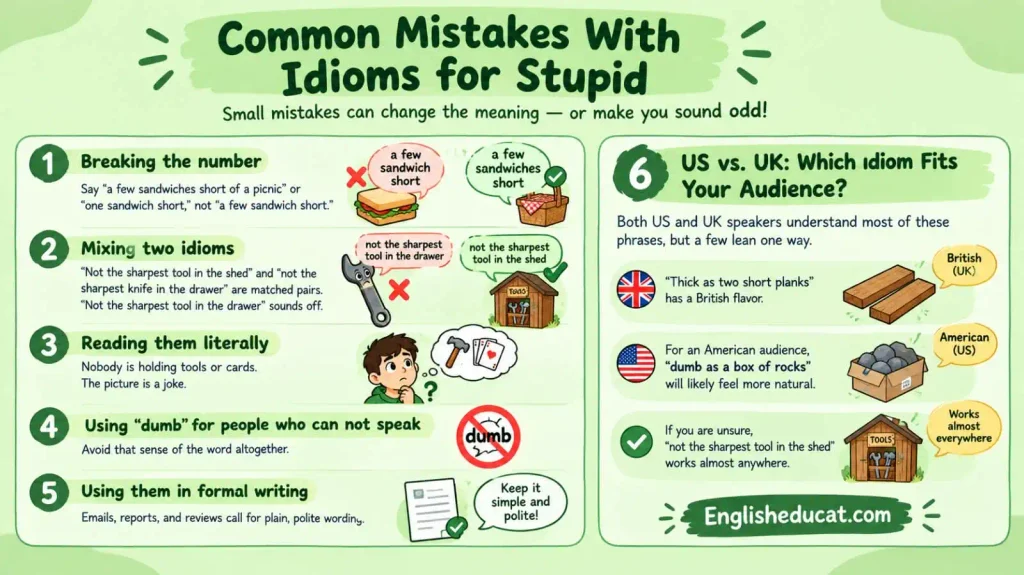
- Breaking the number. Say “a few sandwiches short of a picnic” or “one sandwich short,” not “a few sandwich short.”
- Mixing two idioms. “Not the sharpest tool in the shed” and “not the sharpest knife in the drawer” are matched pairs. “Not the sharpest tool in the drawer” sounds off.
- Reading them literally. Nobody is holding tools or cards. The picture is a joke.
- Using “dumb” for people who can not speak. Avoid that sense of the word altogether.
- Using them in formal writing. Emails, reports, and reviews call for plain, polite wording.
US vs. UK: Which Idiom Fits Your Audience?
Both US and UK speakers understand most of these phrases, but a few lean one way.
“Thick as two short planks” has a British flavor. For an American audience, “dumb as a box of rocks” will likely feel more natural. If you are unsure, “not the sharpest tool in the shed” works almost anywhere.
Frequently Asked Questions
What is a good idiom for stupid?
“Not the sharpest tool in the shed” is a good idiom for stupid because it is mild, popular, and easy to understand. Pick “slow on the uptake” if you want something even gentler.
Is “not the sharpest tool in the shed” offensive?
It is mild, but it can still hurt when said to someone’s face. It works best as teasing between friends or as a joke about yourself.
Where does “not playing with a full deck” come from?
Its earliest known use is a George Carlin routine from 1965, though earlier uses may exist. The phrase compares a mind to a deck of cards with some cards missing.
What is a polite way to say someone is stupid?
A polite way is to skip the insult and describe the situation, such as “he needs more time” or “she is still learning.” If you want humor, mild idioms about stupid like “slow on the uptake” are safer than harsh ones.
Conclusion
Idioms about stupid add humor to English, but tone matters more than the joke. Choose mild phrases for friends, plain words for work, and keep the harsh ones for jokes about yourself. Practice two or three, and use them with care.

ESL Content Writer
Emily is a TESOL-certified writer who has taught English to international students for over 8 years. She loves breaking down idioms and everyday expressions into simple, relatable explanations that make sense to learners at any level.