
Idioms about sun are everyday phrases that use sunshine to talk about luck, time, mood, and big chances. You will find 18 of them here in this article. Each one includes a plain meaning with a short note on its origin, and example sentences you can reuse. Some phrases praise success. Others warn about pride or describe a lazy afternoon. Read on to see which ones fit school, work, family talk, and casual chat.
Quick definition: Idioms about sun are fixed phrases that use the sun to describe success, timing, happiness, or risk. Example: “make hay while the sun shines” tells you to use a before it ends. You should also learn idioms about soccer, they will be very helpful for you.
Common Idioms about Sun at a Glance
The 18 most useful idioms about sun are given below, each with a one-line meaning.
| A place in the sun | A good, comfortable position in life | |
| A day in the sun | A short time of praise and attention | |
| The sun rises and sets on someone | You adore a person and see no flaws | |
| Make hay while the sun shines | Use a good chance while it lasts | |
| Rise with the sun | Wake up very early | |
| Go to bed with the sun | Sleep early, around sunset | |
| Dog days of summer | The hottest stretch of summer | |
| Under the sun | Anywhere on Earth | |
| Everything under the sun | Every possible thing | |
| Nothing new under the sun | No idea is truly new | |
| The sun never sets | Something reaches many places | |
| Ray of sunshine | A cheerful person who lifts others | |
| Walking on sunshine | Extremely happy | |
| Bask in the sun | Relax in warmth or enjoy praise | |
| Soak up the sun | Enjoy sunshine, often outdoors | |
| Catch some sun | Spend time in the sun, often to tan | |
| Fly too close to the sun | Take a risk that leads to a fall | |
| Have the sun in your eyes | Be blinded by sunlight |
Idioms About Success and Recognition
These three phrases use the sun to describe a good position, a short burst of praise, or deep love for someone. Some of the phrases are given below:
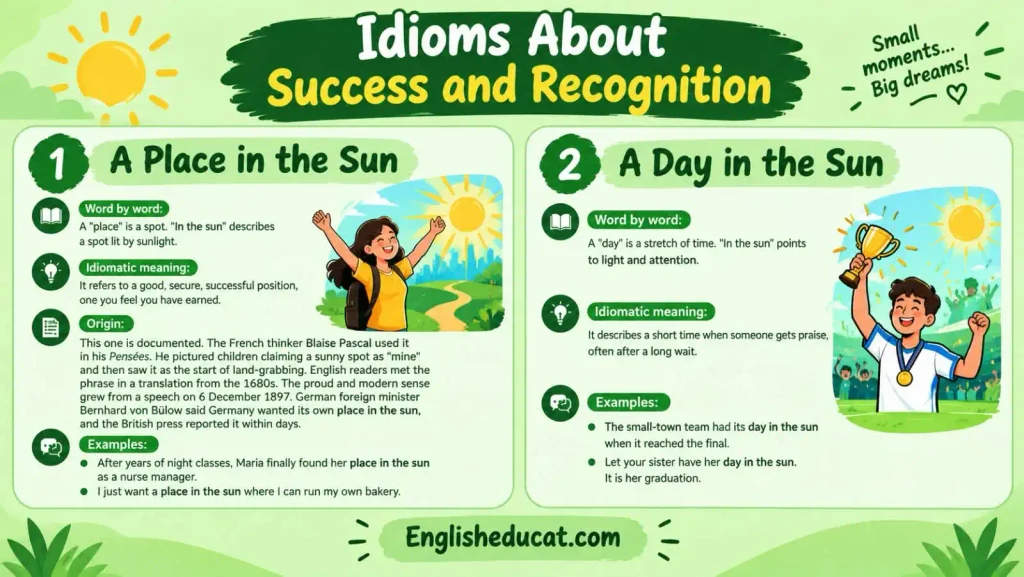
A Place in the Sun
Word by word:
A “place” is a spot. “In the sun” describes a spot lit by sunlight.
Idiomatic meaning:
It refers to a good, secure, successful position, one you feel you have earned.
Origin:
This one is documented. The French thinker Blaise Pascal used it in his Pensées. He pictured children claiming a sunny spot as “mine” and then saw it as the start of land-grabbing. English readers met the phrase in a translation from the 1680s. The proud and modern sense grew from a speech on 6 December 1897. German foreign minister Bernhard von Bülow said Germany wanted its own place in the sun, and the British press reported it within days.
Examples:
- After years of night classes, Maria finally found her place in the sun as a nurse manager.
- I just want a place in the sun where I can run my own bakery.
A Day in the Sun
Word by word:
A “day” is a stretch of time. “In the sun” points to light and attention.
Idiomatic meaning:
It describes a short time when someone gets praise, often after a long wait.
Examples:
- The small-town team had its day in the sun when it reached the final.
- Let your sister have her day in the sun. It is her graduation.
The Sun Rises and Sets on Someone
Word by word:
“Rises” means comes up in the morning. “Sets” means goes down at night.
Idiomatic meaning:
You think a person is perfect, so your whole day seems to circle around them. People usually say “think the sun rises and sets on” someone.
Examples:
- Grandfather of Tom thinks the sun rises and sets on him.
- My boss acts like the sun rises and sets on her new assistant.
Idioms About Time and Opportunity
These idioms about sun use sunrise, sunset, and summer heat to talk about timing. They are given below:
Make Hay While the Sun Shines
Word by word:
To “make hay” is to cut grass and dry it as animal food. “While” marks the same time. “The sun shines” describes good weather.
Idiomatic meaning:
It suggests using a good chance while it lasts.
Origin:
It is an old farming proverb. Hay dries well only in dry and sunny weather. I could not confirm the date of its first use, so I would not give one.
Examples:
- Prices are low this week, so let’s make hay while the sun shines and buy the laptops.
- Your exams are over. Make hay while the sun shines and take that trip.
Rise with the Sun
Word by word:
“Rise” means get up. “With the sun” means at the same time as sunrise.
Idiomatic meaning:
It refers to waking up very early.
Examples:
- Farmers often rise with the sun to feed the animals.
- On camping trips, our family rises with the sun and cooks breakfast outside.
Go to Bed with the Sun
Word by word:
“Go to bed” means head off to sleep. “With the sun” here means at sunset.
Idiomatic meaning:
It describes someone who sleeps early, as soon as the light fades.
Examples:
- My little brother goes to bed with the sun in winter.
- Grandma goes to bed with the sun and wakes before dawn.
Dog Days of Summer
Word by word:
“Dog” is a common animal. “Days” are stretches of time. “Summer” is the hot season.
Idiomatic meaning:
It points to the hottest, stickiest part of summer, usually July and August.
Origin:
The Romans noticed that the bright star Sirius, called the Dog Star, rose with the sun in midsummer. They blamed the star for the heat. The star does not cause it.
Examples:
- School is out; it is the dog days, and nobody wants to move.
- During the dog days, our shop opens at 6 a.m. to beat the heat.
Idioms About “Everything” and “Anywhere”
These phrases use the sun to describe everything, everywhere, or all of history.
Under the Sun
Word by word:
“Under” means below. “The sun” is the bright star in the sky, which shines on the whole world.
Idiomatic meaning:
It stands for anywhere on Earth, or “at all,” and adds emphasis.
Origin:
English speakers have used it since about 1200.
Examples:
- There is no better café under the sun.
- Nobody under the sun can fix this printer.
Everything Under the Sun
Word by word:
“Everything” means all things. “Under the sun” covers the whole world.
Idiomatic meaning:
It refers to every possible thing.
Examples:
- The market sells everything under the sun, from spices to bikes.
- The night manager has dealt with everything under the sun, even a goat in the lobby.
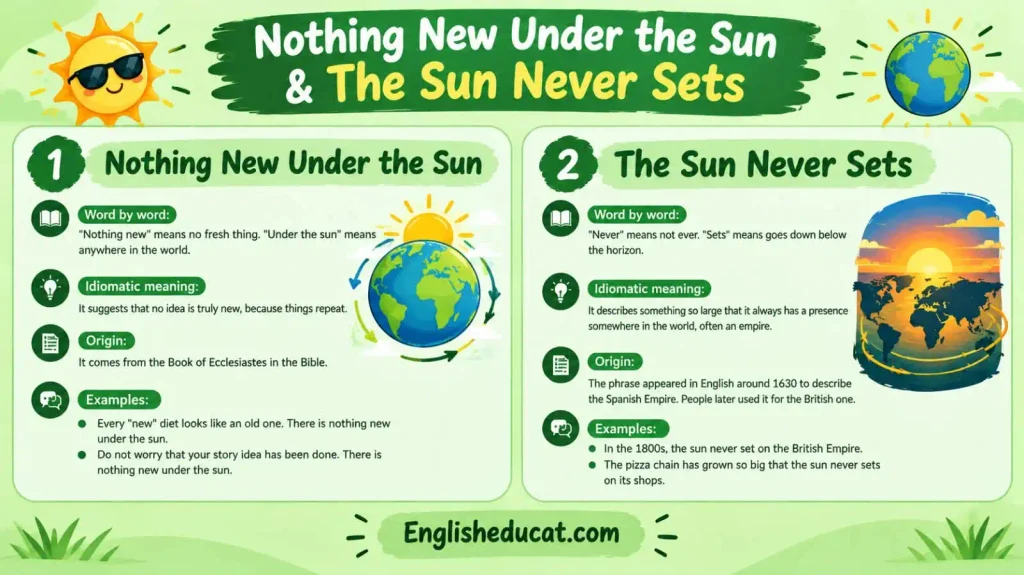
Nothing New Under the Sun
Word by word:
“Nothing new” means no fresh thing. “Under the sun” means anywhere in the world.
Idiomatic meaning:
It suggests that no idea is truly new, because things repeat.
Origin:
It comes from the Book of Ecclesiastes in the Bible.
Examples:
- Every “new” diet looks like an old one. There is nothing new under the sun.
- Do not worry that your story idea has been done. There is nothing new under the sun.
The Sun Never Sets
Word by word:
“Never” means not ever. “Sets” means goes down below the horizon.
Idiomatic meaning:
It describes something so large that it always has a presence somewhere in the world, often an empire.
Origin:
The phrase appeared in English around 1630 to describe the Spanish Empire. People later used it for the British one.
Examples:
- In the 1800s, the sun never set on the British Empire.
- The pizza chain has grown so big that the sun never sets on its shops.
Idioms About Mood and Warmth
These phrases use sunshine to describe happiness, cheerful people, and relaxing outdoors. They are given below:
Ray of Sunshine
Word by word:
A “ray” is a thin beam of light. “Sunshine” is the light and warmth of the sun.
Idiomatic meaning:
It describes a cheerful person who lifts the mood of others.
Origin:
“Sunshine” has stood for cheerfulness since the late 1500s. The “happy person” sense is recorded from 1942.
Examples:
- The new girl is a ray of sunshine. Everyone smiles when she walks in.
- You were a ray of sunshine in that long meeting.
Walking on Sunshine
Word by word:
“Walking” is moving on foot. “Sunshine” is warm light.
Idiomatic meaning:
It points to feeling extremely happy, almost light as air.
Examples:
- After the job offer, she was walking on sunshine all week.
- I am walking on sunshine today. My team won!
Bask in the Sun
Word by word:
To “bask” is to lie in warmth. “In the sun” names the source.
Idiomatic meaning:
It can be literal: lie in sunlight and relax. It also works figuratively, as in enjoying praise or attention.
Examples:
- The cat basks in the sun by the kitchen window.
- After her speech, she basked in the applause.
Soak Up the Sun
Word by word:
“Soak up” means to take in, like a sponge. “The sun” is the warm light.
Idiomatic meaning:
It refers to enjoying sunshine, usually while resting outdoors.
Examples:
- We spent Sunday soaking up the sun by the pool.
- After the long winter, the whole office soaked up the sun at lunch.
Catch Some Sun
Word by word:
“Catch” means grab. “Some sun” is a bit of sunlight.
Idiomatic meaning:
It describes spending time in the sun, often to get a tan.
Examples:
- Want to catch some sun after class?
- She went up to the roof to catch some sun on her break.
Idioms About Risk and Glare
Here are two phrases: one warns about taking big risks, and one is a plain description of bright light.
Fly Too Close to the Sun
Word by word:
“Fly” is to move through the air. “Too close” is nearer than is safe.
Idiomatic meaning:
It warns about reaching too high, too fast, and then crashing.
Origin:
It comes from the Greek myth of Icarus. His wings were made of feathers and wax. He flew near the sun; the wax melted, and he fell.
Examples:
- The start-up grew too fast and flew too close to the sun.
- Do not borrow that much money. You are flying too close to the sun.
Have the Sun in Your Eyes
Word by word:
“Have” means experience. “In your eyes” means shining straight at you.
Idiomatic meaning:
It is mostly literal. It describes sunlight so bright you cannot see well.
Examples:
- I missed the ball because I had the sun in my eyes.
- Drive slowly. I have got the sun in my eyes.
Tone and Connotation of Idioms about Sun
Most idioms about sun sound positive, but a few carry a warning or a cold edge.
| A place in the sun | Positive | Formal and casual |
| A day in the sun | Positive | Casual, news, sports |
| The sun rises and sets on someone | Positive, sometimes mocking | Family talk, casual chat |
| Make hay while the sun shines | Positive, pushy | Work, advice |
| Nothing new under the sun | Neutral, slightly gloomy | Essays, speeches |
| The sun never sets | Proud or neutral | History, business |
| Fly too close to the sun | Negative | Warnings, stories |
| Walking on sunshine | Very positive | Casual chat |
| Catch some sun | Light, relaxed | Casual chat |
Tone can change with history. “A place in the sun” began as Pascal’s complaint about grabbing land. In 1897, it became a proud claim for colonies. Today it sounds gentle and hopeful.
For formal writing, pick “a place in the sun,” “under the sun,” or “nothing new under the sun.” Keep “catch some sun” and “soak up the sun” for casual talk.
Common Mistakes with Idioms about Sun
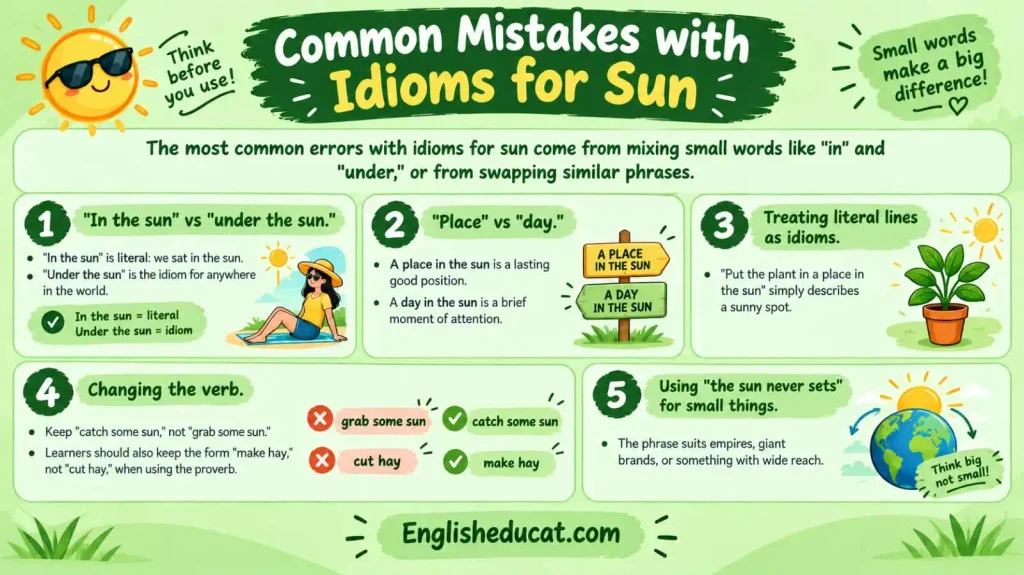
The most common errors with idioms about sun come from mixing small words like “in” and “under,” or from swapping similar phrases.
- “In the sun” vs “under the sun.” “In the sun” is literal: we sat in the sun. “Under the sun” is the idiom for anywhere in the world.
- “Place” vs. “day.” A place in the sun is a lasting good position. A day in the sun is a brief moment of attention.
- Treating literal lines as idioms. “Put the plant in a place in the sun” simply describes a sunny spot.
- Changing the verb. Keep “catch some sun,” not “grab some sun.” Learners should also keep the form “make hay,” not “cut hay,” when using the proverb.
- Using “the sun never sets” for small things. The phrase suits empires, giant brands, or something with wide reach.
Idioms about Sun vs Similar Idioms
Idioms about sun often overlap with other phrases, so it helps to see the small differences.
“Make hay while the sun shines” adds a hint that good weather will not last. “Strike while the iron is hot” focuses on acting fast at the perfect moment. “Seize the day” is about enjoying today, not about timing a chance.
“A place in the sun” and “a day in the sun” also differ. The first is a lasting spot. The second is a short flash of praise.
Frequently Asked Questions
What does “a place in the sun” mean, and where does it come from?
“A place in the sun” refers to a good, secure position in life. It traces back to Pascal’s Pensées and gained its modern sense from a German speech in 1897.
Is it “in the sun” or “under the sun”?
Both are correct, but they do different jobs. “In the sun” is literal, as in sitting in sunlight. “Under the sun” is the idiom for anywhere in the world.
What is the difference between “a place in the sun” and “a day in the sun”?
A place in the sun describes a lasting, good position. A day in the sun describes a short burst of praise, often after a long wait.
What does “make hay while the sun shines” mean?
It suggests using a good chance while it lasts. The phrase comes from farming, where hay must dry in dry, sunny weather.
Conclusion
The best idioms about sun are the ones you can use today. Start with “a place in the sun,” “make hay while the sun shines,” and “under the sun.” Watch the small words, and match the tone to the moment. Pick two or three from this list and try them in your next message or conversation.

Senior English Content Editor
Sarah has over 10 years of experience teaching English as a Second Language in Chicago public schools. She specializes in vocabulary building and simplifying complex word meanings for everyday learners. Sarah holds a Master’s degree in English Education from the University of Illinois.