

Idioms about memory are everyday phrases English speakers use to talk about remembering or forgetting without saying those plain words. Learning idioms about memory is one of the fastest ways to sound natural in English, because native speakers reach for them constantly in casual chat, at work, and even in the news. This guide covers twelve common idioms about memory, split into four easy groups: good memory, bad memory, reminding, and looking back at the past. For each of these idioms about memory, you will find the meaning, a short origin note, and two example sentences you can reuse right away.
Quick definition: Idioms about memory are everyday phrases like “jog your memory” or “memory like a sieve” that describe remembering, forgetting, or reminiscing in a colourful way instead of a plain one. This is very similar to idioms about dance, so you should also learn these idioms.
Why Learn Idioms About Memory?
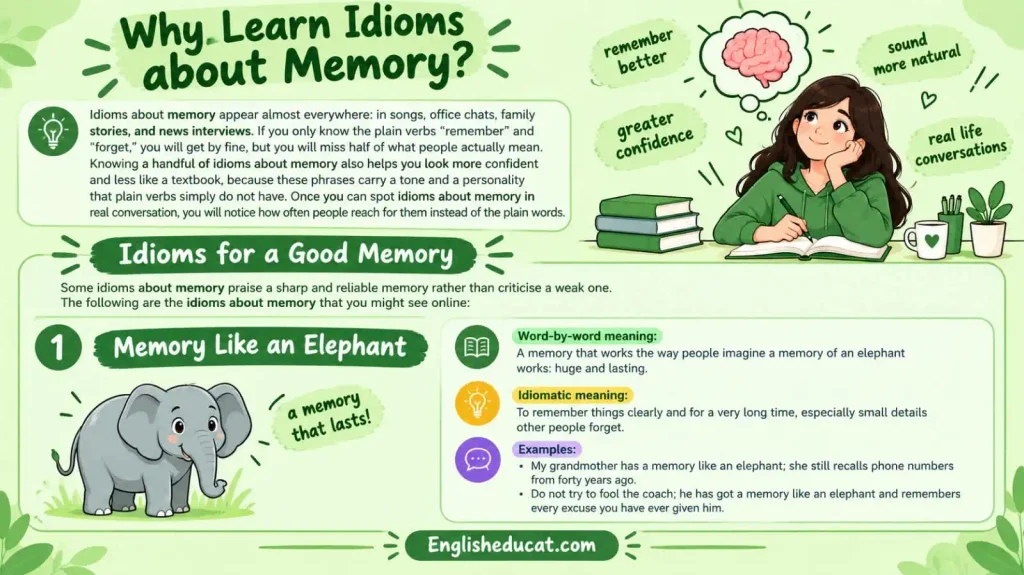
Idioms about memory appear almost everywhere: in songs, office chats, family stories, and news interviews. If you only know the plain verbs “remember” and “forget,” you will get by fine, but you will miss half of what people actually mean. Knowing a handful of idioms about memory also helps you look more confident and less like a textbook, because these phrases carry a tone and a personality that plain verbs simply do not have. Once you can spot idioms about memory in real conversation, you will notice how often people reach for them instead of the plain words.
Idioms for a Good Memory
Some idioms about memory praise a sharp and reliable memory rather than criticise a weak one. The following are the idioms about memory that you might see online:
Memory Like an Elephant
Word-by-word meaning:
A memory that works the way people imagine a memory of an elephant works: huge and lasting.
Idiomatic meaning:
To remember things clearly and for a very long time, especially small details other people forget.
Examples:
- My grandmother has a memory like an elephant; she still recalls phone numbers from forty years ago.
- Do not try to fool the coach; he has got a memory like an elephant and remembers every excuse you have ever given him.
Commit Something to Memory
Word-by-word meaning:
To hand something over to your memory the way you would commit money to a bank.
Idiomatic meaning:
To study or repeat something on purpose until you know it by heart.
Examples:
- The actor committed all forty pages of dialogue to memory before opening night.
- I do not have my password written down anywhere; I committed it to memory years ago.
Photographic Memory
Word-by-word meaning:
A memory that works like a photograph, capturing every detail exactly as it happened.
Idiomatic meaning:
To remember things with extremely sharp, almost picture-perfect detail.
Examples:
- She has a photographic memory and can describe a room she saw only once, months earlier.
- Chess players often train for something close to a photographic memory for board positions.
Learn By Heart
Word-by-word meaning:
To learn something so completely it feels stored close to your heart, not just your head.
Idiomatic meaning:
To memorise something fully, usually through repetition, so you can say or use it without checking.
Examples:
- The students learned the poem by heart for the school recital.
- I have heard that song so many times; I know the lyrics by heart.
Idioms for a Bad or Poor Memory
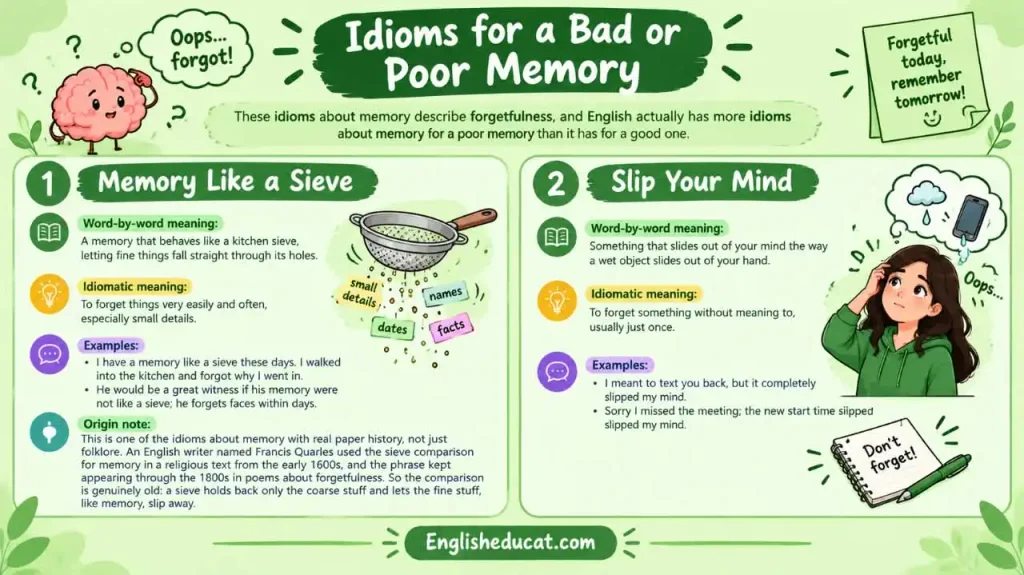
These idioms about memory describe forgetfulness, and English actually has more idioms about memory for a poor memory than it has for a good one.
Memory Like a Sieve
Word-by-word meaning:
A memory that behaves like a kitchen sieve, letting fine things fall straight through its holes.
Idiomatic meaning:
To forget things very easily and often, especially small details.
Examples:
- I have a memory like a sieve these days. I walked into the kitchen and forgot why I went in.
- He would be a great witness if his memory were not like a sieve; he forgets faces within days.
Origin note:
This is one of the idioms about memory with real paper history, not just folklore. An English writer named Francis Quarles used the sieve comparison for memory in a religious text from the early 1600s, and the phrase kept appearing through the 1800s in poems about forgetfulness. So the comparison is genuinely old: a sieve holds back only the coarse stuff and lets the fine stuff, like memory, slip away.
Slip Your Mind
Word-by-word meaning:
Something that slides out of your mind the way a wet object slides out of your hand.
Idiomatic meaning:
To forget something without meaning to, usually just once.
Examples:
- I meant to text you back, but it completely slipped my mind.
- Sorry I missed the meeting; the new start time slipped my mind.
Draw a Blank
Word-by-word meaning:
To reach into your memory and pull out nothing, like drawing an empty lottery ticket.
Idiomatic meaning:
To try hard to remember something and fail.
Examples:
- I tried to remember his name, but I drew a blank.
- The detective asked her where she was that night, and she just drew a blank.
In One Ear and Out the Other
Word-by-word meaning:
Information that enters through one ear and exits through the other without stopping.
Idiomatic meaning:
To hear something but forget it, or ignore it, almost right away.
Examples:
- I have told my brother three times about the party, but it goes in one ear and out the other.
- Everything the teacher says to him goes in one ear and out the other.
Have a Senior Moment
Word-by-word meaning:
A brief, forgetful moment jokingly blamed on getting older.
Idiomatic meaning:
A short, harmless memory lapse, often mentioned humorously about a small forgetful mistake.
Examples:
- I put my keys in the fridge this morning total senior moment.
- Do not worry about forgetting his name; we all have a senior moment now and then.
Idioms for Remembering and Reminding
This next group of idioms about memory describes the act of helping someone, or yourself, remember something.
Jog Someone’s Memory
Word-by-word meaning:
To give a memory a gentle push, the way a light nudge jogs someone’s elbow.
Idiomatic meaning:
To help someone remember something by giving them a hint, clue, or reminder.
Examples:
- This old photo might jog your memory about our trip to Rome.
- Can you jog my memory? I know we have met, but I can not place your name.
Register note: “Jog someone’s memory” is neutral; it works just as well in a casual chat with a friend as it does in a formal meeting or a courtroom.
Bear in Mind
Word-by-word meaning:
To carry a fact in your mind the way you would bear, or carry, a weight.
Idiomatic meaning:
To remember and consider something important while you make a decision or take an action.
Examples:
- Bear in mind that the store closes early on Sundays.
- You should bear in mind that prices always rise before the holidays.
Ring a Bell
Word-by-word meaning:
Something that makes a small bell sound in your mind.
Idiomatic meaning:
To sound familiar, even if you can not remember the full details.
Examples:
- That address rings a bell, but I can not remember whose house it is.
- Her name rings a bell; did she not work with us last year?
Idioms About Looking Back at the Past
This last group of idioms about memory is less about remembering facts and more about revisiting feelings from long ago.
Trip Down Memory Lane
Word-by-word meaning:
An imaginary walk down a road built from your own memories.
Idiomatic meaning:
To remember or talk about happy events from the past, often with a group of people.
Examples:
- Looking through these old yearbooks is such a trip down memory lane.
- The reunion turned into a long trip down memory lane, full of old stories.
Origin note:
Among idioms about memory, this one has an interesting paper trail. Written records of “memory’s lane” go back to at least the 1870s, in American newspaper ads for sentimental songs, and the shorter phrase kept appearing through the early 1900s. A well-known 1924 song simply titled “Memory Lane” is often credited with making the phrase popular, though the wording existed before that song did, so it is fair to call the song a booster of the phrase, not its inventor.
Common Mistakes With Idioms About Memory
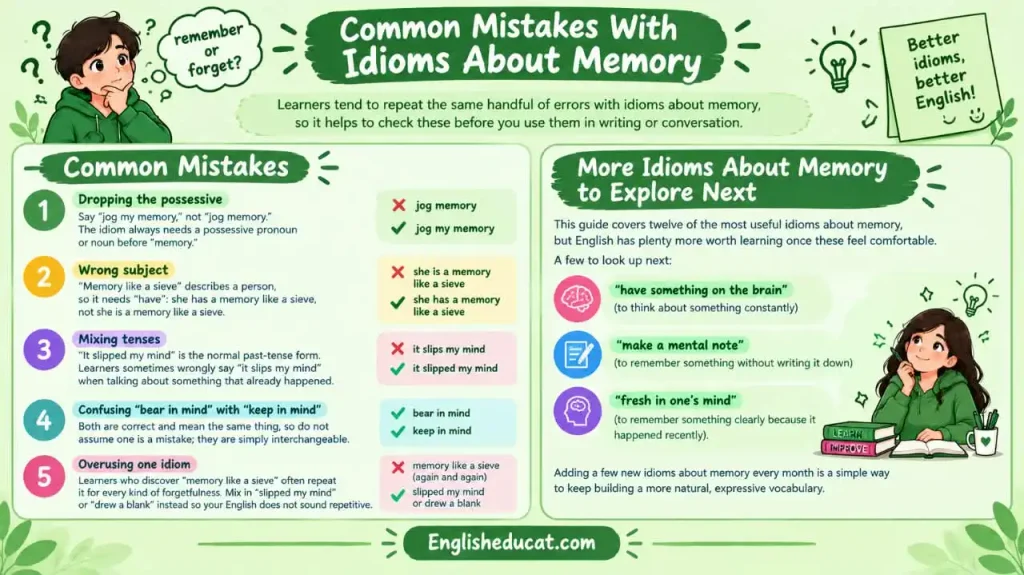
Learners tend to repeat the same handful of errors with idioms about memory, so it helps to check these before you use them in writing or conversation.
- Dropping the possessive: Say “jog my memory,” not “jog memory.” The idiom always needs a possessive pronoun or noun before “memory.”
- Wrong subject: “Memory like a sieve” describes a person, so it needs “have”: she has a memory like a sieve, not she is a memory like a sieve.
- Mixing tenses: “It slipped my mind” is the normal past-tense form. Learners sometimes wrongly say “it slips my mind” when talking about something that already happened.
- Confusing “bear in mind” with “keep in mind”: both are correct and mean the same thing, so do not assume one is a mistake; they are simply interchangeable.
- Overusing one idiom: learners who discover “memory like a sieve” often repeat it for every kind of forgetfulness. Mix in “slipped my mind” or “drew a blank” instead so your English does not sound repetitive.
More Idioms About Memory to Explore Next
This guide covers twelve of the most useful idioms about memory, but English has plenty more worth learning once these feel comfortable. A few to look up next: “have something on the brain” (to think about something constantly), “make a mental note” (to remember something without writing it down), and “fresh in one’s mind” (to remember something clearly because it happened recently). Adding a few new idioms about memory every month is a simple way to keep building a more natural, expressive vocabulary.
Frequently Asked Questions
What does “memory like a sieve” mean?
It means someone forgets things very easily, the same way a kitchen sieve lets fine material fall straight through its holes.
What is the origin of “trip down memory lane”?
The phrase appears in American newspapers as early as the 1870s, and a popular 1924 song called “Memory Lane” is usually credited with spreading it, even though the wording predates that song.
What is another way to say someone has a bad memory?
You can say they have “a memory like a sieve,” they “draw a blank” often, or things “go in one ear and out the other” for them.
Is “jog my memory” formal or informal?
It is neutral. You can use “jog my memory” in a casual conversation, a business meeting, or even a courtroom without sounding out of place.
Why are there so many idioms about memory in English?
English has built up dozens of idioms about memory over the centuries because remembering and forgetting are such common, relatable experiences. Nearly every culture jokes about a bad memory and admires a sharp one, and English has simply collected a large, colourful set of ways to say so.
Conclusion
Idioms about memory give you a natural and colourful way to talk about remembering and forgetting instead of relying on the same plain verbs every time. Start with a few idioms about memory that fit how you actually talk, maybe “slip my mind” for small forgetful moments and “jog my memory” when you need a hint. Practice these idioms about memory in real sentences, and they will start to feel as normal as the plain words they replace.

Senior English Content Editor
Sarah has over 10 years of experience teaching English as a Second Language in Chicago public schools. She specializes in vocabulary building and simplifying complex word meanings for everyday learners. Sarah holds a Master’s degree in English Education from the University of Illinois.