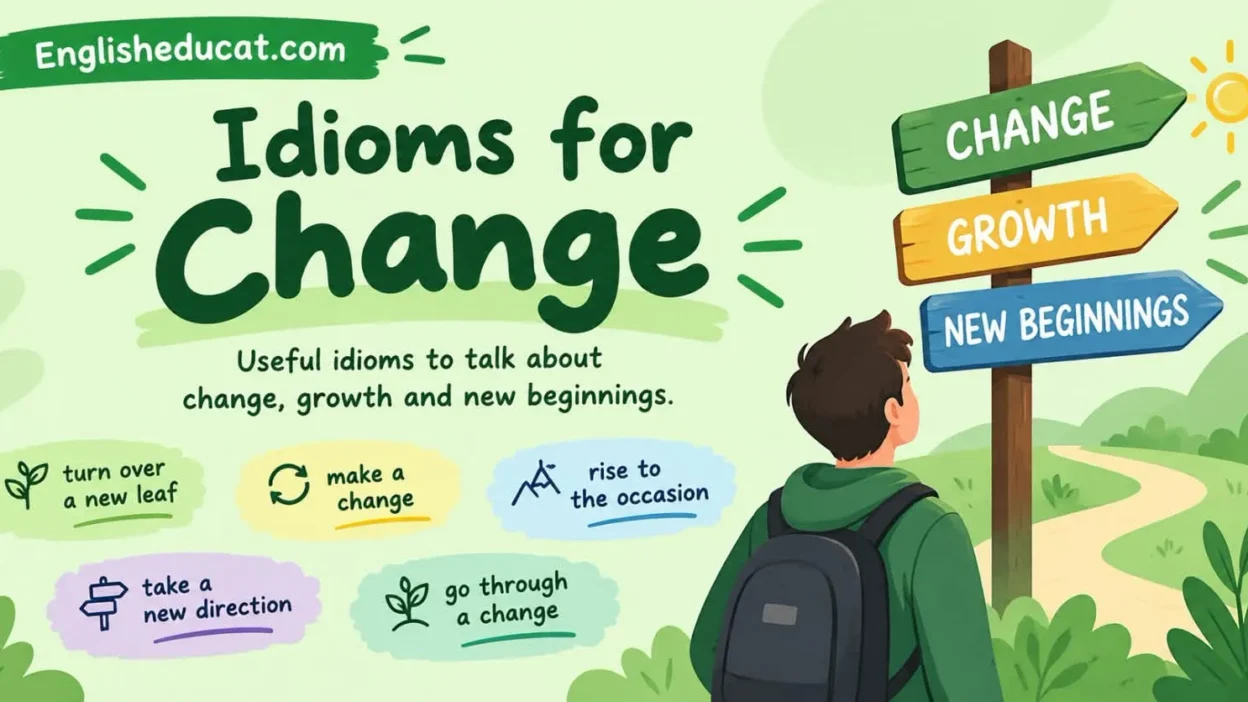
Idioms for change are fixed phrases that describe a change in plans, habits, opinions, or life itself. Each one paints a picture that the plain word “change” cannot. They range from personal growth to big shifts in society. Below, you will find word-by-word breakdowns, idiomatic meanings, known origins, and natural examples for 12 popular phrases. A tone guide, a comparison table, and a list of common mistakes follow in this guide.
Quick definition: An idiom for change is a set phrase that describes something becoming different, such as a new habit, opinion, or situation. Example: “He turned over a new leaf” suggests he began behaving better. There are many other idioms that are very helpful for you just like Beach and Funny.
What Are Idioms for Change?
Idioms for change are expressions whose meaning goes beyond their individual words and describe a shift. Most fall into three groups. Some describe personal change, like turning over a new leaf or changing your tune. Others describe large shifts, like winds of change. A few describe the opposite, a refusal to change, like a leopard can not change its spots. Knowing the group helps you pick the right phrase for the right moment.
Idioms for Change at a Glance
The table below contains all 12 phrases by the kind of change they describe, their tone, and how formal they sound.
| Turn over a new leaf | Better behavior, fresh start | Positive | Neutral |
| Change your tune | Shift in opinion or attitude | Neutral, can sound critical | Informal |
| A change of heart | Shift in feelings | Neutral | Neutral |
| Winds of change | Big shift on the way | Neutral | Neutral to formal |
| Sea change | Deep, lasting shift | Neutral | Neutral to formal |
| A leopard can’t change its spots | No real change | Negative | Informal |
| A change of pace | Break from routine | Positive | Neutral |
| A change of scenery | New place or setting | Positive | Neutral |
| Shake things up | Bold, planned disruption | Mixed | Informal |
| Start from scratch | Begin again with nothing | Neutral | Neutral |
| Don’t change horses in midstream | Keep plans mid-task | Cautionary | Informal |
| A change is as good as a rest | Variety refreshes you | Positive | Informal |
Turn Over a New Leaf
To turn over a new leaf is to start fresh and behave better than before.
Word-by-Word Meaning
- Turn over: flip to the other side.
- A new leaf: a fresh page. In older English, “leaf” was a word for a page in a book.
Idiomatic Meaning
It describes a choice to drop old habits and begin again. The phrase dates to the 1500s, when “leaf” was a common word for a book page, although sources disagree on its earliest use. Of all the idioms for change, it is the one most tied to New Year promises. It usually points to a better path, though not always.
Examples
- After the first failed quiz, Omar turned over a new leaf and studied every night.
- My uncle turned over a new leaf and quit smoking last spring.
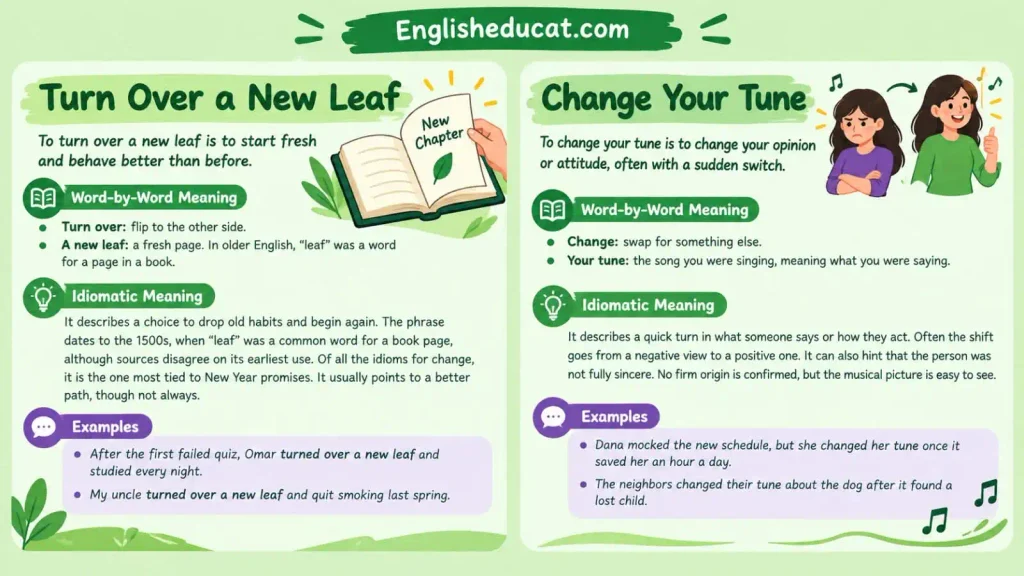
Change Your Tune
To change your tune is to change your opinion or attitude, often with a sudden switch.
Word-by-Word Meaning
- Change: swap for something else.
- Your tune: the song you were singing, meaning what you were saying.
Idiomatic Meaning
It describes a quick turn in what someone says or how they act. Often the shift goes from a negative view to a positive one. It can also hint that the person was not fully sincere. No firm origin is confirmed, but the musical picture is easy to see.
Examples
- Dana mocked the new schedule, but she changed her tune once it saved her an hour a day.
- The neighbors changed their tune about the dog after it found a lost child.
A Change of Heart
A change of heart is a change in how you feel about a choice you made.
Word-by-Word Meaning
- A change: one swap.
- Of heart: belonging to your feelings, since the heart stands for emotion.
Idiomatic Meaning
It points to a decision that flips because your feelings moved, often at the last minute. The change is personal and softer than a change of opinion. No confirmed origin is on record here.
Examples
- Mia planned to sell the house, then had a change of heart after one last walk through it.
- He meant to skip the family dinner but had a change of heart and showed up with dessert.
Winds of Change
Winds of change refers to a strong sense that big shifts are on the way.
Word-by-Word Meaning
- Winds: moving air.
- Of change: carrying a shift with them.
Idiomatic Meaning
It describes trends in society, work, or politics. Among idioms for change, this one fits news and speeches best. The phrase is closely linked to a 1960 speech by British Prime Minister Harold Macmillan in South Africa. His exact words were “wind of change,” in the singular, but most people now say “winds.”
Examples
- A new principal arrived, and the winds of change blew through every classroom.
- Winds of change are coming to our town’s bus system next year.
Sea Change
A sea change is a deep, noticeable transformation.
Word-by-Word Meaning
- Sea: a large body of salt water.
- Change: becoming different.
Idiomatic Meaning
Of the idioms for change in this list, this one has the clearest paper trail. It comes from Shakespeare’s play The Tempest, written around 1610. A spirit sings that a drowned man’s body goes through a “sea-change” into something “rich and strange.” Today the sea link has faded, and the phrase just signals a big shift.
Examples
- Online shopping caused a sea change in how small shops sell their goods.
- Moving abroad brought a sea change in her daily life.
A Leopard Can Not Change Its Spots
This saying states that people do not truly change their basic nature.
Word-by-Word Meaning
- A leopard: a large cat with a spotted coat.
- Can not change its spots: can not swap the marks on its fur.
Idiomatic Meaning
Speakers use it to doubt a promise to change. It stands apart from other idioms for change, because it doubts that change will happen at all. The usual source is the Book of Jeremiah in the Bible, which asks whether a leopard can change its spots. The tone is negative, so use it with care.
Examples
- He swears he will be on time now, but a leopard can not change its spots.
- Do not expect the new boss to be kinder. A leopard can not change its spots.
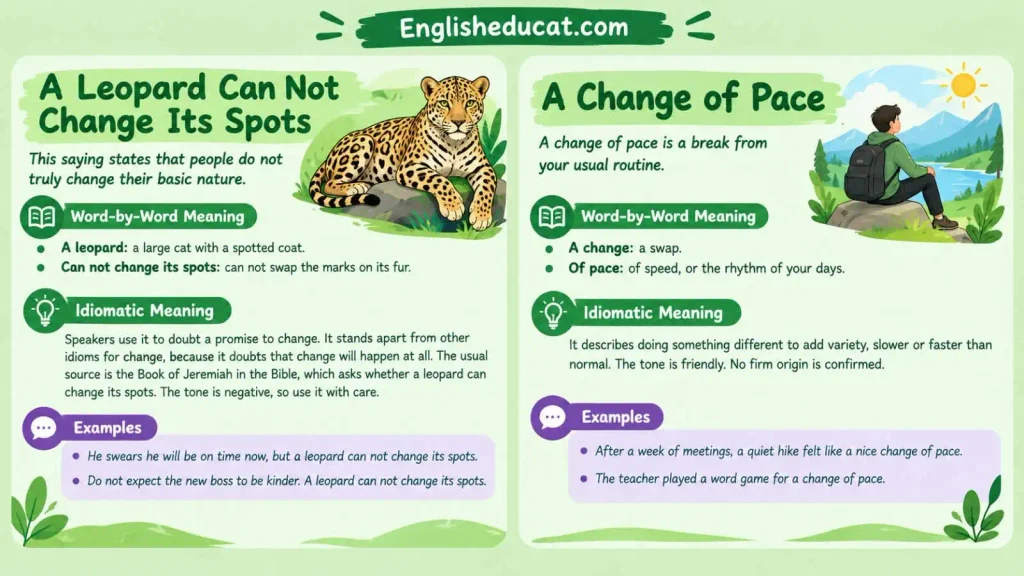
A Change of Pace
A change of pace is a break from your usual routine.
Word-by-Word Meaning
- A change: a swap.
- Of pace: of speed, or the rhythm of your days.
Idiomatic Meaning
It describes doing something different to add variety, slower or faster than normal. The tone is friendly. No firm origin is confirmed.
Examples
- After a week of meetings, a quiet hike felt like a nice change of pace.
- The teacher played a word game for a change of pace.
A Change of Scenery
A change of scenery is a move to a new place for a fresh view.
Word-by-Word Meaning
- A change: a swap.
- Of scenery: of the view around you.
Idiomatic Meaning
It refers to leaving your usual spot to feel refreshed, even for a short time. You may also see “change of scene.” Both versions work.
Examples
- She worked from a cafe for a change of scenery.
- After the long winter, the family drove south for a change of scenery.
Shake Things Up
To shake things up is to make bold changes to a stale situation.
Word-by-Word Meaning
- Shake: move back and forth with force.
- Things up: the situation, mixed around like items in a jar.
Idiomatic Meaning
It describes a planned effort to disturb routine and spark new energy. Few idioms for change carry as much punch as this one. The result can be good or bad, so the tone is mixed.
Examples
- The new coach wants to shake things up by changing the whole lineup.
- Let’s shake things up and cook something new tonight.
Start From Scratch
To start from scratch is to begin again with nothing from the old attempt.
Word-by-Word Meaning
- Start: begin.
- From scratch: from the first mark. One common explanation points to a line scratched on the ground to mark the start of a race.
Idiomatic Meaning
It suggests a full restart, often because the first try failed. The change may be forced, so the tone is neutral. The race-line origin is a common explanation, not a confirmed one.
Examples
- The file was lost, so we had to start from scratch on the project.
- The cake burned, and I started from scratch with new eggs.
Do not Change Horses in Midstream
This saying advises against switching plans or leaders in the middle of a task.
Word-by-Word Meaning
- Change horses: swap the animals you ride.
- In midstream: in the middle of a river.
Idiomatic Meaning
It warns that a change at the wrong moment causes trouble. The saying is often tied to Abraham Lincoln’s 1864 re-election campaign, though it is unclear whether he coined it. It is a cautionary phrase about resisting change.
Examples
- We are halfway through the move, so do not change horses in midstream.
- The team wanted a new captain mid-season, but the coach said not to change horses in midstream.
A Change Is as Good as a Rest
This saying claims that doing something different can refresh you as much as a break.
Word-by-Word Meaning
- A change: a swap in activity.
- Is as good as a rest: gives the same relief as relaxing.
Idiomatic Meaning
It encourages switching tasks when you feel tired. Many people use it with a light, friendly tone. No confirmed origin is on record here.
Examples
- I switched from emails to writing a report. A change is as good as a rest.
- Studying math after history gave me new energy. A change is as good as a rest.
Change Your Mind vs. Change Your Tune vs. a Change of Heart
Change your mind is about a new decision, change your tune is about a shift in what you say, and a change of heart is about feelings. These three idioms for change are easy to mix up.
| Change your mind | An opinion or decision | Neutral, everyday | “I changed my mind and ordered the soup.” |
| Change your tune | The attitude you show | Can sound critical | “He changed his tune when prices rose.” |
| A change of heart | Your feelings | Softer, personal | “She had a change of heart about moving.” |
Formal vs. Informal Use of Idioms for Change
Most of these phrases suit casual speech, while winds of change and sea change also work in news and reports.
Phrases like shake things up and a leopard can not change its spots sound relaxed. Save them for chats, friendly emails, and spoken talk. For essays or reports, sea change and winds of change fit better.
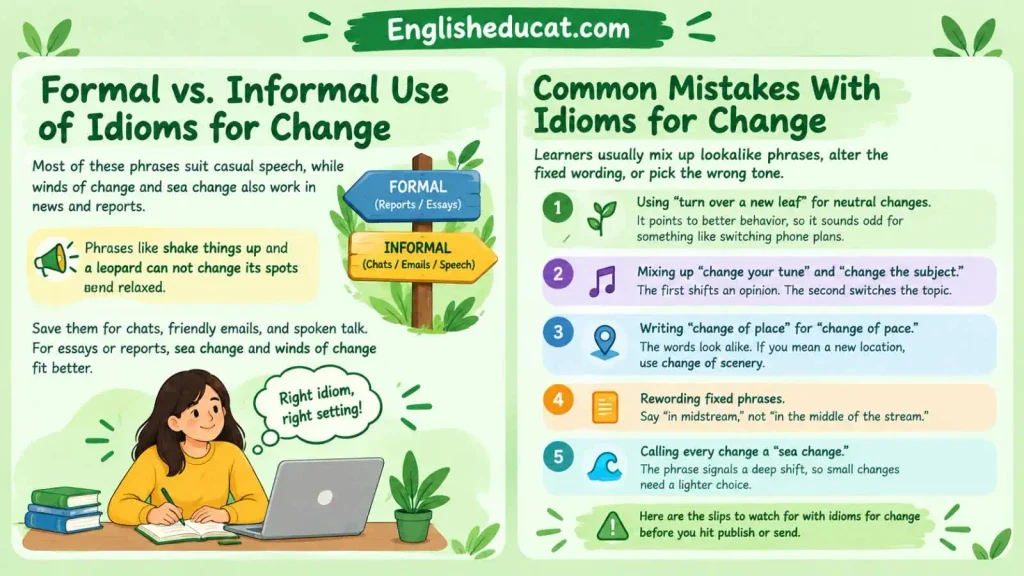
Common Mistakes With Idioms for Change
Learners usually mix up lookalike phrases, alter the fixed wording, or pick the wrong tone.
- Using “turn over a new leaf” for neutral changes. It points to better behavior, so it sounds odd for something like switching phone plans.
- Mixing up “change your tune” and “change the subject.” The first shifts an opinion. The second switches the topic.
- Writing “change of place” for “change of pace.” The words look alike. If you mean a new location, use change of scenery.
- Rewording fixed phrases. Say “in midstream,” not “in the middle of the stream.”
- Calling every change a “sea change.” The phrase signals a deep shift, so small changes need a lighter choice.
Here are the slips to watch for with idioms for change before you hit publish or send.
Frequently Asked Questions
What are the most common idioms for change?
Turn over a new leaf, change your tune, a change of heart, winds of change, and sea change are among the most common. They appear in speech, news, and school writing.
Are idioms for change formal or informal?
Most idioms for change are informal or neutral, so they fit chats and casual work talk best. Winds of change and sea change also appear in news writing.
What is the difference between “change your mind” and “change your tune”?
Change your mind describes a new decision. Change your tune describes a shift in what you say or how you act, often a switch from a negative view to a positive one.
Which idiom describes a change for the better?
Turn over a new leaf is the best-known choice. It points to better behavior and a fresh start.
Conclusion
These idioms for change will give your English color and precision. Use turn over a new leaf for fresh starts, winds of change for big trends, and change your tune for sudden change in view. Pick two or three from this list and use them this week. Practice makes them natural.

Senior English Content Editor
Sarah has over 10 years of experience teaching English as a Second Language in Chicago public schools. She specializes in vocabulary building and simplifying complex word meanings for everyday learners. Sarah holds a Master’s degree in English Education from the University of Illinois.