
Idioms about nature is a phrase that borrows an image from the outdoors a storm, a tree, a river to describe something that has nothing to do with weather or plants. Below you will find 25 common idioms about nature, where each one came from, and real example sentences you can reuse. You will also see how British and American speakers use these phrases differently, and also the mistakes learners make most often while reading idioms just like idioms about trust. .
Quick definition: Idioms about nature uses a natural image (weather, land, water, plants) to express a human feeling or situation. Example: “weather the storm” does not mean surviving bad weather; it means getting through a hard time.
What Are Nature Idioms? (Idiom vs. Proverb)
Idioms about nature is a fixed phrase that means something different from its literal words, built from images found in nature. An idiom and a proverb are not the same thing. An idiom, like “out of the woods,” has no moral lesson; it just describes a situation. A proverb, like “the early bird catches the worm,” teaches a piece of advice. Nature gives English speakers hundreds of idioms because storms, rivers, and seasons are things everyone understands, no matter where they live.
25 Common Nature Idioms: Meaning, Origin, and Examples
The following are idioms about sadness explained with examples:
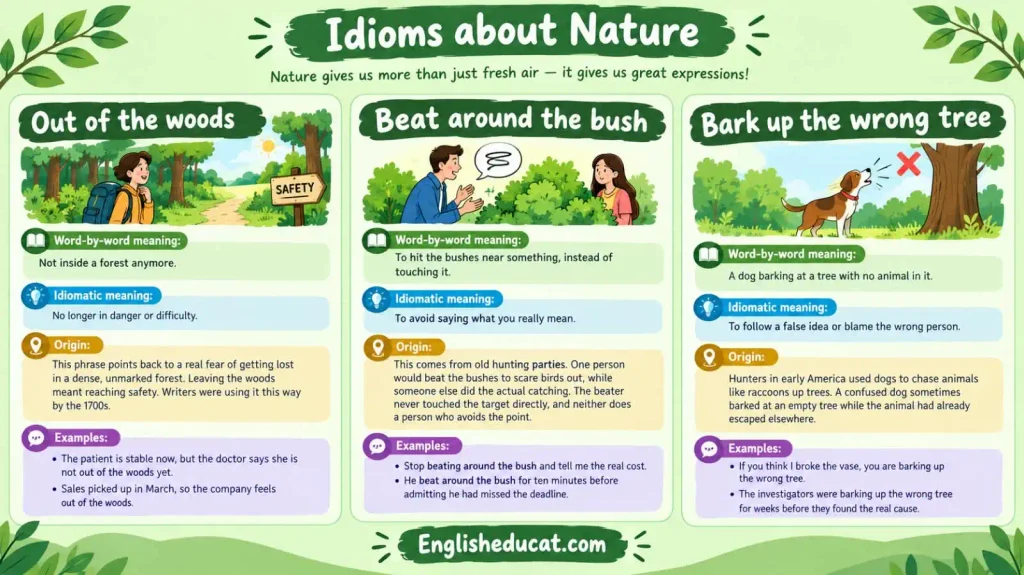
1. Out of the woods
Word-by-word meaning:
Not inside a forest anymore.
Idiomatic meaning:
No longer in danger or difficulty.
Origin:
This phrase points back to a real fear of getting lost in a dense, unmarked forest. Leaving the woods meant reaching safety. Writers were using it this way by the 1700s.
Examples:
- The patient is stable now, but the doctor says she is not out of the woods yet.
- Sales picked up in March, so the company feels out of the woods.
2. Beat around the bush
Word-by-word meaning:
To hit the bushes near something, instead of touching it.
Idiomatic meaning:
To avoid saying what you really mean.
Origin:
This comes from old hunting parties. One person would beat the bushes to scare birds out, while someone else did the actual catching. The beater never touched the target directly, and neither does a person who avoids the point.
Examples:
- Stop beating around the bush and tell me the real cost.
- He beat around the bush for ten minutes before admitting he had missed the deadline.
3. Bark up the wrong tree
Word-by-word meaning:
A dog barking at a tree with no animal in it.
Idiomatic meaning:
To follow a false idea or blame the wrong person.
Origin:
Hunters in early America used dogs to chase animals like raccoons up trees. A confused dog sometimes barked at an empty tree while the animal had already escaped elsewhere.
Examples:
- If you think I broke the vase, you are barking up the wrong tree.
- The investigators were barking up the wrong tree for weeks before they found the real cause.
4. Make a mountain out of a molehill
Word-by-word meaning:
Turning a small pile of dirt into a huge mountain.
Idiomatic meaning:
To treat a small problem as if it were a huge one.
Origin:
This expression has been used in English since at least the 1500s, likely adapted from an older Latin saying about exaggeration.
Examples:
- It is just a scratch on the car; do not make a mountain out of a molehill.
- She made a mountain out of a molehill over one typo in the report.
5. A drop in the ocean
Word-by-word meaning:
One single drop of water inside a massive ocean.
Idiomatic meaning:
An amount so small it barely matters.
Origin:
This image appears in old religious texts describing nations as tiny compared to a higher power, and it evolved into everyday speech over centuries. Americans usually say “a drop in the bucket” instead.
Examples:
- My donation felt like a drop in the ocean next to what the charity actually needed.
- One recycled bottle is a drop in the ocean, but every bit helps.
6. Weather the storm
Word-by-word meaning:
A ship surviving a storm at sea.
Idiomatic meaning:
To get through a hard or stressful period.
Origin:
Sailors used this phrase literally, describing a ship that made it through rough seas without sinking. It later applied to any tough situation on land.
Examples:
- Small businesses that weathered the storm of the recession came back stronger.
- We weathered the storm of exam week and finally got some sleep.
7. The calm before the storm
Word-by-word meaning:
Quiet weather right before a storm arrives.
Idiomatic meaning:
A peaceful moment right before something stressful or busy begins.
Origin:
Sailors and farmers noticed this weather pattern long before it became a figure of speech, and English writers picked it up as a metaphor centuries ago.
Examples:
- The office was silent on Sunday, the calm before the storm of Monday’s big launch.
- Their toddler was napping quietly, but the parents knew it was the calm before the storm.
8. Every cloud has a silver lining
Word-by-word meaning:
A dark rain cloud with a bright silver edge from sunlight behind it.
Idiomatic meaning:
Something good can be found in every bad situation.
Origin:
This phrase comes from a line in John Milton’s 1634 poem Comus, which described a dark cloud turning “forth her silver lining” toward the viewer.
Examples:
- I lost my job, but every cloud has a silver lining; I finally started my own business.
- The trip got cancelled, though every cloud has a silver lining: we saved the money.
9. Go with the flow
Word-by-word meaning:
Moving in the same direction as a river’s current.
Idiomatic meaning:
To relax and accept things as they happen, instead of fighting them.
Origin:
This phrase spread widely in the mid-1900s, drawing on the simple image of a river current that carries things along without resistance.
Examples:
- The schedule kept changing, so we just decided to go with the flow.
- She is easygoing at work and always goes with the flow when plans shift.
10. A breath of fresh air
Word-by-word meaning:
Clean outdoor air after being somewhere stale or stuffy.
Idiomatic meaning:
A refreshing change from something boring or unpleasant.
Origin:
Writers have used this phrase since at least the 1800s to describe anything that feels new and welcome after something tiresome.
Examples:
- The new manager is a breath of fresh air after years of poor leadership.
- Her honest feedback was a breath of fresh air in a meeting full of vague comments.
11. Still waters run deep
Word-by-word meaning:
A calm, quiet river often hides a deep, strong current underneath.
Idiomatic meaning:
A quiet person often has strong feelings or deep thoughts they do not show.
Origin:
This idea traces back to old Latin proverbs about loud rivers being shallow, and English writers were using it by the 1300s.
Examples:
- He barely speaks in meetings, but still waters run deep; his ideas are usually the best ones.
- Do not assume she is shy; still waters run deep with that one.
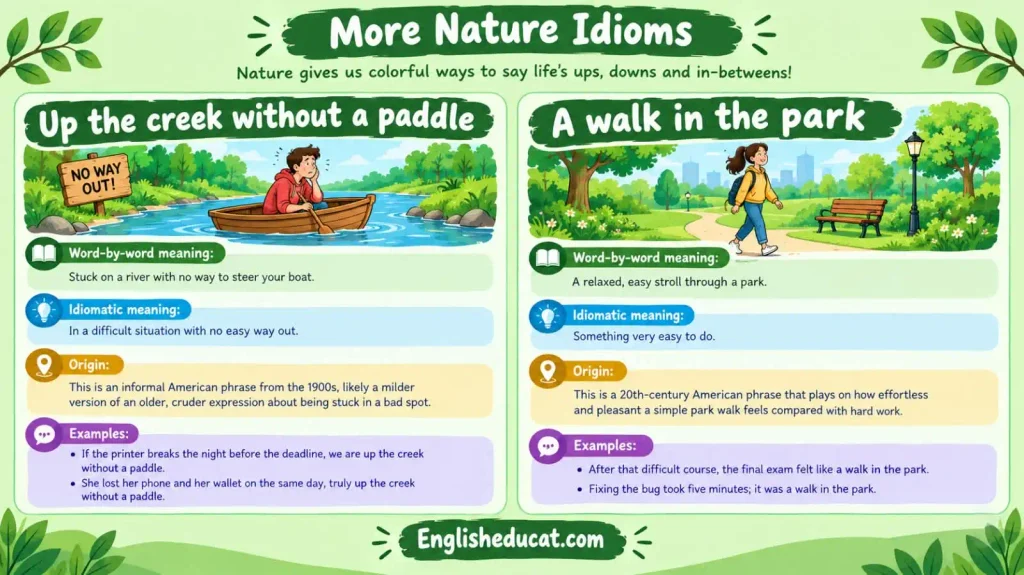
12. Up the creek without a paddle
Word-by-word meaning:
Stuck on a river with no way to steer your boat.
Idiomatic meaning:
In a difficult situation with no easy way out.
Origin:
This is an informal American phrase from the 1900s, likely a milder version of an older, cruder expression about being stuck in a bad spot.
Examples:
- If the printer breaks the night before the deadline, we are up the creek without a paddle.
- She lost her phone and her wallet on the same day, truly up the creek without a paddle.
13. A walk in the park
Word-by-word meaning:
A relaxed, easy stroll through a park.
Idiomatic meaning:
Something very easy to do.
Origin:
This is a 20th-century American phrase that plays on how effortless and pleasant a simple park walk feels compared with hard work.
Examples:
- After that difficult course, the final exam felt like a walk in the park.
- Fixing the bug took five minutes; it was a walk in the park.
14. Make hay while the sun shines
Word-by-word meaning:
Cutting and drying hay only while the weather stays dry and sunny.
Idiomatic meaning:
To use a good opportunity while it lasts.
Origin:
This farming proverb dates back to at least the 1500s, since wet hay rots and farmers had to work fast during dry spells.
Examples:
- Orders are pouring in this month, so we are making hay while the sun shines.
- She took every extra shift during the busy season, making hay while the sun shines.
15. Let the grass grow under your feet
Word-by-word meaning:
Standing so still that grass grows up around your shoes.
Idiomatic meaning:
To waste time or delay taking action (usually used as “do not let the grass grow under your feet”).
Origin:
English speakers have used this image of stillness and delay since around the 1500s.
Examples:
- Do not let the grass grow under your feet; apply for the job today.
- He never lets the grass grow under his feet; he starts new projects right away.
16. The grass is always greener
Word-by-word meaning:
A neighbor’s lawn looking greener than your own.
Idiomatic meaning:
Situations of other people often seem better than they really are.
Origin:
This modern phrasing grew out of older proverbs about envy and comparison, and it became common in the mid-1900s.
Examples:
- He keeps changing jobs, chasing the idea that the grass is always greener.
- I used to envy her travel schedule, but the grass is not always greener.
17. Head in the clouds
Word-by-word meaning:
Your head floating up among the clouds, far from the ground.
Idiomatic meaning:
Daydreaming or out of touch with practical reality.
Origin:
This phrase is often traced to the 1600s, a time when most people worked the land and being “grounded” mattered a great deal.
Examples:
- He is brilliant, but he has his head in the clouds when it comes to deadlines.
- Stop keeping your head in the clouds and focus on the budget.
18. Down to earth
Word-by-word meaning:
Standing firmly on solid ground, not floating away.
Idiomatic meaning:
Practical, honest, and easy to relate to.
Origin:
This phrase grew from the same “grounded” imagery as “head in the clouds,” gaining popularity in the early 1900s as its opposite.
Examples:
- My mentor is so down to earth she gives advice I can actually use.
- Despite his fame, he has stayed down to earth with old friends.
19. Nip it in the bud
Word-by-word meaning:
Pinching off a flower bud before it can open.
Idiomatic meaning:
To stop a problem early, before it grows worse.
Origin:
This comes straight from gardening, where cutting a bud early stops a plant from developing in an unwanted direction. It has been used this way since the 1500s.
Examples:
- The teacher nipped the classroom chatter in the bud before it spread.
- Address small conflicts early and nip them in the bud.
20. Take a leaf out of someone’s book
Word-by-word meaning:
Copying a page from another person’s book.
Idiomatic meaning:
To follow someone’s good example.
Origin:
This phrase spread in the 1800s, when books and their pages were a common symbol for borrowed ideas.
Examples:
- I started waking up earlier, taking a leaf out of my roommate’s book.
- New employees often take a leaf out of the top performer’s book.
21. Can not see the wood for the trees
Word-by-word meaning:
Standing so close to individual trees that you can not view the whole forest.
Idiomatic meaning:
Focusing on small details while missing the bigger picture.
Origin:
This idiom appears in English writing from as far back as the 1500s. British English keeps “wood,” while American English usually says “forest” instead.
Examples:
- He spent so long fixing one sentence that he could not see the wood for the trees.
- Step back from the numbers; you can not see the wood for the trees right now.
22. Once in a blue moon
Word-by-word meaning:
During the rare second full moon that sometimes appears within one month.
Idiomatic meaning:
Very rarely.
Origin:
English speakers used “blue moon” to mean something absurd or impossible as early as the 1500s, and it later settled into meaning “rare” once astronomers linked it to an actual calendar event.
Examples:
- We only eat out once in a blue moon.
- He calls his parents once in a blue moon, usually on holidays.
23. Under the weather
Word-by-word meaning:
Below deck on a ship, away from stormy conditions outside.
Idiomatic meaning:
Feeling slightly sick.
Origin:
Sailors who felt seasick were sent below deck, away from the weather, to recover. The phrase moved ashore and now applies to anyone feeling unwell.
Examples:
- I am feeling a bit under the weather, so I will skip the gym today.
- She stayed home from school because she was under the weather.
24. Lead someone up the garden path
Word-by-word meaning:
Walking someone along a winding garden path instead of a direct route.
Idiomatic meaning:
To mislead or deceive someone.
Origin:
This is a distinctly British phrase from the early 1900s, built on the idea of leading someone somewhere indirectly on purpose.
Examples:
- The salesman led us up the garden path with promises he never kept.
- Do not let that ad lead you up the garden path; read the fine print.
25. Fresh as a daisy
Word-by-word meaning:
A daisy flower that closes at night and opens bright again each morning.
Idiomatic meaning:
Well-rested and full of energy.
Origin:
Writers have used daisies as a symbol of freshness since the 1800s, based on how the flower renews itself daily.
Examples:
- She looked fresh as a daisy even after three back-to-back meetings.
- After a full night’s sleep, he woke up fresh as a daisy.
British vs. American Nature Idioms
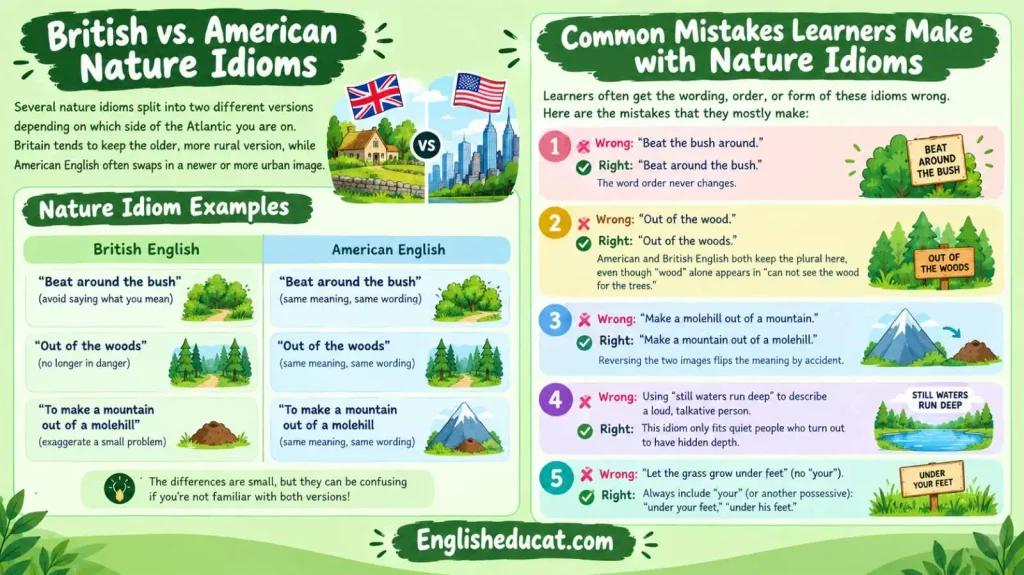
Several nature idioms split into two different versions depending on which side of the Atlantic you are on. Britain tends to keep the older, more rural version, while American English often swaps in a newer or more urban image.
Common Mistakes Learners Make with Nature Idioms
Learners often get the wording, order, or form of these idioms wrong. Here are the mistakes that they mostly make:
- Wrong: “Beat the bush around.” Right: “Beat around the bush.” The word order never changes.
- Wrong: “Out of the wood.” Right: “Out of the woods.” American and British English both keep the plural here, even though “wood” alone appears in “can not see the wood for the trees.”
- Wrong: “Make a molehill out of a mountain.” Right: “Make a mountain out of a molehill.” Reversing the two images flips the meaning by accident.
- Wrong: Using “still waters run deep” to describe a loud, talkative person. Right: This idiom only fits quiet people who turn out to have hidden depth.
- Wrong: “Let the grass grow under feet” (no “your”). Right: Always include “your” (or another possessive): “under your feet,” “under his feet.”
Nature Idioms by Theme
Weather idioms
Weather idioms turn storms, rain, and sunshine into stand-ins for mood and hardship: weather the storm, the calm before the storm, every cloud has a silver lining, under the weather, make hay while the sun shines.
Trees and woods idioms
These phrases use forests and trees to picture confusion, safety, or good example: out of the woods, bark up the wrong tree, can not see the wood for the trees, take a leaf out of someone’s book, nip it in the bud.
Water idioms
Rivers, oceans, and creeks describe emotional depth and risk in these expressions: a drop in the ocean, still waters run deep, up the creek without a paddle, go with the flow.
Earth and land idioms
Land-based idioms often describe character or ease: down to earth, a walk in the park, the grass is always greener, let the grass grow under your feet, head in the clouds, lead someone up the garden path, fresh as a daisy, make a mountain out of a molehill, once in a blue moon.
Frequently Asked Questions
What are some common nature idioms in English?
Some of the most common nature idioms are “out of the woods,” “beat around the bush,” “weather the storm,” and “down to earth.” Each one uses a natural image to describe a human situation instead of the weather or landscape itself.
Do nature idioms actually describe nature?
No, nature idioms rarely describe nature literally; they borrow natural images to describe feelings, people, or events. “Weather the storm,” for example, is usually about surviving a hard time at work or in life, not an actual storm.
What is the difference between “can not see the wood for the trees” and “can not see the forest for the trees”?
They mean the same thing: missing the big picture because you are stuck on small details. British English uses “wood,” while American English uses “forest.”
Which nature idioms are distinctly British rather than American?
“Lead someone up the garden path” and “can not see the wood for the trees” are distinctly British. Americans typically say “the forest for the trees” and do not have a close match for “garden path.”
Conclusion
Nature idioms give English a vivid, human way to talk about hard times, easy wins, and everyday feelings. Once you know where they come from, they stop feeling random and start feeling useful. Pick two or three from this list and try using them in a real conversation this week.

Linguistics Specialist
James is a linguist with a Ph.D. in Applied Linguistics from Boston University. His work focuses on word origins, synonyms, and how language evolves over time. He has contributed to several academic journals on English semantics.