Idioms for soccer are everyday phrases that come from the game of football but get used far away from any field. “Kick off” means to start something. “Drop the ball” means to make a mistake. Below, you will find the meaning of each phrase, where it likely came from, and real example sentences you can use at work, at school, or with friends.
Quick definition: Idioms for soccer is a phrase born from football that now carries a meaning unrelated to the sport itself.
Idioms for soccer or Football:
Soccer and football name the same sport; the word you use just depends on where you live. In the United States, Canada, and Australia, people say “soccer” because the word “football” is already taken by their own sport. In the United Kingdom and most of the rest of the world, “football” is the only word used.
This matters for idioms too. Some phrases like “on the ball” and “level playing field” travel easily and appear in both American and British business writing. Others, like “park the bus” or “nutmeg,” stay closer to British football commentary and sound out of place in a US office email. It is very similar to idioms about motivation.
Idioms of Starting and Momentum
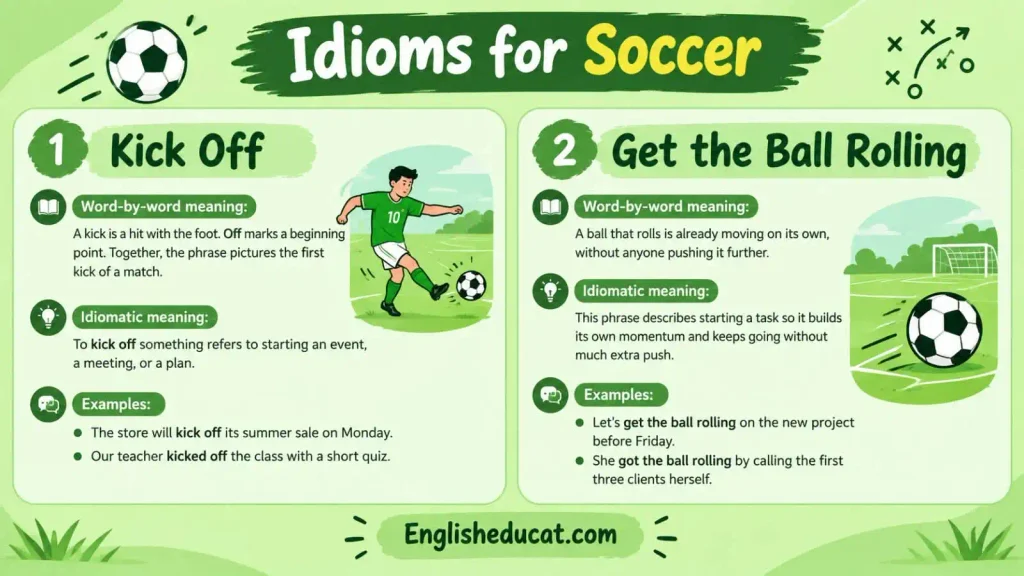
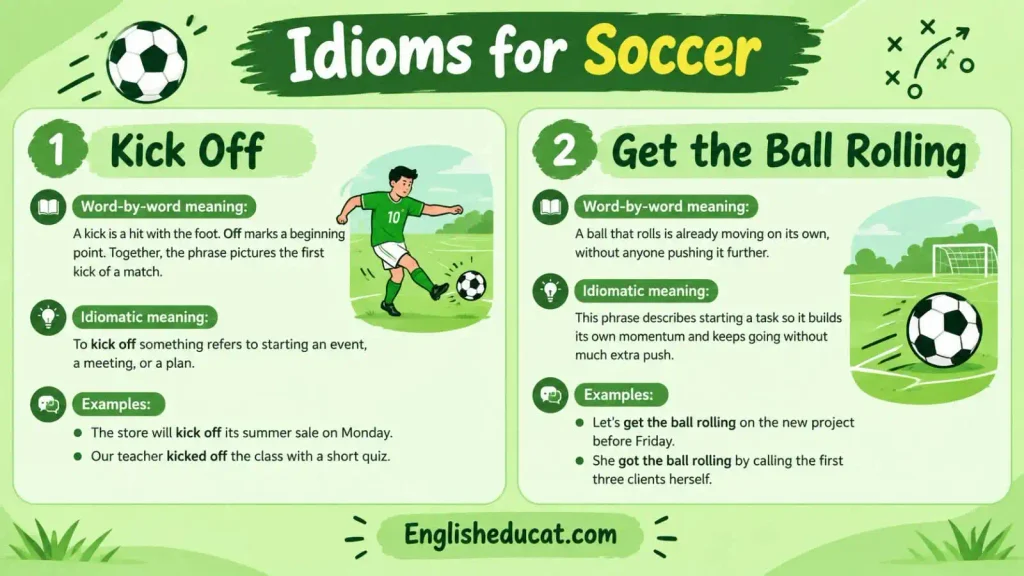
1. Kick Off
Word-by-word meaning:
A kick is a hit with the foot. Off marks a beginning point. Together, the phrase pictures the first kick of a match.
Idiomatic meaning:
To kick off something refers to starting an event, a meeting, or a plan.
Examples:
- The store will kick off its summer sale on Monday.
- Our teacher kicked off the class with a short quiz.
2. Get the Ball Rolling
Word-by-word meaning:
A ball that rolls is already moving on its own, without anyone pushing it further.
Idiomatic meaning:
This phrase describes starting a task so it builds its own momentum and keeps going without much extra push.
Examples:
- Let’s get the ball rolling on the new project before Friday.
- She got the ball rolling by calling the first three clients herself.
3. In Full Swing
Word-by-word meaning:
A swing is a wide, sweeping motion, and “full” means complete or at its highest point.
Idiomatic meaning:
Something in full swing is running at its busiest or most active stage.
Examples:
- The wedding party was in full swing by 9 p.m.
- Harvest work is in full swing on the farm right now.
Idioms of Skill and Performance
4. On the Ball
Word-by-word meaning:
A player “on the ball” is right next to it, ready to control it at any second.
Idiomatic meaning:
A person described as on the ball is alert, sharp, and quick to notice things.
Examples:
- Our new assistant is really on the ball; she caught the billing error before I did.
- You need to stay on the ball during exam week.
5. Hat Trick
Word-by-word meaning:
In football, a hat trick happens when one player scores three goals in a single game. The odd name is often traced back to old cricket, where a bowler who took three wickets in a row was sometimes given a hat as a prize, though the exact story is not fully confirmed.
Idiomatic meaning:
Outside of sports, a hat trick refers to any set of three wins or successes in a row.
Examples:
- The sales team pulled off a hat trick by closing three deals in one week.
- She scored a hat trick of job offers after her interviews.
6. Top of One’s Game
Word-by-word meaning:
The “top” is the highest point, and “game” points to a person’s usual level of skill.
Idiomatic meaning:
Someone at the top of their game is performing at their very best.
Examples:
- After months of practice, the chef was at the top of her game during the contest.
- You will need to be at the top of your game to win that promotion.
Idioms of Fairness and Strategy
7. Level Playing Field
Word-by-word meaning:
A level field has no slopes or bumps, so neither team gets an unfair advantage.
Idiomatic meaning:
This phrase describes a fair situation where everyone has the same chance to succeed.
Examples:
- The new rules created a level playing field for small businesses.
- Without a level playing field, the contest would not mean much.
8. Move the Goalposts
Word-by-word meaning:
Goalposts mark the target a team is trying to reach. Moving them mid-game would make the target harder to hit.
Idiomatic meaning:
This idiom refers to unfairly changing the rules or requirements after something has already started.
Examples:
- Every time I meet their demands, they move the goalposts and ask for more.
- The client moved the goalposts halfway through the project.
9. Game Plan
Word-by-word meaning:
A plan made for how a team will play the game.
Idiomatic meaning:
In everyday use, a game plan points to any well-thought-out strategy for reaching a goal.
Examples:
- What is your game plan for finishing the report by Friday?
- The team built a solid game plan before the product launch.
Move the Goalposts vs. Raise the Bar
These two phrases sound similar, but they carry different feelings.
| Phrase | Tone | What it suggests |
| Move the goalposts | Negative | Someone changed the rules after you already started, which feels unfair |
| Raise the bar | Positive or neutral | The standard went up to push everyone toward better results |
Idioms of Teamwork
10. Team Player
Word-by-word meaning:
A member of a team who plays their role well.
Idiomatic meaning:
This phrase describes someone who works well with others and puts group success ahead of personal credit.
Examples:
- Managers always want to hire team players.
- She proved she was a real team player by staying late to help her coworkers.
11. Pass the Ball
Word-by-word meaning:
To send the ball from one player to another.
Idiomatic meaning:
This expression suggests handing off a task or giving someone else a chance to contribute.
Examples:
- Instead of doing it all yourself, try passing the ball to your teammates.
- The manager passed the ball to the new hire for the quarterly update.
12. Carry the Team
Word-by-word meaning:
To carry something means to hold its weight; here, one player holds up the whole group’s effort.
Idiomatic meaning:
This phrase points to one person whose effort keeps the whole group moving forward.
Examples:
- Marcus practically carried the team during the busy season.
- You can not always carry the team alone; others need to step up too.
Idioms of Setbacks and Mistakes
13. Drop the Ball
Word-by-word meaning:
A player who literally drops the ball loses control of it.
Idiomatic meaning:
This phrase describes making a mistake or failing to follow through on a responsibility.
Examples:
- The organizer dropped the ball by forgetting to book the venue.
- I trusted him with the report, but he dropped the ball on the deadline.
14. Own Goal
Word-by-word meaning:
An own goal happens when a player accidentally sends the ball into their own team’s net.
Idiomatic meaning:
This term describes an action that ends up hurting your own side instead of helping it.
Examples:
- Criticizing his own policy in public was a real own goal for the senator.
- Complaining about the workload in front of the client turned into an own goal.
15. Back to Square One
Word-by-word meaning:
“Square one” points to the very first step or starting box in an old board game or radio-commentary grid system.
Idiomatic meaning:
This phrase suggests starting over completely after a setback.
Examples:
- The prototype failed the safety test, so we are back to square one.
- When the deal fell through, the team was back to square one.
Drop the Ball vs. Miss an Open Goal
Both idioms describe failure, but they point to different kinds of mistakes.
| Phrase | What went wrong | Example use |
| Drop the ball | Someone forgot or failed to act on a duty | “He dropped the ball on sending the invoice.” |
| Miss an open goal | Someone had an easy, obvious chance and still failed | “She missed an open goal by not following up with an interested buyer.” |
Idioms of Pressure and High Stakes
16. Down to the Wire
Word-by-word meaning:
This phrase is often traced back to horse racing, where a wire above the finish line marked the exact end point, so a close race was decided right at the wire.
Idiomatic meaning:
This expression describes something that is not decided until the very last moment.
Examples:
- The election went down to the wire, with results known only after midnight.
- Our deadline is down to the wire, but the report will be finished on time.
17. Injury Time
Word-by-word meaning:
Extra minutes added to a match to make up for time lost due to injuries or delays.
Idiomatic meaning:
Outside of sports, this phrase points to a last stretch of borrowed time to finish something.
Examples:
- We are in injury time on this proposal; the client needs it by tonight.
- The semester is basically in injury time, and I still have two essays left.
18. Penalty Shootout
Word-by-word meaning:
A penalty shootout decides a tied match through a series of one-on-one kicks against the goalkeeper.
Idiomatic meaning:
This phrase describes a tense situation where the outcome rests on individual performance under pressure.
Examples:
- The final round of interviews felt like a penalty shootout; every answer mattered.
- Choosing between the two finalists turned into a penalty shootout for the judges.
When Can You Use Soccer Idioms?
Soccer idioms fit some settings better than others, so match the phrase to your audience.
| Setting | Safe idioms | Idioms to avoid |
| Business email or report | Kick off, level playing field, game plan, team player | Park the bus, nutmeg, take a dive |
| Casual chat with friends | Any idiom on this list | None — casual talk is flexible |
| Academic writing | Level playing field (briefly explained) | Most idioms; formal writing generally avoids slang |
Common Mistakes Learners Make
Many learners mix up idioms that sound alike but mean different things. “Drop the ball” describes forgetting a duty, while “score an own goal” describes an action that backfires on the person who did it; these are not the same failure. Another common slip is using “level playing field” to mean “a good plan,” when it actually refers to fairness, not strategy. Learners also sometimes borrow idioms from other sports, like “step up to the plate” from baseball, and mistake them for soccer phrases. Checking the sport behind a phrase before using it helps avoid these mix-ups.
Frequently Asked Questions
What is the difference between soccer idioms and football idioms?
They are the same idioms; the difference is only in the name of the sport. Americans, Canadians, and Australians call the sport soccer, while most of the rest of the world calls it football, so “soccer idioms” and “football idioms” refer to the same set of phrases.
Can I use soccer idioms in formal or business writing?
Yes, but only the widely known ones. Phrases like “kick off,” “game plan,” and “level playing field” are common in business writing, while more casual phrases like “park the bus” or “take a dive” fit better in relaxed writing or conversation.
What does “on the ball” mean and where does it come from?
“On the ball” describes someone alert and quick to notice things. It comes from the idea of a player staying close to the ball so they can control it the moment it comes near.
Conclusion
Soccer idioms turn plain ideas into pictures anyone can see: a rolling ball, a moved goalpost, a missed open goal. Learn a few at a time, notice how native speakers use them, and try dropping one into your own writing this week.

Linguistics Specialist
James is a linguist with a Ph.D. in Applied Linguistics from Boston University. His work focuses on word origins, synonyms, and how language evolves over time. He has contributed to several academic journals on English semantics.