
Idioms for motivation are short phrases that push you to keep going, stay positive, or aim high, without saying it in plain words. This guide covers 30 of them, grouped by how you would actually use them: to push yourself, to push someone else, to bounce back, or to set a big goal. You will also find real origin stories, a formal-vs-casual guide, common mistakes, and quick answers to common questions.
Quick definition: A motivational idiom is a fixed phrase like “go the extra mile” that carries an encouraging meaning different from its literal words. You should also learn more idioms just like idioms about sadness, they will be very helpful for you.
Idioms to Motivate Yourself
These idioms work best as self-talk, the kind of line you repeat in your own head when things get hard.
1. Keep Your Chin Up
Word by word:
Lift your chin so it does not point down.
Idiomatic meaning:
Stay positive, even during a hard time.
Examples:
Keep your chin up; the exam results are not final yet.
She kept her chin up after losing the match.
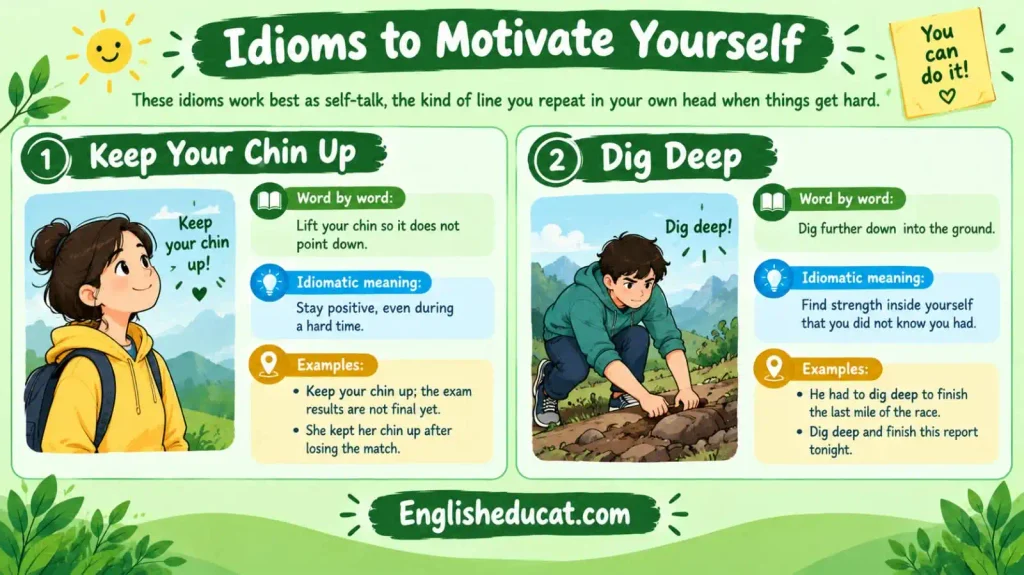
2. Dig Deep
Word by word:
Dig further down into the ground.
Idiomatic meaning:
Find strength inside yourself that you did not know you had.
Examples:
He had to dig deep to finish the last mile of the race.
Dig deep and finish this report tonight.
3. Hang in There
Word by word:
Hold on and do not let go.
Idiomatic meaning:
Keep trying, even when quitting feels easier.
Examples:
Hang in there; the training gets easier after week two.
She told herself to hang in there through the long shift.
4. Push Through
Word by word:
Force your way past something blocking you.
Idiomatic meaning:
Keep going despite pain, tiredness, or fear.
Example:
I pushed through the last hour of studying even though I was exhausted.
5. Get Back on the Horse
Word by word:
Climb onto the horse again after falling off it.
Idiomatic meaning:
Try again right after you fail at something.
Example:
He failed his driving test once, but he got back on the horse the next week.
6. Rise to the Occasion
Word by word:
Stand up to meet a moment.
Idiomatic meaning:
Perform well exactly when it matters most.
Example:
The team was nervous, but they rose to the occasion during the final.
7. Give It Your All
Word by word:
Give every bit of effort you have.
Idiomatic meaning:
Try as hard as you possibly can.
Example:
She gave it her all during the interview and got the job.
8. Stay the Course
Word by word:
Keep following the same path.
Idiomatic meaning:
Stick with your plan, even when progress feels slow.
Example:
Prices dropped, but the investors decided to stay the course.
Idioms to Motivate Someone Else
Use these when you are the one cheering someone on, not yourself. The following are some idioms explained:
1. Light a Fire Under Someone
Word by word:
Put a flame under a person.
Idiomatic meaning:
Push someone to act quickly instead of waiting.
Example:
The looming deadline lit a fire under the whole team.
2. Give It Your Best Shot
Word by word:
Take your most serious single attempt.
Idiomatic meaning:
Try as hard as you can, whatever the outcome.
Example:
Do not worry about winning; just give it your best shot.
3. Step Up to the Plate
Word by word:
Walk up to home plate, ready to bat.
Idiomatic meaning:
Take responsibility when it is needed most.
Example:
When the manager quit, Sam stepped up to the plate and led the team.
4. Cheer Someone On
Word by word:
Shout happy support toward a person.
Idiomatic meaning:
Encourage someone during their effort.
Example:
Her friends cheered her on through the whole marathon.
5. Put Your Heart Into It
Word by word:
Place your heart inside the task.
Idiomatic meaning:
Work on something with real care and feeling.
Example:
He put his heart into planning his sister’s wedding.
6. Believe in Yourself
Word by word:
Trust your own ability.
Idiomatic meaning:
Encouragement to have confidence in what you can do.
Example:
Believe in yourself; you have prepared for this moment for months.
7. You’ve Got This
Word by word:
You are holding this situation.
Idiomatic meaning:
A short line telling someone they can succeed.
Example:
Before the presentation, her coworker whispered, “You have got this.”
Idioms for Bouncing Back After a Setback
These idioms describe recovering after something goes wrong.
1. Bounce Back
Word by word:
Spring back upward after hitting the ground.
Idiomatic meaning:
Recover quickly after a failure or disappointment.
Example:
The company lost money in spring but bounced back by summer.
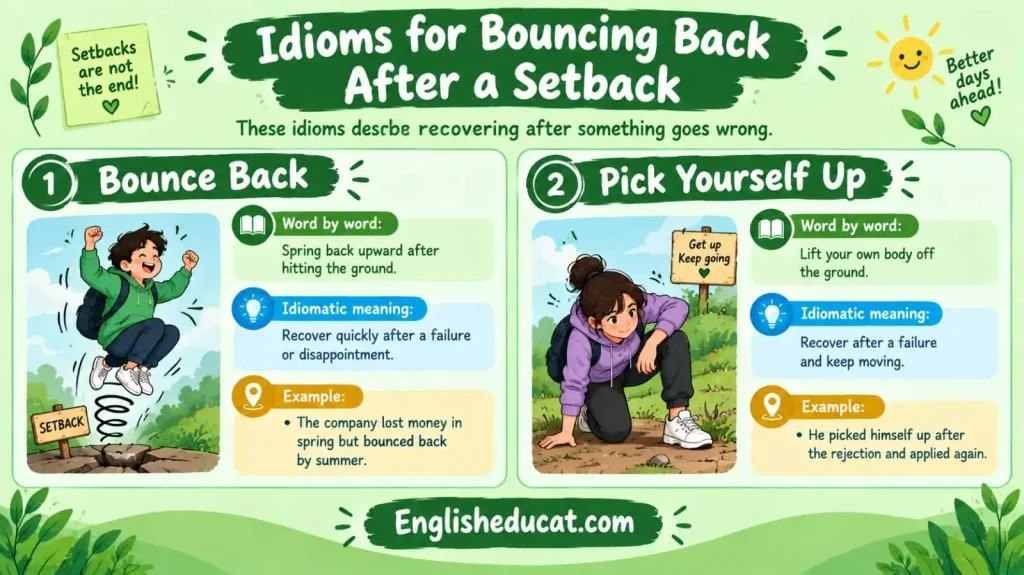
2. Pick Yourself Up
Word by word:
Lift your own body off the ground.
Idiomatic meaning:
Recover after a failure and keep moving.
Example:
He picked himself up after the rejection and applied again.
3. Dust Yourself Off
Word by word:
Brush the dirt off your clothes.
Idiomatic meaning:
Recover from a fall or failure and carry on.
Example:
She dusted herself off after the failed pitch and tried a new plan.
4. Turn Over a New Leaf
Word by word:
Flip to a fresh, blank page.
Idiomatic meaning:
Start over with better habits.
Example:
After the health scare, he turned over a new leaf and started walking daily.
5. Fall Seven Times, Get Up Eight
Word by word:
Count the falls and the times you stood back up.
Idiomatic meaning:
No matter how many times you fail, keep getting up. This line is often called a Japanese proverb, though no single confirmed source backs that claim.
Example:
Her coach reminded her: fall seven times, get up eight.
6. Never Say Die
Word by word:
Do not say the word “die.”
Idiomatic meaning:
Do not give up hope, even in a bad spot.
Example:
Down by ten points, the coach shouted, “Never say die!”
7. Do not Throw in the Towel
Word by word:
Do not toss your towel into the boxing ring.
Idiomatic meaning:
Do not quit before you are forced to.
Example:
Sales were slow this quarter, but the owner refused to throw in the towel.
8. What Does Not Kill You Makes You Stronger
Word by word:
Surviving something hard leaves you tougher than before.
Idiomatic meaning:
Difficult experiences build strength for the future.
Example:
After a rough first year at university, she said What does not kill you makes you stronger.
Idioms for Setting Big Goals
These describe ambition, aiming high and refusing to settle.
1. Shoot for the Stars
Word by word:
Aim your shot at the stars.
Idiomatic meaning:
Set extremely high goals for yourself.
Example:
Her parents always told her to shoot for the stars.
2. Aim High
Word by word:
Point your aim upward.
Idiomatic meaning:
Set ambitious, large goals instead of easy ones.
Example:
The startup decided to aim high and target international markets first.
3. The Sky is the Limit
Word by word:
The sky is the only boundary above you.
Idiomatic meaning:
There is no real limit to what you can achieve.
Example:
With this scholarship, the sky is the limit for her studies.
4. Go the Extra Mile
Word by word:
Travel one mile farther than required.
Idiomatic meaning:
Put in more effort than anyone expects.
Example:
The waiter went the extra mile and remembered our order from last time.
5. Raise the Bar
Word by word:
Lift a bar to a higher height, as in a high jump.
Idiomatic meaning:
Set a tougher standard than before.
Example:
The new coach raised the bar for the whole swim team.
6. Think Big
Word by word:
Think in a large, wide way.
Idiomatic meaning:
Imagine bold, ambitious plans instead of small ones.
Example:
He told his students to think big when picking a career.
7. Take the Bull by the Horns
Word by word:
Grab a bull directly by its horns.
Idiomatic meaning:
Face a hard challenge directly, without waiting.
Example:
She took the bull by the horns and confronted the landlord about the repairs.
Where These Idioms Come From
Most motivational idioms trace back to sports, farming, or old sayings that stuck around. Step up to the plate comes from baseball, where a batter physically steps up to home plate to take their turn. Do not throw in the towel comes from boxing, where a corner would literally throw a towel into the ring to stop the fight.

Turn over a new leaf goes back to an older meaning of “leaf” as a page in a book, so flipping to a fresh page meant starting clean. Fall seven times, get up eight is widely repeated as a Japanese proverb, though this origin is commonly stated rather than firmly confirmed. Not every idiom on this list has a documented history; several, like “you have got this” or “believe in yourself,” are just modern encouragement that became fixed phrases over time.
Formal vs. Informal: Which Idioms Work at Work
Some of these idioms sound fine in a work email; others only belong in casual talk.
| Go the extra mile | Light a fire under someone |
| Rise to the occasion | You’ve got this |
| Give it your best shot | Dig deep |
| Turn over a new leaf | Hang in there |
| Step up to the plate | Don’t throw in the towel |
| Raise the bar | Never say die |
Similar Idioms, Different Strength
A few of these idioms look alike but carry a different level of effort.
| Give it your best shot | Try your hardest, once | The outcome is uncertain and effort is what counts |
| Go the extra mile | Do more than expected | You want to describe consistent extra effort |
| Push through | Keep going despite pain | You’re already tired or struggling partway through |
Common Mistakes Learners Make
A few small slips appear again and again with these idioms. People often say “hang on there” instead of the correct “hang in there”; the phrase uses in, not on. Another common slip is dropping “the” from “go the extra mile,” turning it into the incorrect “go extra mile.” Learners also sometimes say “throw the towel” instead of the full, correct form “throw in the towel.” Small words like “in” and “the” matter in fixed idioms; you can not skip them the way you can in normal sentences.
Frequently Asked Questions
What are some good idioms for motivation?
Strong everyday choices include “go the extra mile,” “hang in there,” “you have got this,” and “shoot for the stars”; each fits a slightly different situation.
What idiom means to motivate someone?
“Light a fire under someone” is the clearest match; it describes pushing another person to act quickly.
What is the idiom for never giving up?
“Do not throw in the towel” and “never say die” both mean refusing to quit, even when things look bad.
Is “go the extra mile” formal or informal?
It is formal-safe; this phrase works fine in a workplace email, a job interview, or a school report.
Conclusion
These 30 idioms give you a ready phrase for almost any moment: pushing yourself, cheering on a friend, recovering from a setback, or setting a goal that feels a little scary. Pick two or three that fit your own life, and start using them in real conversations instead of just recognizing them on a page.

ESL Content Writer
Emily is a TESOL-certified writer who has taught English to international students for over 8 years. She loves breaking down idioms and everyday expressions into simple, relatable explanations that make sense to learners at any level.