
Idioms about sadness are phrases that describe unhappy feelings without saying “sad” or “upset.” This guide explains what they mean, where some of them come from, and how to use them the right way. You will also find real example sentences, a quick table on formal versus casual use, and some mistakes learners make most often.
Quick definition: Idioms about sadness is a fixed phrase, like “feeling blue” or “down in the dumps,” that stands for a low mood or deep grief instead of stating it directly.
What Are Idioms About Sadness?
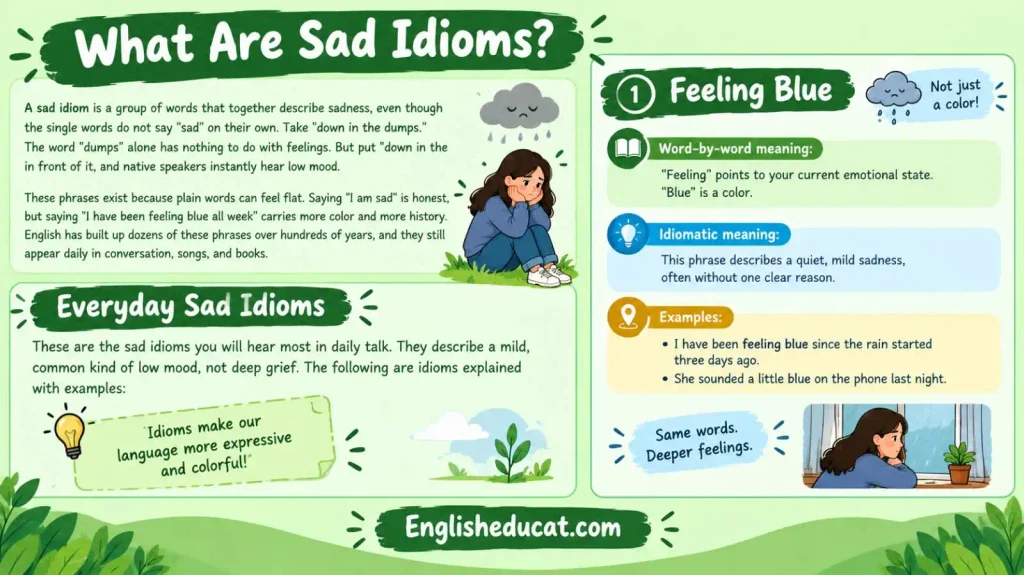
Idioms about sadness is a group of words that together describe sadness, even though the single words do not say “sad” on their own. Take “down in the dumps.” The word “dumps” alone has nothing to do with feelings. But put “down in the” in front of it, and native speakers instantly hear low mood. Also learn nature idioms that should be known.
These phrases exist because plain words can feel flat. Saying “I am sad” is honest, but saying “I have been feeling blue all week” carries more color and more history. English has built up dozens of these phrases over hundreds of years, and they still appear daily in conversation, songs, and books.
Everyday Sad Idioms
These are the sad idioms you will hear most in daily talk. They describe a mild, common kind of low mood, not deep grief. The following are idioms explained with examples:
1. Feeling Blue
Word-by-word meaning:
“Feeling” points to your current emotional state. “Blue” is a color.
Idiomatic meaning:
This phrase describes a quiet, mild sadness, often without one clear reason.
Examples:
- I have been feeling blue since the rain started three days ago.
- She sounded a little blue on the phone last night.
2. Down in the Dumps
Word-by-word meaning:
“Down” suggests a low position. “Dumps” is an old word for a gloomy state of mind, not a trash pile.
Idiomatic meaning:
This describes a low, unhappy mood that lasts for a while, not just a moment.
Examples:
- He has been down in the dumps since his team lost the final.
- Do not worry if you feel down in the dumps after moving to a new city.
3. Under the Weather
Word-by-word meaning:
“Under” means beneath. “The weather” refers to outdoor conditions like rain or clouds.
Idiomatic meaning:
This phrase mostly describes feeling mildly sick, but people also use it for a flat, low mood.
Examples:
- I am a bit under the weather today, so I will skip the gym.
- She seemed under the weather at dinner and barely spoke.
4. Out of Sorts
Word-by-word meaning:
“Out of” suggests being away from something. “Sorts” is an old word for one’s usual state or order.
Idiomatic meaning:
This describes feeling unsettled, low, or not quite yourself, often without a clear cause.
Examples:
- He has been out of sorts ever since the argument with his brother.
- I woke up out of sorts and could not shake the feeling all morning.
Heart and Body Idioms
Many sad idioms link sadness to the chest, throat, or face. These phrases make emotional pain feel physical.
1. Heavy Heart
Word-by-word meaning:
“Heavy” describes weight. “Heart” is the organ tied to emotion in everyday speech.
Idiomatic meaning:
This phrase describes deep sadness that feels like a weight pressing on your chest.
Examples:
- She left her old apartment with a heavy heart.
- With a heavy heart, the manager told the team the project was cancelled.
2. Lump in Your Throat
Word-by-word meaning:
“Lump” is a small solid mass. “Throat” is the front of your neck.
Idiomatic meaning:
This describes the tight, choking feeling you get right before you might cry.
Examples:
- I got a lump in my throat during the graduation speech.
- He got a lump in his throat as he read his grandfather’s old letters.
3. Broken-Hearted
Word-by-word meaning:
“Broken” means damaged or split apart. “Hearted” ties the state to the heart.
Idiomatic meaning:
This describes deep emotional pain, usually after losing someone or something loved.
Examples:
- She was broken-hearted when her childhood dog passed away.
- He looked broken-hearted standing outside their old house.
4. Down in the Mouth
Word-by-word meaning:
“Down” points to a lower position. “Mouth” refers to the corners of your lips.
Idiomatic meaning:
This describes a visibly sad face, where the corners of the mouth turn down.
Examples:
- She looked down in the mouth after the exam results came out.
- Why the long face? You seem down in the mouth today.
Deep Grief and Heavy Sadness Idioms
These phrases carry more weight. Save them for serious sadness, not small setbacks.
1. Hit Rock Bottom
Word-by-word meaning:
“Hit” means to reach or strike. “Rock bottom” is the lowest solid ground.
Idiomatic meaning:
This describes reaching the lowest possible point in life, where things feel like they can not get worse.
Examples:
- After losing his job and his home in the same month, he felt like he had hit rock bottom.
- She hit rock bottom before she finally asked her family for help.
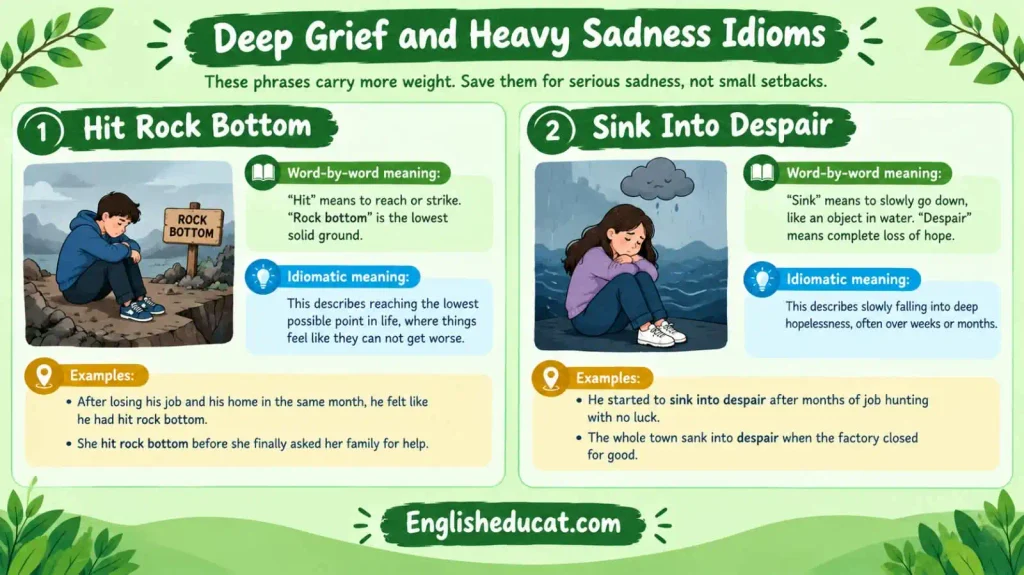
2. Sink Into Despair
Word-by-word meaning:
“Sink” means to slowly go down, like an object in water. “Despair” means complete loss of hope.
Idiomatic meaning:
This describes slowly falling into deep hopelessness, often over weeks or months.
Examples:
- He started to sink into despair after months of job hunting with no luck.
- The whole town sank into despair when the factory closed for good.
3. Carry the Weight of the World
Word-by-word meaning:
“Carry” means to hold or bear something. “Weight of the world” suggests an enormous, impossible load.
Idiomatic meaning:
This describes feeling crushed by huge stress or responsibility, as if everything depends on you.
Examples:
- As the only earner in her family, she often felt like she carried the weight of the world.
- You do not have to carry the weight of the world by yourself. Let someone help.
Where Do These Idioms Come From?
Some sad idioms have a documented history. Others rest on stories that sound believable but were never proven.
“Down in the dumps” has real paper evidence behind it. Sir Thomas More used “dumpes” to mean gloom back in 1529, and Shakespeare wrote a version of the phrase in The Taming of the Shrew in 1596. By 1785, a dictionary of slang recorded “down in the dumps” as an established phrase for low spirits. The word “dumps” itself likely came from the Dutch word “domp,” meaning haze or dullness, or the German “dumpf,” meaning gloomy and heavy.
“Feeling blue” does not have that same clear paper trail. One popular story says that sailors flew blue flags and painted a blue stripe on the hull of ships when a captain died at sea, and that this custom linked the color blue to mourning. It is a nice story, and it gets repeated often, but there is no solid proof that this naval habit actually created the phrase.
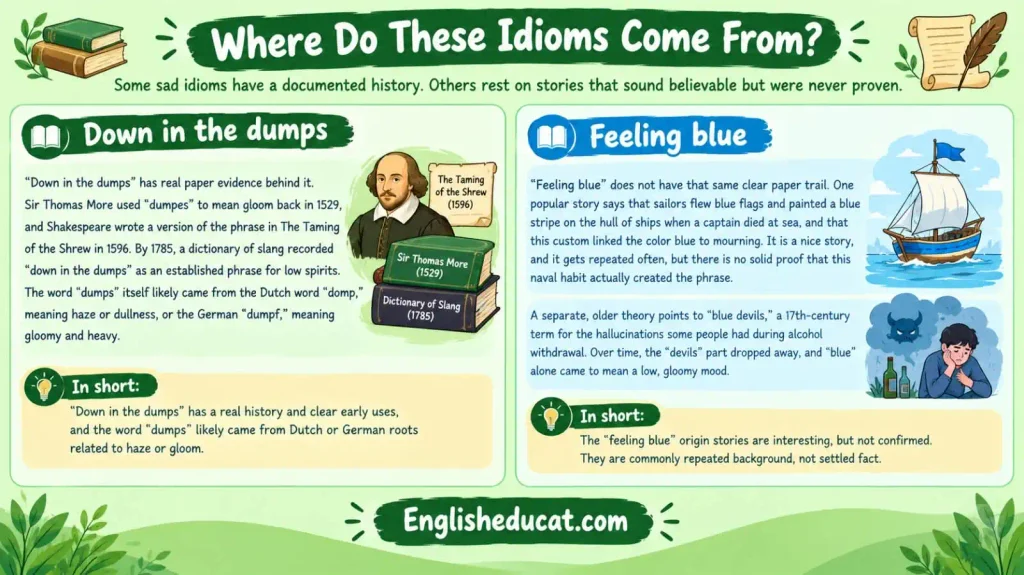
A separate, older theory points to “blue devils,” a 17th-century term for the hallucinations some people had during alcohol withdrawal. Over time, the “devils” part dropped away, and “blue” alone came to mean a low, gloomy mood. Neither story is fully confirmed, so treat both as commonly repeated background rather than settled fact.
Formal vs. Informal, US vs. UK: Quick Reference
Not every sad idiom fits every setting. This table shows where each one sounds natural.
| Feeling blue | Informal | US and UK |
| Down in the dumps | Informal | US and UK |
| Under the weather | Neutral | US and UK |
| Out of sorts | Neutral, slightly formal | Mostly UK |
| Heavy heart | Formal, literary | US and UK |
| Lump in your throat | Neutral | US and UK |
| Broken-hearted | Neutral to formal | US and UK |
| Down in the mouth | Informal | US and UK |
| Hit rock bottom | Neutral | US and UK |
| Sink into despair | Formal, literary | US and UK |
| Carry the weight of the world | Neutral | US and UK |
| Gutted | Very informal | Mostly UK |
| Bummed out | Very informal | Mostly US |
| Face like a wet weekend | Very informal | UK only |
Common Mistakes Learners Make
A few small errors appear again and again with these idioms. Fixing them will make your English sound more natural right away.
- Using “down in the mouth” for yourself. This idiom almost always describes the face of someone else, not your own feelings. Say “You look down in the mouth” rather than “I am down in the mouth.”
- Mixing up “feeling blue” and “have the blues.” Both work for yourself or others, but “have the blues” sounds slightly more distant and is used more often about someone else, not in the first person during casual chat.
- Dropping these idioms into formal writing. Phrases like “down in the dumps” or “gutted” belong in speech and casual writing, not in a report or academic essay. Swap them for plain words like “discouraged” or “disappointed” in that setting.
- Stacking too many idioms in one sentence. One idiom per sentence lands well. Three in a row feels forced and confusing to a reader.
- Forgetting the region. “Gutted” reads as strange or unclear to many American ears, while “bummed out” can sound too casual in British professional settings. Match the idiom to your audience.
Frequently Asked Questions
What are sad idioms?
Sad idioms are fixed English phrases that describe sadness, grief, or disappointment through images instead of plain words. Examples include “feeling blue,” “heavy heart,” and “hit rock bottom.” They let a speaker show emotion with more color than a plain “I am sad” would give.
Where does “feeling blue” really come from?
No one knows for certain. The most repeated story links it to sailors flying blue flags when a ship’s captain died at sea, but this is not confirmed. An older, competing theory ties it to “blue devils,” a 17th-century term for withdrawal hallucinations, which later shortened to just “blue.”
Can I use sad idioms in formal or academic writing?
Generally, no, not directly. Idioms like “down in the dumps” fit conversation and casual writing, not formal essays or reports. In formal writing, describe the idiom rather than use it, or swap it for a plain word like “discouraged.”
Are sad idioms used differently in British and American English?
Yes, several idioms lean toward one region. “Gutted” and “face like a wet weekend” are mainly British, while “bummed out” is mainly American. Idioms like “feeling blue,” “heavy heart,” and “hit rock bottom” work fine in both.
Conclusion
Sad idioms give English speakers a shared and colorful way to talk about low moods and deep grief alike. Learn a handful well, match them to the right setting, and your English will sound more natural the next time sadness comes up in conversation.

Senior English Content Editor
Sarah has over 10 years of experience teaching English as a Second Language in Chicago public schools. She specializes in vocabulary building and simplifying complex word meanings for everyday learners. Sarah holds a Master’s degree in English Education from the University of Illinois.