
Idioms for teamwork are short phrases that describe people working together for just one goal. They look simple, but the words often mean something different from what they say. This guide will give you 23 of them. Each one comes with a word-by-word breakdown, its real meaning, and example sentences for work, school, and home. You will also find honest notes on origins, a comparison table, and common mistakes.
Quick definition: Idioms for teamwork are fixed phrases that describe cooperation, shared effort, or trouble inside a group. Example: “pull together” refers to working as one team, not to dragging anything.
Top Idioms for Teamwork at a Glance
The ten most useful idioms for teamwork are pull together, on the same page, pull your weight, all hands on deck, many hands make light work, two heads are better than one, put our heads together, a well-oiled machine, firing on all cylinders, and too many cooks spoil the broth. These idioms are very similar to idiom about peace.
| Pull together | Work as one group | Positive |
| On the same page | Share the same plan | Neutral |
| Pull your weight | Do your fair share | Neutral, often a complaint |
| All hands on deck | Everyone must help now | Urgent |
| Many hands make light work | Group effort speeds up a job | Positive |
| Two heads are better than one | Two minds solve more than one | Positive |
| Put our heads together | Think as a group | Positive |
| A well-oiled machine | A team that runs smoothly | Positive |
| Firing on all cylinders | Working at full power | Casual, positive |
| Too many cooks spoil the broth | Too many leaders ruin a task | Critical |
Idioms for Unity and Shared Goals
Idioms for teamwork in this group describe people who stand together and aim at the same target. They are given below:
United we stand, divided we fall.
Word-by-word meaning:
“United” is joined as one. “Stand” is to hold your ground. “Divided” is split apart. “Fall” is to drop or fail.
Idiomatic meaning:
A group stays strong when it sticks together. It breaks down when it splits.
Examples:
- “We lost the quiz when we argued. Next time, united we stand, divided we fall.”
- The union leader ended her speech with, “United we stand, divided we fall.”
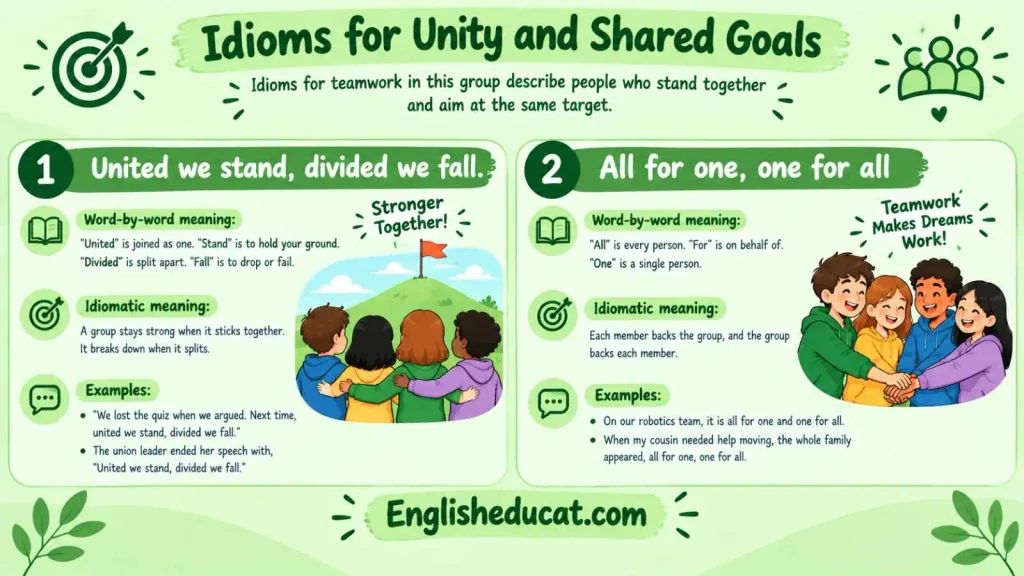
All for one, one for all
Word-by-word meaning:
“All” is every person. “For” is on behalf of. “One” is a single person.
Idiomatic meaning:
Each member backs the group, and the group backs each member.
Examples:
- On our robotics team, it is all for one and one for all.
- When my cousin needed help moving, the whole family appeared, all for one, one for all.
Pull together
Word-by-word meaning:
“Pull” is to tug toward you. “Together” is as one group.
Idiomatic meaning:
The phrase describes a group joining forces, often in a hard time.
Examples:
- After the storm, the neighbors pulled together to fix the fence.
- If we pull together, we can finish the report by Friday.
Row in the same direction
Word-by-word meaning:
“Row” is to move a boat with oars. “Same direction” means the same way.
Idiomatic meaning:
Everyone aims at the same goal. You will also hear “pull in the same direction.”
Examples:
- The sales and design teams must row in the same direction.
- Mom and Dad try to row in the same direction on bedtime rules.
On the same page
Word-by-word meaning:
“On” is at. “Same” means not different. “Page” is one side of a sheet in a book.
Idiomatic meaning:
People share the same plan or understanding.
Examples:
- Let’s meet first, so we are all on the same page.
- Are we on the same page about who brings the snacks?
In the same boat
Word-by-word meaning:
“In” is inside. “Same” is shared. “Boat” is a small vessel on water.
Idiomatic meaning:
People face the same problem. It points to shared trouble, not to teamwork skill.
Examples:
- The test is hard for everyone. We are all in the same boat.
- We both missed the bus, so we are in the same boat.
Idioms for Sharing the Work
These idioms describe people doing a fair part so the load stays light.
Pull your weight
Word-by-word meaning:
“Pull” is to drag. “Your” belongs to you. “Weight” is how heavy something is.
Idiomatic meaning:
You do your fair share of the work. People often use it as a complaint.
Examples:
- Everyone in the group has to pull their weight.
- My brother never pulls his weight at home, so I wash the dishes twice.
Do your bit
Word-by-word meaning:
“Do” is to carry out. “Bit” is a small piece.
Idiomatic meaning:
You give your share of effort, even a small one. It appears most often in British English.
Examples:
- Please do your bit and recycle your cans.
- Everyone did their bit for the school fair.
Many hands make light work.
Word-by-word meaning:
“Many” is a large number. “Hands” stands for people. “Light” is not heavy. “Work” is a task.
Idiomatic meaning:
A big group finishes a job faster.
Examples:
- Let’s all clean the kitchen. Many hands make light work.
- Many hands made light work of moving the sofa.
All hands on deck
Word-by-word meaning:
“All” is everyone. “Hands” are workers or crew. “Deck” is the floor of a ship.
Idiomatic meaning:
Everyone must help right now.
Examples:
- The printer broke an hour before the deadline. It is all hands on deck.
- At home, it is all hands on deck before the guests arrive.
Idioms for Solving Problems Together
Some idioms for teamwork focus on ideas, and these ones describe people who share their thinking to find an answer. These are given below:
Two heads are better than one.
Word-by-word meaning:
“Two heads” are two minds. “Better” is stronger. “One” is a single person.
Idiomatic meaning:
Two people can solve a problem more easily than one.
Examples:
- I can not solve this puzzle. Can you help? Two heads are better than one.
- We studied together because two heads are better than one.
Put our heads together.
Word-by-word meaning:
“Put” is to place. “Heads” are minds. “Together” is as a pair or group.
Idiomatic meaning:
A group thinks about a problem as one.
Examples:
- Let’s put our heads together and plan the trip.
- The mechanics put their heads together to find the leak.
Bounce ideas off someone.
Word-by-word meaning:
“Bounce” is to spring back after a hit. “Ideas” are thoughts. “Off” is away from.
Idiomatic meaning:
You share a thought to hear how the other person reacts.
Examples:
- Can I bounce a few ideas off you before the meeting?
- Dad likes to bounce his garden plans off me.
Idioms for Great Team Chemistry
Idioms for teamwork can also praise a group, and these ones describe a team that works smoothly and gets strong results. They are given below:
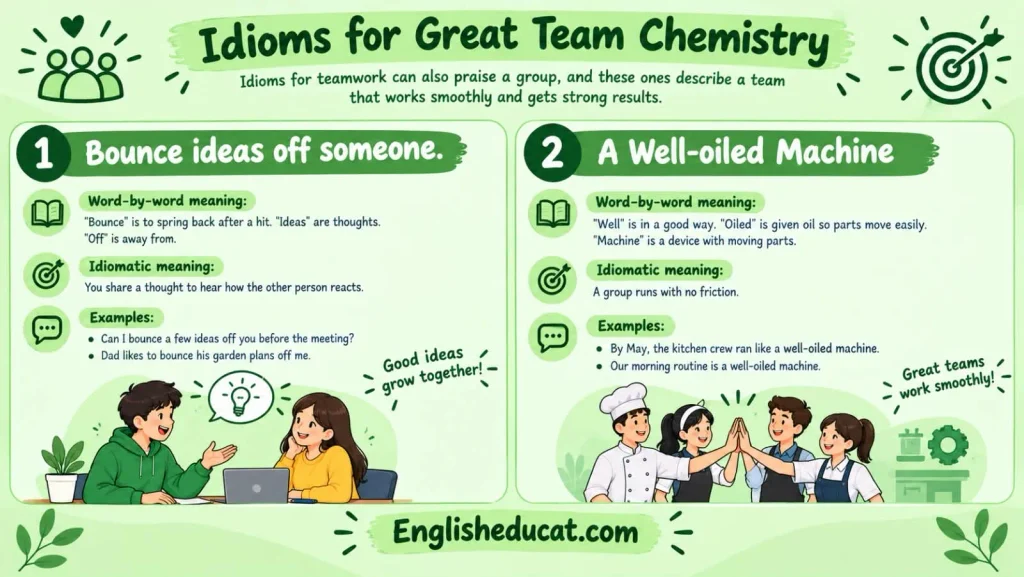
A well-oiled machine
Word-by-word meaning:
“Well” is in a good way. “Oiled” is given oil so parts move easily. “Machine” is a device with moving parts.
Idiomatic meaning:
A group runs with no friction.
Examples:
- By May, the kitchen crew ran like a well-oiled machine.
- Our morning routine is a well-oiled machine.
Hand in glove
Word-by-word meaning:
“Hand” is the body part. “In” is inside. “Glove” is a cover for a hand.
Idiomatic meaning:
Two sides work very closely. Sometimes it hints at a secret deal, so check the context.
Examples:
- The coach and the captain work hand in glove.
- The two bakers worked hand in glove all morning.
Greater than the sum of its parts
Word-by-word meaning:
“Greater” is bigger. “Sum” is the total after adding. “Parts” are pieces.
Idiomatic meaning:
The group achieves more than its members could alone.
Examples:
- Each singer is good, but the choir is greater than the sum of its parts.
- Our small team is greater than the sum of its parts.
Firing on all cylinders
Word-by-word meaning:
“Firing” is lighting fuel in an engine. “Cylinders” are the chambers where that happens.
Idiomatic meaning:
A person or team works at full power.
Examples:
- Once the new hires settled in, the team was firing on all cylinders.
- The whole class was firing on all cylinders in the final week.
Idioms for When Teamwork Goes Wrong
Not every one of the idioms for teamwork is cheerful, and these ones describe groups that argue, clash, or stall. They are given below:
Too many cooks spoil the broth.
Word-by-word meaning:
“Too many” is more than needed. “Cooks” are people who make food. “Spoil” is to ruin. “Broth” is a thin soup.
Idiomatic meaning:
Too many people in charge ruin the result.
Examples:
- Five managers wrote one email, and it was a mess. Too many cooks spoil the broth.
- Three of us planned the party, and nothing was ready.
Pull in different directions.
Word-by-word meaning:
“Pull” is to tug. “Different directions” are opposite ways.
Idiomatic meaning:
Members want different things, so progress stalls.
Examples:
- The board is pulling in different directions on the budget.
- My cousins pull in different directions about where to eat.
At loggerheads
Word-by-word meaning:
“At” is in a state of. “Loggerheads” is an old word that today lives mostly inside this phrase.
Idiomatic meaning:
People strongly disagree.
Examples:
- The two departments have been at loggerheads for weeks.
- My brothers are at loggerheads over the TV.
Step on someone’s toes
Word-by-word meaning: “Step” is to put a foot down. “Toes” are the front of your foot.
Idiomatic meaning: You get in the way of someone’s job, often by accident.
Examples:
- I will ask before editing Maria’s slides. I do not want to step on her toes.
- He stepped on my toes when he reorganized my shelf.
Every man for himself
Word-by-word meaning:
“Every” is each. “Man” is a person. “For himself” is only for his own good.
Idiomatic meaning:
Each person looks out for themselves, with no teamwork. Some speakers now say “every person for themselves.”
Examples:
- When the bell rang, it was every man for himself in the lunch line.
- Once the deadline moved up, it became every man for himself.
Walk on eggshells
Word-by-word meaning:
“Walk” is to move on foot. “Eggshells” are thin and easy to break.
Idiomatic meaning:
You act very carefully so you do not upset someone.
Examples:
- Since the argument, everyone walks on eggshells around the boss.
- We walked on eggshells at dinner.
Where Do Teamwork Idioms Come From?
Most idioms for teamwork have unclear origins, but a few have solid records.
United we stand, divided we fall. John Dickinson’s “The Liberty Song” from 1768 contains the line “By uniting we stand, by dividing we fall.” The idea is also tied to Aesop’s fable “The Four Oxen and the Lion.” Nobody can confirm that Aesop wrote it, so treat that link as tradition, not fact.
All hands on deck. The phrase comes from sailing ships, where it called every sailor to the deck. One source gives a longer, older form, “all hands and the cook on deck.” That detail is not confirmed. Another source guesses the 1700s, which is also unconfirmed.
Team up. A dictionary links this phrase to harnessing animals together, with use starting in the first half of the 1900s.
Pull your weight. Writers often trace it to rowing, though that origin is not confirmed.
A claim you will often see. Several lists say most teamwork idioms are nautical or military. Only a few have records that support it.
Similar Idioms Compared
Some idioms for teamwork look alike but do different jobs, and the table shows how to tell them apart.
| In the same boat / On the same page | Shared problem vs. shared plan | Facing trouble together, or checking agreement |
| Pull together / Pull your weight | Group effort vs. one person’s share | Praising the team, or judging one member |
| Many hands make light work / Too many cooks | More helpers help, or more leaders hurt | Sharing chores, or too many bosses |
| All hands on deck / Do your bit | Urgent call vs. steady small effort | A crisis, or a regular task |
Formal or Casual? Using Teamwork Idioms the Right Way
Idioms for teamwork range from formal to casual, and the safest choices for emails and reports are “on the same page,” “pull together,” and “greater than the sum of its parts.”
Save “bounce ideas off,” “firing on all cylinders,” and “walk on eggshells” for speech or friendly messages. “At loggerheads” suits news writing. “United we stand” fits speeches. In IELTS Speaking, a few well-placed idioms look natural. A crowd of them sounds forced.
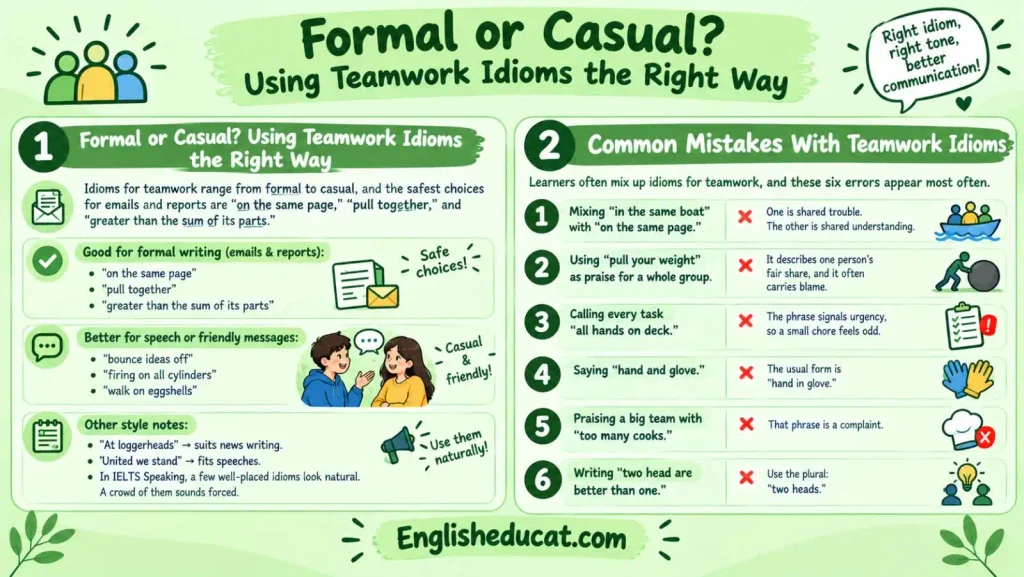
Common Mistakes With Teamwork Idioms
Learners often mix up idioms for teamwork, and these six errors appear most often.
- Mixing “in the same boat” with “on the same page.” One is shared trouble. The other is shared understanding.
- Using “pull your weight” as praise for a whole group. It describes one person’s fair share, and it often carries blame.
- Calling every task “all hands on deck.” The phrase signals urgency, so a small chore feels odd.
- Saying “hand and glove.” The usual form is “hand in glove.”
- Praising a big team with “too many cooks.” That phrase is a complaint.
- Writing “two head are better than one.” Use the plural: “two heads.”
Frequently Asked Questions
What are some good idioms for teamwork?
Good idioms for teamwork include pull together, on the same page, pull your weight, all hands on deck, and two heads are better than one. Each describes a different side of cooperation, from sharing work to solving problems.
Where does “united we stand, divided we fall” come from?
The line is closely tied to John Dickinson’s 1768 “Liberty Song,” which contains “By uniting we stand, by dividing we fall.” It is also linked to an Aesop fable, but that link is tradition and can not be confirmed.
What is the difference between “pull your weight” and “pull together”?
“Pull your weight” is about one person doing a fair share, while “pull together” is about the whole group acting as one. The first can sound like criticism. The second sounds like encouragement.
Can I use idioms for teamwork in formal writing or IELTS?
Yes, but choose neutral ones such as “on the same page” or “pull together.” Clear meaning matters more than the number of idioms, so use only a few and make sure each one fits.
Conclusion
Teamwork has its own colorful language. Learn a handful of these phrases, match each to the right setting, and your English will sound warmer and more natural. Pick two to try today.

Linguistics Specialist
James is a linguist with a Ph.D. in Applied Linguistics from Boston University. His work focuses on word origins, synonyms, and how language evolves over time. He has contributed to several academic journals on English semantics.