

Idioms for peace are phrases that describe calm, harmony, and the end of conflict. They rarely mean what the words say. “Bury the hatchet” is not about yard work. This guide will cover the meaning, origin, and use of each phrase, with plain examples you can reuse at work, at school, or at home. You will also find a tone guide and a list of common mistakes.
Quick definition: An idiom for peace is a fixed phrase that uses picture language to talk about calm, forgiveness, or ending a fight. Example: “bury the hatchet” means to end a quarrel.
What Are Idioms for Peace?
Idioms for peace are fixed phrases that usually talk about calm, forgiveness, and ending fights without using the literal meaning of their words. You can sort them into three groups. Some contain the word “peace” itself. Some describe how people end a quarrel. Others describe a calm mind. This article follows that order. Also idiom about darkness is explained in the same way so you should also learn it.
Quick Answer: 10 Common Idioms for Peace
The ten most useful idioms for peace are keep the peace, make peace, at peace, peace of mind, peace, bury the hatchet, olive branch, call a truce, clear the air, and keep your cool.
| Keep the peace | Stop trouble before it starts | “I stayed quiet to keep the peace.” |
| Make peace | End a fight | “The sisters finally made peace.” |
| At peace | Calm, or not at war | “He felt at peace with his choice.” |
| Peace of mind | Freedom from worry | “A good lock gives me peace of mind.” |
| Peace and quiet | Calm without noise | “I need peace and quiet to read.” |
| Bury the hatchet | Forgive and move on | “They buried the hatchet after years.” |
| Olive branch | A gesture that offers peace | “She sent an olive branch by text.” |
| Call a truce | Pause a fight | “The kids called a truce at dinner.” |
| Clear the air | Talk away tension | “Let’s clear the air before Monday.” |
| Keep your cool | Stay calm under stress | “He kept his cool in the crisis.” |
Idioms for Peace That Contain the Word “Peace”
Seven everyday phrases use the word “peace” itself, and each one does a different job. They are given below:
1. Keep the Peace
Word-by-word meaning
“Keep” is to hold on to something. “Peace” is calm and order. Put together, the words describe holding on to calm.
Idiomatic meaning
This phrase refers to stopping a fight before it starts or grows. Police, teachers, and parents often do it. Sometimes it also hints at staying silent to dodge an argument.
Examples
- The teacher stood between the two boys to keep the peace.
- I skipped the topic of money at dinner, just to keep the peace.
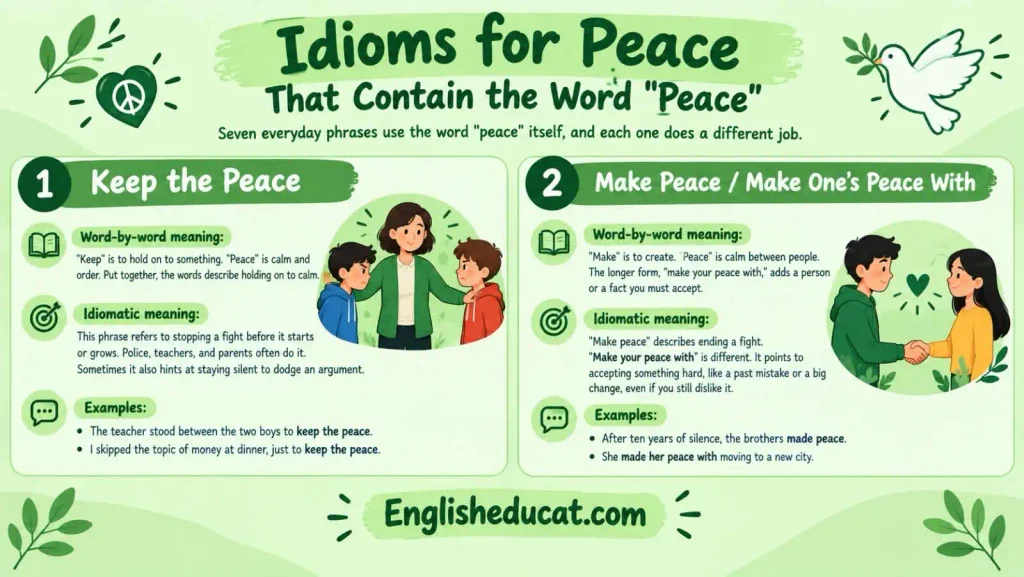
2. Make Peace / Make One’s Peace With
Word-by-word meaning
“Make” is to create. “Peace” is calm between people. The longer form, “make your peace with,” adds a person or a fact you must accept.
Idiomatic meaning
“Make peace” describes ending a fight. “Make your peace with” is different. It points to accepting something hard, like a past mistake or a big change, even if you still dislike it.
Examples
- After ten years of silence, the brothers made peace.
- She made her peace with moving to a new city.
3. At Peace
Word-by-word meaning
“At” shows a state or place. “Peace” is calm. The phrase places someone inside a calm state.
Idiomatic meaning
It can describe two countries that are not at war. It can also describe a calm mind. Dictionaries also list a gentle use for someone who has died: “She is at peace now.”
Examples
- The two nations have been at peace for fifty years.
- After the long talk, he felt at peace with his decision.
4. Hold Your Peace
Word-by-word meaning
“Hold” is to keep something in place. “Peace” here uses an old sense of the word: silence. So the words say to keep your silence.
Idiomatic meaning
This phrase suggests staying quiet instead of speaking up. One major learner’s dictionary marks it as old-fashioned. You will mostly hear it in jokes or in movie wedding scenes.
Origin
The best-known use is the wedding line “speak now or forever hold your peace.” That line comes from older English wedding services. I could not pin down a single first use, so treat any exact date you see online with caution.
Examples
- I wanted to argue, but I held my peace until the meeting ended.
- If you can not say something helpful, hold your peace.
5. Peace of Mind
Word-by-word meaning
“Peace” is calm. “Mind” is your thoughts. The words describe a calm set of thoughts.
Idiomatic meaning
The phrase stands for freedom from worry. It usually appears when something removes a fear, such as insurance, a backup, or a clear answer.
Examples
- Travel insurance gave her peace of mind.
- Saving my files twice gives me peace of mind.
6. peace
Word-by-word meaning
“Peace” is calm. “Quiet” is low noise. Together they describe calm with no noise.
Idiomatic meaning
The expression refers to a time or place with no noise and no interruptions. The order is fixed. “Quiet” sounds odd to native ears.
Examples
- I took my laptop to the library for some peace.
- The baby finally slept, so we got peace.
7. Disturb the Peace
Word-by-word meaning
“Disturb” is to interrupt or upset. “The peace” is the calm of a public place.
Idiomatic meaning
This one is mostly a legal phrase. It describes loud or rowdy behavior that bothers others. It is the opposite of “keep the peace.”
Examples
- The neighbors got a warning for disturbing the peace with loud music at midnight.
- Shouting in the street late at night can count as disturbing the peace.
Idioms for Peace That End a Conflict
These nine phrases are the main idioms for peace that describe ending an argument or a fight.
8. Bury the Hatchet
Word-by-word meaning
“Bury” is to put something under the ground. A “hatchet” is a small axe that was once used as a weapon.
Idiomatic meaning
The phrase describes ending a quarrel and choosing peace. Both sides drop the anger and move on.
Examples
- The two coaches buried the hatchet and shared the field.
- It has been a year. Isn’t it time to bury the hatchet with your cousin?
9. Extend an Olive Branch
Word-by-word meaning
An “olive branch” is a small twig from an olive tree. “Extend” is to hold something out toward another person.
Idiomatic meaning
This expression points to a friendly gesture that offers peace. It can be a call, a gift, or an invitation.
Origin
The olive branch has been a symbol of peace since ancient times, and it is linked to ancient Greece. I found no firm source for who first used it as a figure of speech, so I would not give a date.
Examples
- She offered an olive branch by inviting her rival to lunch.
- The company extended an olive branch with a full refund.
10. Call a Truce
Word-by-word meaning
“Call” is to announce. A “truce” is a pause in fighting.
Idiomatic meaning
The phrase describes agreeing to stop fighting, often for a short time. A truce can end in real peace, but it does not have to.
Examples
- The kids called a truce so they could watch the movie together.
- The two teams called a truce for the holiday week.
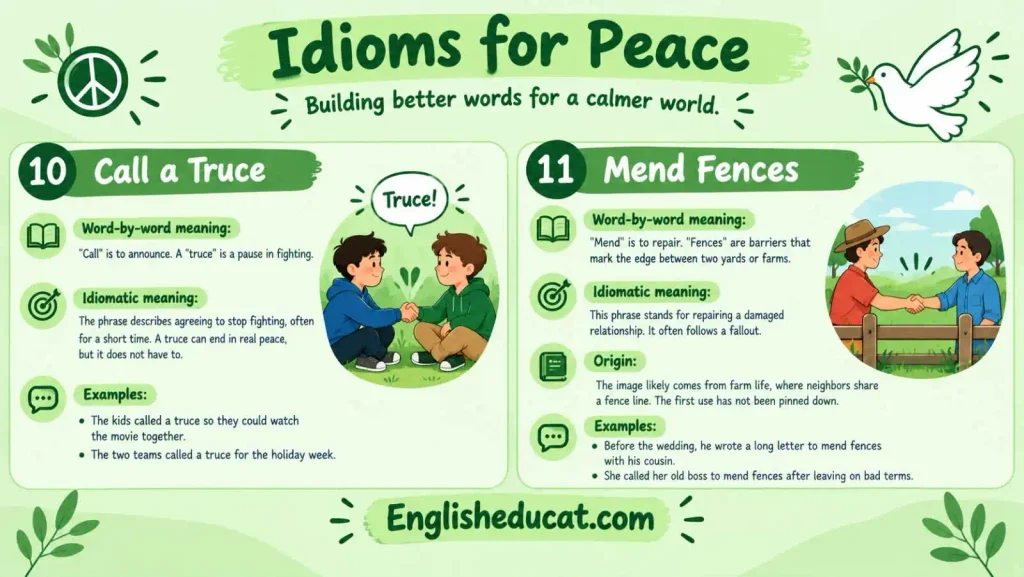
11. Mend Fences
Word-by-word meaning
“Mend” is to repair. “Fences” are barriers that mark the edge between two yards or farms.
Idiomatic meaning
This phrase stands for repairing a damaged relationship. It often follows a fallout.
Origin
The image likely comes from farm life, where neighbors share a fence line. The first use has not been pinned down.
Examples
- Before the wedding, he wrote a long letter to mend fences with his cousin.
- She called her old boss to mend fences after leaving on bad terms.
12. Patch Things Up / Smooth Things Over
Word-by-word meaning
To “patch” is to cover a hole with a small piece. To “smooth over” is to make a rough surface flat.
Idiomatic meaning
Both phrases describe repairing a strained relationship. “Patch things up” fixes the damage. “Smooth things over” soothes the mood.
Examples
- They argued on Monday but patched things up by Friday.
- A quick apology smoothed things over with the client.
13. Clear the Air
Word-by-word meaning
“Clear” is to remove what blocks the way. “Air” is the feeling in a room.
Idiomatic meaning
The expression refers to talking honestly so that tension goes away. It works best after a hidden problem has been bothering everyone.
Examples
- The manager held a short meeting to clear the air after the news.
- Let’s clear the air before we leave on the trip.
14. Let Bygones Be Bygones
Word-by-word meaning
“Let” is to allow. “Bygones” are things from the past. “Be” is to stay as they are.
Idiomatic meaning
The phrase suggests forgetting old quarrels. Nobody brings up the past again.
Examples
- It happened years ago, so let’s let bygones be bygones.
- Both coaches agreed to let bygones be bygones.
15. Turn the Other Cheek
Word-by-word meaning
“Turn” is to move. The “other cheek” is the side of the face that was not hit.
Idiomatic meaning
This expression describes answering an insult or harm without striking back. It can be praise for patience. It can also sound like criticism, as if someone is too passive.
Origin
The phrase comes from the Bible. It appears in the Sermon on the Mount in the Gospel of Matthew. This origin is documented.
Examples
- He turned the other cheek when the driver shouted at him.
- I would not turn the other cheek if they keep taking credit for my work.
16. Beat Swords Into Plowshares
Word-by-word meaning
“Beat” is to hammer into a new shape. “Swords” are weapons. “Plowshares” are the blades of a farm plow.
Idiomatic meaning
The phrase points to turning tools of war into tools for peaceful work. People also use it for moving money from weapons to schools or farms.
Origin
The image appears in the Old Testament, in the books of Isaiah and Micah. This origin is documented.
Examples
- After the war, the factory beat swords into plowshares and began building tractors.
- Some leaders want to beat swords into plowshares by funding schools instead of weapons.
Idioms for Peace That Mean Staying Calm
Three idioms for peace describe a calm person or a calm moment, and not an ended fight.
17. Keep Your Cool
Word-by-word meaning
“Keep” is to hold on to. “Cool” is the opposite of hot, as in hot-tempered.
Idiomatic meaning
It describes staying calm under pressure. The opposite is “lose your cool.”
Examples
- The nurse kept her cool when the alarm went off.
- Try to keep your cool when traffic is bad.
18. Cool as a Cucumber
Word-by-word meaning
“Cool” is not hot. A “cucumber” is a vegetable that feels cold to the touch.
Idiomatic meaning
The phrase refers to someone who stays very calm and not nervous at all.
Origin
A popular explanation says cucumbers stay cool inside even on warm days. That story is commonly repeated but unconfirmed.
Examples
- He walked on stage cool as a cucumber.
- She stayed cool as a cucumber during the exam.
19. Calm Before the Storm
Word-by-word meaning
“Calm” is stillness. A “storm” is rough weather.
Idiomatic meaning
This phrase describes a quiet time right before trouble. It is a warning. It does not describe real peace.
Examples
- The office was silent on Monday morning. It felt like the calm before the storm.
- The shop was empty for an hour, then the holiday crowd arrived.
Where Do Idioms for Peace Come From? Fact vs. Folklore
Only some idioms for peace have a documented origin, and the rest come from folklore or plain everyday images.
Two origins are documented. “Turn the other cheek” comes from the Gospel of Matthew. “Beat swords into plowshares” comes from Isaiah and Micah. The word “peace” itself came into English from Old French and goes back to the Latin word pax. Three origins are less certain. “Bury the hatchet” has a strong tradition behind it, but the first English use is later than the story. “Mend fences” and “cool as a cucumber” have popular explanations with no firm proof.
Tone and Register: When to Use Each Phrase
Most idioms for peace work in casual speech, while a few sound formal, old-fashioned, or legal.
| Keep the peace | Neutral | Work, family, news | Can hint at hiding a problem |
| Bury the hatchet | Casual, warm | Friends, family, sports | Fine at work, if the mood is light |
| Hold your peace | Old-fashioned | Jokes, weddings | Sounds stiff in daily talk |
| Olive branch | Neutral to formal | News, politics, work | Often used with “extend” |
| Turn the other cheek | Can be positive or negative | Moral talk, advice | May sound like weakness |
| Disturb the peace | Legal | Police, news | Not used for small quarrels |
| Clear the air | Casual | Teams, friends | Needs honest talk |
| Cool as a cucumber | Casual, playful | Stories, praise | Too light for serious topics |
| Beat swords into plowshares | Formal, poetic | Speeches, essays | Rare in chat |
| Calm before the storm | Neutral, dramatic | Stories, news | A warning, not good news |
Common Mistakes With Idioms for Peace
The most common errors with idioms for peace are spelling mix-ups, wrong word forms, and using a warning phrase as a happy one.
- Peace vs. piece. The two words sound the same. “Peace of mind” is correct. “Piece of mind” is a spelling error. A different idiom, “give someone a piece of your mind,” means to scold them.
- “Hold the peace.” This form is wrong. Say “hold your peace.”
- Defuse vs. diffuse. To defuse a tense moment is to remove the danger, like pulling a fuse. To diffuse is to spread something out. Write “defuse the conflict.”
- Calm before the storm. Do not use it for a happy, peaceful time. It tells the listener that trouble is coming.
- Make peace vs. make your peace with. The first ends a fight. The second means accepting something hard.
- US vs. UK law talk. Dictionaries list “breach of the peace” in British usage and show “disturbing the peace” in American examples. Both describe loud or rowdy public behavior. Check local law words before using them in formal writing.
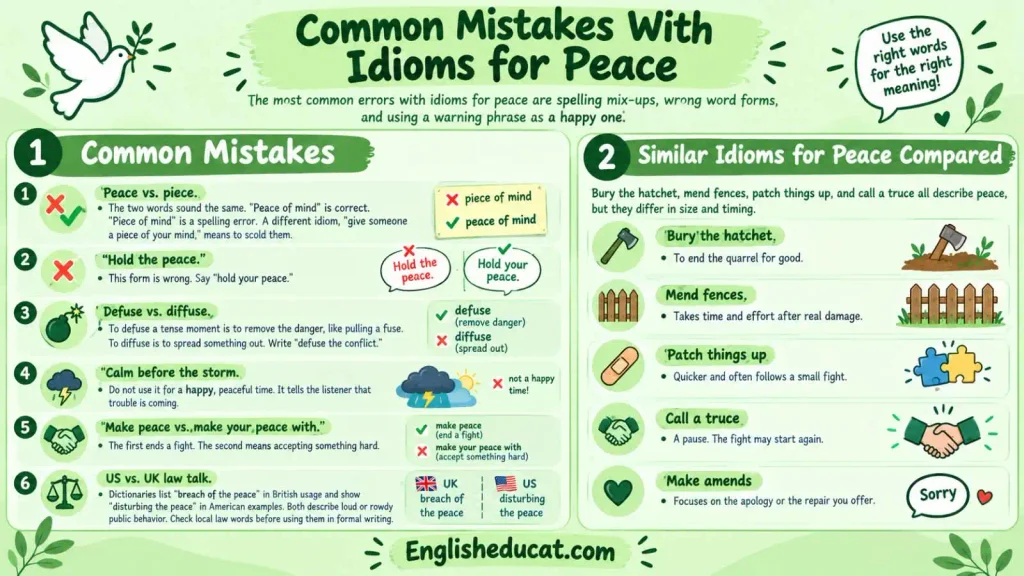
Similar Idioms for Peace Compared
Bury the hatchet, mend fences, patch things up, and call a truce all describe peace, but they differ in size and timing.
A truce is a pause. The fight may start again. To bury the hatchet is to end the quarrel for good. To mend fences takes time and effort after real damage. To patch things up is quicker and often follows a small fight. “Make amends” is another close phrase. It focuses on the apology or the repair you offer.
Frequently Asked Questions
What does “hold your peace” mean?
To hold your peace means to stay quiet and not speak. The phrase is old-fashioned today, and most people know it from the wedding line “speak now or forever hold your peace.”
What is the origin of “bury the hatchet”?
The phrase is often traced to Haudenosaunee (Iroquois) traditions of burying weapons as a sign of peace. The story comes from oral tradition and early European accounts, and the exact English wording appears in records around 1753.
What is the difference between “peace of mind” and “piece of mind”?
“Peace of mind” is the correct phrase, and it means freedom from worry. “Piece of mind” is a spelling mistake, since “piece” means a part of something.
Can peace idioms be used in professional settings?
Yes, most idioms for peace work well at the office, especially keep the peace, clear the air, and extend an olive branch. Casual ones like “cool as a cucumber” suit friendly talk better than formal reports.
Conclusion
Idioms for peace give you short, clear ways to talk about calm, forgiveness, and ending a fight. Learn the seven “peace” phrases first, then add the conflict and calm groups. Watch the spelling of “peace” and “piece,” and check the tone before you use a phrase at work. With practice, these expressions will feel natural.

ESL Content Writer
Emily is a TESOL-certified writer who has taught English to international students for over 8 years. She loves breaking down idioms and everyday expressions into simple, relatable explanations that make sense to learners at any level.