
Atom, acid, acceleration, allele, atmosphere: open almost any science glossary, and the A section is already loaded with ideas that later chapters depend on. This guide gathers science words that start with A and sorts them by branch, so that biology terms sit with biology and physics with physics. Every entry gets a plain-English definition and a sentence that puts the word to work. Where a term has a story behind it, whether a Nobel Prize, a famous experiment, or a spacecraft, you will also find that. A bonus table at the end adds eight rarer terms for anyone wanting a bigger challenge. We will explain science words starting from A to Z, so also learn science words for letter B and C.
The Hidden Pattern Behind Many Science Words That Start With A
Read enough of these terms and a pattern surfaces. The Greek prefix a- (an- before a vowel) means “without” or “not,” and it flips whatever root follows it. Biotic describes living things, so abiotic covers everything lifeless in an ecosystem. The rule has exceptions (acid, aorta, and aquifer come from other roots), yet it reaches into medicine too: anemia literally means “without blood,” and atrophy “without nourishment.” Six science words that start with A show the trick at work:
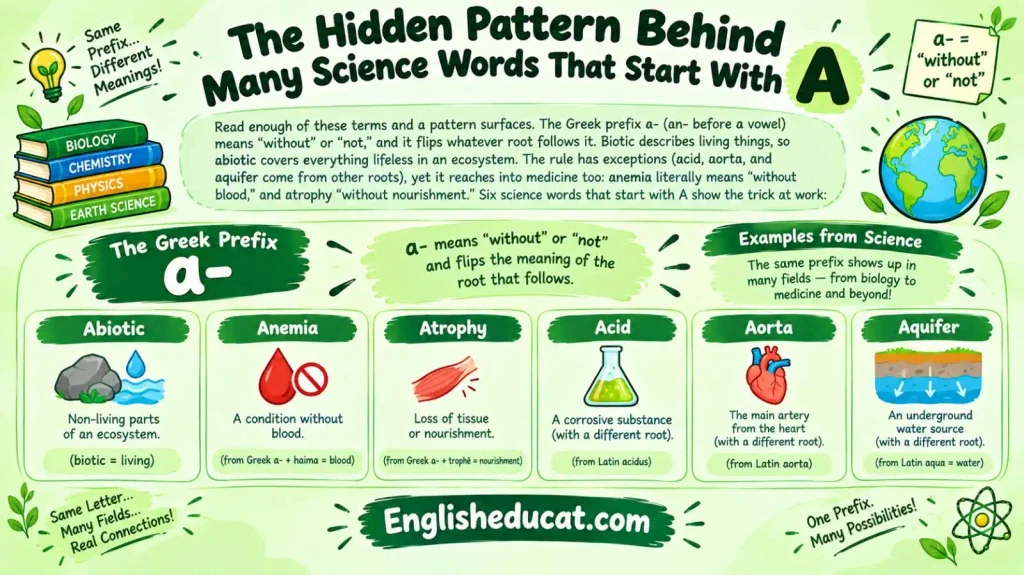
| Word | Built from | Literal meaning |
| Atom | a- + tomos (cut) | uncuttable |
| Abiotic | a- + bios (life) | without life |
| Anaerobic | an- + aer (air) + bios | living without air |
| Anhydrous | an- + hydor (water) | without water |
| Amorphous | a- + morphe (form) | without form |
| Anoxic | an- + oxygen | without oxygen |
Biology: Science Words That Start With A in Living Systems (17 Terms)
Biology has vocabulary for everything from single molecules to entire domains of life. These seventeen science words that start with A appear in genetics, immunology, physiology, and ecology classes.
| Term | Definition | Example |
| Abiotic | Lifeless part of a habitat, such as light, water, heat or soil. | Before surveying a habitat, ecologists log abiotic factors such as temperature and soil pH. |
| Adaptation | Heritable feature that improves survival or reproduction in a particular environment. | A camel’s wide, padded feet are an adaptation for walking on loose sand. |
| Adenine | One of four bases in DNA’s code, paired with thymine on the opposite strand. | Watson and Crick’s 1953 model showed adenine bonding with thymine across the double helix. |
| Aerobic | Depending on oxygen to extract energy from fuel molecules such as glucose. | Distance runners rely on aerobic respiration to keep their muscles working for hours. |
| Agar | Gelatin-like seaweed product that firms up nutrient broth for culturing microbes. | Robert Koch’s lab adopted agar in the early 1880s, and petri dishes still use it. |
| Allele | Particular variant of a gene, inherited from one parent. | Disease studies compare how often a particular allele turns up in patients and healthy volunteers. |
| Alveoli | Microscopic lung pockets where oxygen enters the blood and carbon dioxide leaves. | Oxygen crosses the thin walls of hundreds of millions of alveoli with every breath. |
| Amino acid | Small molecule that links in chains to form proteins. | Cells string about twenty standard amino acids together in different orders to make every protein. |
| Anaerobic | Happening, or surviving, in the absence of oxygen. | Brewing depends on anaerobic fermentation, in which yeast turns sugar into alcohol. |
| Antibiotic | Drug that treats bacterial infections by killing bacteria or halting their growth. | Fleming’s 1928 observation of mold killing bacteria began the path to penicillin. |
| Antibody | Y-shaped protein from immune cells that locks onto one particular target. | Vaccines train the body to produce antibodies before the real virus arrives. |
| Antigen | Molecule that the immune system treats as a signal to respond. | A flu vaccine supplies harmless viral surface proteins that act as antigens. |
| Apoptosis | Cell’s built-in self-destruct routine, used to remove damaged or unneeded cells. | Studies of apoptosis in roundworms earned three scientists the 2002 Nobel Prize in Physiology or Medicine. |
| Archaea | Single-celled organisms forming a domain apart from bacteria, many thriving in extreme conditions. | In 1977, Carl Woese proposed that archaea form their own branch of life. |
| Autotroph | Self-feeder that builds its own food from sunlight or chemical reactions. | Bacteria at deep-sea vents are autotrophs that draw energy from chemicals instead of sunlight. |
| Auxin | Plant growth hormone that directs stems and roots to lengthen or bend. | While studying why oat seedlings bend toward light, Frits Went isolated auxin in the 1920s. |
| Axon | Neuron’s long output cable that carries electrical signals onward. | Physiologists worked out how nerve impulses travel by recording from the giant axon of a squid. |
Keep one pair straight: abiotic factors are the lifeless conditions of a habitat, while biotic factors are the living organisms and their interactions.
Chemistry: Science Words That Start With A in the Lab (15 Terms)
Chemistry supplies vocabulary for substances, particles, and the way reactions unfold. The fifteen terms below span acids and bases, atomic structure, materials and reaction energy.
| Term | Definition | Example |
| Acid | Compound that releases hydrogen ions in water, giving a pH below 7. | Danish chemist Søren Sørensen introduced the pH scale in 1909 to express how acidic a solution is. |
| Activation energy | Energy barrier that reacting particles must overcome before products can form. | Enzymes speed up reactions in the body by lowering the activation energy. |
| Adsorption | Molecules clinging to the outer surface of a solid or liquid. | Water filters use activated charcoal, which traps impurities through adsorption. |
| Alkali metal | Group 1 element, such as lithium or sodium, that reacts eagerly with water. | Sodium, an alkali metal, is stored under oil because it reacts with moisture in air. |
| Alkane | Hydrocarbon whose carbon atoms are joined only by single bonds. | Methane, the main component of natural gas, is the simplest alkane. |
| Allotrope | One of the different atomic arrangements an element can take. | Diamond, graphite and graphene are allotropes of carbon with strikingly different properties. |
| Alloy | Metal blended with other elements to improve its strength or other properties. | Aircraft builders favor aluminum alloys because they are strong yet light. |
| Amalgam | Metal mixture in which mercury is one ingredient. | Dentists long filled cavities with silver amalgam, now being phased down in many countries. |
| Amorphous | Solid with atoms jumbled rather than arranged in a repeating crystal pattern. | Glass is amorphous, so it shatters into irregular shards. |
| Anhydrous | Free of water, including the water sometimes locked inside crystals. | Trace moisture can ruin some reactions, so chemists reach for anhydrous solvents. |
| Anion | Ion carrying a negative charge because it holds extra electrons. | When chlorine gains an electron, it becomes the chloride anion found in table salt. |
| Anode | Electrode at which a substance loses electrons. | In a zinc–copper cell, zinc is oxidized at the anode. |
| Aqueous | Describes a solution in which water is the solvent. | Chemical equations label dissolved substances with (aq), short for aqueous. |
| Atom | Basic building block of matter, made of a nucleus plus electrons. | Rutherford’s gold-foil experiments revealed that an atom’s mass sits in a tiny nucleus. |
| Avogadro’s number | Count of particles in one mole: roughly 6.022 × 10²³. | Since the 2019 SI redefinition, the mole is fixed by an exact value of Avogadro’s number. |
Students often mix up definitions of absorption and adsorption. The first draws a substance into the bulk of another, as a sponge does with water; the second leaves molecules stuck only to the surface.
Physics: Science Words That Start With A in Motion, Waves and Energy (12 Terms)
Some physics terms travel widely. Amplitude, for instance, describes ocean swells, sound, and seismic waves, while acceleration appears in crash tests and rocket launches alike.
| Term | Definition | Example |
| Ablation | Loss of surface material through burning, melting, vaporizing or erosion. | Apollo capsules survived re-entry because their heat shields carried heat away by ablation. |
| Absolute zero | Coldest temperature theoretically possible: 0 kelvin, or −273.15 °C. | In 1995, physicists chilled atoms to within billionths of a degree of absolute zero and made a Bose–Einstein condensate. |
| Absorption | Process of a material taking in energy such as light, heat or sound. | Dark pavement heats up in summer because of its strong absorption of sunlight. |
| Acceleration | How quickly an object’s speed or direction is changing. | Crash-test engineers record the acceleration a dummy’s head experiences in a collision. |
| Alpha particle | Two protons and two neutrons ejected together in some radioactive decays. | A sheet of paper stops an alpha particle, so the real danger is swallowing an alpha-emitting material. |
| Alternating current | Electric current whose direction flips back and forth many times each second. | Mains electricity is alternating current, cycling 50 times a second in the UK and 60 in the US. |
| Amplitude | How far a wave swings from its midpoint to its peak. | On a seismogram, the amplitude of ground vibrations helps gauge an earthquake’s size. |
| Angular momentum | Measure of an object’s spin, unchanged unless an outside twisting force acts. | A figure skater spins faster by pulling in her arms, conserving angular momentum. |
| Antimatter | Mirror-image particles that annihilate, releasing energy, on meeting ordinary matter. | PET scanners in hospitals detect positrons, the antimatter twin of the electron. |
| Aperture | Opening that decides how much light enters an optical instrument. | The James Webb Space Telescope’s 6.5-meter aperture gathers light from very distant galaxies. |
| Archimedes’ principle | Upward push on an object in a fluid equals the weight of fluid displaced. | Naval architects apply Archimedes’ principle to work out how deep a loaded ship will sit. |
| Attenuation | Fading of a wave’s or signal’s strength as it passes through a medium. | In CT scans, tissues attenuate X-rays by different amounts, and that contrast forms the image. |
Ablation is worth a second look because its meaning shifts with the field. Engineers use it for spacecraft heat shields, surgeons for removing tissue, and glaciologists for the snow and ice a glacier sheds through melting and related processes.
Astronomy and Space: Science Words That Start With A Beyond Earth (10 Terms)
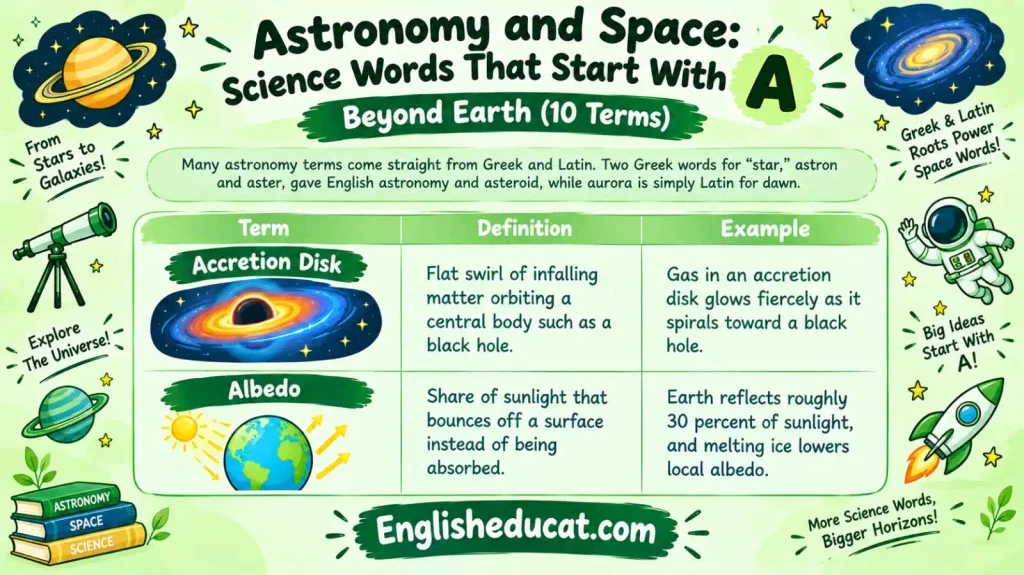
Many astronomy terms come straight from Greek and Latin. Two Greek words for “star,” astron and aster, gave English astronomy and asteroid, while aurora is simply Latin for dawn.
| Term | Definition | Example |
| Accretion disk | Flat swirl of infalling matter orbiting a central body such as a black hole. | Gas in an accretion disk glows fiercely as it spirals toward a black hole. |
| Albedo | Share of sunlight that bounces off a surface instead of being absorbed. | Earth reflects roughly 30 percent of sunlight, and melting ice lowers local albedo. |
| Andromeda Galaxy | Closest big spiral galaxy to ours, roughly 2.5 million light-years away. | On a dark night, you can see the Andromeda Galaxy with the naked eye as a faint smudge. |
| Aphelion | Farthest point of a body’s orbit around the Sun. | Earth reaches aphelion in early July, about 152 million kilometers from the Sun. |
| Apogee | Farthest point of an orbit around Earth, as for the Moon or a satellite. | A satellite in an elliptical orbit moves slowest at its apogee. |
| Asteroid | Rocky or metallic leftover from the solar system’s formation. | NASA’s OSIRIS-REx probe delivered samples from the asteroid Bennu to Earth in 2023. |
| Astronomical unit | Yardstick equal to the average Earth–Sun distance, about 150 million kilometers. | Jupiter orbits roughly 5 astronomical units from the Sun. |
| Atmosphere | Layer of gas that gravity holds around a planet or moon. | Mars has a thin atmosphere, mostly carbon dioxide, that holds little heat. |
| Aurora | Curtain of colored light in polar skies, triggered by solar particles. | Charged particles from the Sun strike gases high in Earth’s atmosphere and light up an aurora. |
| Axial tilt | Angle between a planet’s spin axis and the line perpendicular to its orbit. | Earth’s axial tilt of about 23.5 degrees, not its distance from the Sun, causes the seasons. |
Three orbit words share a Greek prefix. Apo- means “away from,” so aphelion marks the point farthest from the Sun (helios) and apogee the point farthest from Earth (gaia). The advanced table adds apoapsis, the same idea applied to any orbit.
Earth and Environmental Science: Science Words That Start With A in Nature (13 Terms)
Landforms, hazards, water and human impact all have their own A-words. Geologists, oceanographers and climate scientists rely on these thirteen regularly.
| Term | Definition | Example |
| Abyssal plain | Vast, nearly flat stretch of deep seafloor, thousands of meters below the surface. | Marine geologists sample thick ooze that settles slowly across the abyssal plain. |
| Acid rain | Precipitation made unusually acidic by sulfur and nitrogen pollution. | Twentieth-century acid rain damaged forests and stonework across Europe and North America. |
| Aerosol | Fine solid or liquid specks floating in air. | Volcanic aerosols can reflect sunlight and cool global temperatures for a year or two. |
| Algal bloom | Sudden population boom of algae, usually triggered by surplus nutrients in water. | Fertilizer runoff has fed repeated algal blooms in Lake Erie. |
| Alluvium | Loose sediment such as sand, silt and clay left behind by rivers. | Fertile alluvium left by annual Nile floods supported farming in ancient Egypt. |
| Anoxic | Having no dissolved oxygen. | Deep water in the Black Sea is anoxic, so few organisms besides microbes can live there. |
| Anthropogenic | Originating from human activities rather than natural processes. | Climate assessments separate anthropogenic greenhouse gas emissions from natural sources such as volcanoes. |
| Anticline | Upward-bulging fold in rock layers, with the oldest rock in the middle. | Anticlines interest petroleum geologists because oil and gas can pool beneath the crest. |
| Aquifer | Rock or sediment that stores and transmits groundwater. | The Ogallala Aquifer supplies water to farms across the US Great Plains. |
| Archean | Geologic eon lasting from roughly 4 to 2.5 billion years ago. | Some of the oldest signs of life are preserved in Archean rocks in Western Australia. |
| Archipelago | Cluster or chain of islands. | Hawaii is an archipelago built by a volcanic hot spot beneath the Pacific plate. |
| Asthenosphere | Weak, slowly flowing part of the upper mantle lying under the rigid outer shell. | Tectonic plates glide over the asthenosphere at roughly the speed fingernails grow. |
| Atoll | Ring of coral surrounding a central lagoon. | Charles Darwin proposed that atolls form as volcanic islands sink while coral keeps growing upward. |
Aquifer and artesian well are easy to blur. The aquifer is the water-bearing rock or sediment itself; an artesian well taps a pressurized aquifer, so water rises without a pump.
Advanced Science Words That Start With A (Rare and Specialist Terms)
Advanced science words that start with A tend to live in university courses and research papers. These eight span five branches, from origin-of-life research to orbital mechanics.
| Term | Definition | Example |
| Abiogenesis (biology) | Emergence of living matter from non-living chemistry. | Origin-of-life labs test abiogenesis by recreating early-Earth chemistry in flasks. |
| Abscission (biology) | Plant’s controlled release of a leaf, petal or fruit. | Shorter autumn days trigger abscission, so deciduous trees drop their leaves. |
| Allopatric speciation (biology) | New species arising after a population is split by a geographic barrier. | Darwin’s finches on separate islands are often cited as a case of allopatric speciation. |
| Azeotrope (chemistry) | Liquid mixture that boils without changing composition, so distillation cannot separate it. | Ethanol and water form an azeotrope at about 95.6 percent ethanol. |
| Adiabatic (physics) | Happening without heat flowing into or out of the system. | Air rising up a mountainside cools adiabatically as it expands. |
| Anisotropy (physics) | Direction-dependent behavior, where a property changes with how you measure it. | Wood shows anisotropy: it splits easily along the grain but resists across it. |
| Apoapsis (astronomy) | Farthest point in an orbit from the object being circled. | A comet crawls at apoapsis, then speeds up as it falls back toward the Sun. |
| Aeolian (Earth science) | Related to wind, including the landforms and sediments it creates. | Rovers on Mars have photographed aeolian dunes and ripples shaped by wind. |
Why Learn Science Words That Start With A?
Vocabulary is the quickest upgrade a science student can make. When a textbook calls a solution “aqueous” or a habitat “anoxic,” the sentence either lands or it does not, and no amount of clever reasoning replaces knowing the word. That is the practical case for learning science words that start with A: they appear in introductory courses across every branch and keep coming back.
Words also travel between subjects. Absorption means one thing to a chemist and something slightly different to a physicist, so noticing an overlap trains you to ask which science a sentence belongs to.
Then there is confidence. Read a news story about aquifer depletion, anthropogenic emissions, or a heat shield’s ablation, and you can follow the argument instead of skimming past it. Scientists depend on precise terms because loose language breeds misunderstanding, and learning the terms is how you join the conversation.
Frequently Asked Questions
What are some science words that start with A?
Common science words that start with A include atom, acid, acceleration, adaptation, allele, atmosphere, asteroid, and aquifer. They span biology (allele, adaptation), chemistry (atom, acid), physics (acceleration), astronomy (asteroid), and Earth science (aquifer, atmosphere). This guide defines 75, each with an example sentence.
What does the prefix a- mean in science?
In science, the prefix a- (an- before a vowel) is Greek for “without” or “not.” It reverses the root’s meaning: abiotic means lifeless, anaerobic means happening without oxygen, and anhydrous means containing no water. Plenty of A-words do not use it; acid, aorta, and aquifer are examples.
What are 5-letter science words that start with A?
Algae, alloy, amino, anode, and aorta are five-letter science words that start with A. Algae are simple aquatic organisms, an alloy is a metal mixed with other elements, amino describes the NH₂ group in amino acids, an anode is where oxidation occurs, and the aorta is the body’s largest artery.
What is the difference between absorption and adsorption?
Absorption means one substance is drawn throughout the volume of another, like a sponge soaking up water. Adsorption means molecules stick only to a surface, like odors trapped by activated charcoal. The words differ by one letter but describe different processes.
What is an example of an abiotic factor?
An abiotic factor is a lifeless component of an ecosystem, such as sunlight, temperature, water, soil, or air. These conditions determine which living, or biotic, organisms can survive there. Low rainfall, for example, limits plant growth in a desert.
What are the hardest science words that start with A?
Abiogenesis, abscission, allopatric speciation, azeotrope, adiabatic, anisotropy, apoapsis, and aeolian rank among the harder science words that start with A. They come from specialist fields such as origin-of-life research, plant biology, evolution, distillation, thermodynamics, and orbital mechanics. See the advanced table above for each definition.
Conclusion
You started with a single letter and finished with 75 terms that stretch from the smallest particle to the polar sky. Along the way you met the atom that builds matter, the allele behind inherited traits, the aquifer that hides fresh water underground, and the aurora that lights up polar nights. Five branches of science, one alphabet, and a shared habit of naming things precisely.
So put the list to work. Choose five terms, say them aloud, and use each in a sentence about your own day. Then look for them in a textbook, a documentary, or a news headline; every sighting proves the words are already yours. Science words that start with A are only the first page of a much bigger glossary, and the B words are waiting whenever you are.

ESL Content Writer
Emily is a TESOL-certified writer who has taught English to international students for over 8 years. She loves breaking down idioms and everyday expressions into simple, relatable explanations that make sense to learners at any level.