
Science words that start with B appear everywhere, from a third-grade lesson on bacteria to a graduate seminar on black holes. Few letters carry as much scientific weight, stretching across biology, chemistry, physics, astronomy, and earth science with almost equal ease. Whether you are a student memorizing vocabulary, a teacher building a word wall, or someone who enjoys collecting unusual terms, this list of science words that start with B is genuinely useful, not just exhaustive. They are very similar like other words that start with C and D.
Below you will find 48 real science words that start with B, organized by branch, each with an original explanation and also an example sentence. A bonus section covers advanced and rare B-words for anyone who wants a challenge, plus a short FAQ answering the most common questions about science words that start with B.
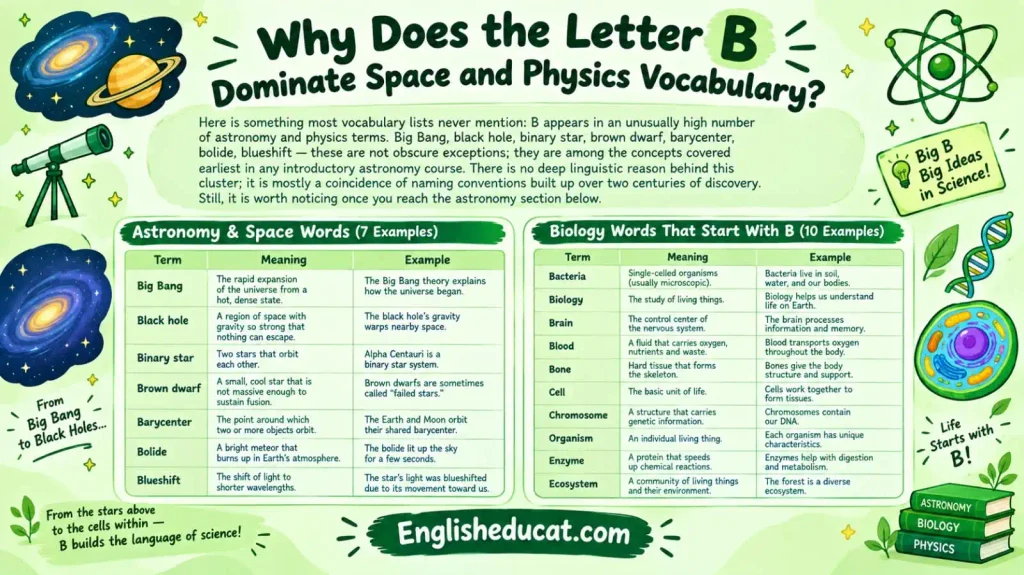
Why Does the Letter B Dominate Space and Physics Vocabulary?
Here is something most vocabulary lists never mention: B appears in an unusually high number of astronomy and physics terms. Big Bang, black hole, binary star, brown dwarf, barycenter, bolide, blueshift these are not obscure exceptions; they are among the concepts covered earliest in any introductory astronomy course. There is no deep linguistic reason behind this cluster; it is mostly a coincidence of naming conventions built up over two centuries of discovery. Still, it is worth noticing once you reach the astronomy section below.
Biology Words That Start With B
Biology hands over a large share of the science words that start with B, since so many biological terms trace back to “bio,” the Greek root for life. The ten entries below run from the microscopic to the anatomical, covering vocabulary most students meet between middle school and their first college science course.
In every table below, the first column gives the term name, the second its meaning, and the third an example of that term.
| Term | Meaning | Example |
| Bacteria | Not villains by default: single-celled organisms that live in soil, oceans, and the human gut, often quietly supporting the systems around them rather than causing illness. | A microbiology student culturing an overnight sample can watch an entire colony spread across the dish by morning. |
| Biodiversity | The range of species sharing a habitat or ecosystem a rainforest packed with thousands of insect species and a single-crop farm field sit at opposite ends of it. | Conservation researchers frequently point to the Amazon as the benchmark for biodiversity among the world’s land habitats. |
| Biome | The combination of climate and geography that decides which plants and animals can survive somewhere. | A tundra biome, shaped by its short growing season and permanently frozen subsoil, supports only a fraction of the species found in a tropical one. |
| Biosphere | Stretch a line from the deepest ocean trench to the upper edge of the atmosphere, and everywhere life exists along that line falls inside it. | Environmental researchers increasingly track how human activity is straining that thin layer’s ability to sustain future generations. |
| Botany | The study of plants which was already shaping agriculture and medicine long before genetics or biotechnology existed. | A botanist researching drought resistance today might spend years cataloguing wild wheat relatives most people have never heard of. |
| Bioluminescence | Fireflies blinking over a backyard and plankton glowing along a shoreline share the same trick: light generated by a living organism’s own internal chemistry. | A large enough plankton bloom can turn breaking ocean waves an eerie blue after dark. |
| Biopsy | Removal of a small tissue sample to check for disease, most often cancer, when imaging alone can’t confirm what’s happening inside the body. | Physicians typically order one only after other tests suggest something worth investigating. |
| Biotic | Ecologists split every ecosystem into two categories, and the living half predators, prey, plants, decomposers as opposed to abiotic factors like rainfall or temperature. | A single food web can involve dozens of biotic relationships. |
| Bronchi | Air entering the lungs has to pass through them first: the two branching passages that split off from the trachea on the way to each lung. | During an asthma attack, inflammation narrows the bronchi enough to make every breath a struggle. |
| Biomass | Add up the weight of every living thing in a given area and you get this figure which ecologists rely on to estimate how much carbon a forest or wetland is storing. | Researchers calculating a forest’s biomass are often really trying to answer a bigger question: how much carbon would be released if that forest disappeared tomorrow. |
Chemistry Words That Start With B
Chemistry keeps contributing new science words that start with B the deeper you look, since so many trace straight back to the periodic table or to reactions covered in a first-year lab course.
| Term | Meaning | Example |
| Bond | What holds atoms together once they share or trade electrons, or once opposite charges pull them close. | Atoms rarely stay isolated for long, and most students meet the idea of a covalent bond within their first few weeks of high school chemistry. |
| Base | A strong base is a substance that either accepts protons or releases hydroxide ions once dissolved, such as sodium hydroxide in water. | Traditional soap-making relies on exactly this kind of base to break fats down into something that lathers. |
| Buffer | A solution engineered to resist pH change when small amounts of acid or base get introduced. | Blood shouldn’t swing wildly in pH after a meal or a hard workout, and it doesn’t the bloodstream’s natural buffer system is one reason survival depends on staying within such a narrow pH range. |
| Boiling point | The exact moment a liquid’s vapor pressure catches up with the pressure pushing down on it. | Climb a mountain and water boils at a noticeably lower temperature than it would at sea level, and that altitude-dependent quirk is why some recipes need adjusting above a certain elevation. |
| Bromine | Among the halogens on the periodic table, bromine stands out as the only nonmetal that’s naturally a liquid at room temperature, carrying the symbol Br. | Flame retardants and certain water-treatment processes both depend on bromine compounds doing their job quietly in the background. |
| Boron | A metalloid element with the atomic symbol B. | Ordinary glass shatters under sudden heat, but glass reinforced with boron resists that kind of thermal shock far better which is exactly why laboratory glassware is almost always made from borosilicate glass rather than the standard kind. |
| Binary compound | Any substance built from exactly two different elements. | Table salt looks unremarkable, but it’s a textbook case, built from sodium and chlorine chemists use “binary” strictly to describe element count, not molecular complexity. |
| Bronsted-Lowry acid | Any substance that donates a hydrogen ion during a reaction, a definition built to fill the gap left by acid reactions that don’t happen in water. | That broader framework let chemists finally explain acid-base behavior in reactions where water never enters the picture at all. |
Physics Words That Start With B
Physics supplies some of the most hands-on science words that start with B, many tied to forces or particles students first meet through a classroom demonstration.
| Term | Meaning | Example |
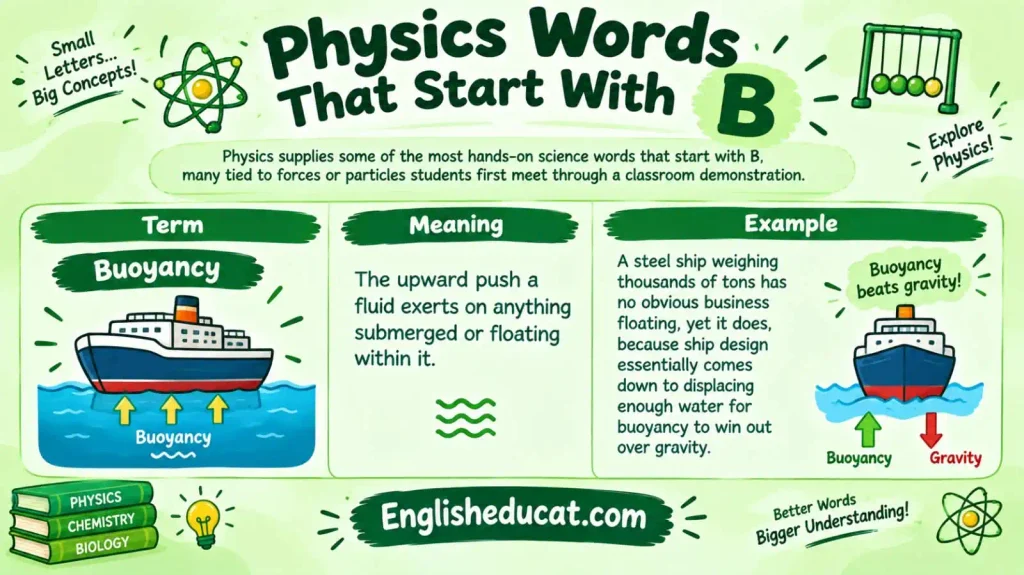
| Buoyancy | The upward push a fluid exerts on anything submerged or floating within it. | A steel ship weighing thousands of tons has no obvious business floating, yet it does, because ship design essentially comes down to displacing enough water for buoyancy to win out over gravity. |
| Ballistics | The study of how a launched projectile moves once it’s airborne, relied on by investigators reconstructing a crime scene and engineers plotting a rocket’s flight path. | A bullet’s trajectory, once analyzed through ballistics, can sometimes pinpoint exactly where a shot was fired from. |
| Bernoulli’s principle | The pressure imbalance created when air moving faster across the curved top of an airplane wing exerts less pressure than the slower air underneath it. | Pilots owe a surprising amount of lift, quite literally, to this one relationship between fluid speed and pressure. |
| Bandwidth | The range of frequencies a channel or signal can actually carry. | Try streaming a video over a connection built for text messages and you’ll run straight into the limits of bandwidth — high-definition video demands dramatically more bandwidth than a simple email ever would. |
| Binding energy | The energy required to tear the particles of a nucleus back apart, the only reason protons packed tightly together don’t repel each other into oblivion. | Nuclear binding energy is effectively the glue holding every atomic nucleus together despite that internal repulsion. |
| Brownian motion | The random, jittery drift of tiny particles suspended in a liquid or gas — which gave physicists proof atoms existed long before anyone could see one directly. | Early twentieth-century analysis of Brownian motion became some of the strongest evidence that matter really is made of discrete particles. |
| Barometer | The instrument used to track atmospheric pressure. | A sudden drop on a barometer is often the first hint of an approaching storm long before any clouds appear, and meteorologists still treat a falling reading as one of the most reliable early warning signs available to them. |
| Boyle’s law | The rule describing how gas pressure and volume move in opposite directions at constant temperature. | A sealed bag of chips wants to expand, not shrink, at higher altitude — nearly every introductory physics course reaches for that puffed-up bag of chips as the go-to example. |
Astronomy and Space Words That Start With B
As the hook section above suggested, astronomy is where science words that start with B really pile up, packing an outsized share of the defining ideas of the field into a single letter of the alphabet.
| Term | Meaning | Example |
| Big Bang | The rapid expansion event thought to have occurred roughly 13.8 billion years ago, from which cosmologists trace the universe’s entire history. | It’s worth noting that most researchers describe the Big Bang not as an explosion happening inside space, but as the expansion of space itself. |
| Black hole | A region where gravity becomes strong enough to trap everything nearby — cross a certain boundary and there’s no coming back, not even for light. | Since no telescope can observe a black hole directly, astronomers infer its presence from how surrounding stars and gas behave. |
| Binary star | A star locked into a system orbiting a shared center of mass with a stellar companion — roughly half of all sunlike stars in the galaxy may be in one. | Spotting a binary star from Earth often requires watching for a telltale dip in brightness as one star periodically passes in front of the other. |
| Brown dwarf | An object too small to ignite the nuclear fusion that powers a true star, glowing only dimly, mostly from heat left over from its own formation. | Astronomers sometimes describe a brown dwarf as sitting in the awkward middle ground between the largest planets and the smallest stars. |
| Barycenter | The shared point around which two orbiting bodies both revolve, rather than circling each other directly. | Pluto and its moon Charon are close enough in mass that their barycenter actually falls outside Pluto’s surface entirely. |
| Bolide | An unusually bright meteor that breaks apart as it burns through the atmosphere. | Witnesses sometimes report an explosion or a plane crash when what they actually saw was a bolide, since the flash and sonic boom a bolide produces can be dramatic enough to trigger emergency calls across an entire region. |
| Blueshift | The compression of light into shorter wavelengths when an object rushes toward Earth. | Detecting blueshift in a distant galaxy’s spectrum is one of the clearest signs that galaxy is approaching rather than moving away. |
| Asteroid belt | A scattered region of small rocky bodies between the orbits of Mars and Jupiter, far less crowded than science fiction movies tend to suggest. | Most objects inside the asteroid belt are considerably smaller than Earth’s moon, despite popular depictions of ships weaving through dense rubble. |
Why Learn Science Words That Start With B?
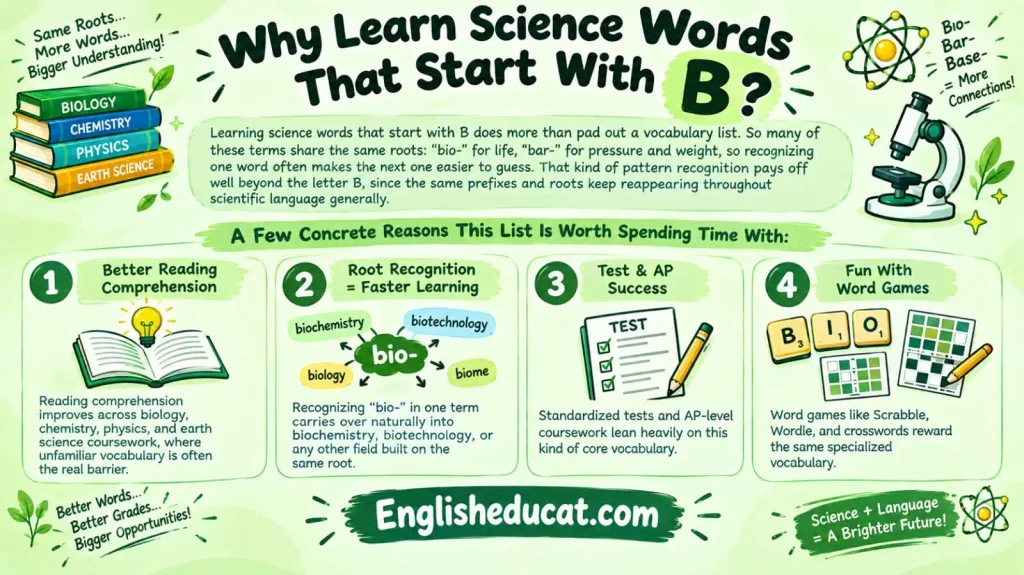
Learning science words that start with B does more than pad out a vocabulary list. So many of these terms share the same roots: “bio-” for life, “bar-” for pressure and weight, so recognizing one word often makes the next one easier to guess. That kind of pattern recognition pays off well beyond the letter B, since the same prefixes and roots keep reappearing throughout scientific language generally.
A few concrete reasons this list is worth spending time with:
- Reading comprehension improves across biology, chemistry, physics, and earth science coursework, where unfamiliar vocabulary is often the real barrier.
- Recognizing “bio-” in one term carries over naturally into biochemistry, biotechnology, or any other field built on the same root.
- Standardized tests and AP-level coursework lean heavily on this kind of core vocabulary.
- Word games like Scrabble, Wordle, and crosswords reward the same specialized vocabulary.
Whether the goal is passing a biology exam or just enjoying how language and science intersect, working through science words that start with B is a small investment that pays off in more contexts than you would expect.
Frequently Asked Questions
What are some science words that start with B?
Bacteria, biodiversity, bond, buoyancy, black hole, and biome are a few of the most recognizable. Between them, these science words that start with B already touch on cellular biology, ecology, chemistry, and astrophysics.
What is a 5-letter science word that starts with B?
“Biome,” “boron,” and “brine” all qualify, drawn from three different branches: ecology, chemistry, and general lab vocabulary.
What science words that start with B are used in biology?
Bacteria, biodiversity, biosphere, biotic, and biopsy come up constantly in biology coursework, most tracing back to the Greek root “bio,” meaning life.
What is the hardest science word that starts with B?
Bremsstrahlung and buckminsterfullerene are the usual contenders. One describes radiation released when a charged particle decelerates suddenly; the other names a soccer-ball-shaped molecule made of sixty carbon atoms.
Why are there so many space and physics terms that start with B?
Astronomy and physics happen to cluster an unusually large number of foundational B-terms, including Big Bang, black hole, binary star, and brown dwarf. There is no real linguistic explanation for it; the pattern mostly reflects how these fields built up their terminology over time.
How many science words start with the letter B?
This guide covers 48 verified science words that start with B, spread across biology, chemistry, physics, astronomy, and earth science. Thousands more exist in specialized academic literature well beyond what is practical to include here.
Conclusion
From the bacteria living quietly in a petri dish to the black holes bending light across billions of light-years, science words that start with B prove how much ground a single letter can cover. You have now made it through 48 terms across five branches of science and also half a dozen advanced words that would challenge a seasoned researcher- a working map of how scientists actually talk to each other.
The real payoff is not memorizing every definition in one sitting. It is noticing the patterns: how “bio-” keeps resurfacing, how B gravitates toward space and physics, how a word like “buffer” means something slightly different in chemistry than in everyday conversation. Once those threads start appearing on their own, science words that start with B stop feeling like a list to memorize and start feeling like a language you are already halfway to speaking. Pick a favorite term, use it in a sentence of your own, and let curiosity carry you to the next letter.

Senior English Content Editor
Sarah has over 10 years of experience teaching English as a Second Language in Chicago public schools. She specializes in vocabulary building and simplifying complex word meanings for everyday learners. Sarah holds a Master’s degree in English Education from the University of Illinois.