Ask any student to name a science word, and there is a fair chance it starts with C. This guide gathers 134 science words that start with C, sorted across five branches: biology, chemistry, physics, astronomy, and earth science, with eight advanced bonus terms for anyone ready to go further.
Each entry pairs a plain-language definition with a real-world example, so instead of just memorizing a list, you will see how these terms are used in classrooms, labs, and scientific writing. Whether you are preparing for an exam, filling out a classroom word wall, or just chasing down a term you overheard on the news, this collection of science words that start with C is built to be genuinely useful, not just comprehensive. They are explained just like other science words that start with D and E.
Why C Is Science’s Busiest Letter
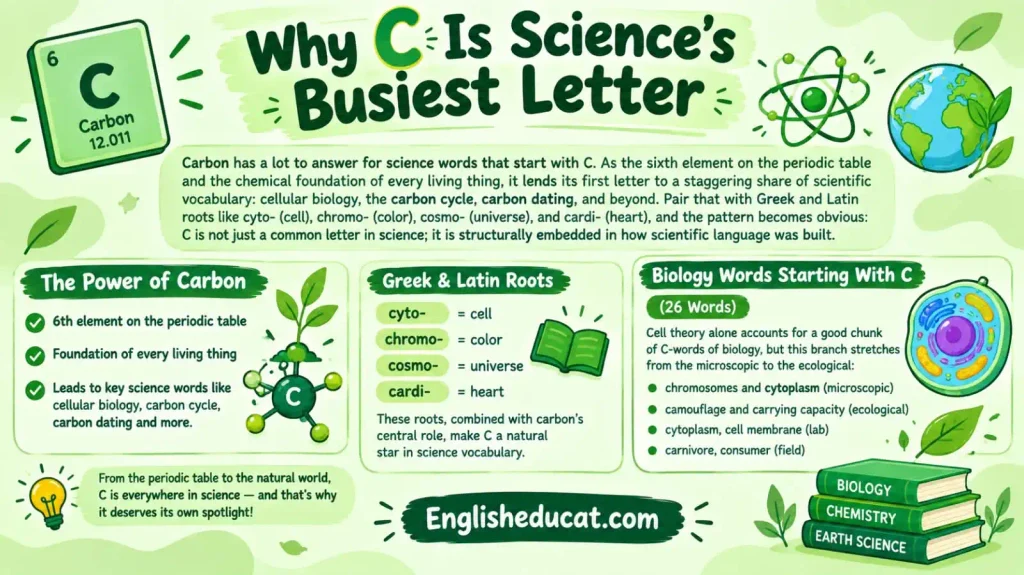
Carbon has a lot to answer for science words that start with C. As the sixth element on the periodic table and the chemical foundation of every living thing, it lends its first letter to a staggering share of scientific vocabulary: cellular biology, the carbon cycle, carbon dating, and beyond.
Pair that with Greek and Latin roots like cyto- (cell), chromo– (color), cosmo- (universe), and cardi- (heart), and the pattern becomes obvious: C is not just a common letter in science; it is structurally embedded in how scientific language was built. That is part of why science words that start with C deserve a dedicated list rather than getting lost in a general vocabulary roundup.
Biology Words Starting With C (26 Words)
Cell theory alone accounts for a good chunk of C-words of biology, but this branch stretches from the microscopic to the ecological: chromosomes and cytoplasm on one end, camouflage and carrying capacity on the other. A lab tech examining tissue samples will run into terms like cytoplasm or cell membrane almost every day; a field biologist tracking predator-prey dynamics is more likely to use carnivore or consumer. Together, these 26 biology-focused science words starting with C show how scientists study life at every scale.
| Term | Definition | Example |
| Cell | The smallest working unit of life, capable of carrying out its own basic functions | A single skin cell divides constantly to repair damaged tissue. |
| Chromosome | A coiled strand of DNA that stores an organism’s genetic instructions | Humans have 46 chromosomes arranged in 23 pairs. |
| Chlorophyll | The pigment responsible for a plant’s green color and its ability to trap sunlight | Chlorophyll gives leaves their bright green color in summer. |
| Chloroplast | The internal structure in plant cells where sunlight gets converted into chemical energy | Chloroplasts capture sunlight to produce sugars for the plant. |
| Cytoplasm | The jelly-like material inside a cell that holds its internal structures in place | Nutrients move through the cytoplasm to reach the nucleus. |
| Capillary | A tiny blood vessel thin enough to let gases and nutrients pass through its walls | Oxygen passes from blood into tissue through capillary walls. |
| Carnivore | An animal whose diet consists mainly of other animals | A lion is a carnivore that hunts large herbivores. |
| Cartilage | A tough but bendable tissue that cushions joints and shapes structures like the ear | Cartilage cushions the knee joint during running. |
| Cilia | Tiny hair-like projections that beat rhythmically to move fluid along a surface | Cilia in the airway sweep dust and mucus upward. |
| Cloning | The lab process of producing an organism with identical DNA to another | Scientists used cloning to create a genetically identical sheep. |
| Cortex | The outermost layer of an organ, often where the most active processing happens | The cerebral cortex controls higher thinking and language skills. |
| Cotyledon | The first leaf-like structure that feeds a sprouting seed before true leaves form | The cotyledon supplies energy to the seedling before it sprouts. |
| Commensalism | An ecological relationship where one organism gains something and the other stays unaffected | Barnacles on a whale show commensalism between two species. |
| Cardiac muscle | The specialized muscle tissue that gives the heart its pumping ability | Cardiac muscle contracts rhythmically to pump blood nonstop. |
| Consumer | Any organism that gets its energy by eating other living things rather than making its own food | A deer is a consumer that feeds on grasses and shrubs. |
| Cytology | The branch of biology focused specifically on how cells are built and how they function | Cytology helped researchers identify abnormal cells in the sample. |
| Cell membrane | The flexible outer layer that regulates what moves in and out of a cell | The cell membrane blocks harmful substances from entering the cell. |
| Cnidarian | A group of water-dwelling animals equipped with stinging cells, including jellyfish and coral | A jellyfish is a cnidarian that uses tentacles to sting prey. |
| Colony | A cluster of same-species organisms living and often working together | A coral colony can grow to cover several acres of seafloor. |
| Cross-pollination | The movement of pollen from one plant to a genetically different plant of the same species | Bees enable cross-pollination as they move between flowers. |
| Cerebellum | The part of the brain responsible for balance and smooth, coordinated movement | Damage to the cerebellum can cause unsteady, jerky walking. |
| Cochlea | The spiral-shaped structure in the inner ear that turns sound waves into nerve impulses | The cochlea sends signals to the brain so we hear music. |
| Cell division | The splitting of one cell into two, allowing growth and tissue repair | Cell division allows a wound to heal by replacing damaged tissue. |
| Carrying capacity | The largest population size a given environment can sustain over time | Limited food lowered the carrying capacity for deer in the valley. |
| Camouflage | Coloring or patterning that helps an organism disappear into its surroundings | A stick insect’s camouflage makes it nearly invisible on tree bark. |
| Cellular respiration | The chemical process cells use to turn glucose and oxygen into usable energy | Cellular respiration releases energy that powers muscle contraction. |
Chemistry Words Starting With C (26 Words)
Organic chemistry exists because of carbon, so it is no surprise this branch is packed with C-vocabulary. These terms appear constantly in lab write-ups, reaction rates, bonding, separation techniques, the everyday language of anyone running experiments. If you have sat through a chemistry unit on bonding or acids, chances are you have already met several of these science words that start with C without realizing how many others belong to the same family.
| Term | Definition | Example |
| Carbon | The nonmetal element that forms the structural backbone of nearly all organic molecules | Carbon atoms bond together to form diamond and graphite. |
| Catalyst | A substance that accelerates a chemical reaction while remaining unchanged itself | An enzyme acts as a catalyst during digestion of food. |
| Compound | A pure substance formed when two or more elements bond together chemically | Water is a compound formed from hydrogen and oxygen. |
| Covalent bond | A chemical connection created when two atoms share a pair of electrons | A covalent bond holds the two oxygen atoms in O2 together. |
| Combustion | A fast-burning reaction between a fuel and oxygen that releases heat and light | Combustion of gasoline powers most car engines. |
| Concentration | A measure of how much of a substance is packed into a given amount of solution | A higher salt concentration makes seawater denser than tap water. |
| Condensation | The change of state that happens when a cooling gas turns back into liquid | Condensation forms water droplets on a cold soda can. |
| Corrosion | The slow chemical wearing-away of a material, most commonly a metal exposed to moisture or air | Corrosion slowly turned the old iron gate reddish brown. |
| Crystallization | The formation of a solid whose atoms lock into a repeating, ordered pattern | Crystallization produced clear sugar crystals in the cooled syrup. |
| Cation | An ion that carries a positive charge after losing one or more electrons | Sodium loses an electron to become a cation in solution. |
| Chromatography | A lab method for pulling apart a mixture based on how fast its parts travel through a medium | Chromatography separated the ink into its different colored pigments. |
| Colloid | A mixture in which fine particles stay suspended throughout a substance without fully dissolving | Milk is a colloid with fat droplets suspended in water. |
| Calorimetry | A technique for measuring how much heat enters or leaves a system during a reaction | Calorimetry measured the heat produced when the fuel burned. |
| Chemical equilibrium | A balanced point where a reaction’s forward and reverse rates match | The reaction reached chemical equilibrium after several minutes. |
| Chlorine | A highly reactive halogen element commonly used to kill bacteria in water | Chlorine is added to pools to kill harmful bacteria. |
| Chromium | A hard, corrosion-resistant metal that gives stainless steel its shine | Chromium plating gives the bumper its bright, reflective shine. |
| Cesium | A soft alkali metal so reactive it’s used to define ultra-precise time standards | Cesium atoms vibrate at a precise rate used to define the second. |
| Carbonate | A compound built around the carbonate ion, found widely in shells and rock formations | Calcium carbonate makes up much of the eggshell’s structure. |
| Chelation | A process in which a molecule grips a metal ion tightly enough to pull it out of a system | Doctors use chelation therapy to remove lead from the bloodstream. |
| Conjugate acid | The species that results when a base picks up a hydrogen ion | Ammonium is the conjugate acid formed when ammonia gains a proton. |
| Copolymer | A polymer built from two or more distinct types of monomer units | Rubber tires often contain a copolymer for added durability. |
| Carboxylic acid | An organic acid identified by its -COOH functional group | Vinegar contains acetic acid, a common carboxylic acid. |
| Chemical formula | A shorthand notation showing which elements make up a compound and in what ratio | The chemical formula for table salt is NaCl. |
| Cracking | An industrial process that breaks large hydrocarbon chains into smaller, more usable ones | Refineries use cracking to turn crude oil into gasoline. |
| Calcination | Heating a solid strongly enough to release trapped water or gas without melting it | Calcination converts limestone into quicklime by releasing carbon dioxide. |
| Curie point | The threshold temperature past which a magnetic material stops behaving magnetically | Heating the iron past its Curie point erased its magnetic field. |
Physics Words Starting With C (25 Words)
Electricity and motion dominate this list: circuits, capacitors, conductors the vocabulary that appears whenever engineering students start wiring circuits or calculating forces. It is also the branch most likely to sneak into everyday reading: articles about lasers, nuclear reactors, or fiber-optic cables all lean on these exact terms without necessarily explaining them.
| Term | Definition | Example |
| Current | The steady movement of electric charge through a wire or other conductor | Current flows through the wire whenever the switch is closed. |
| Circuit | A complete, unbroken loop that lets electricity travel from source to destination and back | Breaking the circuit instantly turned off every connected light. |
| Capacitor | A component built to hold electric charge briefly before releasing it | A capacitor releases stored energy quickly inside a camera flash. |
| Conduction | Heat or electricity spreading through a material via direct physical contact | Conduction quickly warms a metal spoon left in hot soup. |
| Convection | Heat transfer driven by the rising and sinking motion of a fluid | Convection currents carry warm air upward from a radiator. |
| Centripetal force | The inward-pulling force that keeps a moving object curving along a circular path | Centripetal force keeps the moon in orbit around Earth. |
| Coulomb | The standard unit for quantifying electric charge | One coulomb equals the charge of about 6.24 quintillion electrons. |
| Coulomb’s law | A physics rule describing how the force between two charges changes with distance | Coulomb’s law predicts weaker force as charges move farther apart. |
| Compression | The squeezing of a substance into a smaller space under pressure | Compression of the gas inside the cylinder raised its temperature. |
| Coherent light | Light in which all the waves march in step at the same wavelength | Lasers produce coherent light used in precise cutting tools. |
| Critical mass | The smallest quantity of fissile material capable of sustaining a nuclear chain reaction | Reaching critical mass let the reactor sustain a steady reaction. |
| Center of mass | The single point where an object’s weight is evenly distributed in all directions | A tightrope walker keeps their center of mass above the wire. |
| Conductor | Any material that lets electric current or heat pass through it with little resistance | Copper is a common conductor used in household wiring. |
| Chromatic aberration | A lens flaw that splits colors unevenly, producing fringes of color around an image | Chromatic aberration created faint colored fringes around the photo’s edges. |
| Collision | The moment two or more objects meet with enough force to exchange momentum | The collision transferred momentum to the stationary ball. |
| Constructive interference | Overlapping waves reinforcing each other to produce a stronger combined wave | Constructive interference produced a louder sound where speakers overlapped. |
| Critical angle | The specific angle at which light stops refracting and reflects entirely instead | Light past the critical angle reflects entirely inside the fiber. |
| Conservation of energy | The rule that total energy in a closed system stays constant, only changing form | Conservation of energy explains why the pendulum’s total energy stays constant. |
| Charge | The basic electrical property that makes particles attract or repel one another | A balloon rubbed on hair gains a negative charge. |
| Cosmic ray | A high-speed particle originating from deep space that occasionally reaches Earth’s atmosphere | A cosmic ray occasionally strikes Earth’s upper atmosphere at near light speed. |
| Crystal lattice | The repeating geometric arrangement atoms form inside a solid | The crystal lattice of salt forms a cubic pattern. |
| Capacitance | A number describing how much charge a capacitor can hold at a given voltage | Increasing the plate area raises a capacitor’s capacitance. |
| Centrifugal effect | The outward push someone feels while riding through a sharp turn | Passengers feel a centrifugal effect when a car turns sharply. |
| Cavitation | Bubbles forming in a liquid where pressure drops suddenly, which can erode nearby surfaces | Cavitation near the propeller can gradually damage its blades. |
| Cryogenics | The branch of physics dealing with matter at extremely low temperatures | Cryogenics lets scientists cool metals until they become superconductors. |
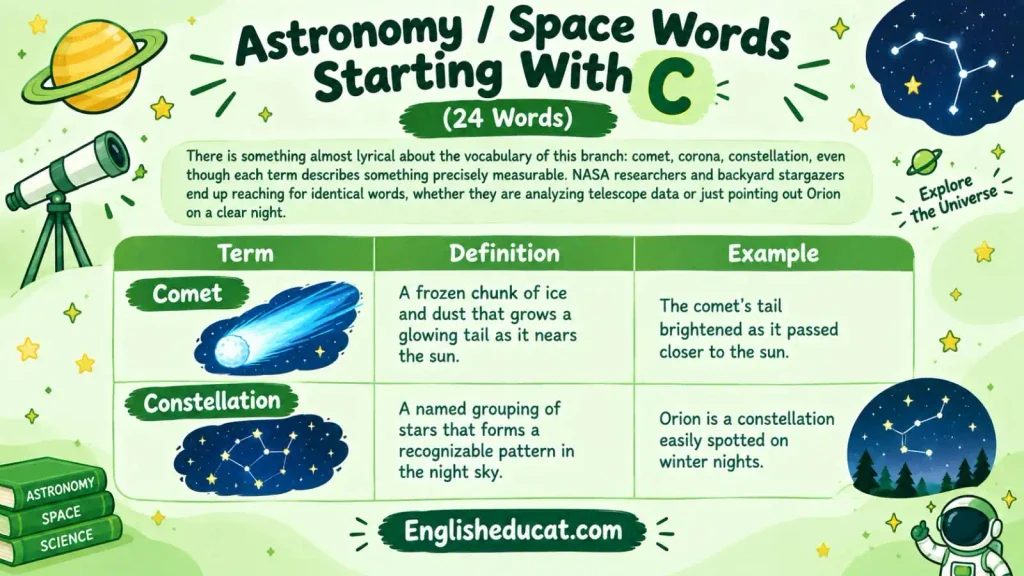
Astronomy / Space Words Starting With C (24 Words)
There is something almost lyrical about the vocabulary of this branch: comet, corona, constellation, even though each term describes something precisely measurable. NASA researchers and backyard stargazers end up reaching for identical words, whether they are analyzing telescope data or just pointing out Orion on a clear night.
| Term | Definition | Example |
| Comet | A frozen chunk of ice and dust that grows a glowing tail as it nears the sun | The comet’s tail brightened as it passed closer to the sun. |
| Constellation | A named grouping of stars that forms a recognizable pattern in the night sky | Orion is a constellation easily spotted on winter nights. |
| Corona | The wispy, superheated outer atmosphere surrounding the sun | The sun’s corona becomes visible during a total solar eclipse. |
| Cosmos | Another word for the universe, emphasizing its structure and order as a whole | Astronomers study the cosmos to understand its earliest moments. |
| Celestial body | A general term for any natural object that exists in space | The moon is the closest celestial body to Earth. |
| Cosmic microwave background | The faint leftover radiation that fills the universe following the Big Bang | The cosmic microwave background provides evidence for the Big Bang. |
| Crater | A bowl-shaped scar left behind by an impact or volcanic collapse | A meteorite created the large crater found in Arizona. |
| Cepheid variable | A type of star whose brightness rises and falls on a predictable schedule | Astronomers use a Cepheid variable to estimate distances to galaxies. |
| Coronal mass ejection | A massive cloud of solar plasma hurled outward from the sun’s corona | A coronal mass ejection can disrupt satellites and power grids. |
| Circumstellar disk | A flattened ring of gas and dust orbiting a newly forming star | Planets often form from material within a circumstellar disk. |
| Celestial equator | The sky’s version of Earth’s equator, projected outward into space | Stars near the celestial equator appear overhead near Earth’s equator. |
| Chromosphere | A thin, reddish layer of the sun’s atmosphere sitting just above its visible surface | The chromosphere becomes briefly visible just before a total eclipse. |
| Circumpolar star | A star positioned close enough to the pole that it never dips below the horizon | Polaris appears as a circumpolar star from most northern latitudes. |
| Conjunction | A moment when two objects in the sky appear to line up closely from Earth’s viewpoint | Venus and Jupiter formed a striking conjunction in the evening sky. |
| Culmination | The instant a celestial object reaches its highest point above the horizon | The star reached culmination shortly after midnight. |
| Cosmic dust | Microscopic solid grains scattered throughout the space between stars | Cosmic dust can gradually accumulate to form new planetesimals. |
| Cosmic inflation | A theorized burst of extremely rapid expansion just after the universe began | Cosmic inflation explains why the universe appears so uniform. |
| Cassini Division | A visible gap separating two of Saturn’s major rings | The Cassini Division is visible through a moderately powerful telescope. |
| Convective zone | A layer inside a star where energy travels via rising and sinking plasma | Energy rises through the sun’s convective zone before reaching its surface. |
| Circumbinary planet | A planet that circles a pair of stars rather than just one | A circumbinary planet experiences two sunrises from its twin stars. |
| Cosmological constant | A value in Einstein’s equations linked to the universe’s accelerating expansion | The cosmological constant helps explain dark energy’s effect on expansion. |
| Corotation | The synchronized spin of a moon or ring system that matches its planet’s rotation | Corotation causes some moons to keep the same face toward their planet. |
| Cassegrain telescope | A telescope design that folds light between two mirrors to shrink its overall length | A Cassegrain telescope allows a long focal length in a compact tube. |
| Chondrite | A stony meteorite containing small, rounded mineral grains formed early in the solar system | Scientists study a chondrite to learn about the early solar system. |
Earth & Environmental Science Words Starting With C (25 Words)
Geology, weather, and environmental science round out this collection, and these are the terms most likely to appear outside a classroom entire in weather forecasts, climate reporting, and outdoor recreation guides. Knowing the difference between a cold front and a cyclone, or between climate and climate change, makes following that kind of coverage a lot less confusing.
| Term | Definition | Example |
| Climate | The typical weather conditions a region experiences over many years | A tropical climate brings warm temperatures and heavy rainfall year-round. |
| Crust | Earth’s thin, rigid outermost layer, sitting above the mantle | The continental crust is thicker than the oceanic crust. |
| Core | The dense, metal-rich layer at the very center of the Earth | Heat from Earth’s core drives movement in the mantle above it. |
| Continental drift | The slow, ongoing shifting of Earth’s landmasses across geologic time | Continental drift slowly separated Pangaea into today’s continents. |
| Carbon cycle | The ongoing exchange of carbon between the atmosphere, oceans, land, and living organisms | Plants play a key role in the carbon cycle by absorbing CO2. |
| Cyclone | A large storm system that rotates around a low-pressure center | The cyclone brought heavy rain and strong winds to the coast. |
| Climate change | A measurable, long-term shift in global temperature and weather trends | Rising sea levels are one visible effect of climate change. |
| Conservation | Deliberate efforts to protect and responsibly manage natural resources | Conservation efforts helped the wolf population recover in the region. |
| Canyon | A steep, narrow valley shaped gradually by flowing water | The Colorado River carved the canyon over millions of years. |
| Caldera | A large crater-like basin left after a volcano’s summit caves in | A caldera formed after the volcano’s summit collapsed inward. |
| Continental shelf | The gently sloping underwater edge of a continent before the ocean floor drops off | Fishing fleets rely on the nutrient-rich waters of the continental shelf. |
| Compaction | The pressing together of sediment layers under their own weight over time | Compaction over millions of years turned loose sand into solid rock. |
| Cumulus cloud | A puffy, cotton-like cloud usually associated with calm, fair weather | A cumulus cloud drifted slowly across the clear afternoon sky. |
| Cirrus cloud | A thin, feathery cloud that forms at high altitude | A cirrus cloud often signals a weather change within a day or two. |
| Cold front | The leading edge where an advancing mass of cold air displaces warmer air | A cold front brought sudden thunderstorms and a sharp temperature drop. |
| Carbon footprint | A tally of the total greenhouse gases produced by a person’s or organization’s activities | Switching to public transit lowered her daily carbon footprint. |
| Carbon sequestration | The trapping and long-term storage of atmospheric carbon dioxide | Forests support carbon sequestration by storing carbon in wood and soil. |
| Coriolis effect | The apparent curving of moving air or water caused by Earth’s own rotation | The Coriolis effect causes hurricanes to spin counterclockwise up north. |
| Composting | The controlled decomposition of organic waste into usable, nutrient-dense soil | Composting kitchen scraps reduced the household’s landfill waste. |
| Coral reef | A living underwater structure built up by generations of coral organisms | The coral reef supports thousands of species of marine life. |
| Contour line | A map line connecting all points sitting at the same elevation | Closely spaced contour lines indicate a steep section of the mountain. |
| Cryosphere | The collective term for all of Earth’s frozen water, from glaciers to permafrost | The cryosphere includes glaciers, sea ice, and permafrost regions. |
| Convergent boundary | A tectonic plate boundary where two plates push toward and into each other | Mountains often form along a convergent boundary between two plates. |
| Cave | A naturally hollowed-out underground space, often shaped by water erosion | Dripping water slowly formed stalactites inside the limestone cave. |
| Climate zone | A geographic region defined by a consistent, repeating climate pattern | A desert climate zone typically gets less than 10 inches of rain yearly. |
Advanced & Rare Science Words Starting With C (Bonus: 8 Words)
These eight terms live mostly in research papers and upper-level coursework rather than everyday reading, but they are worth knowing if you want to push past the basics.
| Term | Definition | Example |
| Catenation | An element’s ability carbon especially to bond with itself repeatedly, forming long chains | Carbon’s catenation allows it to form the long chains found in plastics. |
| Chondrule | A tiny, spherical mineral grain preserved inside certain primitive meteorites | A chondrule preserves clues about conditions in the early solar system. |
| Chirality | A molecule’s property of having a mirror-image twin that can’t be superimposed on it | Chirality explains why two versions of the same molecule can smell different. |
| Cladogenesis | The evolutionary branching of a single species into two separate lineages | Cladogenesis produced two separate finch species on neighboring islands. |
| Cryoturbation | Soil disturbance caused by repeated freeze-thaw cycles | Cryoturbation disturbs soil layers in permafrost regions each spring. |
| Cherenkov radiation | A faint blue glow produced when a particle outpaces light traveling through the same medium | Cherenkov radiation gives nuclear reactor pools their eerie blue glow. |
| Cetane number | A rating that reflects how readily diesel fuel ignites under compression | A higher cetane number means the diesel fuel ignites more readily. |
| Cryptochrome | A light-sensitive protein tied to regulating internal biological clocks | Cryptochrome helps migratory birds sense Earth’s magnetic field. |
Why Learn C Science Words?
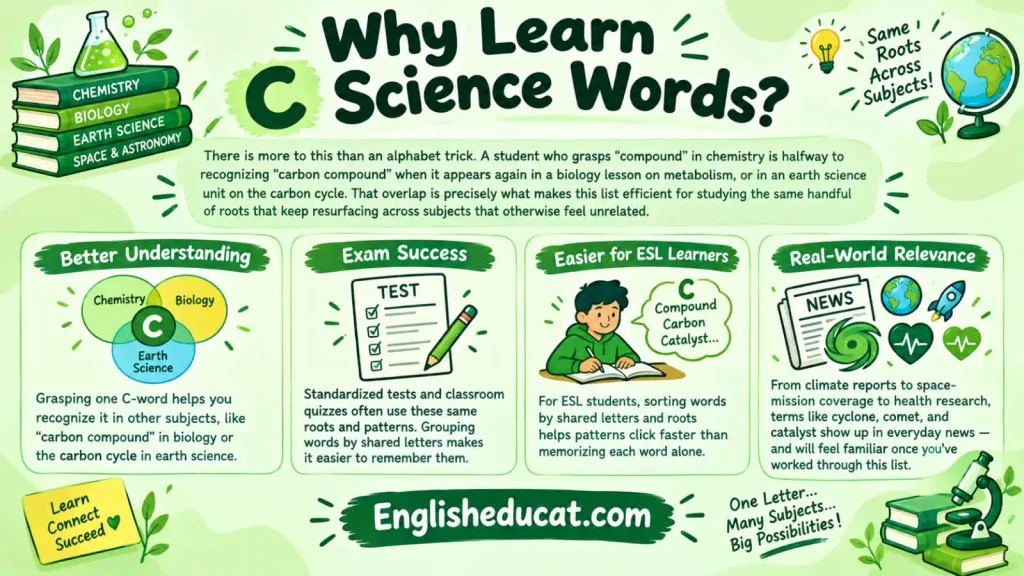
There is more to this than an alphabet trick. A student who grasps “compound” in chemistry is halfway to recognizing “carbon compound” when it appears again in a biology lesson on metabolism, or in an earth science unit on the carbon cycle. That overlap is precisely what makes this list efficient for studying the same handful of roots that keep resurfacing across subjects that otherwise feel unrelated.
Exams reward this kind of grouping too. Standardized tests and classroom vocabulary quizzes draw from exactly this sort of list, and for ESL students working through English-language science material, sorting words by shared letters and roots makes patterns click faster than memorizing them in isolation. Outside the classroom, the payoff appears when reading the news: climate reports, space-mission coverage, and health research all lean on terms like cyclone, comet, and catalyst, and none of them need to feel unfamiliar once you have worked through a list like this one.
Frequently Asked Questions
How many science words start with the letter C?
This list includes 134 total: 126 core terms spread across biology, chemistry, physics, astronomy, and earth science, plus 8 advanced bonus words for more experienced learners.
What is an easy science word that starts with C?
Cell, carbon, and climate are good starting points; each is a foundational term introduced early in most science curricula, and each anchors an entire branch of study.
What is a hard or advanced science word that starts with C?
Cherenkov radiation (the blue glow produced by particles outpacing light in a medium) and chirality (a molecule’s mirror-image property) are both terms typically reserved for upper-level or specialized coursework.
How do C-words differ across science subjects?
The same letter covers very different ground depending on the field: cell belongs to biology, compound to chemistry, current to physics, comet to astronomy, and climate to earth science, each carrying a distinct meaning.
Why do so many science terms start with C?
Carbon’s central role across chemistry and biology, combined with widely used Greek and Latin roots like cyto-, chromo-, and cosmo-, means C ends up disproportionately represented compared to most other letters.
What are some astronomy terms that start with C?
Comet, corona, constellation, and Cepheid variable are common examples, all regularly used in both academic space research and casual stargazing.
Conclusion
Somewhere between memorizing flashcards and reading a full research paper, there is a middle ground where vocabulary actually starts working for you, and that is what this list is built for. The letter C touches nearly every branch of science precisely because so much of the foundational language of the field grew out of the same few roots: carbon, cell, cosmos.
You do not need to absorb all 134 terms in one sitting. Keep this page open before your next exam, pull it up mid-project, or just skim it the next time a science headline throws an unfamiliar word your way. Chances are, the next C-word you run into would not be a stranger anymore, and that small flicker of recognition is really what learning vocabulary is supposed to feel like.

Linguistics Specialist
James is a linguist with a Ph.D. in Applied Linguistics from Boston University. His work focuses on word origins, synonyms, and how language evolves over time. He has contributed to several academic journals on English semantics.