

Crossword stuck? Studying for an exam? Building a vocabulary list for class? The letter D turns out to be one of the richest in all of science: DNA in biology, density in chemistry, displacement in physics, dwarf planets in astronomy. Few single letters carry this much scientific ground.
This guide pulls together more than 130 science words that start with D across five branches: biology, chemistry, physics, astronomy, and earth science. Each entry gets a plain-language explanation and a sentence showing the word in actual use just like other science words that start with E and F, rather than a definition you have to memorize cold.
Why Chemistry Claims So Many D-Words
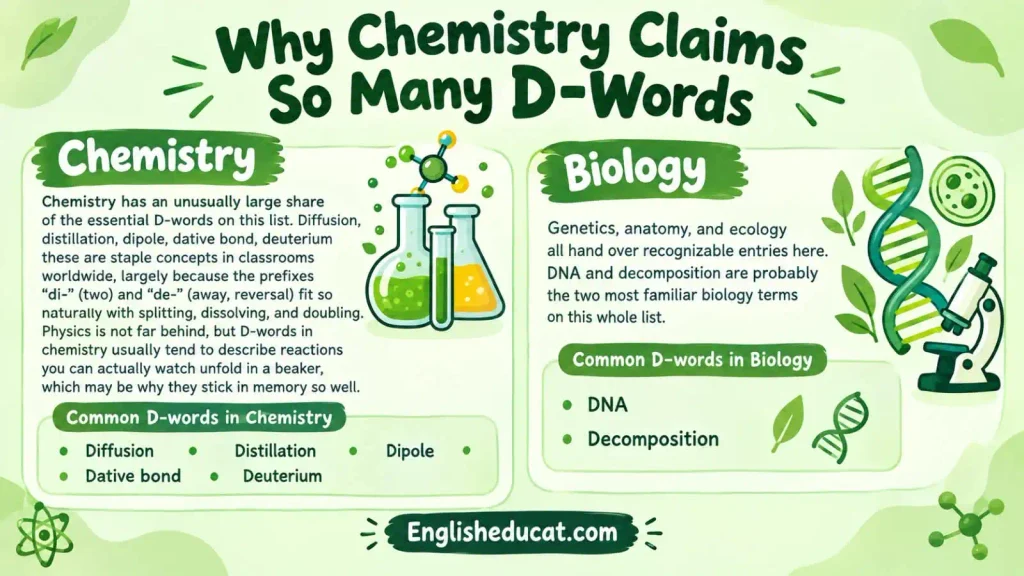
Chemistry has an unusually large share of the essential D-words on this list. Diffusion, distillation, dipole, dative bond, deuterium these are staple concepts in classrooms worldwide, largely because the prefixes “di-” (two) and “de-” (away, reversal) fit so naturally with splitting, dissolving, and doubling. Physics is not far behind, but D-words in chemistry usually tend to describe reactions you can actually watch unfold in a beaker, which may be why they stick in memory so well.
Biology Words That Start With D
Genetics, anatomy, and ecology all hand over recognizable entries here. DNA and decomposition are probably the two most familiar biology terms on this whole list.
| Term | Definition | Example Sentence |
| DNA | The molecule inside cells that stores an organism’s genetic code. | The scientist extracted DNA from the blood sample. |
| Diploid | A cell holding two full sets of chromosomes, one from each parent. | Human body cells are diploid, containing 46 chromosomes. |
| Dominant (allele) | A gene form strong enough to produce its trait with just one copy present. | Brown eyes are often controlled by a dominant allele. |
| Decomposer | An organism that feeds on and breaks apart dead matter. | Fungi act as decomposers, recycling nutrients into soil. |
| Decomposition | The gradual breakdown of organic material into simpler substances. | Decomposition of fallen leaves enriches the forest floor. |
| Diaphragm | The dome-shaped muscle beneath the lungs that powers breathing. | The diaphragm contracts every time you inhale. |
| Dermis | The skin’s inner layer, home to nerve endings and hair follicles. | A tattoo needle deposits ink into the dermis. |
| Dorsal | Describing the back or upper surface of an animal’s body. | The shark’s dorsal fin cut through the water. |
| Diastole | The resting phase of the heartbeat, when the chambers fill with blood. | Diastole occurs right after the heart contracts. |
| Duodenum | The short upper stretch of the small intestine, just past the stomach. | Digestive enzymes enter the duodenum from the pancreas. |
| Dichotomous key | A branching set of paired questions used to identify a species. | Students used a dichotomous key to classify insects. |
| Differentiation | The process by which a generic cell takes on a specialized role. | Stem cell differentiation produces muscle and nerve cells. |
| Deciduous | A term for plants that drop their leaves on a seasonal cycle. | Deciduous trees lose their leaves every autumn. |
| Detritivore | An animal that survives by consuming decaying organic scraps. | Earthworms are detritivores that improve soil quality. |
| Dormancy | A low-activity survival state organisms enter during harsh conditions. | Many seeds enter dormancy until conditions favor growth. |
| Double helix | The spiral, ladder-like structure formed by a strand of DNA. | Watson and Crick modeled the double helix in 1953. |
| Disjunction | The pulling apart of paired chromosomes during cell division. | Nondisjunction during meiosis can cause genetic disorders. |
| Digestion | The bodily process of turning food into usable nutrients. | Digestion begins in the mouth with saliva. |
| Directional selection | A pattern of natural selection that pushes a population toward one extreme trait. | Directional selection produced longer beaks in the finch population. |
| Denaturation | The unraveling of a protein’s shape, usually from heat or chemical exposure. | Cooking an egg causes denaturation of its proteins. |
| Dendrite | A branching extension of a neuron that picks up incoming signals. | Dendrites carry impulses toward the neuron’s cell body. |
| Dysplasia | Irregular or disordered growth in cells or tissue. | The biopsy revealed early signs of cervical dysplasia. |
| Biodiversity | The range of different species living within one ecosystem. | Coral reefs support extraordinary marine biodiversity. |
| Domain (taxonomy) | The broadest level of biological classification, sitting above kingdom. | Bacteria belong to a separate domain from humans. |
| Desiccation | Severe moisture loss that leaves an organism dangerously dry. | Desert lizards have adaptations that prevent desiccation. |
A term like “diploid” means the same thing to a working geneticist as it does on this list, which is really the point of learning D-words as a set: the definitions hold up outside the classroom, too.
Chemistry Words That Start With D
Chemistry brings another 25 entries to the list, and true to form, most of them describe something happening to matter rather than a fixed and static property.
| Term | Definition | Example Sentence |
| Density | How tightly mass is packed into a given volume of material. | Gold has a much higher density than aluminum. |
| Diffusion | The natural drift of particles from a crowded area toward a less crowded one. | Perfume diffuses through a room over time. |
| Distillation | A purification method that heats a liquid into vapor, then cools it back down. | Distillation purifies water by removing dissolved salts. |
| Dissolution | The process of a solid spreading evenly through a liquid until it disappears into it. | Sugar’s dissolution in tea speeds up with stirring. |
| Dilution | Weakening a solution’s strength by mixing in more solvent. | Dilution of the acid made it safer to handle. |
| Dipole | A molecule with a positive end and a negative end. | Water is a polar dipole molecule. |
| Decomposition reaction | A reaction in which a single compound splits into two or more simpler products. | Heating calcium carbonate causes a decomposition reaction. |
| Double bond | A connection between two atoms formed by sharing two electron pairs instead of one. | Ethylene contains a carbon-carbon double bond. |
| Disaccharide | A sugar molecule created by joining two simple sugar units together. | Sucrose is a disaccharide of glucose and fructose. |
| Deuterium | A hydrogen variant carrying an extra neutron in its nucleus. | Deuterium is used as fuel in fusion research. |
| Dative bond | A covalent bond in which only one of the two atoms contributes electrons. | Ammonia forms a dative bond with a hydrogen ion. |
| Desiccant | A drying agent that pulls moisture out of the surrounding air. | Silica gel packets act as a desiccant in shoeboxes. |
| Deliquescence | The tendency of certain solids to soak up so much humidity that they liquefy. | Deliquescence causes calcium chloride to turn into liquid. |
| Dispersion force | A faint attraction between molecules caused by brief, shifting charge imbalances. | Dispersion forces hold noble gas atoms loosely together. |
| Decay constant | A fixed number that describes how quickly a radioactive element loses atoms over time. | The decay constant determines an isotope’s half-life. |
| Denaturing | Breaking down a protein’s natural shape through heat or chemical action. | Denaturing enzymes with heat stops a chemical reaction. |
| Dalton | The standard unit for expressing the mass of atoms and molecules. | A carbon-12 atom has a mass of 12 daltons. |
| Ductility | A metal’s capacity to stretch into thin wire without snapping. | Copper’s ductility makes it ideal for wiring. |
| Diatomic | Made up of exactly two atoms bonded together. | Oxygen exists naturally as a diatomic molecule, O2. |
| Deprotonation | The loss of a hydrogen ion from a molecule or compound. | Deprotonation of acetic acid forms the acetate ion. |
| Detonation | A near-instant, shockwave-driven explosion. | The detonation released energy far faster than combustion. |
| Derived unit | A measurement unit built by combining two or more base units. | The newton is a derived unit equal to kg·m/s². |
| Dimer | A larger molecule built from two matching smaller units joined together. | Diacetyl is a simple dimer used in flavoring. |
| Diazonium compound | An organic compound built around a pair of bonded nitrogen atoms. | Diazonium compounds are used to make azo dyes. |
| Dextrorotatory | Describing a substance that twists polarized light in a clockwise direction. | The dextrorotatory form of the molecule is labeled D-. |
Most chemistry courses cover density and diffusion in the first weeks, then hold dative bonds and diazonium compounds back for later organic chemistry units a rough guide to how wide the difficulty range really is here.
Physics Words That Start With D
Physics supplies a full 25 terms, stretching from early motion vocabulary like displacement and deceleration all the way to modern dark matter and dark energy of cosmology.
| Term | Definition | Example Sentence |
| Displacement | The straight-line distance and direction between a starting point and an ending point. | The ball’s displacement was 5 meters to the right. |
| Dynamics | The area of physics concerned with forces and the motion they cause. | Dynamics explains why a pushed object accelerates. |
| Deceleration | How quickly a moving object loses speed. | The car’s deceleration was sharp when the brakes engaged. |
| Diffraction | The spreading or bending of waves as they pass an edge or opening. | Diffraction lets sound travel around corners. |
| Doppler effect | The shift in a wave’s pitch or frequency caused by the motion of its source. | A siren’s pitch drops as it passes due to the Doppler effect. |
| Drag | The resistive force a fluid or gas exerts against a moving object. | Drag slows a skydiver’s fall before the parachute opens. |
| Damping | The steady loss of energy that shrinks an oscillation over time. | Damping in the shock absorber smooths out bumps. |
| Dielectric | A non-conducting material capable of holding an electric field. | A dielectric layer separates a capacitor’s plates. |
| Decibel | A logarithmic scale used to measure how loud a sound is. | A whisper measures around 30 decibels. |
| Dark matter | An unseen form of matter whose presence is inferred only from its gravitational pull. | Dark matter makes up most of the universe’s mass. |
| Dynamic equilibrium | A steady state maintained by two opposing processes running at equal rates. | The reaction reached dynamic equilibrium at a stable temperature. |
| Diamagnetism | A weak, repelling response some materials show when placed in a magnetic field. | Diamagnetism can make a frog levitate in a strong field. |
| Diffuse reflection | Light bouncing off a rough surface in many scattered directions at once. | Diffuse reflection lets us see non-shiny objects. |
| Direct current | Electrical current that always flows in a single, unchanging direction. | Batteries supply direct current to small electronics. |
| Drag coefficient | A number that measures how easily a shape moves through air or fluid. | A lower drag coefficient improves a car’s fuel efficiency. |
| Dimensional analysis | A technique for checking an equation by tracking the units on each side. | Dimensional analysis confirmed the formula’s units were consistent. |
| Dynamic pressure | The pressure a fluid generates purely from being in motion. | Dynamic pressure increases as an aircraft’s speed rises. |
| Diode | An electronic component that lets current pass in only one direction. | A diode protects circuits from reversed current flow. |
| Dispersion (optics) | The separation of white light into its individual colors. | Dispersion through a prism produces a rainbow spectrum. |
| Damping ratio | A number that describes how fast an oscillating system settles down. | Engineers tune the damping ratio to prevent bridge resonance. |
| Degrees of freedom | The number of independent ways a system is free to move or store energy. | A free particle in 3D space has three degrees of freedom. |
| Drift velocity | The slow net speed at which electrons actually creep through a wire. | Drift velocity in a copper wire is surprisingly slow. |
| Dark energy | A mysterious force believed to be pushing the universe’s expansion faster over time. | Dark energy counters gravity on a cosmic scale. |
| Derived quantity | A physical measurement built by combining more basic quantities. | Velocity is a derived quantity from distance and time. |
| Double-slit experiment | A classic experiment demonstrating that light behaves as both a particle and a wave. | The double-slit experiment produced an interference pattern. |
Dark matter and dark energy are still active research topics, not settled textbook facts a good reminder that a handful of these D-words describe science still being written.
Astronomy & Space Words That Start With D
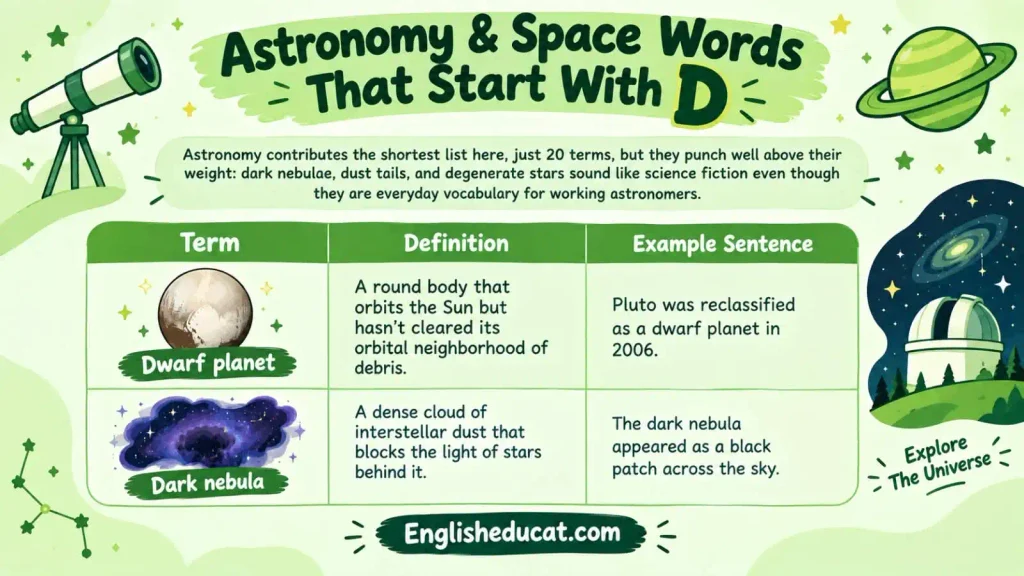
Astronomy contributes the shortest list here, just 20 terms, but they punch well above their weight: dark nebulae, dust tails, and degenerate stars sound like science fiction even though they are everyday vocabulary for working astronomers.
| Term | Definition | Example Sentence |
| Dwarf planet | A round body that orbits the Sun but hasn’t cleared its orbital neighborhood of debris. | Pluto was reclassified as a dwarf planet in 2006. |
| Dark nebula | A dense cloud of interstellar dust that blocks the light of stars behind it. | The dark nebula appeared as a black patch across the sky. |
| Declination | A coordinate that pinpoints a star’s angle above or below the celestial equator. | Astronomers use declination to pinpoint a star’s position. |
| Doppler shift | A change in a star or galaxy’s light frequency caused by its motion toward or away from us. | Redshift is a Doppler shift showing a galaxy moving away. |
| Double star | Two stars that appear next to each other from Earth’s point of view. | Some double stars are true binaries orbiting each other. |
| Degenerate matter | An extremely compressed state of matter found in the cores of collapsed stars. | Degenerate matter supports white dwarfs against gravitational collapse. |
| Dust disk | A flattened ring of gas and dust circling a newly formed star. | Planets form from material in a protoplanetary dust disk. |
| Deep sky object | Any object outside our solar system worth observing, such as a nebula or star cluster. | Deep sky objects require a telescope to observe clearly. |
| Diurnal motion | The apparent nightly journey of stars across the sky, caused by Earth’s spin. | Diurnal motion is caused by Earth’s rotation. |
| Direct imaging | A method that captures an actual photograph of a planet outside our solar system. | Direct imaging revealed a planet orbiting a distant star. |
| Damocloid | A small solar system body that orbits like a comet but shows no visible tail. | Damocloids are thought to be inactive comet nuclei. |
| Descending node | The spot where an orbiting body crosses the ecliptic while heading south. | The Moon’s descending node shifts over an 18.6-year cycle. |
| Density wave | A model explaining why spiral arms in galaxies keep their shape over time. | Density wave theory helps explain why spiral arms persist. |
| Degenerate star | A collapsed star, such as a white dwarf, held up by degenerate matter rather than fusion. | A degenerate star no longer generates energy through fusion. |
| Declination axis | The telescope mount axis that adjusts for a star’s north-south position. | Astronomers adjust the declination axis to follow a star’s path. |
| Debris disk | A belt of dust and rocky leftovers orbiting a star well past its formative years. | A debris disk can reveal signs of unseen orbiting planets. |
| Dwarf galaxy | A small galaxy holding far fewer stars than a galaxy like the Milky Way. | The Milky Way has several dwarf galaxies as satellites. |
| Diffraction limit | The finest level of detail a telescope can pick out, set by the wave nature of light. | Larger telescopes have a smaller diffraction limit for sharper images. |
| Doppler broadening | The blurring of a spectral line caused by the random motion of particles. | Doppler broadening reveals the temperature of a star’s atmosphere. |
| Dust tail | A stream of dust grains a comet sheds under pressure from sunlight. | A comet’s dust tail always curves away from the Sun. |
Astronomers usually rely on declination and descending node every time they aim a telescope, which is a good reminder that this branch of the list is working vocabulary, not trivia.
Earth & Environmental Science Words That Start With D
The final branch spans two very different worlds: slow-moving geology (delta, dip, divergent boundary) and environmental issues that make headlines (drought, desertification, dead zone).
| Term | Definition | Example Sentence |
| Deposition | The settling of sediment that wind, water, or ice has been carrying. | Deposition at a river’s mouth builds up a delta. |
| Delta | A fan-shaped stretch of land built up where a river meets a larger body of water. | The Nile Delta supports rich agricultural land. |
| Drought | A prolonged stretch of unusually dry weather. | The drought forced farmers to ration irrigation water. |
| Desertification | The slow transformation of once-fertile land into desert. | Overgrazing accelerates desertification in dry regions. |
| Dust storm | A wall of wind-driven soil particles that sweeps across open land. | A dust storm reduced visibility across the plains. |
| Drainage basin | The full stretch of land that funnels its rainfall into one river system. | The Amazon’s drainage basin covers much of South America. |
| Dune | A mound of sand reshaped over time by shifting wind. | Sand dunes shift position slowly over decades. |
| Denudation | The slow stripping-away of Earth’s surface through weathering and erosion. | Denudation gradually lowers mountain elevations over millions of years. |
| Divergent boundary | A tectonic plate edge where two plates are pulling apart from each other. | New crust forms at a divergent boundary like the Mid-Atlantic Ridge. |
| Dip (geology) | The steepness at which a rock layer slants away from flat. | Geologists measure dip to map underground rock formations. |
| Downwelling | The sinking of cold, dense ocean water toward the depths. | Downwelling near the poles drives deep ocean circulation. |
| Dead zone | A patch of ocean so starved of oxygen that most marine life can’t survive there. | Fertilizer runoff contributes to the Gulf of Mexico’s dead zone. |
| Dust Bowl | The 1930s stretch of the American plains left barren by extreme wind erosion. | The 1930s Dust Bowl devastated American farmland. |
| Diastrophism | Large-scale movement of Earth’s crust that raises mountains or opens rift valleys. | Diastrophism over eons shaped the region’s mountain ranges. |
| Dendrochronology | A dating technique that reads the age of a tree from its growth rings. | Dendrochronology helped scientists date the ancient timber beam. |
| Deforestation | The widespread clearing of forest land for farming, development, or other use. | Deforestation in the Amazon threatens countless species. |
| Decomposition (ecology) | The recycling of dead plant and animal matter back into the ecosystem. | Decomposition returns nutrients from dead leaves to the soil. |
| Dolomite | A sedimentary rock made largely of calcium magnesium carbonate. | Dolomite forms distinctive pale cliffs in mountain ranges. |
| Depression (weather) | A low-pressure system that brings clouds, wind, and rain. | A tropical depression can strengthen into a hurricane. |
| Detritus | Dead plant and animal remains that feed decomposer food chains. | Detritus accumulates on the forest floor after autumn. |
| Desert varnish | A thin, dark mineral coating that builds up on rock surfaces over centuries. | Ancient petroglyphs were carved through a layer of desert varnish. |
| Deep time | The idea that Earth’s history stretches back billions of years, far beyond human timescales. | Deep time helps geologists understand slow-forming rock layers. |
| Downburst | A sudden column of wind that plunges down out of a thunderstorm. | A downburst flattened trees across the campsite. |
| Discharge (hydrology) | The amount of water passing a given point in a river over a set period. | The river’s discharge rises sharply after heavy rain. |
| Drainage divide | A ridge of high ground that separates two neighboring river basins. | The drainage divide determines which watershed rainfall flows into. |
7 Advanced D-Words to Impress Your Teacher
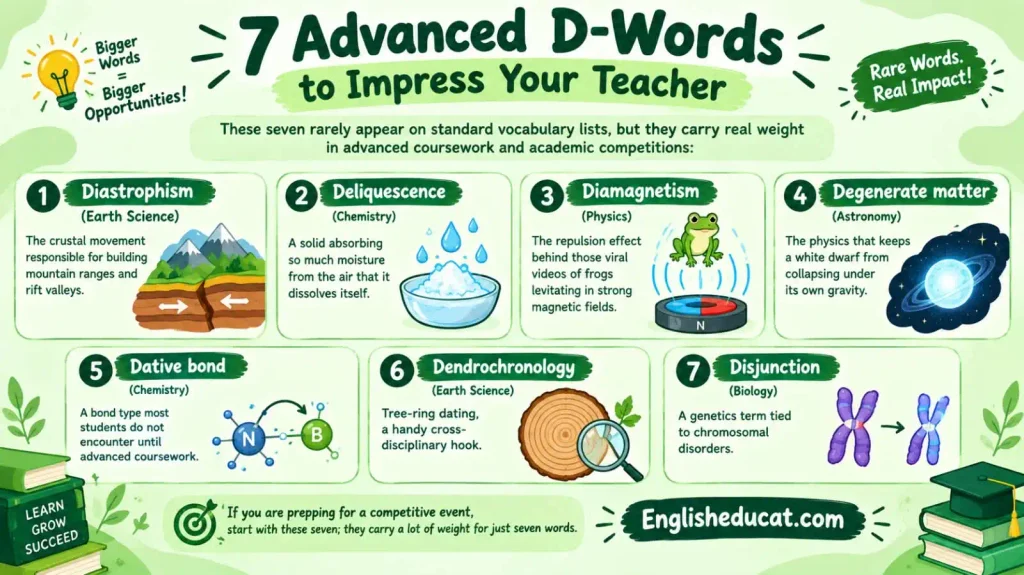
These seven rarely appear on standard vocabulary lists, but they carry real weight in advanced coursework and academic competitions:
- Diastrophism (Earth Science) the crustal movement responsible for building mountain ranges and rift valleys.
- Deliquescence (Chemistry) a solid absorbing so much moisture from the air that it dissolves itself.
- Diamagnetism (Physics) the repulsion effect behind those viral videos of frogs levitating in strong magnetic fields.
- Degenerate matter (Astronomy): the physics that keeps a white dwarf from collapsing under its own gravity.
- Dative bond (Chemistry): a bond type most students do not encounter until advanced coursework.
- Dendrochronology (Earth Science): tree-ring dating, a handy cross-disciplinary hook.
- Disjunction (Biology): a genetics term tied to chromosomal disorders.
If you are prepping for a competitive event, start with these seven; they carry a lot of weight for just seven words.
Why Learn D Science Words?
Three reasons make this worth the effort. Exam preparation is the obvious one: tests like the SAT, ACT, and AP exams lean on precise vocabulary, so already knowing terms like density or dynamic equilibrium saves valuable time. Pattern recognition is the subtler payoff once the prefixes “de-” and “di-” click into place; unfamiliar science vocabulary elsewhere gets much easier to decode on sight. And there is plain recreational value too, since crosswords, Scrabble, and trivia nights all reward exactly this kind of organized knowledge.
Grouping vocabulary by branch, rather than tossing it all into one long glossary, also tends to help retention; related ideas like diffusion and dissolution end up sitting next to each other in memory instead of scattered at random.
Frequently Asked Questions
What are some science words that start with D?
DNA, density, displacement, decomposition, diffusion, and dwarf planet are among the most common fundamental terms spanning biology, chemistry, physics, and astronomy.
What is a science word that starts with D in biology?
DNA is probably the most recognizable, since it is the molecule that stores an organism’s genetic code. Decomposer and diaphragm are two other everyday examples.
What is a science word that starts with D in chemistry?
Density, how tightly mass is packed into a given volume, is one of the earliest chemistry terms students learn, alongside dilution and dative bonds.
What is the hardest or most advanced science word that starts with D?
Diastrophism and degenerate matter are strong candidates. Diastrophism describes the crustal movement that raises mountain ranges; degenerate matter is the physics holding up collapsed stars like white dwarfs.
How many science words start with the letter D?
This guide compiles 130 commonly used terms across five branches. Plenty more obscure ones exist, but this list sticks to words that are actually useful for students and educators.
Why do so many science terms start with D?
Most trace back to Latin and Greek prefixes like “de-” (down, reversal) and “di-” (two, double), which map naturally onto processes like splitting or reversing.
Conclusion
These D-words are not just isolated trivia. They are threads running through five branches of science at once, connecting a chromosome under a lab microscope to a comet’s dust tail in a telescope eyepiece, and a density calculation in a beginner’s notebook to the dark energy stretching the far edges of the universe.
So do not stop at one read-through. Go back to whichever branch gave you the most trouble, quiz yourself on the seven advanced terms, and pay attention to how often “de-” or “di-” appear along the way. Once that pattern sinks in, you will start noticing D-words everywhere, long after you have closed this page.

ESL Content Writer
Emily is a TESOL-certified writer who has taught English to international students for over 8 years. She loves breaking down idioms and everyday expressions into simple, relatable explanations that make sense to learners at any level.