No other letter carries quite as much scientific weight as E. Physics leans on it for energy and electron, biology for ecosystem and evolution, and earth science for erosion and equinox. That is not an accident: roots like ex-, en-, endo-, and electro- come from Greek and Latin words describing movement, containment, and charge, and those ideas sit at the center of how scientists explain change and structure.
Below are 129 real science words that start with E, grouped by branch: biology, chemistry, physics, astronomy, and earth science, with a plain-language definition and an example sentence for each. A bonus list of advanced and rare terms rounds things out for readers who want to go beyond the basics.
Why So Many Science Words Start With E
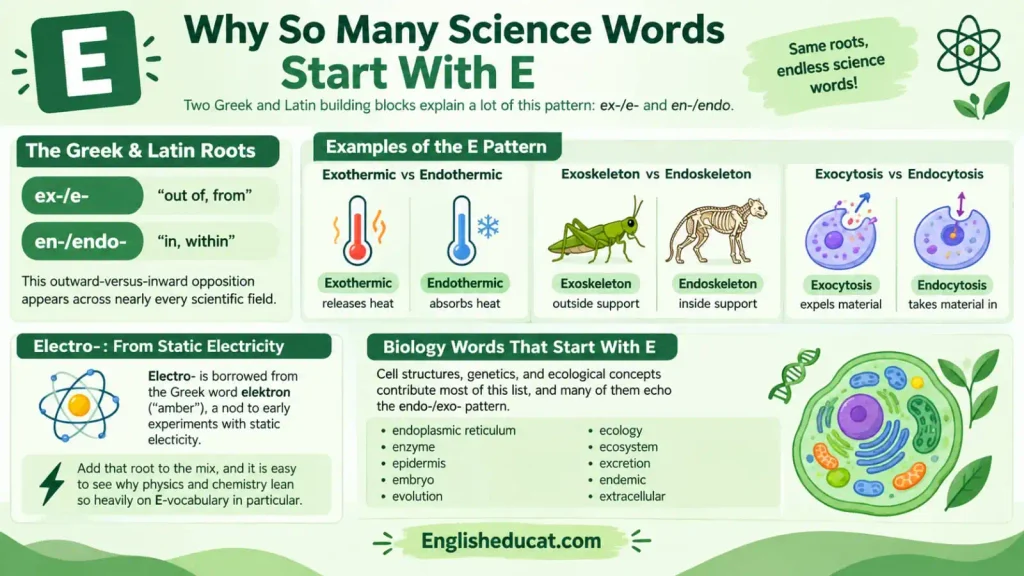
Two Greek and Latin building blocks explain a lot of this pattern: ex-/e- (“out of, from”) and en-/endo- (“in, within”). That single outward-versus-inward opposition appears across nearly every scientific field. These words are common just like other science words that start with F and G. Exothermic reactions release heat; endothermic reactions absorb heat. An exoskeleton holds an animal up from the outside; an endoskeleton does the job from within. Cells use exocytosis to expel material and endocytosis to take it in.
Then there is electro-, borrowed from the Greek word elektron (“amber”), a nod to early experiments with static electricity. Add that root to the mix, and it is easy to see why physics and chemistry lean so heavily on E-vocabulary in particular.
Biology Words That Start With E
Cell structures, genetics, and ecological concepts contribute most of this list, and a good chunk of them echo the endo-/exo- pattern described above: something happening inside or outside a cell or organism.
| Term | Definition | Example Sentence |
| Evolution | The gradual reshaping of a species across generations, driven by natural selection | Biologists cite finch beak variation as classic evidence of evolution. |
| Enzyme | A protein that speeds up a chemical reaction inside a living cell | An enzyme in saliva begins breaking down starch as soon as you chew. |
| Eukaryote | Any organism built from cells that keep their genetic material inside a membrane-bound nucleus | Animals, plants, and fungi are all classified as eukaryotes. |
| Embryo | An organism in its earliest stage of development, before birth or hatching | The embryo’s heart begins beating within the first few weeks. |
| Epidermis | The outermost protective layer covering skin or plant tissue | Sunburn damages cells in the epidermis first. |
| Exoskeleton | A rigid outer shell that both protects an organism and gives it structural support | An insect’s exoskeleton must molt as the animal grows larger. |
| Endoskeleton | A supportive framework of bone or cartilage built inside the body | Humans rely on an endoskeleton for movement and support. |
| Exocytosis | How a cell pushes material out through its membrane | Nerve cells use exocytosis to release chemical messengers. |
| Endocytosis | How a cell pulls material in from outside its membrane | White blood cells use endocytosis to engulf harmful bacteria. |
| Ecology | The branch of biology examining how living things interact with their surroundings | Ecology helped researchers explain why the wolf population affected deer numbers. |
| Extinction | The permanent disappearance of a species from Earth | Habitat loss remains a leading driver of extinction today. |
| Epithelium | A thin sheet of tissue that lines organs and body surfaces | The lungs are lined with a delicate epithelium for gas exchange. |
| Endosperm | The nutrient-rich tissue inside a seed that feeds the growing plant embryo | Corn kernels store much of their starch in the endosperm. |
| Epigenetics | The study of how genes get switched on or off without any change to the DNA sequence itself | Epigenetics explains why identical twins can develop different traits. |
| Exon | A stretch of DNA that actually codes for part of a protein | Only the exon regions of a gene are used to build the final protein. |
| Endospore | A tough, dormant structure certain bacteria form to survive extreme conditions | Certain bacteria form an endospore to withstand extreme heat. |
| Ethology | The scientific study of how animals behave, often in their natural habitat | Ethology examines why certain birds perform elaborate mating dances. |
| Entomology | The branch of biology devoted to insects | Entomology researchers track beetle populations to monitor ecosystem health. |
| Endotherm | An animal that produces and manages its own internal body heat | Mammals and birds are endotherms, unlike most reptiles. |
| Ectotherm | An animal whose body temperature depends largely on its surroundings | A lizard, as an ectotherm, basks in sunlight to warm up. |
| Epidemiology | The study of how, why, and where diseases spread through a population | Epidemiology tracks how quickly an outbreak spreads through a community. |
| Embryology | The study of how an organism develops from a single fertilized cell into a complex body | Embryology explains how a single cell divides into complex organ systems. |
| Excretion | The bodily process of clearing out metabolic waste | Kidneys handle most excretion in the human body. |
| Erythrocyte | The scientific name for a red blood cell, responsible for ferrying oxygen through the body | Each erythrocyte lacks a nucleus once fully mature. |
| Ecdysis | The shedding of an outer covering, most common among arthropods and reptiles | Snakes and insects both undergo ecdysis as they grow. |
Physics Words That Start With E
No branch claims more E-vocabulary than physics, largely because of how much of the field revolves around energy, current, and charge, all territory the electro- root covers.
| Term | Definition | Example Sentence |
| Energy | Whatever it takes to do work or bring about change in a system | Solar panels convert sunlight into usable electrical energy. |
| Electric current | Charge moving steadily through a conductor | Electric current flows through a wire whenever a circuit is closed. |
| Electric charge | A basic property of matter behind every electric and magnetic effect | Rubbing a balloon on hair builds up static electric charge. |
| Electric field | The zone around a charged object where its pull or push can be felt | An electric field surrounds every charged particle. |
| Electromagnetism | The physics of how electric and magnetic forces relate to one another | Electromagnetism explains how a spinning generator produces electricity. |
| Electromagnet | A magnet made by running electric current through a coiled wire | An electromagnet lifts scrap metal at recycling facilities. |
| Electromagnetic spectrum | Every wavelength of electromagnetic radiation there is, from radio waves up to gamma rays | Visible light is just a small slice of the electromagnetic spectrum. |
| Electron volt | A small energy unit used mainly in atomic and particle physics | Physicists measure particle collision energy in electron volts. |
| Electromotive force | The push per unit of charge that a source like a battery supplies to a circuit | A fresh battery provides a higher electromotive force than a depleted one. |
| Electrostatics | The physics of charges that stay put, and the forces they exert | Electrostatics explains why a charged comb attracts small paper bits. |
| Elasticity | How readily a material snaps back to its original shape once a deforming force is removed | Rubber bands demonstrate high elasticity compared to clay. |
| Elastic collision | An impact where no kinetic energy is lost afterward | Billiard balls colliding closely resemble an elastic collision. |
| Equilibrium | A resting state in which every force and torque acting on an object cancels out | An object stays at rest when it’s in mechanical equilibrium. |
| Entropy | How spread out or dispersed a system’s energy has become | Entropy in an isolated system tends to increase over time. |
| Efficiency | The share of input energy an engine or device actually converts into useful output | A modern engine’s efficiency rarely exceeds 40 percent. |
| Eddy current | A swirling loop of electric current triggered inside a conductor by a shifting magnetic field | Eddy current braking slows trains without physical contact. |
| Echo | Sound that bounces off a surface and returns to where it started | Sonar devices use echo timing to measure ocean depth. |
| Escape velocity | The speed an object needs to permanently break free of a planet’s gravitational pull | A rocket must reach escape velocity to leave Earth’s gravitational pull. |
| Exponential decay | A drop-off that slows down over time instead of falling at a constant rate — the pattern behind radioactive decay | Radioactive isotopes follow a predictable exponential decay pattern. |
| Energy conservation | The rule that a closed system’s total energy stays fixed, even as it changes form | Energy conservation means energy only changes form, never disappears. |
| Electric potential | The energy available per unit of charge at a given point in a field | Electric potential differences drive current through a circuit. |
| Electron microscope | A microscope that images extremely tiny structures using a beam of electrons instead of light | Researchers used an electron microscope to examine the virus’s shape. |
| Evaporative cooling | A drop in temperature caused by a liquid turning into vapor | Sweating relies on evaporative cooling to regulate body temperature. |
| Excitation | Pushing an atom or particle up into a higher energy state | Laser light causes electron excitation within the gas medium. |
Astronomy & Space Words That Start With E
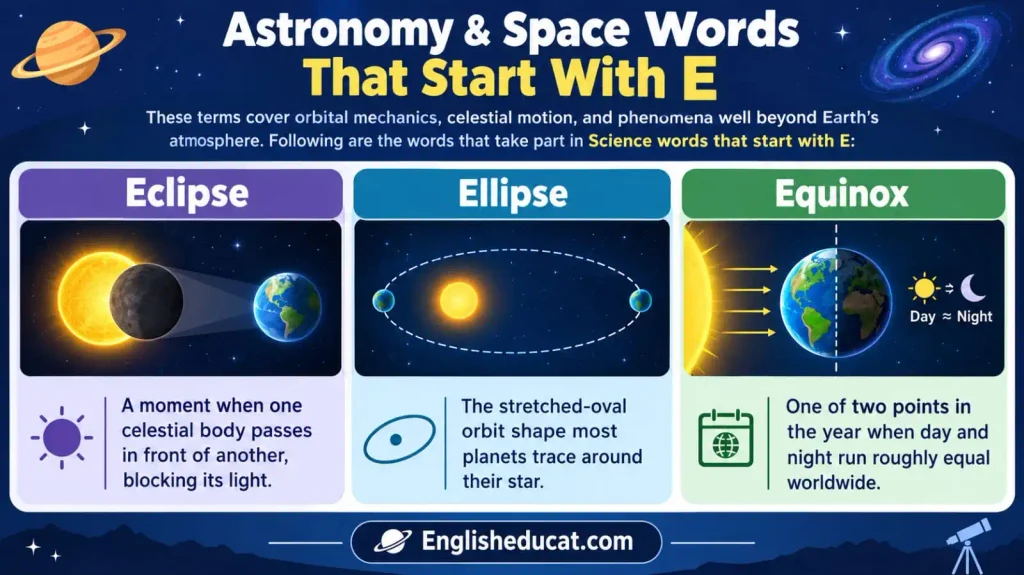
These terms cover orbital mechanics, celestial motion, and phenomena well beyond Earth’s atmosphere. Following are the words that take part in Science words that start with E:
| Term | Definition |
| Eclipse | A moment when one celestial body passes in front of another, blocking its light |
| Ellipse | The stretched-oval orbit shape most planets trace around their star |
| Equinox | One of two points in the year when day and night run roughly equal worldwide |
| Exoplanet | Any planet found orbiting a star other than our own Sun |
| Event horizon | The line around a black hole past which even light can not escape |
| Ejecta | Debris hurled outward by an impact or eruption on a planetary surface |
| Eccentricity | A number describing how far an orbit strays from a perfect circle |
| Emission nebula | A cloud of gas glowing under its own light, rather than reflecting it |
| Exosphere | The thin, outermost fringe of a planet’s atmosphere |
| Extraterrestrial | Coming from somewhere beyond Earth |
| Equatorial | Having to do with a planet’s or star’s equator |
| Ephemeris | A chart predicting where a celestial object will be at given points in time |
| Eclipsing binary | Two orbiting stars that, from Earth’s vantage point, periodically dim each other |
| Electromagnetic radiation | Energy traveling through space in waves, including everything from visible light to X-rays |
| Equinoctial | Associated with the period surrounding an equinox |
| Escape trajectory | A flight path that lets a spacecraft leave a body’s gravity for good |
| Elongation | The angle, as seen from Earth, between a planet and the Sun |
| Solar eruption | A sudden burst of energy and material blasting off the Sun’s surface |
| Exosolar | Belonging to a star system other than our own |
| Exoatmospheric | Taking place beyond a planet’s atmosphere |
| Earth-like planet | A world with conditions similar enough to Earth’s to draw interest for habitability |
| Epoch | A fixed moment in time that astronomers use as a reference point for calculations |
Precise vocabulary matters more in astronomy than in most fields, if only because so much of it describes objects nobody will ever see up close.
Earth & Environmental Science Words That Start With E
Geological processes, climate systems, and environmental science round out the list. Following are some words that start with E in Environmental Science:
| Term | Definition | Example Sentence |
| Erosion | The slow stripping-away of soil or rock by wind, water, or ice | Erosion along the riverbank exposed layers of ancient sediment. |
| Evaporation | Liquid water turning into vapor | Evaporation from the ocean feeds most of Earth’s rainfall. |
| Earthquake | A sudden burst of underground energy that shakes the ground | The earthquake registered a magnitude of 6.2 on regional monitors. |
| Epicenter | The exact spot on Earth’s surface sitting directly above where an earthquake started | Damage was most severe near the epicenter of the quake. |
| Eutrophication | Nutrient overload in a body of water that fuels runaway algae growth | Fertilizer runoff contributed to eutrophication in the shallow lake. |
| Emission | Gas or particles released into the air, often used to describe pollution | Reducing vehicle emission is a key climate policy goal. |
| Ecosystem services | The practical benefits humans get from nature, such as clean water or crop pollination | Wetlands provide ecosystem services by filtering pollutants from water. |
| Evapotranspiration | The combined water loss from evaporation off surfaces and transpiration through plants | Evapotranspiration rates rise sharply during summer heat waves. |
| Ecological footprint | A rough measure of how much environmental resource a person or activity consumes | A meat-heavy diet typically raises an individual’s ecological footprint. |
| Endangered species | A species whose population has dropped low enough to put it at real risk of dying out | Conservationists list the mountain gorilla as an endangered species. |
| Environment | Everything around an organism that shapes how it lives | Pollution can permanently alter a local environment. |
| Equator | The imaginary belt circling Earth exactly halfway between the poles | Regions near the equator experience little seasonal temperature change. |
| Elevation | How far a point sits above sea level | Plants at high elevation must tolerate thinner, colder air. |
| Escarpment | A steep cliff or slope marking the border between two flatter stretches of land | Hikers admired the dramatic escarpment carved by ancient glaciers. |
| Eon | The broadest slice of geologic time, measured in billions of years | Earth’s history is divided into just four major eons. |
| Era | A major chunk of geologic time nested within an eon | Dinosaurs dominated much of the Mesozoic era. |
| Mass extinction event | A geologically fast, planet-wide collapse in species diversity | An asteroid impact likely triggered the mass extinction event 66 million years ago. |
| Eolian | Shaped or driven by wind | Eolian deposits formed the region’s rolling sand dunes. |
| Effluent | Wastewater discharged into the environment, often from a factory or treatment plant | Treatment plants must clean effluent before releasing it into rivers. |
| Ecotone | The in-between strip where two different ecosystems blend together | The marsh’s ecotone supports species from both wetland and forest habitats. |
| Exfoliation | Weathering that peels rock apart in thin, curved sheets | Freeze-thaw cycles accelerate exfoliation in exposed granite. |
| El Niño | A recurring climate pattern driven by warmer-than-usual surface water in the Pacific | El Niño typically brings wetter winters to parts of North America. |
Advanced & Rare E-Words for Science Enthusiasts
These lesser-known terms appear in specialized or college-level coursework and cut across multiple disciplines.
| Term | Branch | Definition | Example Sentence |
| Epistasis | Biology/Genetics | A situation where one gene’s effect hinges on whether another gene is present | Epistasis explains why some coat-color genes mask others entirely. |
| Eutectic | Chemistry | A mixture that melts at a lower temperature than any of the pure substances that make it up | Solder often uses a eutectic alloy to melt at a lower temperature. |
| Ergodic | Physics | A system where averaging over time gives the same result as averaging over all possible states | Physicists rely on ergodic assumptions to simplify statistical mechanics. |
| Eigenstate | Physics/Quantum | A quantum state tied to one exact, measurable value | An electron’s energy eigenstate determines its exact orbital energy. |
| Ecotype | Biology | A population that has genetically adapted to the particular conditions of its local environment | Coastal and inland populations of the same plant can form separate ecotypes. |
| Exaptation | Evolutionary Biology | A trait that took on a new function different from the one it originally evolved for | Bird feathers are a classic exaptation, first useful for insulation. |
| Euphotic zone | Marine Ecology | The sunlit surface layer of water where enough light penetrates for photosynthesis | Most marine plant life is concentrated in the euphotic zone. |
Why Learn E Science Words?
Few letters cover as much ground as E. Rather than clustering around one field, E-vocabulary spreads fairly evenly across biology, chemistry, physics, astronomy, and earth science, which makes it an efficient way to build broad scientific literacy in one pass.
That matters directly at test time for students. Standardized science exams and college entrance tests lean heavily on precise vocabulary, and terms like entropy, evolution, and equilibrium keep reappearing across biology, chemistry, and physics units throughout a typical curriculum. Learn them once, and they pay off in multiple classes.
There is a lighter use for this list too. Anyone hunting for a strong E-word for Wordle, Scrabble, or a crossword puzzle will find plenty of options here; ester, eddys, eon, and exon are all short, high-value entries.
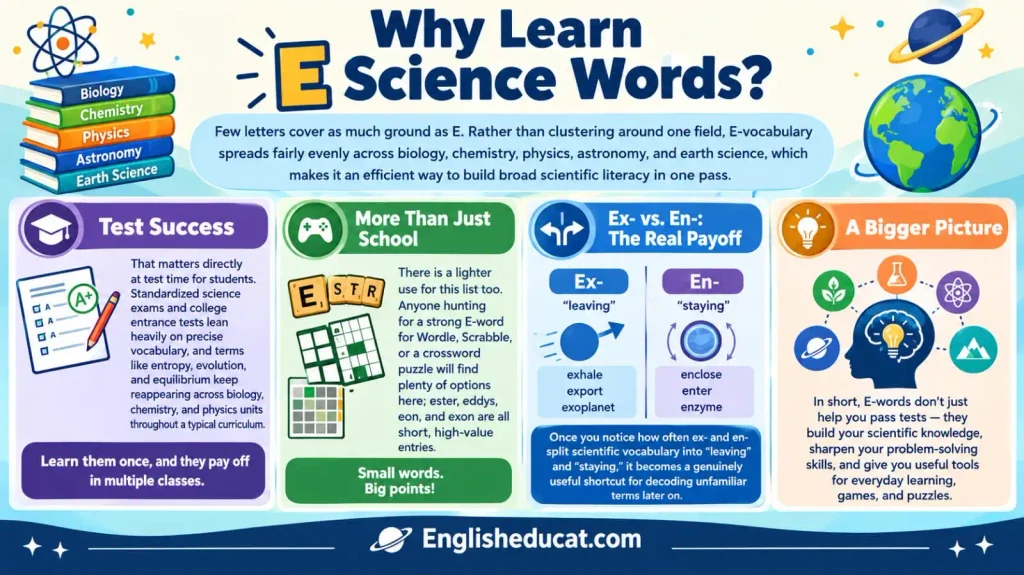
At the end of it all, the outward-versus-inward pattern is the real payoff. Once you notice how often ex- and en- split scientific vocabulary into “leaving” and “staying,” it becomes a genuinely useful shortcut for decoding unfamiliar terms later on.
Frequently Asked Questions
What are some science words that start with E?
A few common ones are energy, ecosystem, electron, evolution, erosion, and equinox terms that span biology, physics, chemistry, and earth science.
What is a 5-letter science word that starts with E?
Ester and eddies both fit. Ester is a chemistry term for an organic compound often responsible for fruity smells.
What are chemistry terms that start with E?
Element, electron, electrolyte, enthalpy, and entropy are among the most common, covering atomic structure, reactions, and energy changes.
What are biology words that start with E?
Ecosystem, evolution, enzyme, eukaryote, and embryo show up often, touching on cell structure, genetics, and ecological relationships.
Why do so many science words start with E?
Largely because of Greek and Latin roots like ex- (out), en- (in), and electro- (amber/electricity), all tied to core scientific ideas like energy transfer and structure.
What is an easy science word for kids that starts with E?
Earth, energy, egg, environment, and evaporation are simple enough for elementary science classes.
Conclusion
The real takeaway here is not the alphabet trivia; it is what this list reveals about how science talks about the world, from the electron spinning inside an atom to the exoplanet orbiting a star light-years away. Bookmark this collection of 129 science words that start with E and come back to it whenever an unfamiliar E-word appears in a textbook, an article, or a crossword clue. Once you have got that outward-versus-inward pattern in your head, decoding the next one gets a lot easier.

Senior English Content Editor
Sarah has over 10 years of experience teaching English as a Second Language in Chicago public schools. She specializes in vocabulary building and simplifying complex word meanings for everyday learners. Sarah holds a Master’s degree in English Education from the University of Illinois.