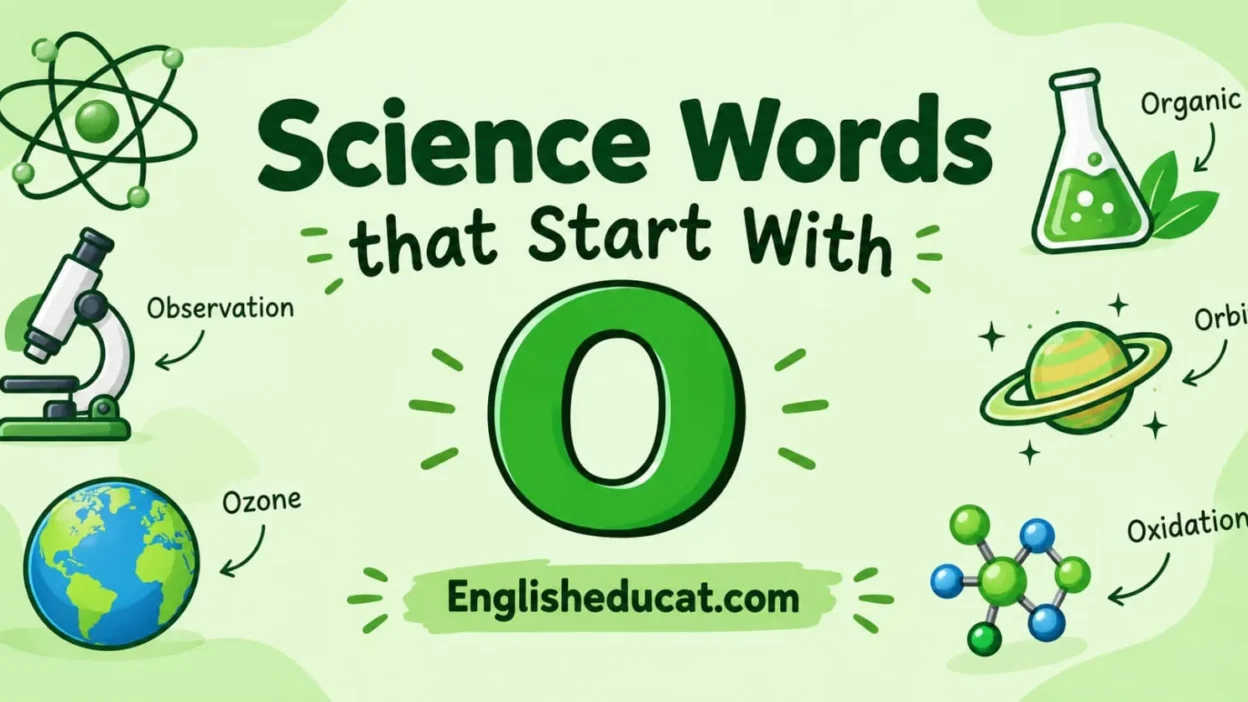
Science words that start with O appear more often than you would expect in biology textbooks, chemistry labs, physics lectures, and even the nightly weather report. It is one of the more productive letters in scientific vocabulary, carrying well over 130 distinct terms across five major branches of science. You likely picked up a few of these, like oxygen and orbit, in elementary school. Others, like osmoregulation or oxyanion, tend not to surface until you are several years into a science degree.
This guide sorts science words that start with O by branch instead of piling everything into one undifferentiated list. If you are a student prepping for a biology exam, a teacher putting together a vocabulary worksheet, or someone stuck on a crossword clue, you should be able to find what you need without much scrolling. Every entry comes with a plain-language definition and a short example sentence, and near the end you will find a bonus set of rarer and more advanced O-words for anyone who wants to go past the fundamentals. Also learn other science word that start with P and Q.
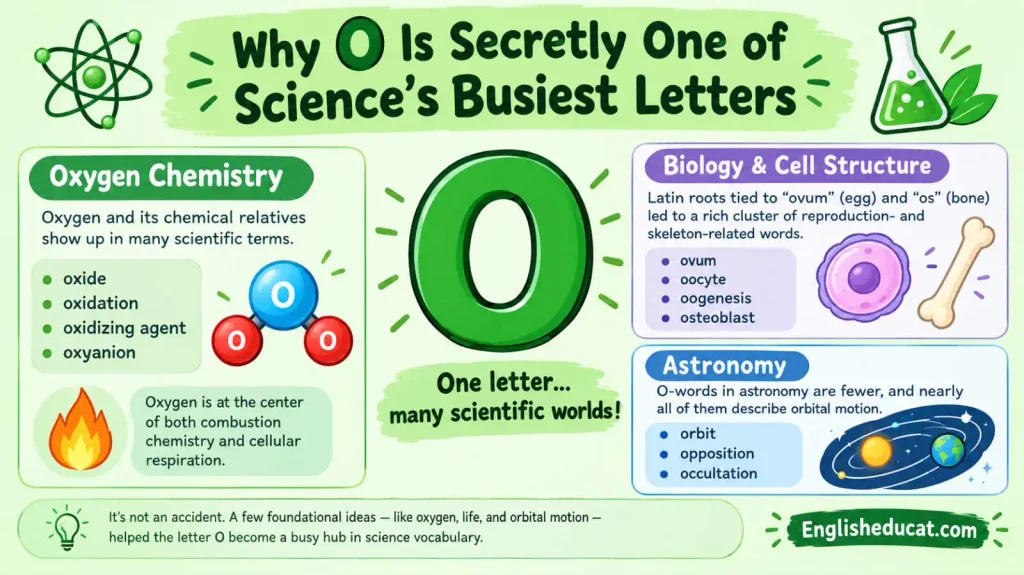
Why O Is Secretly One of Science’s Busiest Letters
A pattern appears once you line up enough science words that start with O: a surprising number of them cluster around two themes. One is oxygen chemistry: oxide, oxidation, oxidizing agent, oxyanion. The other is biological reproduction and cell structure: ovum, oocyte, oogenesis, osteoblast. That is not really an accident. Oxygen sits at the center of both combustion chemistry and cellular respiration, so its name and its chemical relatives ended up carrying an outsized share of scientific terminology.
On the biology side, Latin roots tied to “ovum” (egg) and “os” (bone) fed a dense cluster of reproduction- and skeleton-related vocabulary. Astronomy tells a different story: its O-words are fewer, and nearly all of them describe orbital motion specifically orbit, opposition, occultation rather than covering the field broadly. It is just a minor pattern, but it says something real about how scientific vocabulary grows around a small number of foundational ideas.
Biology Words That Start With O
Biology supplies one of the largest categories here, mostly thanks to terms describing cells, reproduction, and human anatomy. Medical and pre-med students run into a dense cluster of these words early, often in a single semester of anatomy and physiology.
| Term | Definition | Example Sentence |
| Organism | A living thing that grows, reproduces, and responds to its surroundings. | Every organism needs a source of energy to survive. |
| Organ | A group of tissues working together to carry out one bodily function. | The heart is an organ that pumps blood. |
| Organelle | A small, specialized structure inside a cell with its own job to do. | Mitochondria are organelles that generate cellular energy. |
| Osmosis | The passive movement of water from a less concentrated area to a more concentrated one across a membrane. | Osmosis lets plant roots draw water from soil. |
| Ovary | The reproductive organ where eggs develop and mature. | The ovary releases an egg during ovulation. |
| Ovum | A mature egg cell capable of being fertilized. | Fertilization happens when sperm meets an ovum. |
| Oocyte | An egg cell that hasn’t yet finished maturing. | The oocyte develops inside an ovarian follicle. |
| Oogenesis | The multi-stage process that produces mature egg cells. | Oogenesis actually starts before a female is even born. |
| Omnivore | An animal whose diet includes both plant and animal matter. | Bears are omnivores that eat berries and fish. |
| Oviparous | Describes animals that lay eggs which hatch outside the body. | Birds and most reptiles are oviparous animals. |
| Ovoviviparous | Describes animals whose eggs hatch while still inside the mother. | Some sharks are ovoviviparous, giving birth to live young. |
| Osteoblast | A bone-building cell that lays down new tissue. | Osteoblasts help repair a broken bone. |
| Osteoclast | A cell that breaks down bone tissue for remodeling and repair. | Osteoclasts release stored calcium into the bloodstream. |
| Osteocyte | A mature, embedded bone cell that maintains existing bone. | Osteocytes keep bone tissue healthy over a lifetime. |
| Olfaction | The physiological process behind the sense of smell. | Dogs rely on olfaction to track food. |
| Oxytocin | A hormone that plays a role in bonding, labor, and lactation. | Oxytocin is released during labor and breastfeeding. |
| Operon | A set of genes in bacteria that switch on or off together. | The lac operon controls lactose digestion in bacteria. |
| Ontogeny | The full developmental path an organism follows from embryo to adult. | Ontogeny traces how one cell becomes a complex animal. |
| Osmoregulation | An organism’s internal mechanism for balancing water and salt levels. | Fish use osmoregulation to survive in salty water. |
| Ornithology | The scientific field devoted to studying birds. | She studied ornithology to track migration patterns. |
| Oncology | The medical specialty concerned with diagnosing and treating cancer. | The patient was referred to oncology for tests. |
| Ossification | The gradual hardening of tissue into bone. | Ossification continues gradually through childhood. |
| Opsonization | An immune process that marks pathogens for destruction. | Opsonization helps white blood cells find bacteria. |
| Outcrossing | Breeding between unrelated members of the same species. | Outcrossing increases genetic diversity in a population. |
| Ovule | The plant structure that, once fertilized, becomes a seed. | Pollen fertilizes the ovule inside a flower. |
| Oral cavity | The mouth, where digestion physically begins. | Digestion begins in the oral cavity through chewing. |
| Otolith | A small calcium-based structure in the inner ear involved in balance. | Otoliths help the inner ear sense balance. |
| Oropharynx | The section of throat located just behind the mouth. | Food passes through the oropharynx toward the esophagus. |
Chemistry Words That Start With O
Chemistry contributes a different flavor of science words that start with O, and almost all of them trace back to oxygen in some way. Anyone who has studied redox reactions has already met several of these terms often without noticing the shared theme.
| Term | Definition | Example Sentence |
| Oxidation | A reaction in which a substance gives up electrons. | Oxidation causes iron to rust over time. |
| Oxidizing agent | The substance in a reaction that takes electrons from another, driving oxidation. | Oxygen acts as an oxidizing agent during combustion. |
| Oxide | Any compound where oxygen has bonded with another element. | Iron oxide is more commonly known as rust. |
| Oxygen | An element vital to respiration and to burning almost anything. | Plants release oxygen during photosynthesis. |
| Organic chemistry | The field devoted to carbon-based compounds and how they react. | Organic chemistry explains how proteins and fats form. |
| Organic compound | Any compound built around a carbon backbone. | Methane is one of the simplest organic compounds. |
| Octane | A hydrocarbon whose presence indicates how well a fuel resists engine knock. | Higher octane fuel resists knocking in strong engines. |
| Octet rule | A bonding pattern in which atoms trade or share electrons to reach eight in their outer shell. | The octet rule explains why sodium bonds with chlorine. |
| Oligomer | A short chain molecule built from just a few repeating units. | An oligomer has fewer units than a full polymer. |
| Oligosaccharide | A short carbohydrate chain made of a handful of sugar molecules. | An oligosaccharide is shorter than a polysaccharide chain. |
| Osmotic pressure | The force required to keep osmosis from occurring across a membrane. | Osmotic pressure keeps blood cells from bursting. |
| Osmolarity | A measurement of how many dissolved particles a solution contains. | Doctors check blood osmolarity to assess hydration. |
| Oxime | A compound produced when a carbonyl group reacts with hydroxylamine. | Oximes appear in the synthesis of certain pesticides. |
| Oxalic acid | A mildly toxic organic acid occurring naturally in some vegetables. | Spinach contains small amounts of oxalic acid. |
| Oxoacid | An acid built around an oxygen atom bonded to a central element. | Sulfuric acid is a common industrial oxoacid. |
| Oxyanion | A negatively charged particle that carries oxygen as part of its structure. | Nitrate is an oxyanion found in fertilizers. |
| Osmium | A bluish-gray transition metal known for being extremely dense. | Osmium ranks among the densest metals known. |
| Oganesson | A short-lived, lab-made superheavy element at the far edge of the periodic table. | Oganesson was first created in a laboratory in 2002. |
| Organometallic compound | A compound in which a metal atom bonds directly to carbon. | Organometallic compounds work as industrial catalysts. |
| Olefin | A hydrocarbon containing at least one double bond between carbons. | Olefins like ethylene are used to make plastics. |
| Open system | A physical system free to trade both matter and energy with its surroundings. | A boiling pot of water acts as an open system. |
| Optical isomerism | A property where mirror-image molecules bend polarized light differently. | Optical isomerism occurs in molecules with a chiral center. |
| Ozonation | A purification method that introduces ozone gas into a liquid or gas. | Ozonation disinfects municipal drinking water. |
| Oleum | A fuming, highly concentrated mixture used in industrial acid production. | Oleum is a key step in sulfuric acid production. |
| Ortho | A chemical prefix marking substituents on adjacent ring carbons. | Ortho-substituted compounds have groups on neighboring carbons. |
| Oxonium | The formal chemistry term for a triple-bonded, positively charged oxygen atom. | Oxonium is the preferred chemical term for hydronium. |
| Octet | A full, stable set of eight electrons in an atom’s outer shell. | Noble gases naturally have a full octet. |
| Oxidation state | A number that tracks how many electrons an atom has effectively lost or gained. | Oxygen almost always carries an oxidation state of negative two. |
Physics Words That Start With O
Physics moves in a different direction: many of its O-words describe motion, light, or electricity, and quite a few appear in everyday technology even when nobody stops to notice the physics behind them.
| Term | Definition | Example Sentence |
| Orbit | The repeating path a smaller body traces around a larger one under gravity’s pull. | A satellite follows a fixed orbit around Earth. |
| Oscillation | A repeated swing back and forth around a resting point. | A swinging pendulum demonstrates simple oscillation. |
| Optics | The area of physics concerned with how light behaves and travels. | Optics explains how lenses bend and focus light. |
| Ohm | The standard unit used to measure electrical resistance. | A resistor rated at 100 ohms limits current flow. |
| Ohm’s law | A formula linking voltage, current, and resistance in a circuit. | Ohm’s law states that voltage equals current times resistance. |
| Oscillator | Any device built to generate a steady, repeating signal. | A quartz oscillator keeps precise time in a watch. |
| Oscilloscope | An instrument that turns electrical signals into a viewable waveform. | Engineers use an oscilloscope to visualize voltage changes. |
| Orbital | A probability zone marking where an electron is likely located. | Each orbital holds a maximum of two electrons. |
| Orbital velocity | The minimum speed an object needs to stay in orbit rather than fall. | A satellite needs enough orbital velocity to avoid falling. |
| Opacity | How effectively a material stops light from passing through it. | Thick curtains have high opacity and block sunlight. |
| Overtone | A secondary frequency riding above an object’s base vibration. | The overtone gives an instrument its distinct tone. |
| Oersted | A unit that quantifies magnetic field strength. | The oersted is named after physicist Hans Christian Ørsted. |
| Optoelectronics | The engineering field focused on light-based electronic components. | Optoelectronics underlies the design of LEDs and solar cells. |
| Optical fiber | A slender glass strand designed to carry data as pulses of light. | Optical fiber carries internet data at very high speeds. |
| Order of magnitude | A rough sense of scale, expressed as a power of ten. | The two measurements differed by an order of magnitude. |
| Output power | The rate at which a system delivers usable energy. | The amplifier’s output power determines the speaker’s volume. |
| Open circuit | A broken electrical path where current can no longer flow. | A blown fuse creates an open circuit in the wiring. |
| Overload | A state where a system is pushed past its safe operating limit. | Too many appliances on one outlet can cause an overload. |
| Optical density | A numerical measure of how much light a substance absorbs. | Sunglasses with higher optical density block more glare. |
| Orthogonal | Set at a 90-degree angle, or unrelated in a mathematical sense. | The two applied forces act in orthogonal directions. |
| Oscillatory motion | Movement that repeats the same back-and-forth pattern indefinitely. | A vibrating guitar string shows oscillatory motion. |
| Optical illusion | A visual scene the brain interprets differently than it physically exists. | The bent-straw effect in water is an optical illusion. |
| Oscillation frequency | How often a full oscillation cycle repeats in a given time. | A higher oscillation frequency produces a higher pitch. |
| Optical spectrum | The band of wavelengths the human eye can perceive as light. | A rainbow displays the full optical spectrum. |
| Oscillating field | An electric or magnetic field whose strength rises and falls in a pattern. | An oscillating electric field generates electromagnetic waves. |
Astronomy & Space Words That Start With O
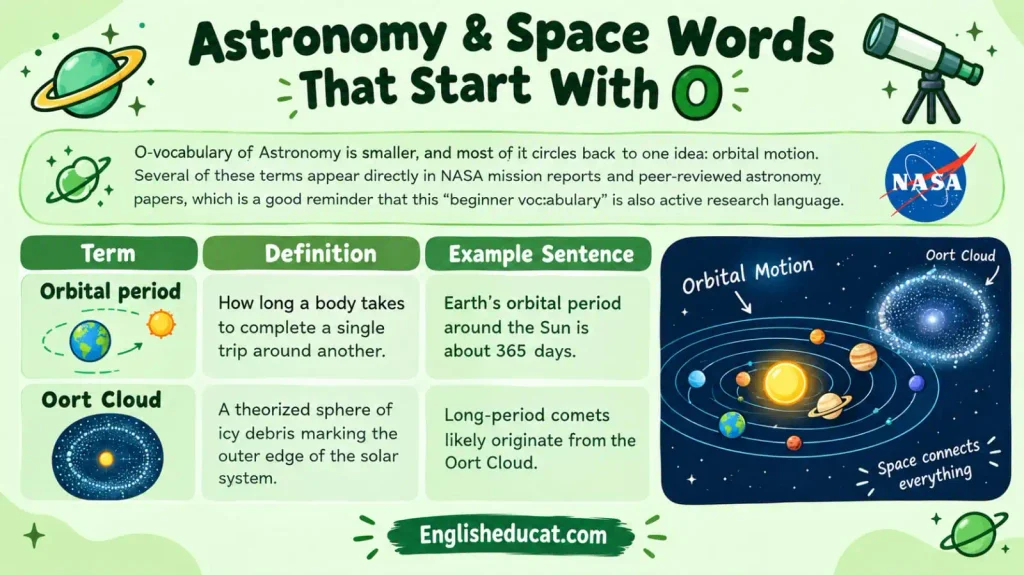
O-vocabulary of Astronomy is smaller, and most of it circles back to one idea: orbital motion. Several of these terms appear directly in NASA mission reports and peer-reviewed astronomy papers, which is a good reminder that this “beginner vocabulary” is also active research language.
| Term | Definition | Example Sentence |
| Orbital period | How long a body takes to complete a single trip around another. | Earth’s orbital period around the Sun is about 365 days. |
| Oort Cloud | A theorized sphere of icy debris marking the outer edge of the solar system. | Long-period comets likely originate from the Oort Cloud. |
| Observatory | A dedicated site built and equipped for watching the sky. | The observatory houses a telescope for studying distant galaxies. |
| Occultation | An event where a nearer object briefly blocks a farther one from view. | The occultation of the star lasted several minutes. |
| Oblate | Bulging slightly at the equator due to spin. | Earth is technically an oblate spheroid, not a perfect sphere. |
| Opposition | A configuration where Earth sits directly between the Sun and another planet. | Mars appears at its brightest during opposition. |
| Orbital resonance | A gravitational relationship where two orbiting bodies repeatedly tug on each other in sync. | Orbital resonance keeps some of Jupiter’s moons in locked patterns. |
| Ophiuchus | A sprawling constellation that sits along the celestial equator. | Some astronomers call Ophiuchus an unofficial 13th zodiac sign. |
| Outer planet | Any planet orbiting beyond the asteroid belt. | Jupiter, Saturn, Uranus, and Neptune are outer planets. |
| Orbital inclination | The angle between an orbit and a fixed reference plane. | A satellite’s orbital inclination determines its coverage area. |
| Oblateness | A numerical measure of how much a spinning body bulges at its equator. | Saturn’s fast rotation gives it noticeable oblateness. |
| Orion | A well-known winter constellation named for a figure in Greek mythology. | Orion’s belt is one of the easiest patterns to spot. |
| Orbital eccentricity | A value showing how far an orbit strays from a perfect circle. | Comets often follow orbits with high orbital eccentricity. |
| Outburst | A sharp, short-lived spike in a star’s brightness. | Astronomers recorded an outburst from the young star system. |
| Orbital plane | The imaginary flat surface that contains an entire orbit. | Most planets orbit roughly within the same orbital plane. |
| Optical telescope | A telescope built to gather and focus visible light specifically. | An optical telescope lets astronomers observe galaxies directly. |
| Orbital mechanics | The applied science of predicting and controlling motion under gravity. | Orbital mechanics helps engineers plan spacecraft trajectories. |
| Oscillating universe | A cosmological model in which the universe repeatedly expands and then contracts. | The oscillating universe theory proposes repeated cosmic cycles. |
Earth & Environmental Science Words That Start With O
This last branch covers oceans, geology, and climate, and a good number of these terms appear regularly in environmental journalism, not just textbooks.
| Term | Definition | Example Sentence |
| Oceanography | The scientific discipline dedicated to studying oceans and marine systems. | Oceanography examines currents, marine life, and the seafloor. |
| Ocean current | A large-scale, consistent flow of seawater in a set direction. | The Gulf Stream is a powerful warm ocean current. |
| Ozone layer | A stratospheric band that filters out most harmful UV radiation. | The ozone layer protects organisms from UV damage. |
| Ozone depletion | A measurable thinning of the ozone layer over time. | Ozone depletion raises the risk of skin cancer. |
| Outcrop | A patch of underlying rock that pokes through the surface soil. | Geologists studied the outcrop to read the rock layers. |
| Orogeny | The long-term tectonic process that builds mountain ranges. | Orogeny occurs as tectonic plates collide over millions of years. |
| Ophiolite | A fragment of ancient ocean floor now stranded on dry land. | The ophiolite revealed layers typical of the ocean floor. |
| Oceanic crust | The thinner, denser layer of Earth’s crust found under the oceans. | Oceanic crust is denser than continental crust above it. |
| Ocean trench | A narrow, extremely deep channel cut into the seafloor. | The Mariana Trench is the deepest known ocean trench. |
| Ocean upwelling | A current pattern that pulls cold, nutrient-dense water toward the surface. | Ocean upwelling supports rich fishing grounds along the coast. |
| Ocean salinity | A reading of how much salt is dissolved in a given volume of seawater. | Ocean salinity varies with rainfall and evaporation. |
| Ocean basin | A vast, bowl-shaped depression in Earth’s crust that holds an ocean. | The Pacific Ocean basin is the largest on the planet. |
| Oxbow lake | A crescent-shaped lake left behind after a river changes course. | The oxbow lake once formed part of the river’s channel. |
| Obliquity | The angle at which a planet’s axis leans relative to its orbit. | Earth’s obliquity causes its seasonal changes. |
| Orographic precipitation | Rain or snow triggered when air is forced upward over rising terrain. | Orographic precipitation makes the mountain’s windward side wetter. |
| Overburden | Loose rock and soil that has to be cleared before reaching a resource beneath it. | Miners removed the overburden to reach the coal seam. |
| Old-growth forest | A mature forest ecosystem that has escaped major disturbance for generations. | Old-growth forests support unusually high biodiversity. |
| Organic matter | Decomposed plant and animal material mixed into soil or sediment. | Organic matter improves soil fertility and water retention. |
| Overfishing | Removing fish from a population faster than it can naturally recover. | Overfishing has depleted several major fish stocks. |
| Ozone hole | A seasonal, localized zone of severe ozone thinning near the poles. | The ozone hole over Antarctica shrinks and grows seasonally. |
| Outgassing | The slow release of gas that had been trapped inside rock or magma. | Volcanic outgassing releases sulfur dioxide into the air. |
| Ocean acidification | A gradual drop in ocean pH driven by absorbed atmospheric carbon dioxide. | Ocean acidification threatens coral reefs worldwide. |
| Overwash | Storm-driven water that spills across a barrier, carrying sediment with it. | Overwash deposited a layer of sand across the island. |
| Outwash plain | A flat expanse built up from sediment carried by glacial meltwater. | The outwash plain formed as meltwater carried sand downstream. |
| Ocean gyre | A wide circular current system formed by wind and Earth’s rotation. | The Pacific gyre concentrates floating plastic debris. |
Advanced & Rare O-Words
A handful of science words that start with O rarely appear outside graduate-level or research contexts. These are not classroom staples, but they are worth knowing if you are heading further into genetics, astronomy, or microbiology.
| Term | Field | Definition | Example Sentence |
| ʻOumuamua | Astronomy | The name given to the first object confirmed to have entered our solar system from interstellar space. | ʻOumuamua’s odd elongated shape puzzled astronomers when it was spotted in 2017. |
| Osmoreceptor | Biology | A sensory neuron that monitors how concentrated the blood is. | Osmoreceptors in the brain trigger thirst as dehydration begins. |
| Opsin | Biology | A protein in the eye that reacts to light and kicks off vision. | Opsin changes shape the instant it absorbs a photon. |
| Overdominance | Genetics | A genetic effect where carrying two different gene versions outperforms carrying two identical ones. | Overdominance helps explain why the sickle cell trait persists. |
| Orthologous | Genetics | Describes genes in separate species that trace back to one shared ancestral gene. | Orthologous genes often keep similar functions across species. |
| Osmophilic | Microbiology | Describes microbes adapted to survive in unusually concentrated, sugar-heavy environments. | Osmophilic yeasts can survive in extremely sugary environments like honey. |
| Ontology | Bioinformatics | A structured map of terms and relationships used to organize knowledge in a field. | Researchers built an ontology to standardize gene-function terms. |
Why Learn O Science Words?
The payoff from learning science words that start with O depends a bit on why you are here in the first place. For students and teachers, this vocabulary cuts across several subjects at once. “Orbit,” for instance, appears in physics, astronomy, and earth-science units on tides, so learning it once saves time across an entire school year. For anyone writing lab reports or scientific essays, a precise term like “oxidation” or “osmoregulation” lets you name a process exactly instead of describing it in a roundabout way.
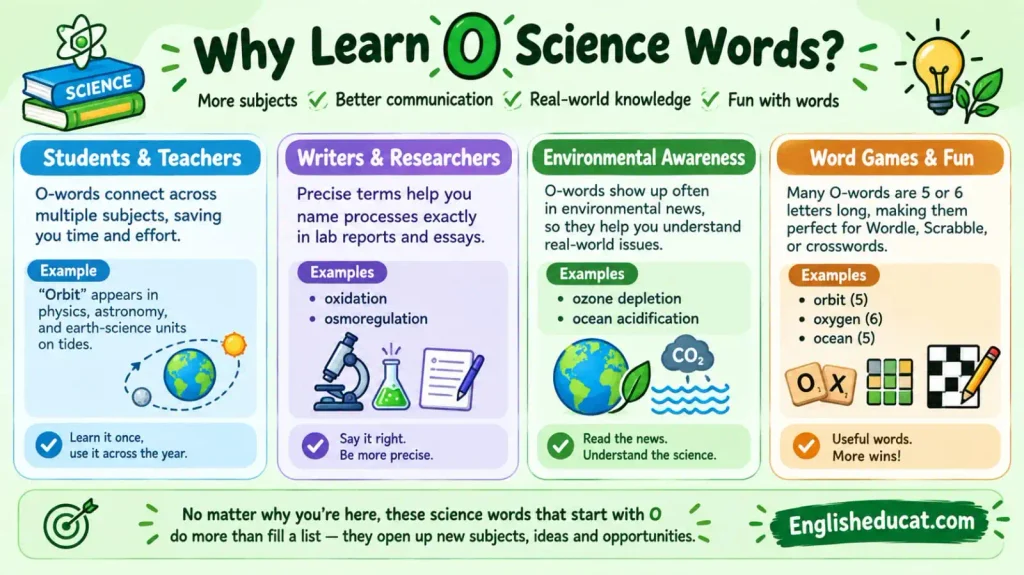
There is also a more everyday angle. Terms like “ozone depletion” and “ocean acidification” change constantly in environmental reporting, and knowing them makes real scientific journalism easier to follow instead of easier to skim past. And if word games are more your speed, this list is genuinely useful; plenty of these O-words land at exactly five or six letters, which makes them solid Wordle, Scrabble, or crossword material. However you landed here, this collection of science words that start with O was built to do more than one job.
Frequently Asked Question
What are some common science words that start with O?
Common science words that start with O include oxygen, orbit, osmosis, oxidation, organism, and optics. These terms span biology, chemistry, and physics and are among the O-words most often taught in school science.
What is a 5-letter science word that starts with O?
Ozone, orbit, and optic are all 5-letter science words that start with O, which makes them useful answers for Wordle, Scrabble, or a crossword puzzle.
What is the most important science word that starts with O?
Oxygen is generally considered the most important science word that starts with O, given its central role in respiration, combustion, and nearly every life process on Earth.
What are chemistry words that start with O?
Chemistry words that start with O include oxidation, oxide, organic compound, oxidizing agent, and oxyanion, most of which connect back to oxygen’s role in chemical reactions.
What are physics words that start with O?
Physics words that start with O include orbit, oscillation, optics, ohm, and orbital, covering topics like motion, light, and electricity.
Are there rare or advanced science words that start with O?
Yes. Advanced science words that start with O include osmoreceptor, opsin, orthologous, and ʻOumuamua, the name given to the first confirmed interstellar object detected passing through our solar system in 2017.
Conclusion
The letter O turns out to be far richer than it first appears: not a minor entry in the alphabet, but something closer to a cross-section of science itself. In one list, you have got the oxygen keeping you alive right now, the orbit holding planets in place, the osmosis happening quietly inside every plant cell, and the ozone layer standing between us and the worst of the radiation from the sun. That is the real case for learning science words that start with O: they do not stay confined to one subject or one classroom. They stretch from inside a single living cell all the way out to the edge of the solar system.
Whether you came here to cram for an exam, build a lesson plan, settle a word-game dispute, or just chase down where “oxidation” actually comes from, hopefully this list left you with more than a stack of definitions; it showed how tightly these science words that start with O actually connect. Bookmark it, because scientific vocabulary has a habit of resurfacing exactly when you are not expecting it.

Linguistics Specialist
James is a linguist with a Ph.D. in Applied Linguistics from Boston University. His work focuses on word origins, synonyms, and how language evolves over time. He has contributed to several academic journals on English semantics.