
Ditto meaning in text is very simple. It means “same here” or “I agree.” People use it to repeat what someone just said, without typing it all again. If you just got a text that says “ditto.” And Now you are looking at your phone wondering what it means. Then you are not alone. Do not worry; the ditto meaning in text is very easy to understand once you see it in action.
This article covers the ditto meaning in text used in everyday chats and messages. It is not about the pink Pokémon character named Ditto. We will cover that mix-up later on in this guide.
What Is the Ditto Meaning in Text? (Quick Answer)
The short version: “ditto” means “the same as what was just said.” There are many other slang terms like SRS, Bru and ONG that are used in texting.
The Plain English Definition
Ditto is a word that shows agreement with something. It means “same” or “I feel that way too.”
Here is a simple example to understand it:
- Friend: “I am so tired today.”
- You: “Ditto.”
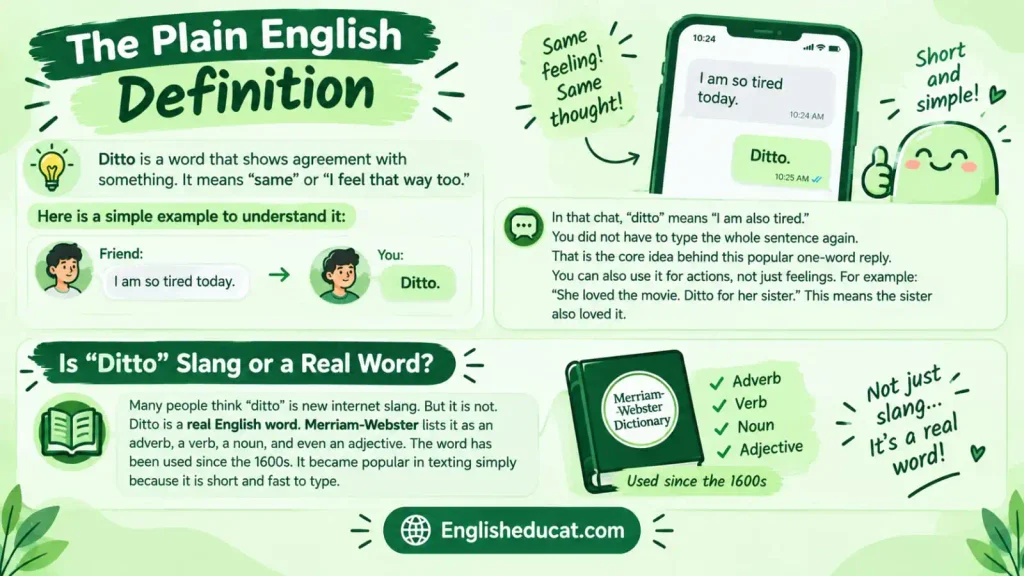
In that chat, “ditto” means “I am also tired.” You did not have to type the whole sentence again. That is the core idea behind this popular one-word reply. You can also use it for actions, not just feelings. For example: “She loved the movie. Ditto for her sister.” This means the sister also loved it.
Is “Ditto” Slang or a Real Word?
Many people think “ditto” is new internet slang. But it is not. Ditto is a real English word. Merriam-Webster lists it as an adverb, a verb, a noun, and even an adjective. The word has been used since the 1600s. It became popular in texting simply because it is short and fast to type.
Where Does the Word “Ditto” Come From?
Knowing the history makes the modern texting use easier to understand.
From Italian “Detto” to English Ledgers
“Ditto” comes from the Italian word detto, meaning “said” or “the aforesaid.” Detto came from the Latin verb dicere, which means “to say.” Many years ago, Italian writers used ditto to avoid repeating month names in dated lists. English traders picked up the habit in the 1600s. They began using “ditto” to avoid repeating any word in a written record.
This history shows that the word is not brand new. It is an old space-saving trick that simply moved into modern chat apps.
The Ditto Machine: Why “Ditto” Also Means “Copy”
In the 1900s, offices used a tool called a ditto machine. This machine made copies of papers using purple ink. Teachers often used one to print worksheets for a whole class.
That machine is why “ditto” can also mean “copy” or “duplicate.” A ditto machine copied a page. In a similar way, saying “ditto” in a chat copies the feeling or opinion of someone.
This ditto-machine history explains why the word still carries a sense of “the same” today. It is tied to real machines and real records, not just casual slang.
How People Use “Ditto” in Texts and Online
Here is where this word actually appears in real life.
In Text Messages and DMs
This is the most common place where you can find it. Someone shares a feeling, and you feel the same way, then you type “ditto” instead of writing a full sentence.
Example:
- I can not wait for the weekend.
- Ditto!”
This kind of reply looks quick, casual, and friendly. You will see it just as often in WhatsApp chats as in regular text messages.
On Social Media
People also use “ditto” in comments and captions. If someone posts an opinion you agree with, typing “ditto” in the comments shows that you also agree with it and shows full support.
You will find this word in Instagram, TikTok, and Facebook comment sections. The meaning stays the same everywhere: “I feel that too.”
In Group Chats and Gaming Chat
In group chats, one person often speaks for many. If someone says, “I am down for pizza,” others might just reply “ditto” instead of repeating the full plan.
Gamers also use this word. If a teammate says, “Let’s push the left side,” another player might type “ditto” to agree fast. Speed matters in a game, so a one-word reply works well.
On Dating Apps
On apps like Tinder or Bumble, “ditto” is a light way to show shared interests. Say your match writes, “I love hiking.” Replying “Ditto! Do you have a favorite trail?” shows you agree and keeps the chat going.
Be careful with using it too often, though. Repeating “ditto” over and over can feel lazy on a dating app. Instead add a question after it.
What It Means When a Guy or Girl Texts “Ditto”
The meaning does not change based on who sends it. A guy texting “ditto” means the same thing as a girl texting “ditto.” Both are saying, “I feel that way too.”
The tone can change a little based on the relationship, not gender. A close friend’s “ditto” might feel playful. A new match’s “ditto” might feel a bit more careful and polite.
When to Use “Ditto” and When to Avoid It
Knowing what the word means is only half the job. You also need to know when to use it and when you can not use it.
Good Moments to Use It
“Ditto” works great when the topic is light. Good times to use it include:
- Agreeing about food, weather, or plans
- Replying to fun news
- Chatting in a group where speed matters
- Casual talks with friends or family
In these places, it feels natural and warm, not cold.
When It Can Come Across as Cold or Dismissive
Here is where things get tricky. A one-word reply can feel like you do not care, even when that is not the intent. I remember a moment in a group chat I moderated for a small online community. One member shared that she had just lost her job that day. It was a hard and personal update. Another person in the chat replied with a single word: “ditto,” meaning they had lost their job too.
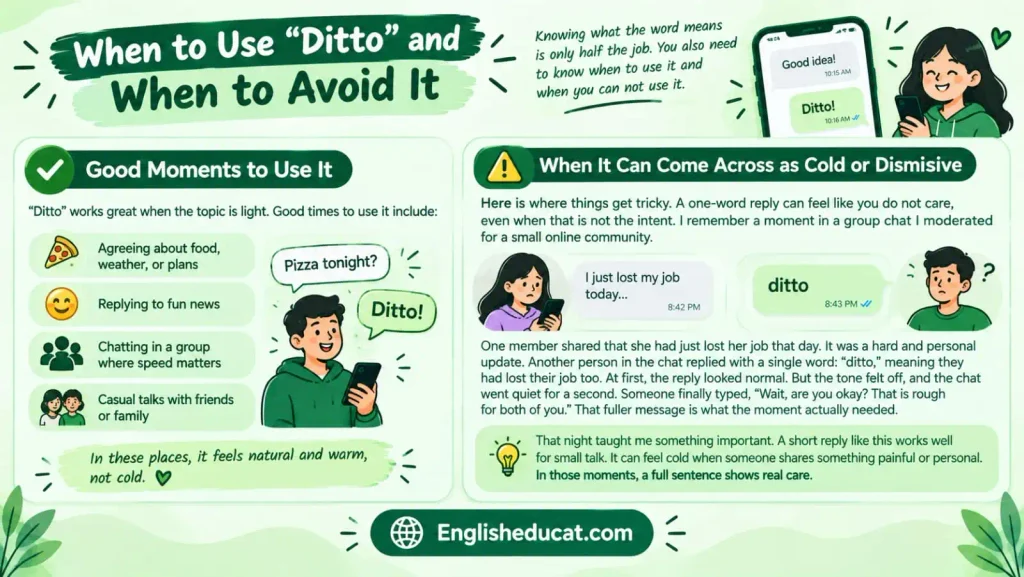
At first, the reply looked normal. But the tone felt off, and the chat went quiet for a second. Someone finally typed, “Wait, are you okay? That is rough for both of you.” That fuller message is what the moment actually needed.
That night taught me something important. A short reply like this works well for small talk. It can feel cold when someone shares something painful or personal. In those moments, a full sentence shows real care.
Is It OK for Professional Emails?
In many cases, no. Work emails and business messages should stay clear and formal. Saying “ditto” to a boss or client can seem too casual for that setting.
Instead of using it, use “I agree,” “I share your view,” or “Likewise”. These phrases carry the same meaning, but they sound more polished for work.
“Ditto” vs. Similar Words: Which Should You Use?
“Ditto” is not the only word for agreement. Knowing the differences helps you choose the right one.
Comparison Table
| Word | Tone | Best Use |
| Ditto | Playful, quick | Texting, casual chat |
| Same here | Friendly, relatable | Texting, social media |
| Me too | Direct, personal | Everyday talk |
| Likewise | Polite, formal | Work emails, new contacts |
| Agreed | Short, decisive | Group decisions, meetings |
| Absolutely | Strong, excited | Big agreement moments |
Formal Alternatives for Work Messages
If “ditto” feels too casual, swap it for “I concur,” “I share your perspective,” or “That matches my experience too.” These phrases keep the same idea without the casual tone.
Beyond Texting: The Other Meanings of “Ditto”
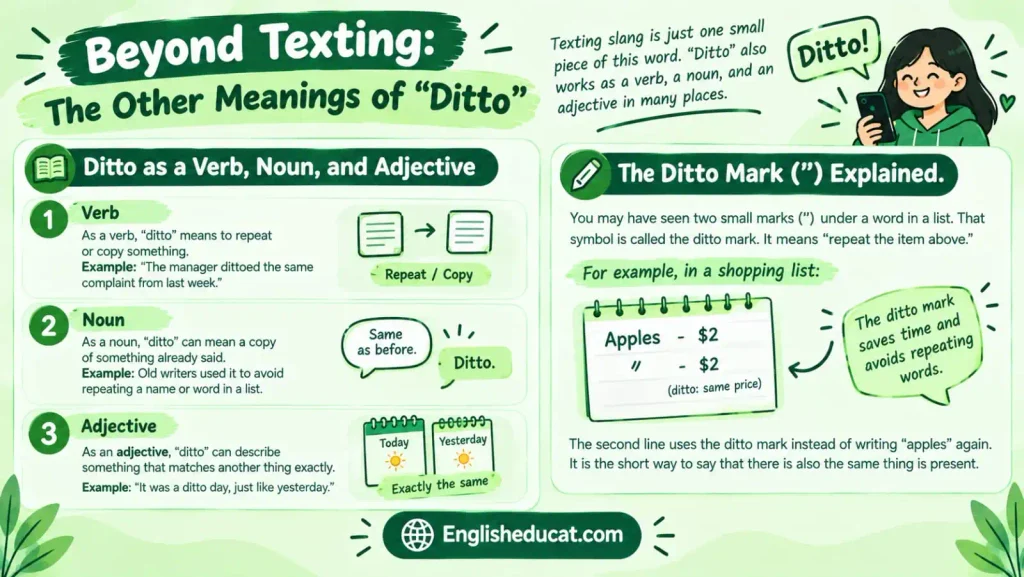
Texting slang is just one small piece of this word. “Ditto” also works as a verb, a noun, and an adjective in many places.
Ditto as a Verb, Noun, and Adjective
As a verb, “ditto” means to repeat or copy something. Example: “The manager dittoed the same complaint from last week.”
As a noun, “ditto” can mean a copy of something already said. Old writers used it to avoid repeating a name or word in a list.
As an adjective, “ditto” can describe something that matches another thing exactly. Example: “It was a ditto day, just like yesterday.”
The Ditto Mark (″) Explained.
You may have seen two small marks (″) under a word in a list. That symbol is called the ditto mark. It means “repeat the item above.”
For example, in a shopping list:
Apples – $2
” – $2 (ditto: same price)
The second line uses the ditto mark instead of writing “apples” again. It is the short way to say that there is also the same thing is present.
Real Examples in Physics, Medical, and Aviation Notes
This word also appears in careful and technical writing.
In physics or lab notebooks, a scientist may write “ditto” under a repeated measurement, such as the same temperature reading, to avoid rewriting the number.
In medical charts, a nurse might use a ditto mark to show a dosage stays the same as the line above it, instead of rewriting the full instruction.
In aviation logs, ground crews sometimes use “ditto” to confirm a repeated check, like a fuel level, matches the last entry exactly.
These examples show that a casual texting habit is rooted in a word that still does serious work in careful records.
Frequently Asked Questions
What does ditto mean in text?
In a text message, “ditto” means “same here” or “I feel the same way.” It lets you agree with what someone just wrote without retyping their whole message. For example, if a friend texts “I am exhausted today,” replying “ditto” instantly shows you feel exhausted too, in just one word.
Is ditto a real word, or just slang?
Ditto is a genuine English word, not modern internet slang. Dictionaries have listed it since the 1600s, when it started as a way to avoid repeating dates and names in written records. It became popular in texting simply because it is short, clear, and easy to type quickly.
Is it rude to say ditto?
Ditto is not rude by itself, but a one-word reply can feel cold if someone shares serious or emotional news. In light, everyday chats about food, weather, or plans, “ditto” reads as friendly and quick. Save fuller sentences for moments when someone truly needs to feel heard.
Can you use ditto in a professional email?
It is best to avoid “ditto” in formal work emails, since it can sound too casual for business communication. Phrases like “I agree,” “I share your perspective,” or “Likewise” express the same idea while sounding polished. Save “ditto” for quick chats with coworkers you already text casually.
Is ditto the same as “me too”?
Ditto and “me too” both show agreement, so in most everyday texting they mean the same thing. Ditto is slightly broader, though, since it can also mean “the same thing applies here” rather than only “I feel that too.” Either word works fine in casual conversation.
What does it mean when a guy or girl texts “ditto”?
The meaning of “ditto” does not change based on who sends it. A guy or girl texting “ditto” is simply agreeing with, or sharing the feeling in, your last message. Any difference in tone comes from the relationship between the two people, not from gender.
Where does the word “ditto” come from?
“Ditto” comes from the Italian word “detto,” meaning “said,” which traces back further to the Latin verb “dicere,” meaning “to speak.” English traders adopted the word in the 1600s to avoid repeating dates and words in written lists, and it later moved into everyday speech.
Conclusion
This small word does a big job: it says “same here” without typing a full sentence. It comes from real history, real machines, and a real dictionary entry, not just internet trends. Use it freely for light chats, quick agreements, and fun replies. Save fuller sentences for moments that need real care, like the one I saw in that group chat. Once you understand the full ditto meaning in text, from its Italian roots to its use in medical notes, you will never look at that little word the same way again.

Linguistics Specialist
James is a linguist with a Ph.D. in Applied Linguistics from Boston University. His work focuses on word origins, synonyms, and how language evolves over time. He has contributed to several academic journals on English semantics.