

Z is one of the rarest letters that begin with science words, but it still carries real weight across biology, chemistry, physics, astronomy, and earth science. Words like zygote, zinc, zeolite, and zenith are not obscure trivia; they change regularly in textbooks, lab reports, and research papers. It is much different then word meanings that are used in texting, they are about texting and it is about science words.
This guide organizes more than 120 real science words starting with Z by branch, each with a plain language definition and also with an example. A bonus section at the end covers advanced and rarely seen Z terms for anyone who wants to go beyond the basics.
Why Z Punches Above Its Weight in Science
A third of the words on this list trace back to just two Greek roots. Zōon means “animal,” and that gives us zoology, zygote, and zooplankton. Zymē means “ferment,” and that gives us zymase, zymology, and zymogen. That is part of why biology and biochemistry dominate the science words starting with Z more heavily than physics or astronomy; the scientific vocabulary of letters owes as much to ancient Greek as it does to modern discovery.
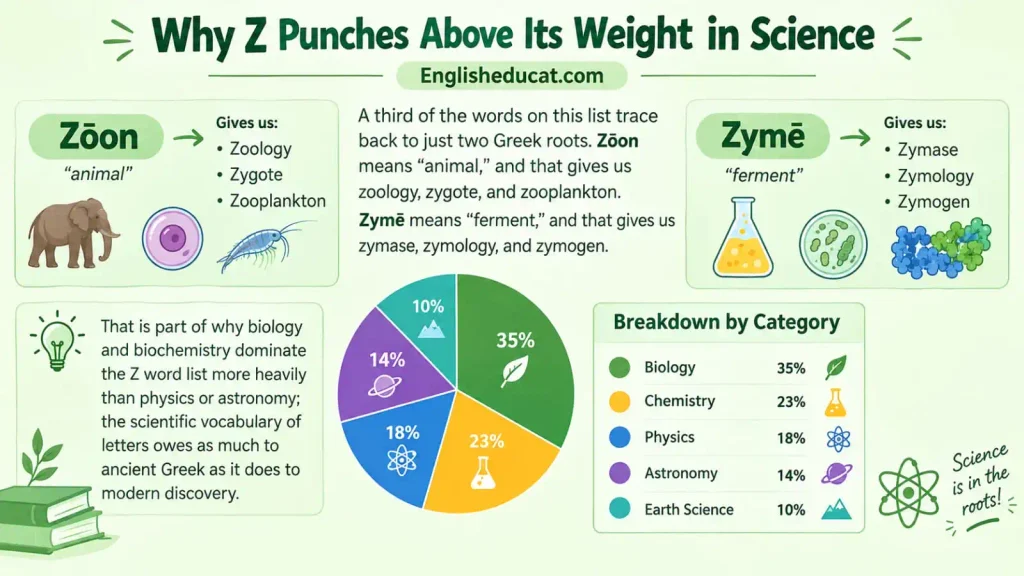
Broken down by category, the terms below split roughly into 35% biology, 23% chemistry, 18% physics, 14% astronomy, and 10% earth science, a distribution that mirrors those root-word origins almost exactly.
Biology Words That Start With Z
Biology contributes the largest share of Z-words on this list, and a handful of them appear again and again in coursework. Zygote and zoology in particular are staples of introductory biology classes and standardized science tests, while zoonosis has become a familiar term in public health reporting.
| Term | Definition | Example Sentence |
| Zygote | The single cell that forms once a sperm successfully fertilizes an egg | The zygote divided rapidly within days of fertilization. |
| Zoology | The branch of biology devoted to animal life, from behavior to body structure | She majored in zoology to study primate social behavior. |
| Zoonosis | An infection that jumps from an animal host into a human population | Rabies is a well-known example of zoonosis. |
| Zoologist | A researcher who focuses on animal behavior, anatomy, or classification | The zoologist tracked wolf packs across the reserve. |
| Zooplankton | Microscopic drifting creatures that sit near the base of aquatic food chains | Zooplankton feed on phytoplankton near the ocean’s surface. |
| Zoonotic | Capable of passing from animals to people, as certain diseases do | Scientists monitor bats for zoonotic virus spillover. |
| Zygospore | A thick-walled spore produced when two similar-looking gametes fuse | Bread mold reproduces sexually by forming a zygospore. |
| Zona Pellucida | The glycoprotein layer surrounding a mammalian egg cell | Sperm must penetrate the zona pellucida to fertilize the egg. |
| Zygomatic | Relating to the cheekbone area of the skull | The zygomatic arch protects the eye socket from impact. |
| Zoogeography | The study of where animal species live and why | Zoogeography explains why marsupials dominate Australia. |
| Zooxanthellae | Microscopic algae that live inside coral cells and supply them with food through photosynthesis | Coral bleaching occurs when corals expel their zooxanthellae. |
| Zoospore | A flagellated spore that swims through water, produced by algae and fungi | The zoospore swims through water to find a new host. |
| Zygotene | The second stage of prophase I in meiosis, when chromosomes begin pairing | Chromosome pairing begins during the zygotene stage. |
| Zymogen | An inactive enzyme that switches on only after a biochemical trigger | Pepsinogen is a zymogen converted to active pepsin. |
| Zootoxin | A toxin an animal produces, such as venom | Snake venom contains zootoxins that affect blood clotting. |
| Zebrafish | A small freshwater fish widely used as a genetic research model | Researchers used zebrafish to study heart regeneration. |
| Zygomycete | A fungus phylum known for producing zygospores | Bread mold is a common zygomycete. |
| Zoophily | Plant pollination carried out by animals rather than wind or water | Zoophily is common in flowers pollinated by bats. |
| Zooid | One individual member of a larger colonial animal structure | Each zooid in the colony shares nutrients with its neighbors. |
| Zymology | The scientific study of fermentation | Zymology explains how yeast converts sugar into alcohol. |
| Zonation | The way organisms arrange themselves into distinct bands within a habitat | Zonation on a rocky shore reflects tolerance to tides. |
| Zoopharmacognosy | Self-medicating behavior observed in wild animals | Zoopharmacognosy explains why sick primates eat bitter leaves. |
| Zoosporangium | The structure that produces and releases zoospores | The zoosporangium ruptures to release swimming spores. |
| Zoogamy | Sexual reproduction that relies on motile gametes | Zoogamy allows some green algae to reproduce via swimming gametes. |
| Zymogen Granule | A storage vesicle that holds inactive digestive enzymes | Pancreatic cells store enzymes inside zymogen granules. |
| Zebra Mussel | An invasive freshwater mollusk studied for its ecological impact | Zebra mussels clog water intake pipes across the Great Lakes. |
| Zinc Finger Protein | A DNA-binding protein motif that’s stabilized by zinc ions | Zinc finger proteins help regulate gene expression. |
| Zona Reaction | A biochemical shift that blocks additional sperm from entering a fertilized egg | The zona reaction prevents polyspermy after fertilization. |
| Zygomorphic | A term for flowers symmetrical along only one axis, rather than every direction | Orchids are classic examples of zygomorphic flowers. |
| Zoophagous | Feeding on animal tissue, a trait used to describe certain insects | Zoophagous beetle larvae prey on smaller soil insects. |
| Zoonotic Reservoir | A host species that carries a pathogen capable of infecting humans | Bats act as a zoonotic reservoir for several viruses. |
| Zoogloea | A gelatinous mass of bacteria that forms during wastewater treatment | Zoogloea formation helps bacteria settle in sewage treatment. |
| Zymogenic Cell | A stomach cell type that secretes inactive digestive enzyme precursors | Zymogenic cells release pepsinogen into the stomach lining. |
| Zootomy | The dissection and anatomical study of animal bodies | Early zootomy texts compared skeletons across species. |
Chemistry Words That Start With Z
In chemistry, zinc and zeolite both appear most: one as a common metallic element used across industry and biology, the other as a workhorse material behind water softeners and petroleum refining.
| Term | Definition | Example Sentence |
| Zinc | A bluish-white metal, atomic number 30, essential to both industry and the human body | Zinc is added to steel to prevent rusting. |
| Zeolite | A honeycomb-structured mineral whose tiny pores let it selectively capture or release molecules | Zeolite is added to detergents to soften water. |
| Zirconium | A corrosion-resistant transition metal, atomic number 40 | Zirconium is used in nuclear reactor components. |
| Zwitterion | A single molecule carrying a positive charge on one part and a negative charge on another | Amino acids exist as zwitterions at neutral pH. |
| Zero-Order Reaction | A reaction whose speed stays constant no matter how much reactant remains | Ammonia decomposition on hot metal is a zero-order reaction. |
| Ziegler–Natta Catalyst | A catalyst that builds stereoregular polymer chains from simple alkenes | This catalyst revolutionized polyethylene production. |
| Zone Refining | A purification method that sweeps impurities along a slowly moving molten band | Zone refining produces ultrapure silicon for semiconductors. |
| Zymase | The yeast enzyme complex responsible for alcoholic fermentation | Zymase converts glucose into ethanol and carbon dioxide. |
| Zincate | The negative ion formed when zinc dissolves in a strong base | Zincate forms when zinc dissolves in concentrated sodium hydroxide. |
| Zeta Potential | A measurement of the electrical charge at a particle’s surface in liquid | Zeta potential predicts whether suspended particles will clump. |
| Zirconocene | An organometallic compound pairing zirconium with cyclopentadienyl rings | Zirconocene complexes are studied as polymerization catalysts. |
| Zinc Oxide | A white compound used in sunscreens and pigments | Zinc oxide reflects UV rays in mineral sunscreen. |
| Zircon | A zirconium-bearing silicate mineral prized for dating ancient rocks | Zircon crystals reveal the age of ancient rocks. |
| Zeptomole | A unit describing an almost immeasurably small quantity of substance | Sensitive detectors can measure a zeptomole of material. |
| Zeolitic Water | Water held loosely within a zeolite’s crystal framework | Heating a zeolite drives off its zeolitic water. |
| Zincography | A printing technique that uses etched zinc plates | Zincography allowed faster reproduction of old illustrations. |
| Zero-Valent Iron | Uncharged metallic iron used to break down groundwater pollutants | Zero-valent iron barriers remove solvents from polluted groundwater. |
| Zincblende | A cubic mineral form of zinc sulfide and the most common zinc ore | Zincblende is the most common ore of zinc. |
| Zone Electrophoresis | A technique that separates charged molecules as they migrate through a medium | Zone electrophoresis separates proteins by size and charge. |
| Zirconia | A hard ceramic compound made from zirconium dioxide | Zirconia is used in dental crowns for strength. |
| Zinc-Air Battery | A battery that generates power by reacting zinc with atmospheric oxygen | Zinc-air batteries commonly power hearing aids. |
| Zwitterionic Surfactant | A surfactant molecule that carries both positive and negative charged groups | Zwitterionic surfactants appear in mild, low-irritation shampoos. |
| Zero-Point Charge | The pH at which a surface holds no net electrical charge | Soil scientists use the zero-point charge to predict nutrient binding. |
| Zincite | A red or orange mineral form of zinc oxide | Zincite crystals are prized by mineral collectors. |
| Zwitterionic Chromatography | A separation method using a stationary phase with balanced charges | This chromatography helps separate polar metabolites in samples. |
| Zone Melting | Another name for the zone-refining purification process | Zone melting grows ultrapure semiconductor crystals. |
| Zinc Sulfate | A compound used as both a dietary supplement and an agricultural fungicide | Farmers apply zinc sulfate to correct crop zinc deficiency. |
Physics Words That Start With Z
Physics only claims a handful of Z-terms, but two of them, zero-point energy and the Zeeman effect, appear most often in college-level physics and spectroscopy courses.
| Term | Definition | Example Sentence |
| Zero-Point Energy | The energy a quantum system retains even at absolute zero, since particles never fully stop moving | Even at absolute zero, particles retain zero-point energy. |
| Zeeman Effect | A magnetic field’s tendency to split a single spectral line into several closely spaced lines | The Zeeman effect helps measure the Sun’s magnetic fields. |
| Z Boson | A neutral fundamental particle that helps mediate the weak nuclear force | The Z boson was discovered at CERN in 1983. |
| Zener Diode | A diode engineered to let current flow backward once a set voltage is reached | A Zener diode regulates voltage in electronic circuits. |
| Zeptosecond | A unit of time equal to one sextillionth of a second | Electron movement was measured on a zeptosecond timescale. |
| Z-Axis | The third coordinate axis, representing depth in three-dimensional space | The robot arm moved along the z-axis to lift the object. |
| Zero Gravity | The apparent weightlessness objects experience while in continuous free fall | Astronauts float freely in the zero gravity of orbit. |
| Z-Pinch | A method of compressing plasma using the magnetic field its own current generates | Z-pinch devices are studied as a path toward fusion. |
| Zero-Point Fluctuation | Random bursts of energy that persist in a vacuum even without added heat | Zero-point fluctuations are linked to the Casimir effect. |
| Zone Plate | An optical device that focuses light using rings of concentric diffraction patterns | A zone plate focuses X-rays that normal lenses can’t bend. |
| Zeroth Law of Thermodynamics | The principle that two objects in equilibrium with a third are in equilibrium with each other | The zeroth law explains how thermometers work. |
| Z-Transform | A mathematical tool used to analyze discrete-time signals and systems | Engineers use the z-transform to design digital filters. |
| Zone of Silence | An area near an explosion or loud event where sound is unexpectedly faint | A zone of silence formed miles from the blast site. |
| Zero-Field Cooling | Cooling a magnetic material with no external magnetic field applied | Zero-field cooling reveals a material’s magnetic memory. |
| Zettabyte | A digital storage unit equal to one sextillion bytes | Global data storage now exceeds several zettabytes yearly. |
| Zeptowatt | An extremely small unit of power, equal to 10⁻²¹ watts | Detectors can register signals as faint as a zeptowatt. |
| Z Parameter | A value describing impedance relationships within an electrical circuit | Engineers use z parameters to model microwave networks. |
| Z Machine | A pulsed-power research facility used to study extreme physical conditions | The Z Machine generates intense X-ray bursts for fusion research. |
| Zero-Sequence Current | An unbalanced current component found in three-phase electrical systems | Zero-sequence current helps detect faults in power grids. |
| Zeroth-Order Approximation | A rough first estimate in a physics problem, before finer corrections are added | Physicists start with a zeroth-order approximation before refining it. |
Astronomy & Space Words That Start With Z
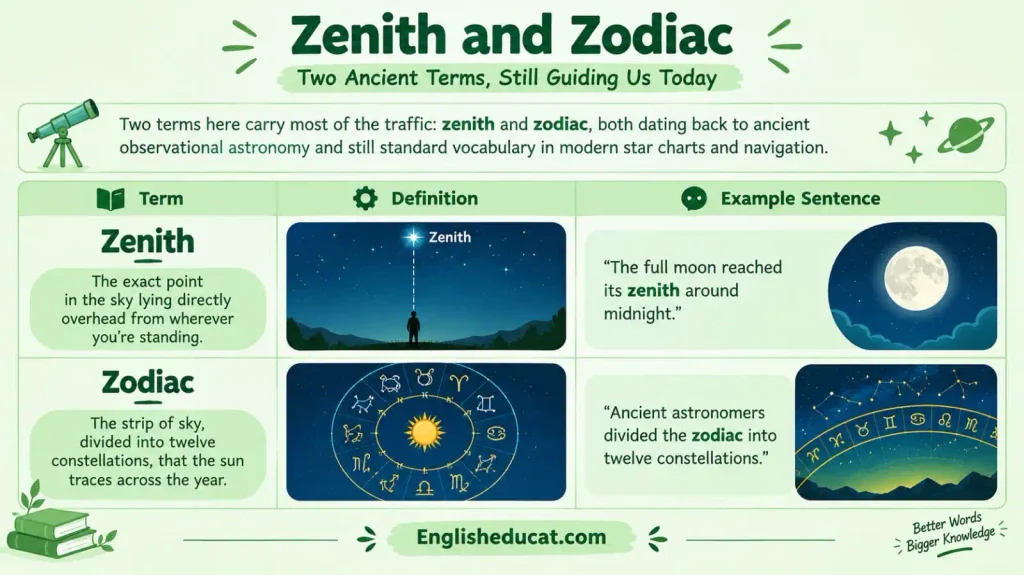
Two terms here carry most of the traffic: zenith and zodiac, both dating back to ancient observational astronomy and still standard vocabulary in modern star charts and navigation.
| Term | Definition | Example Sentence |
| Zenith | The exact point in the sky lying directly overhead from wherever you’re standing | The full moon reached its zenith around midnight. |
| Zodiac | The strip of sky, divided into twelve constellations, that the sun traces across the year | Ancient astronomers divided the zodiac into twelve constellations. |
| Zodiacal Light | A faint glow caused by sunlight scattering off interplanetary dust | Zodiacal light is best seen just after sunset in dark skies. |
| Zero-Age Main Sequence | The stage when a newly formed star settles into stable hydrogen fusion | Our Sun started at the zero-age main sequence billions of years ago. |
| Zenith Angle | The angle measured between the zenith and an object elsewhere in the sky | A low zenith angle means the star is nearly overhead. |
| Zenith Distance | The angular gap between a celestial object and the zenith | Observatories track a star’s zenith distance to plan observations. |
| Zonal Wind | Wind that travels roughly parallel to a planet’s lines of latitude | Jupiter’s zonal winds create its distinctive banded clouds. |
| Zwicky Cluster | A galaxy cluster catalogued by astronomer Fritz Zwicky | Zwicky clusters gave early evidence for dark matter. |
| Zone of Avoidance | The region of sky hidden from view by the Milky Way’s dust and stars | Galaxies hidden in the zone of avoidance are hard to detect. |
| Zenithal Hourly Rate | The predicted number of meteors visible per hour during a shower under ideal conditions | The Perseids can reach a zenithal hourly rate over 100. |
| Zenith Telescope | An instrument built specifically to observe objects passing directly overhead | A zenith telescope precisely measures a star’s overhead position. |
| Zodiacal Cloud | A disk of dust particles orbiting near the Sun’s ecliptic plane | The zodiacal cloud is replenished by comet debris. |
| Zone of Habitability | The orbital range around a star where conditions might allow liquid water to persist | Earth orbits within the Sun’s zone of habitability. |
| Zenith Passage | The moment the sun sits directly overhead at a given location | Tropical regions experience a zenith passage twice yearly. |
| Zone of Totality | The narrow ground path from which a total solar eclipse is visible | Thousands traveled to stand within the zone of totality. |
Earth & Environmental Science Words That Start With Z
Earth science Z-words tend to describe zones, boundaries, and thresholds, a naming pattern that recurs across hydrology, climatology, and glaciology alike.
| Term | Definition | Example Sentence |
| Zephyr | A soft, light wind, traditionally associated with breezes from the west | A cool zephyr drifted across the valley at dusk. |
| Zone of Saturation | The underground layer where every pore and crack in the rock has filled with water | Wells draw water from below the zone of saturation. |
| Zonal Flow | Large-scale atmospheric or oceanic movement that runs along lines of latitude | Zonal flow in the jet stream steers weather eastward. |
| Zone of Aeration | The unsaturated soil layer sitting above the water table | Rainwater percolates through the zone of aeration first. |
| Zeugen | Ridge-shaped rock formations sculpted by wind erosion | Zeugen form when soft rock erodes faster than caprock. |
| Zircon Dating | A radiometric technique that uses zircon crystals to determine a rock’s age | Zircon dating revealed some of Earth’s oldest known minerals. |
| Zoogeomorphology | The study of how animal activity — burrowing, grazing, dam-building — physically reshapes landforms | Zoogeomorphology examines how beavers alter river channels. |
| Zonal Soil | Soil whose properties are shaped mainly by regional climate and vegetation | Zonal soils like chernozem develop under grassland climates. |
| Zonal Climate | A climate classification tied to specific latitude bands | Zonal climate explains why deserts form near 30° latitude. |
| Zero Liquid Discharge | A wastewater strategy in which no liquid waste ever leaves the facility | The plant adopted zero liquid discharge to end water pollution. |
| Zone of Influence | The surrounding area where a pumping well measurably lowers the water table | Overpumping expanded the well’s zone of influence. |
| Zenithal Rainfall | Rainfall driven by intense solar heating when the sun sits nearly overhead | Zenithal rainfall is common in equatorial regions seasonally. |
| Environmental Zoning | Land-use planning that restricts activity in order to protect natural resources | Environmental zoning blocked construction near the wetland. |
| Zooplankton Bloom | A sudden surge in zooplankton numbers, usually tied to available nutrients | A zooplankton bloom followed the spring phytoplankton bloom. |
| Zero-Curtain Effect | A period during permafrost thaw when soil temperature hovers near freezing | The zero-curtain effect can delay soil freezing for weeks. |
| Zone of Ablation | The part of a glacier where more ice melts away than accumulates | The glacier’s zone of ablation has expanded with warming. |
| Zonal Index | A measurement of how strongly west-to-east winds flow through the atmosphere | A high zonal index often means fewer weather disruptions. |
| Zonal Vegetation | Plant communities shaped primarily by a region’s climate | Zonal vegetation shifts from rainforest to grassland as rainfall drops. |
Advanced Science Words Starting With Z
Once you know the basics, these six terms are worth knowing too. They surface in graduate-level coursework and specialized research rather than intro textbooks, which is exactly why they tend to appear in trivia contests and spelling bees; most people simply never encounter them casually.
- Zitterbewegung (Physics): A rapid, oscillatory motion predicted by the Dirac equation for free relativistic electrons; it emerges due to interference between positive and negative-energy quantum states.
- Zeise’s Salt (Chemistry): Discovered in 1827, this compound is widely regarded as the first organometallic complex ever synthesized, with a platinum atom bonded directly to an ethylene molecule.
- Zeta Function Regularization (Physics): A mathematical technique physicists use to assign finite and meaningful values to sums that would otherwise diverge to infinity in quantum field theory.
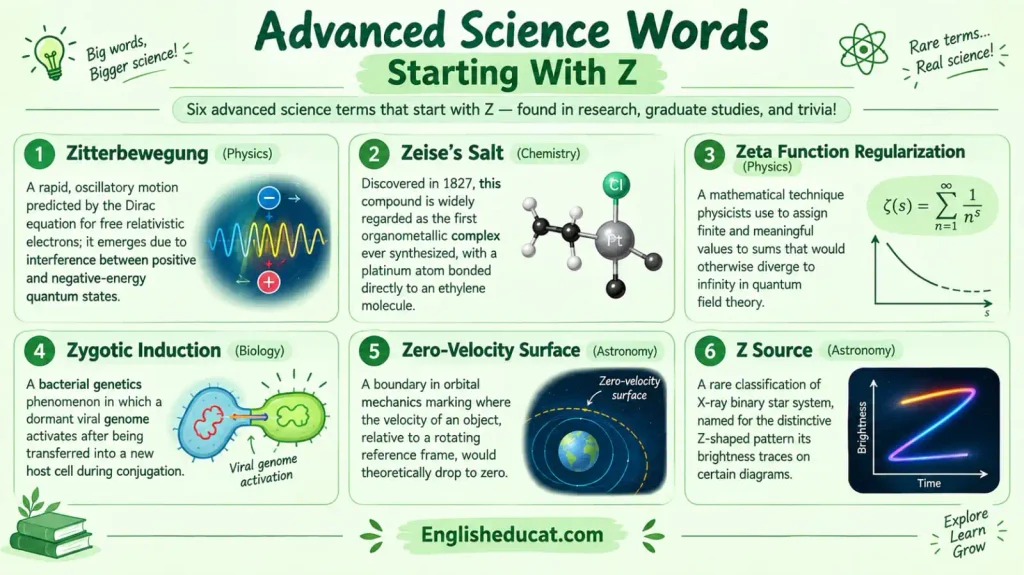
- Zygotic Induction (Biology): A bacterial genetics phenomenon in which a dormant viral genome activates after being transferred into a new host cell during conjugation.
- Zero-Velocity Surface (Astronomy): A boundary in orbital mechanics marking where the velocity of an object, relative to a rotating reference frame, would theoretically drop to zero.
- Z Source (Astronomy): A rare classification of X-ray binary star system, named for the distinctive Z-shaped pattern its brightness traces on certain diagrams.
Frequently Asked Questions
What are some common science words that start with Z?
The most common science words starting with Z are zygote, zoology, zinc, zenith, and zero-point energy. These terms appear across biology, chemistry, physics, and astronomy, and are frequently taught from middle school through college-level science courses.
Is zygote a biology or chemistry term?
Zygote is a biology term. It refers to the single fertilized cell formed when a sperm and egg unite, marking the earliest stage of development in sexually reproducing organisms.
What Z words are used in chemistry?
Common Z chemistry terms include zinc, zeolite, zwitterion, zero-order reaction, and the Ziegler–Natta catalyst. Zinc and zeolite are the two referenced most often in general chemistry courses.
Are there any physics terms that start with Z?
Yes. Physics includes several Z-terms, such as the Zeeman effect, which describes the splitting of spectral lines in a magnetic field, zero-point energy, a quantum system’s lowest possible energy state, and the Z boson, a fundamental particle.
What is the rarest or most advanced science word starting with Z?
Zitterbewegung is among the rarest; it describes a trembling motion predicted for relativistic electrons by the Dirac equation. Other advanced examples include zeta function regularization and zygotic induction.
Why are there so few science words that start with Z?
Z is one of the least-used letters in English, and in the Greek and Latin roots that form most scientific terminology, which limits how many Z-words exist compared to letters like C or S.
Conclusion
Z is not a filler letter in science; it is a shorthand for some of the biggest ideas of different fields. One small word can carry the start of life (zygote), the edge of a glacier (zone of ablation), or the strangest corner of quantum theory (zero-point energy). Two Greek roots quietly built most of this list, yet the result stretches from lab benches to deep space. So the next time someone dismisses Z as the “weak” letter, you will have 120+ reasons ready to prove them wrong. Looking to keep building your science vocabulary? Explore more letter-by-letter guides: Science Words That Start With Y · Science Words That Start With X · Science Words That Start With W.

Senior English Content Editor
Sarah has over 10 years of experience teaching English as a Second Language in Chicago public schools. She specializes in vocabulary building and simplifying complex word meanings for everyday learners. Sarah holds a Master’s degree in English Education from the University of Illinois.