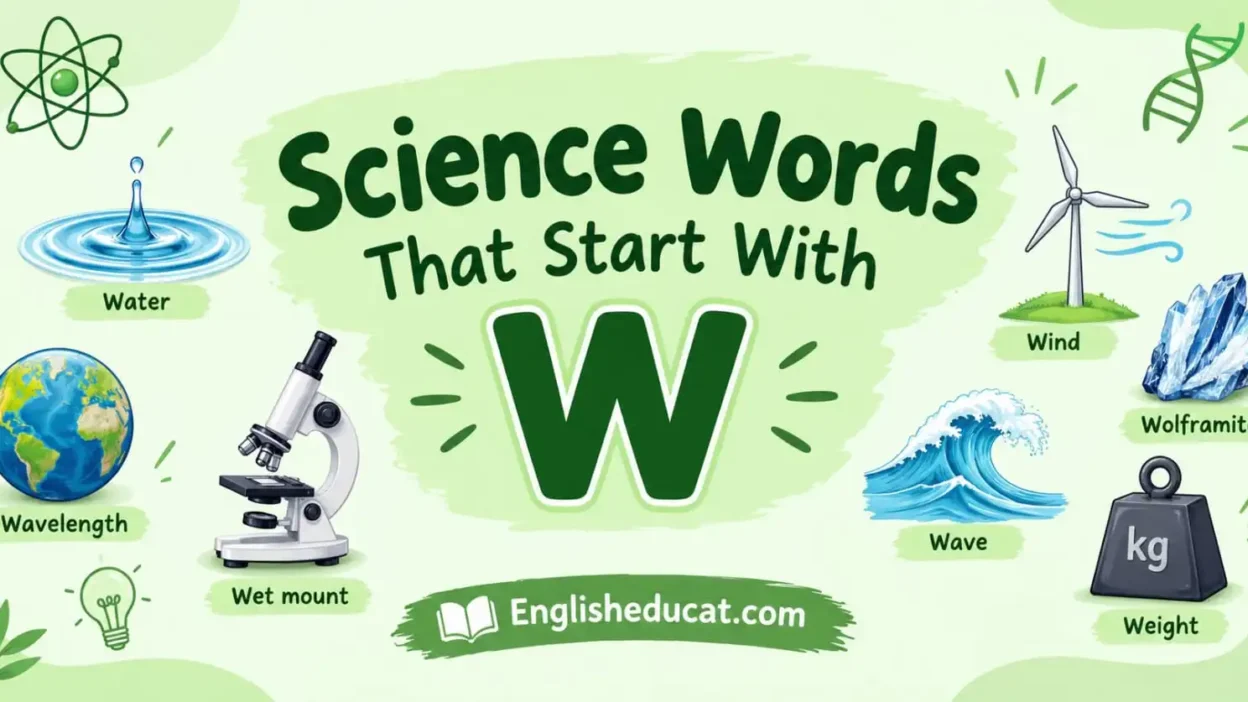
Few letters pull this much scientific weight. Science words that start with W appear in the unit that measures the power running through your walls, in the wavelength that decides what color you are actually seeing, and in the water cycle that keeps every living thing on the planet alive. Ask a biologist, a physicist, and an astronomer which W-word they would pick first, and you will get three completely different answers, proof of how far this one letter reaches.
Below, you will find science words that start with W sorted by branch: biology, chemistry, physics, astronomy, and earth science. Each term includes a plain language definition and real examples, because a word on a list rarely sticks on its own. A bonus round at the end covers rarer, research-level W-terms for readers who want to push past the basics.
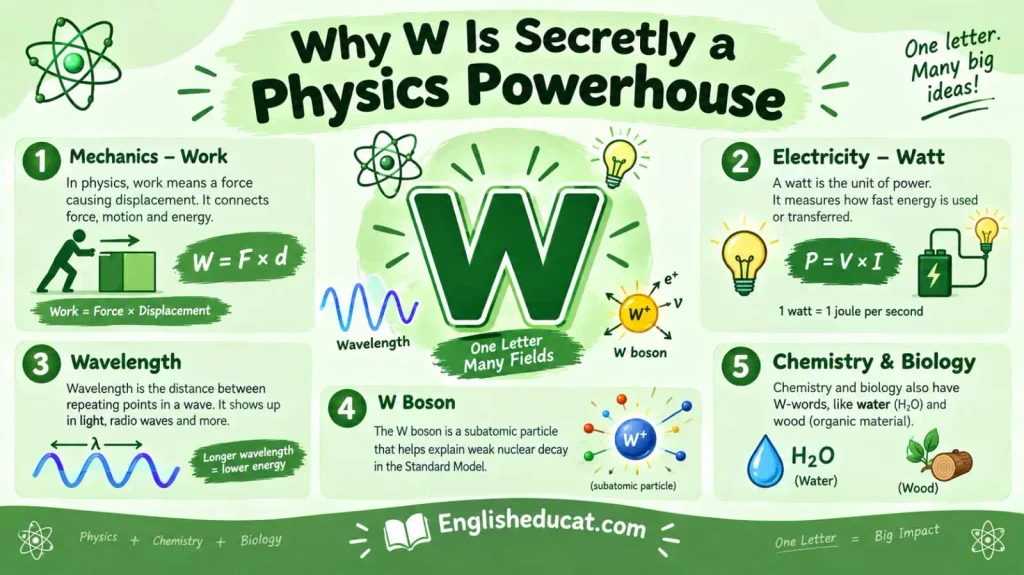
Why W Is Secretly a Physics Powerhouse
Physics has the strongest claim on science words that start with W. Work, watt, wavelength, and the W boson cover an enormous range from a simple push-and-pull force all the way to subatomic particle decay. Chemistry and biology each contribute their share of W-words, sure, but nowhere else does a single letter anchor this many core ideas across mechanics, electricity, and quantum theory at once. A textbook might introduce “watt” in an energy chapter, then bring the same word back months later inside a unit on circuits one term, two jobs. You can also learn other science words.
Biology Words That Start With W
From immune cells to entire ecosystems, vocabulary of W words in Biology covers a surprising range. A handful of these terms, like Watson-Crick base pairing, first appear in high school and then resurface years later in university genetics courses; the underlying concept never really goes away.
Chemistry Words That Start With W
Lab equipment and named reactions dominate the W list of Chemistry, the kind of vocabulary you would meet in an organic chemistry course rather than a general science class. Tungsten’s chemical symbol, W, is a small leftover reminder of how much chemistry terminology traces back to older European naming conventions.
| Term | Definition | Example Sentence |
| Water | Molecule of two hydrogens and one oxygen that dissolves more compounds than any other liquid. | Water dissolves more substances than almost any other liquid known. |
| Weak acid | An acid that lets go of only some of its hydrogen ions in solution. | Vinegar is a common weak acid used in cooking. |
| Weak base | A base that only partly ionizes once it hits water. | Ammonia behaves as a weak base in water. |
| Wolfram | Older European name for tungsten, still preserved in its chemical symbol. | Wolfram is the source of tungsten’s chemical symbol, W. |
| Wetting agent | An additive that cuts a liquid’s surface tension so it spreads instead of beading up. | Detergents contain a wetting agent so water spreads more evenly. |
| Wurtz reaction | A coupling reaction that stitches two alkyl halides into one longer alkane chain. | Chemists use the Wurtz reaction to build symmetrical hydrocarbon chains. |
| Wöhler synthesis | Friedrich Wöhler’s 1828 breakthrough that produced urea without using any living organism. | Wöhler synthesis famously undercut the idea that only living things could make organic compounds. |
| Water bath | A warm-water setup for heating lab samples slowly and evenly. | The enzyme sample sat in a water bath at body temperature. |
| Wash bottle | The squeezable bottle chemists reach for to rinse out glassware. | She rinsed the flask using a wash bottle filled with distilled water. |
| Walden inversion | A flip in a molecule’s 3D arrangement that happens mid-substitution reaction. | Walden inversion flips the molecule’s structure during the reaction step. |
| Wacker process | The industrial route that turns ethylene gas into acetaldehyde using a palladium catalyst. | The Wacker process remains central to acetaldehyde production worldwide. |
| Water softener | A household device that strips calcium and magnesium out of hard water. | A water softener keeps mineral buildup out of household pipes. |
| Wurtzite | A hexagonal crystal arrangement found in minerals such as zinc sulfide. | Certain semiconductor materials form naturally in the wurtzite structure. |
| Wood alcohol | Old-fashioned name for methanol, a simple alcohol that’s toxic if swallowed. | Wood alcohol is far more dangerous to drink than ethanol. |
Physics Words That Start With W
No branch leans on W harder than physics, and it shows the letter anchors units, particles, and entire branches of study all at once. It is also an important science words that start with W. A watt tells you how fast energy moves; a W boson explains why atoms decay the way they do.
| Term | Definition | Example Sentence |
| Watt | The standard unit for how fast energy gets used, equal to one joule every second. | A 60-watt bulb uses more energy each second than a 10-watt one. |
| Work | What physicists call it when a force actually succeeds in moving something. | Pushing a stalled car counts as physical work in science terms. |
| Wave | A traveling disturbance that carries energy along without dragging matter with it. | Sound reaches your ear as a traveling pressure wave. |
| Wavelength | How far apart two neighboring wave peaks sit. | Red light has a longer wavelength than blue light does. |
| Weight | How hard gravity pulls on a given mass. | Your weight on the Moon is roughly one-sixth what it is on Earth. |
| Weak force | The fundamental force responsible for certain kinds of radioactive decay. | The weak force allows a neutron to break down into a proton. |
| Wavefunction | The math that predicts where a quantum particle is likely to turn up. | An electron’s wavefunction shows where it’s most likely to be found. |
| Wave-particle duality | The strange rule that light and matter behave like waves sometimes, particles other times. | Wave-particle duality explains why electrons create interference patterns like light does. |
| Weber | The metric unit magnetic flux gets measured in. | One weber equals the flux that induces a single volt over one second. |
| Work function | The energy threshold an electron needs to escape a solid’s surface. | Metals with a lower work function release electrons more easily. |
| Wattmeter | A meter built specifically to read electrical power in real time. | The wattmeter showed the heater was drawing over a thousand watts. |
| Weightlessness | That falling-forever feeling of experiencing zero apparent gravity. | Astronauts experience weightlessness while orbiting the Earth. |
| Wheatstone bridge | A four-resistor circuit that pins down an unknown resistance with precision. | Engineers rely on a Wheatstone bridge to detect tiny resistance shifts. |
| Wave interference | What happens when two overlapping waves combine into a new one. | Wave interference produces the light and dark bands seen in the classic double-slit experiment. |
| W boson | The particle that carries the weak nuclear force between other particles. | Discovering the W boson confirmed a major prediction of particle physics. |
| Wind tunnel | An enclosed chamber engineers use to watch how air flows around a test object. | A scale-model car goes through a wind tunnel before the real one is ever built. |
Astronomy & Space Science Words That Start With W
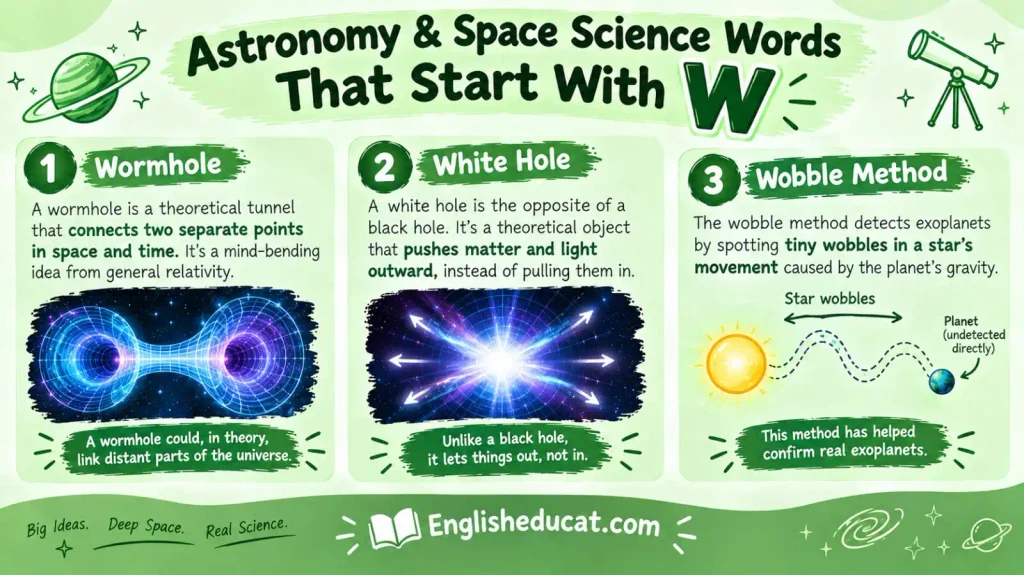
Many of W words of astronomy sound dramatic, and often are: a wormhole and a white hole are both theoretical objects that stretch general relativity to its limits, while the far more grounded wobble method has actually helped astronomers confirm real exoplanets.
| Term | Definition | Example Sentence |
| Wormhole | A hypothetical shortcut linking two far-apart points in spacetime. | A wormhole could, in theory, connect two far-apart galaxies instantly. |
| White dwarf | The compact, burnt-out core a mid-sized star leaves behind. | Our Sun is expected to eventually become a white dwarf. |
| White hole | A theoretical mirror-image of a black hole that spits matter out instead of swallowing it. | A white hole is often described as a black hole running in reverse. |
| Waning moon | The lunar phase where the lit-up portion gets smaller every night. | Night by night, the waning moon grows visibly thinner. |
| Waxing moon | The lunar phase where more of the disk lights up each night. | Each evening brought a slightly brighter waxing moon. |
| Wolf-Rayet star | A short-lived, blisteringly hot star that’s actively blowing off its own outer layers. | A Wolf-Rayet star loses material through powerful stellar winds. |
| WIMP | A leading, still-undetected candidate particle for what dark matter might actually be. | Underground detectors are built specifically to catch a passing WIMP. |
| Wide binary | Two stars locked in a slow orbit around each other from far apart. | This wide binary system takes thousands of years to complete a single orbit. |
| White light | Light that contains every visible wavelength blended together. | A glass prism splits white light into a full rainbow. |
| Wobble method | A planet-hunting technique that spots the tiny gravitational tug a planet has on its star. | Astronomers first confirmed several exoplanets using the wobble method. |
| Widmanstätten pattern | A crisscrossed crystal pattern that only forms inside slow-cooled iron meteorites. | Cut open an iron meteorite, and you might reveal a Widmanstätten pattern. |
| Wide-field telescope | A telescope built to photograph huge swaths of sky in a single exposure. | One wide-field telescope can survey thousands of galaxies in a single night. |
Earth & Environmental Science Words That Start With W
You can actually observe most of Earth science words that start with W in action: weather changing overnight, a watershed collecting rain into one river, a wildfire spreading across dry hills. These terms also appear constantly in news coverage of climate and conservation.
| Term | Definition | Example Sentence |
| Weather | What the atmosphere is doing right now — temperature, wind, rain, all of it. | Within a single afternoon, the weather flipped from sunny to stormy. |
| Weathering | The slow physical or chemical breakdown of rock exposed to the elements. | Weathering over millions of years carved the canyon’s steep walls. |
| Water cycle | The nonstop loop water travels through as it moves between ocean, sky, and land. | Ocean moisture travels inland as rain clouds thanks to the water cycle. |
| Watershed | A stretch of land where all the rainfall drains toward one shared river or lake. | Everything upstream in this watershed eventually reaches the same river. |
| Water table | The underground boundary marking where soil switches from damp to fully saturated. | Two years of drought left the water table noticeably lower. |
| Westerlies | The steady mid-latitude winds that blow from west to east. | Sailing ships historically relied on the westerlies to cross the Atlantic. |
| Wildfire | A fast-moving, unplanned fire tearing through dry brush or forest. | Thousands of acres of dry forest burned in the wildfire. |
| Wetland | A soggy ecosystem where standing or slow-moving water sticks around most of the year. | Dozens of migrating bird species shelter in this wetland each spring. |
| Wind erosion | Soil and sediment loss caused entirely by moving air, not water. | Wind erosion stripped away the exposed farmland’s topsoil. |
| Water pollution | Harmful substances working their way into rivers, lakes, or oceans. | Factory runoff caused serious water pollution downstream. |
| Wastewater | Used, dirty water on its way out of a home or factory. | Before it reaches the river again, wastewater passes through the treatment plant’s filters. |
| Wind chill | How much colder moving air makes bare skin feel, beyond the actual temperature. | Factor in the wind chill, and the air feels far colder than the thermometer admits. |
| Water vapor | Water floating around as an invisible gas in the air. | Rising water vapor eventually cools and condenses into clouds. |
| Wind shear | An abrupt shift in wind speed or direction across a short stretch of sky. | Wind shear near the runway made the landing especially rough. |
| Windward | Whichever side of a hill or coast catches the wind head-on. | Rain falls heaviest on the windward side of the mountain range. |
| Windbreak | A planted line of trees or shrubs meant to cut wind speed at ground level. | Farmers planted a windbreak to protect the young crops from strong gusts. |
Advanced W-Words (Bonus Section)
These terms rarely surface outside upper-level coursework or research papers, but they are worth knowing if you are headed into a science-heavy degree or you just enjoy collecting genuinely obscure vocabulary.
Why Learn Science words that start with W?
Memorizing a word list only matters if it changes what you can actually read. Someone who knows what a watt is can look at an appliance label and understand it instantly; someone who recognizes “watershed” can follow a local flood story on the news without stumbling over the jargon.
Science words that start with W happen to be a particularly rewarding letter to study because it touches nearly every branch of science at once. Learn a dozen W-words in one sitting, and you will walk away with something from physics, something from biology, and something from earth science, all at the same time. That kind of cross-disciplinary exposure builds intuition faster than working through an isolated list from a single subject ever could.
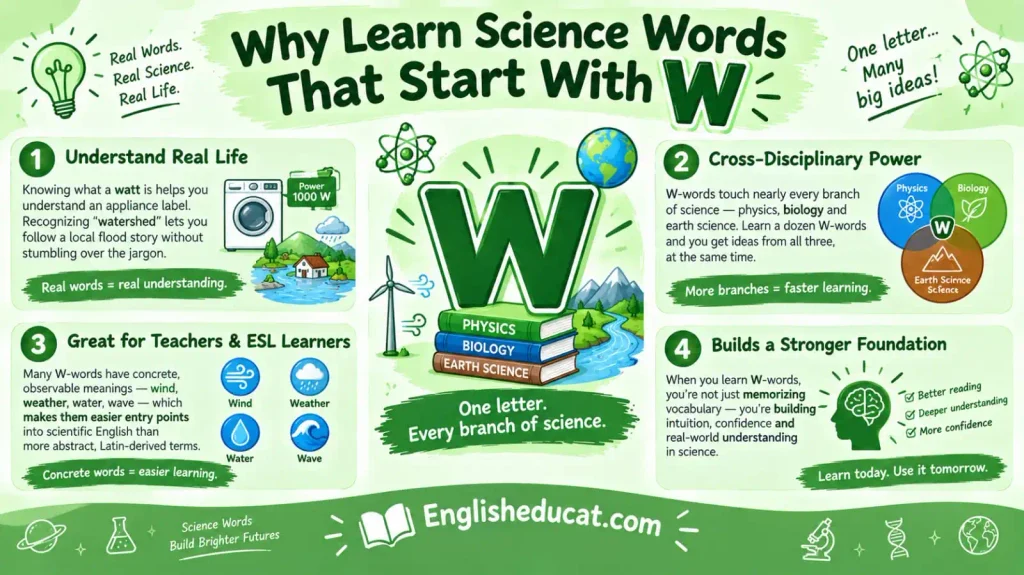
For teachers and ESL learners, W-words also carry a bonus: many have concrete, observable meanings wind, weather, water, wave which makes them easier entry points into scientific English than more abstract, Latin-derived terms.
Frequently Asked Questions
What are some science words that start with W?
Common science words starting with W include water, wave, watt, wavelength, weather, wildlife, and the water cycle. These terms span physics, biology, earth science, and chemistry, making W one of the more cross-disciplinary letters in scientific vocabulary.
What does W stand for in science?
In science, W most often stands for watt, the SI unit of power, or work, a core physics concept. In chemistry, W is also the chemical symbol for tungsten, derived from its older name, Wolfram.
Is there a science word for every letter, including W?
Yes. Every letter of the alphabet has multiple associated scientific terms across biology, chemistry, physics, astronomy, and earth science, and W is no exception; it’s actually one of the richer letters for physics vocabulary specifically.
What is a hard science word that starts with W?
Advanced W-words include wavefunction, the Wittig reaction, and the Warburg effect, terms typically introduced in university-level science courses rather than in introductory classes.
What is a science word starting with W for kids?
Simple, kid-friendly W science words include water, wind, weather, wave, and worm. These are concrete, everyday terms that young learners can observe directly, which makes them easier to teach than abstract vocabulary.
How many science words start with the letter W?
There are well over 80 well-documented science words starting with W across the major branches of science, ranging from basic terms like water to specialized ones like the Weissenberg effect.
Conclusion
W rarely gets called the most exciting letter in the alphabet, yet it earns its place in science more than most. It measures the power running through your walls, describes the color of the sky, names a particle physicists spent decades chasing, and appears in the weather report you check every morning without a second thought. Not many letters manage to feel this ordinary and this extraordinary at once.
Whether you are cramming for a biology exam, building a lesson plan, or hunting for a solid word to drop into a crossword, the list above should get you there, and now you will know exactly where each term belongs the next time it comes up.

Senior English Content Editor
Sarah has over 10 years of experience teaching English as a Second Language in Chicago public schools. She specializes in vocabulary building and simplifying complex word meanings for everyday learners. Sarah holds a Master’s degree in English Education from the University of Illinois.