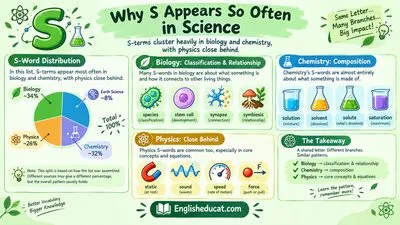

Open almost any science textbook and the letter T appears constantly in the forces that hold bridges together, the processes that keep cells alive, and the storms that reshape coastlines overnight. This collection of science words that start with T pulls together 128 terms from five branches of science, each explained in plain language and paired with an example sentence so you can see the word doing actual work, not just sitting in a glossary.
Maybe you are a student cramming for a biology exam, a teacher building out a vocabulary unit, or someone who enjoys collecting unusual words for trivia night. Either way, this list will be helpful for you. Terms are grouped by subject: Biology, Chemistry, Physics, Astronomy, and Earth & Environmental Science, with a bonus section near the end covering rarer, more advanced vocabulary that rarely makes it into beginner glossaries. Scroll through the whole thing or jump straight to the branch you need; either way, you will come away knowing far more science words that start with T than the average glossary offers. You must also learn other science words.
Why the Letter T Matters in Science Vocabulary
So many science words that start with T feel foundational rather than obscure, and there is a linguistic reason for that. A cluster of Latin and Greek roots tied to stretching, turning, heat, and time all start with tendere (to stretch), tropos (turning), thermos (heat), tempus (time). Those four roots alone quietly seeded many of terms across unrelated fields: tension and torsion in physics, tropism in biology, thermodynamics in chemistry, and temperate in earth science all descend from the same small set of ancestors.
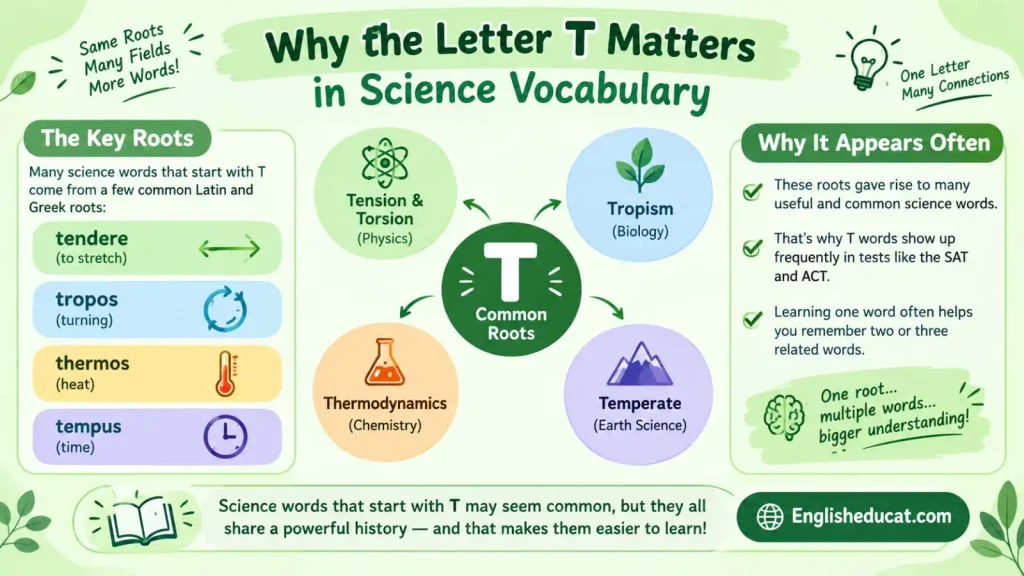
That shared ancestry is probably why science words that start with T appear so often on vocabulary tests and exams like the SAT and ACT. They are rarely niche. Learning one often hands you a shortcut into two or three related words you had not studied yet, since the roots keep repeating themselves across disciplines.
A Quick Hook: Why T Is Physics Favorite Letter
Here is something most vocabulary lists never point out: physics and chemistry are the two densest branches for T, each contributing 25 terms to this collection. That is not a coincidence. A striking number of foundational units and forces in classical mechanics trace back to that same root: tendere, torque, tension, tesla, torr, tensile strength, and terminal velocity all owe something to the idea of stretching or pulling. When a physicist says something is “under tension” or “resisting torsion,” they are leaning on a two thousand years old idea that just happened to keep its opening letter intact. Of every branch covered here, physics is where the letter T carries the most linguistic weight.
Biology Words That Start With T
T vocabulary of Biology splits roughly into three clusters: how organisms are classified and built, how genetic material gets copied and used, and how living things behave within their environments. Medical students pick up several of these terms in their first year of anatomy; tendon, thymus, trachea, and testis show up early precisely because so much of human anatomy vocabulary has Latin roots.
| Term | Definition | Example Sentence |
| Taxonomy | The system biologists use to sort living things into ranked groups, from broad kingdoms down to individual species. | Taxonomy helps biologists organize species by shared traits. |
| Tissue | A cluster of similarly built cells working together toward one job in the body. | Muscle tissue contracts to produce movement in the body. |
| Transpiration | The steady release of water vapor out through a plant’s leaf surfaces. | Transpiration pulls water up from the roots to the leaves. |
| Trait | A physical or behavioral feature passed down genetically from a parent. | Eye color is a trait determined by multiple genes. |
| Trophic level | A rung on the food-chain ladder, marking how far an organism sits from the original energy source. | Herbivores occupy the second trophic level in most ecosystems. |
| Tropism | A plant’s tendency to grow toward or away from an outside trigger like light or gravity. | Phototropism causes stems to bend toward sunlight. |
| Tendon | Tough, cord-like tissue that anchors a muscle to a bone. | The Achilles tendon links the calf muscle to the heel bone. |
| Thymus | A small gland behind the breastbone that trains immune cells during early life. | The thymus produces T-cells during childhood development. |
| Thyroid | A butterfly-shaped gland in the neck that sets the body’s metabolic pace through hormones. | An underactive thyroid can slow a person’s metabolism. |
| Transcription | The step where a cell copies a DNA segment into a matching strand of RNA. | Transcription occurs in the nucleus before protein synthesis begins. |
| Translation | The stage where ribosomes read RNA and assemble the amino acids into a protein. | Ribosomes carry out translation by reading messenger RNA. |
| Telomere | A protective sleeve of repeated DNA sequence sitting at each chromosome’s tip. | Telomeres shorten slightly every time a cell divides. |
| Taxon | A single named unit within any level of biological classification. | Genus and species are both examples of a taxon. |
| Taproot | A single, thick root that grows straight down and stores much of a plant’s energy. | Carrots grow as a swollen, edible taproot underground. |
| Trachea | The windpipe connecting the throat to the lungs. | Food occasionally enters the trachea, triggering a cough reflex. |
| Trilobite | An armored sea-dwelling arthropod, now extinct, that fills much of the early fossil record. | Trilobites went extinct roughly 250 million years ago. |
| Tumor | A lump of tissue that forms when cells multiply without the usual controls. | Not every tumor found on a scan is cancerous. |
| Turgor pressure | The push of water against a plant cell’s wall that keeps stems and leaves rigid. | Turgor pressure loss causes a wilting houseplant to droop. |
| Testis | The male organ responsible for producing sperm and testosterone. | Each testis produces sperm and testosterone continuously after puberty. |
| Trophoblast | The outer shell of cells on an early embryo, later forming part of the placenta. | The trophoblast eventually develops into the placenta. |
| Taxis | An organism’s automatic movement toward or away from a stimulus, such as light or chemicals. | Phototaxis draws certain insects directly toward a light source. |
| Trematode | A parasitic flatworm that lives inside another animal’s body. | A trematode called a liver fluke can infect livestock. |
| Thorax | The middle section of an insect’s body, or the chest region in vertebrates. | An insect’s wings and legs attach to its thorax. |
| Tetrapod | Any vertebrate built with four limbs, including their descendants that later lost some. | Amphibians were among the first tetrapods to walk on land. |
| Trypsin | A pancreatic enzyme that breaks dietary protein down into smaller pieces. | Trypsin becomes active only after leaving the pancreas. |
Chemistry Words That Start With T
T words of chemistry fall into three familiar buckets: elements and isotopes sitting on the periodic table, the reactions that rearrange matter, and the properties chemists measure by hand in a lab. A few of these titration and titer, among them describe procedures undergraduate students actually perform at a bench, which is probably why these particular science words that start with T tend to stay memorable long after the course ends.
| Term | Definition | Example Sentence |
| Titration | A stepwise lab technique for figuring out exactly how concentrated an unknown solution is. | Chemists use titration to measure the acidity of vinegar. |
| Titrant | The precisely measured solution added drop by drop during a titration. | The titrant is added drop by drop until the reaction is complete. |
| Thermochemistry | The branch of chemistry focused on how much heat a reaction releases or absorbs. | Thermochemistry explains why some reactions release heat as they occur. |
| Transition metal | Any of the metallic elements occupying the periodic table’s central block. | Iron and copper are common transition metals. |
| Tautomerism | A molecule’s ability to flip back and forth between two closely related structural arrangements. | Tautomerism allows glucose to shift between two ring structures. |
| Thermoplastic | A plastic that turns soft under heat and firms back up once it cools. | Recycling plants can remelt thermoplastic into new products. |
| Thermosetting polymer | A plastic that hardens irreversibly the first time it’s heated, then can’t be reshaped. | Thermosetting polymers are used in heat-resistant cookware handles. |
| Tungsten | A dense, gray metal that holds the record for the highest melting point of any element. | Tungsten filaments once glowed inside incandescent light bulbs. |
| Tritium | A radioactive hydrogen variant carrying two extra neutrons in its nucleus. | Tritium is used in some nuclear fusion research. |
| Thorium | A radioactive element sometimes proposed as a lower-risk alternative fuel for nuclear reactors. | Some reactor designs use thorium instead of uranium. |
| Toluene | A clear, sharp-smelling solvent commonly found in paint thinner. | Toluene is added to gasoline to boost octane rating. |
| Tarnish | The dull film that forms on a metal’s surface after reacting with air or other chemicals. | Silver jewelry can tarnish when exposed to sulfur compounds. |
| Trace element | A nutrient an organism needs only in extremely small quantities to function normally. | Zinc is a trace element essential for enzyme function. |
| Transmutation | The rare transformation of one chemical element into a completely different one. | Radioactive decay causes the natural transmutation of uranium into lead. |
| Tetrahedron | A four-sided molecular shape built from triangular faces meeting at a point. | A methane molecule has a tetrahedron shape around its carbon atom. |
| Tellurium | A brittle, silvery metalloid used in certain photovoltaic cells. | Tellurium is combined with cadmium in some solar cell designs. |
| Terbium | A rare earth metal prized for the green glow it produces in phosphor coatings. | Terbium compounds glow green under ultraviolet light. |
| Thallium | A highly toxic heavy metal historically used as a pesticide against rodents. | Thallium poisoning can cause hair loss and nerve damage. |
| Tantalum | A metal resistant to corrosion, widely used inside electronics and medical implants. | Tantalum capacitors appear inside most modern smartphones. |
| Thermite reaction | An intensely hot chemical reaction between a metal and a metal oxide, releasing molten iron. | A thermite reaction can melt through steel rail track. |
| Triple bond | A strong chemical bond built from three shared electron pairs between two atoms. | Nitrogen gas molecules are held together by a strong triple bond. |
| Thermal decomposition | The splitting apart of a compound purely from applied heat, without another chemical reacting. | Thermal decomposition of limestone produces lime and carbon dioxide. |
| Tetravalent | Describing an atom capable of forming exactly four chemical bonds. | Carbon is tetravalent, allowing it to form four chemical bonds. |
| Titer | A lab reading of how concentrated a particular substance is within a sample. | Doctors check antibody titer levels after a vaccination. |
| Turbidity | The cloudy, hazy look a liquid takes on when fine particles are suspended throughout it. | High turbidity in a lake can block sunlight from reaching plants. |
Physics Words That Start With T
If any branch can claim the letter T as its own, it is physics. These terms describe how matter behaves under stress, heat, and motion, forces, waves, and energy on the move. Engineers reach for many of these constantly: a bridge designer thinks in terms of tensile strength and torsion every day, while an electrical engineer treats tesla and transformer as ordinary shop-floor vocabulary.
| Term | Definition | Example Sentence |
| Torque | The twisting effort applied to something so it turns around a fixed point. | Turning a wrench applies torque to loosen a bolt. |
| Tension | A pulling force running through something like a rope, cable, or muscle fiber. | Tension in the climbing rope kept the climber secure. |
| Thermodynamics | The physics of how heat moves and converts into other forms of energy. | The laws of thermodynamics govern how engines convert fuel to motion. |
| Terminal velocity | The fastest speed a falling object can reach once air resistance cancels out further acceleration. | A skydiver reaches terminal velocity before opening the parachute. |
| Trajectory | The arcing route a moving object traces from launch to landing. | Engineers calculate a rocket’s trajectory before every launch. |
| Turbulence | Rough, unpredictable swirling within a moving fluid or gas. | Turbulence at high altitude can shake an airplane cabin. |
| Transverse wave | A wave whose particles vibrate side to side, perpendicular to the wave’s own travel direction. | Light travels through space as a transverse wave. |
| Time dilation | The stretching-out of time experienced near strong gravity or at very high speed. | Time dilation means astronauts age slightly slower than people on Earth. |
| Total internal reflection | A phenomenon where light striking a boundary at a steep enough angle bounces back entirely rather than passing through. | Total internal reflection lets fiber optic cables carry data over long distances. |
| Tensile strength | The maximum pulling force a material can withstand before it snaps. | Steel cables need high tensile strength to support suspension bridges. |
| Tesla | The standard unit scientists use to express the strength of a magnetic field. | An MRI machine typically operates between 1.5 and 3 tesla. |
| Tachyon | A theoretical particle that, if it existed, would travel faster than light. | No experiment has ever confirmed that a tachyon exists. |
| Torsion | The strain a material experiences when one end is twisted relative to the other. | Torsion in a metal rod can eventually cause it to fracture. |
| Thermal expansion | The tendency of a material to grow slightly larger as its temperature rises. | Thermal expansion is why railway tracks include small gaps. |
| Thermal conductivity | How efficiently a given material passes heat through itself. | Copper’s high thermal conductivity makes it useful in cooking pans. |
| Thermal equilibrium | The point at which two touching objects settle at an identical temperature. | A hot drink cools toward thermal equilibrium with the surrounding air. |
| Transformer | An electrical device that steps voltage up or down as current passes through it. | A transformer on the power line reduces voltage before it enters homes. |
| Thermocouple | A temperature sensor built from two different metals joined at one end. | Ovens often use a thermocouple to regulate internal temperature. |
| Trough | The lowest dip in a repeating wave pattern. | The trough of a sound wave corresponds to lower air pressure. |
| Thermistor | A component whose electrical resistance shifts in a predictable way as temperature changes. | Digital thermometers rely on a thermistor to detect body heat. |
| Torr | A pressure unit roughly equal to the push exerted by one millimeter of mercury. | Vacuum chambers are often measured in torr rather than atmospheres. |
| Tangential velocity | How fast a point is moving along the curve of a circular path at any instant. | A point on a spinning wheel’s rim has higher tangential velocity than one near the center. |
| Thin-film interference | The rainbow-like color banding that appears when light bounces between the surfaces of an extremely thin layer. | Thin-film interference explains the rainbow colors seen in soap bubbles. |
| Thermal radiation | Heat energy given off by an object as invisible electromagnetic waves. | A campfire warms nearby skin mostly through thermal radiation. |
| Terminal impedance | The opposition a circuit’s output presents to the flow of current. | Mismatched terminal impedance can cause signal loss in audio cables. |
Astronomy & Space Words That Start With T
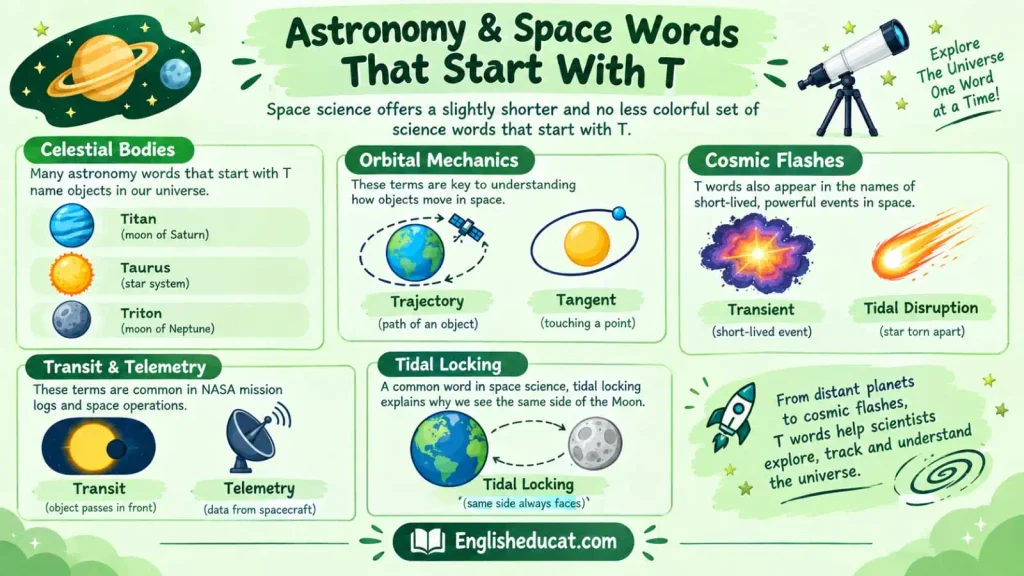
Space science offers a slightly shorter and no less colorful set of science words that start with T. These terms include celestial bodies, orbital mechanics, and the short-lived cosmic flashes astronomers rush to catch before they fade. Several transit, telemetry, and tidal locking appear in NASA mission logs as everyday working vocabulary rather than specialist jargon.
| Term | Definition | Example Sentence |
| Telescope | An instrument built to gather and magnify light arriving from distant objects in space. | The Hubble Space Telescope has photographed galaxies billions of light-years away. |
| Terrestrial planet | A relatively small, rocky world orbiting close to its star. | Mars is a terrestrial planet with a thin, cold atmosphere. |
| Transit | The moment a smaller body crosses directly in front of a larger one as seen from an observer. | Astronomers detect distant exoplanets by observing a transit dimming starlight. |
| Titan | Saturn’s largest moon, notable for its surface lakes of liquid methane. | Titan is the only moon in the solar system with a thick atmosphere. |
| Tidal locking | A gravitational effect that forces an orbiting body to keep the same side permanently facing its parent. | Tidal locking is why we only ever see one side of the Moon. |
| Terminator | The moving line separating a planet’s daylight side from its night side. | Photographers often capture the Moon near its terminator to highlight crater shadows. |
| Trojan asteroid | An asteroid trapped in a stable pocket of a planet’s orbit by combined gravitational pull. | Jupiter’s Trojan asteroids cluster far ahead of and behind the planet. |
| T Tauri star | A newly forming star still shrinking under gravity, not yet stable enough to sustain fusion. | A T Tauri star can vary in brightness as it continues forming. |
| Transient | Any astronomical event that flares up and disappears relatively quickly. | A supernova is one of the most dramatic transients astronomers observe. |
| Tail (comet) | The trail of gas and dust a comet sheds as solar heat and wind strip material from it. | A comet’s tail always points away from the Sun, regardless of travel direction. |
| Termination shock | The region where the outward-rushing solar wind suddenly loses speed against interstellar gas. | Voyager 1 crossed the termination shock in 2004. |
| Tropical year | The span it takes Earth to run through one complete cycle of seasons. | A tropical year is slightly shorter than the time Earth takes to return to the same stars. |
| Totality | The brief window during a total eclipse when one body is fully blocked from view. | Observers along the path of totality briefly saw the Sun’s corona. |
| Tidal force | An uneven gravitational pull strong enough to stretch or distort an object. | Extreme tidal force near a black hole can stretch matter apart. |
| Telemetry | Data sent automatically back from a distant spacecraft to mission controllers on Earth. | Mission control monitors a spacecraft’s health through continuous telemetry. |
| Thermosphere | The high atmospheric band where temperature climbs sharply the further up you go. | The International Space Station orbits within Earth’s thermosphere. |
| Trans-Neptunian object | Any small body circling the Sun at a distance greater than Neptune’s orbit. | Pluto is classified as a trans-Neptunian object. |
| Twin paradox | A relativity puzzle in which one twin who travels near light speed ages more slowly than the twin left behind. | The twin paradox illustrates how high-speed travel affects the passage of time. |
| Type Ia supernova | A predictable class of stellar explosion astronomers use as a reliable cosmic distance marker. | Astronomers used a Type Ia supernova to help measure the universe’s expansion rate. |
| Twilight zone (planetary) | The permanent border strip between a locked planet’s endless day and endless night. | A tidally locked exoplanet close to its star may have a permanent twilight zone. |
Earth & Environmental Science Words That Start With T
T words of Earth Science capture the planet mid-motion: plates shifting underfoot, storms spinning up overhead, tides rising and falling on schedule. A handful of these appear constantly in disaster coverage (tsunami, tornado, tropical cyclone), which makes this branch one of the more instantly familiar sets of science words that start with T, even for readers who never took an earth science class.
| Term | Definition | Example Sentence |
| Tectonic plate | One of the massive rock slabs making up Earth’s crust, drifting slowly over geologic time. | Tectonic plate collisions can push up new mountain ranges. |
| Tsunami | A towering ocean wave set off by a sudden shift in the seafloor, typically from an earthquake. | A tsunami can travel across an entire ocean basin within hours. |
| Troposphere | The bottommost slice of the atmosphere, where nearly all weather forms. | Nearly all clouds and storms form within the troposphere. |
| Tundra | A treeless, frigid biome sitting atop soil that stays frozen year-round. | Mosses and lichens dominate the sparse vegetation of the tundra. |
| Topography | The overall shape of the land its hills, valleys, and elevation changes. | Topography maps use contour lines to show changes in elevation. |
| Thermocline | A band within a body of water where temperature drops off sharply with depth. | Sound waves bend unpredictably when they cross a thermocline. |
| Turbidity current | A fast underwater avalanche of sediment-heavy water rushing down a slope. | A turbidity current can carve deep canyons into the ocean floor. |
| Talus | A pile of broken rock fragments accumulating at the foot of a steep slope or cliff. | Hikers often scramble across loose talus near steep mountain trails. |
| Taiga | A vast, cold forest biome dominated by cone-bearing evergreen trees. | The taiga stretches across much of northern Russia and Canada. |
| Trade winds | Consistent winds that blow from east to west across the tropics. | Sailing ships once relied on the trade winds to cross the Atlantic. |
| Tropopause | The thin dividing layer separating the troposphere from the stratosphere above it. | Commercial jets often cruise just below the tropopause. |
| Topsoil | The fertile top layer of soil where most plant roots and nutrients concentrate. | Erosion can strip away topsoil needed for healthy crop growth. |
| Tremor | A slight, localized shaking of the ground caused by shifting rock underground. | A minor tremor sometimes precedes a larger earthquake. |
| Tornado | A tightly spinning funnel of air dropping down from a severe thunderstorm. | A tornado can level buildings within seconds of touching down. |
| Tropical cyclone | A large, rotating storm system fueled by warm ocean water. | A tropical cyclone weakens quickly after moving over land. |
| Tidal range | The vertical gap between a coastline’s high tide and its following low tide. | The Bay of Fundy has one of the largest tidal ranges on Earth. |
| Till | A jumbled mix of rock and debris a glacier drops as it melts or retreats. | Farmers in parts of the Midwest plow through soil formed from glacial till. |
| Tephra | Rock and ash fragments hurled into the air during a volcanic eruption. | Falling tephra can blanket towns for miles around an erupting volcano. |
| Thermal vent | A crack in the seafloor releasing mineral-rich water heated far below. | Unique ecosystems thrive in total darkness near a thermal vent. |
| Terrane | A chunk of crust that formed elsewhere and later fused onto a larger landmass, carrying its own separate history. | Geologists identified an accreted terrane along the Pacific coast. |
| Temperate zone | The mild climate band sitting between the tropics and the polar regions. | Most of the continental United States lies within the temperate zone. |
| Tidal wetland | A shoreline habitat that floods and drains twice daily with the tides. | A tidal wetland filters pollutants before water reaches the open ocean. |
| Thermohaline circulation | The planet-spanning ocean current system driven by differences in water temperature and salt content. | Thermohaline circulation helps redistribute heat around the planet. |
| Trench (oceanic) | A long, steep-sided gouge cut into the deep ocean floor. | The Mariana Trench is the deepest known point in any ocean. |
| Tide pool | A small rocky basin left brimming with seawater and marine life once the tide pulls back. | A tide pool often shelters small crabs, anemones, and snails. |
Advanced & Rare Science Words Starting With T
Beyond the fundamentals sits a smaller set of science words that start with T that rarely surface in beginner glossaries but matter a great deal in specialized fields, competitive word games, and trivia circles. These eight terms reach into paleontology, engineering, physics, and even animal behavior. The following are the words that are rare and advanced in science:
| Term | Definition | Example Sentence |
| Taphonomy | The study of what happens to an organism’s remains between death and fossilization. | Taphonomy helps paleontologists understand which conditions preserve ancient life. |
| Thermoluminescence | A dating method that measures light released from a heated mineral to estimate its age. | Thermoluminescence dating helped researchers estimate when ancient pottery was last fired. |
| Tautochrone | A curved path down which an object always takes the same amount of time to reach the bottom, no matter its starting point. | The cycloid is the classic example of a tautochrone curve. |
| Thigmotropism | A plant’s directional growth response triggered by physical contact. | Thigmotropism allows a pea plant’s tendril to coil around a fence wire. |
| Tribology | The engineering discipline focused on friction, wear, and lubrication between moving surfaces. | Tribology research helps engineers design longer-lasting engine bearings. |
| Tokamak | A ring-shaped chamber that uses powerful magnetic fields to contain superheated fusion plasma. | Scientists hope a working tokamak can someday generate clean fusion energy. |
| Thanatosis | A survival tactic where an animal goes limp and appears dead to discourage a predator. | Thanatosis lets an opossum avoid predators by appearing lifeless. |
| Tympanic resonance | The hollow, drum-like sound produced when a gas-filled body cavity is tapped during examination. | Doctors listen for tympanic resonance when checking for excess gas in the abdomen. |
Why Learn Science Words That Start With T?
Memorizing a themed list of 128 terms might seem excessive when vocabulary tends to sink in naturally through class and reading. Still, a few practical reasons make this particular exercise worth the effort.
Standardized tests reward exactly this kind of prep. Reading passages on the SAT, ACT, and GRE draw heavily from physical science and biology, so a solid base of science words that start with T means fewer unfamiliar terms slowing down a passage mid-read. Teachers and homeschool parents also gravitate toward letter-themed units for a practical reason: a single week spent on T-words can touch five different subjects biology, chemistry, physics, astronomy, earth science without ever feeling repetitive to a student.

Trivia formats lean on science categories constantly, too, and knowing a term like tribology or thanatosis can genuinely separate a strong player from one relying on general knowledge alone. There is a quieter payoff as well: studying science words that start with T in clusters builds pattern recognition. Once thermo- clicks as “heat” and trans- clicks as “across” or “beyond,” unfamiliar science vocabulary outside this list starts decoding itself.
Frequently Asked Questions
What are some science words that start with T?
Frequently cited science words that start with T include torque, taxonomy, tectonic plate, thermodynamics, and tsunami terms drawn from physics, biology, geology, and earth science. Transcription in genetics, transit in astronomy, and titration in chemistry are three more that come up often in coursework.
How many science words start with the letter T?
This collection totals 128 science words that start with T, split across five branches: Biology (25), Chemistry (25), Physics (25), Astronomy (20), and Earth & Environmental Science (25), plus 8 advanced or rare bonus terms for readers who want to go further.
What is the most important science word that starts with T?
No single term wins outright, since “important” depends on the field, but thermodynamics is a strong candidate because it underlies energy transfer across physics, chemistry, and engineering alike. In biology, taxonomy plays a comparably foundational role.
What are some biology words that start with T?
Taxonomy, tissue, transcription, translation, and trophic level rank among the most commonly taught biology terms starting with T, covering classification, genetics, and ecology. Tendon and thyroid show up early in most human anatomy courses as well.
What are some physics words that start with T?
Torque, tension, thermodynamics, terminal velocity, and tesla, the unit used to measure magnetic field strength, are among the most common physics terms starting with T. Physics supplies more T-words to this list than any other branch.
What is a rare or advanced science word that starts with T?
Tribology (the study of friction and wear), tokamak (a magnetic fusion-reactor design), and thanatosis (an animal’s defensive “playing dead” reflex) all qualify as advanced science words that start with T, and none of the three tends to appear in beginner vocabulary lists.
Conclusion
Somewhere between the classroom and the cosmos, the letter T built itself into one of the most versatile tools of science. It stretches across a telomere of cells and hums through a spacecraft’s telemetry feed. It twists a torqued bolt and spins up a tornado’s funnel. It cools inside a thermocline and flares white-hot in a thermite reaction. Few letters reach that far from structures too small to see without a microscope to storms visible from orbit.
Having made it through all 128 entries, you now carry more science words that start with T in your head than most people pick up in a full year of casual reading. Bookmark the list, tackle one branch a week, or challenge a friend to see who remembers more of the advanced section by Friday. Whether the goal is acing an exam, winning trivia night, or simply feeding a curious mind, this collection of science words that start with T rewards repeat visits far more than a single read-through. Vocabulary like this does not just fill blanks on a worksheet; it hands you a sharper lens for spotting the science already at work all around you.

Senior English Content Editor
Sarah has over 10 years of experience teaching English as a Second Language in Chicago public schools. She specializes in vocabulary building and simplifying complex word meanings for everyday learners. Sarah holds a Master’s degree in English Education from the University of Illinois.