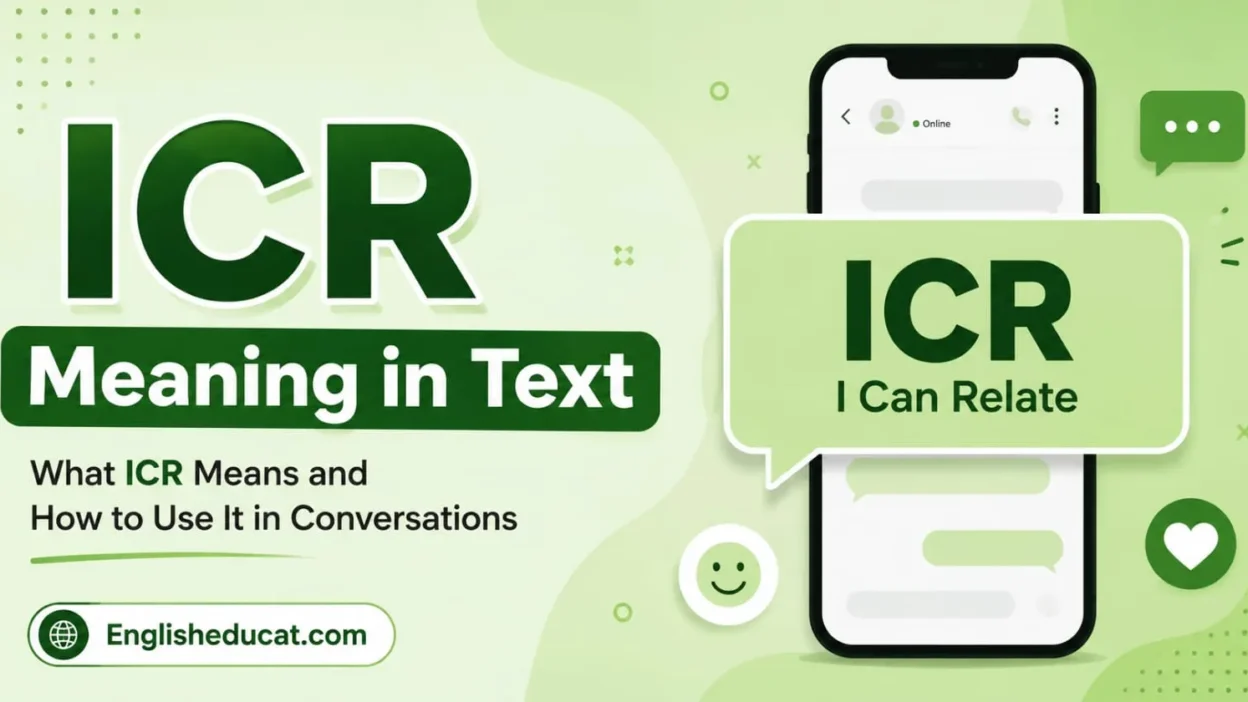
ICR meaning in text is simple. Mostly, it means “I Can Relate.” People send it to show they understand your feelings. Sometimes, ICR means “I Can not Remember.” A third meaning, Intelligent Character Recognition, belongs to computer scanning tech, not texting. We will clear up all three, so you will never guess wrong again.
This guide shows you every common use of ICR. You will see real examples, learn where it appears online, and find out how to reply when someone sends it to you.
What is ICR meaning in text? (Quick Answer)
ICR meaning in text depends on the message around it just like other slang terms. But one meaning wins most of the time.
ICR = “I Can Relate”
This is the top meaning. When someone types ICR after you share a story, then they are usually saying: “I understand. I have felt that too.”
For example, you text a friend, “I am so tired today.” They reply, “ICR.” That means they also feel tired. This use shows empathy. Relating to a feeling is not the same as agreeing with an opinion; you can relate to how someone feels without agreeing with what they think.
ICR = “I Can not Remember”
This meaning is less common, but it is real. Here, ICR shows a memory gap. It works like IIRC (“If I Recall Correctly”) or AFAICR (“As Far As I Can Recall”).
If a friend asks, “What time did the movie start?” you might text back with “ICR, maybe 7?” Read the full sentence to understand its meaning; it rarely stands alone.
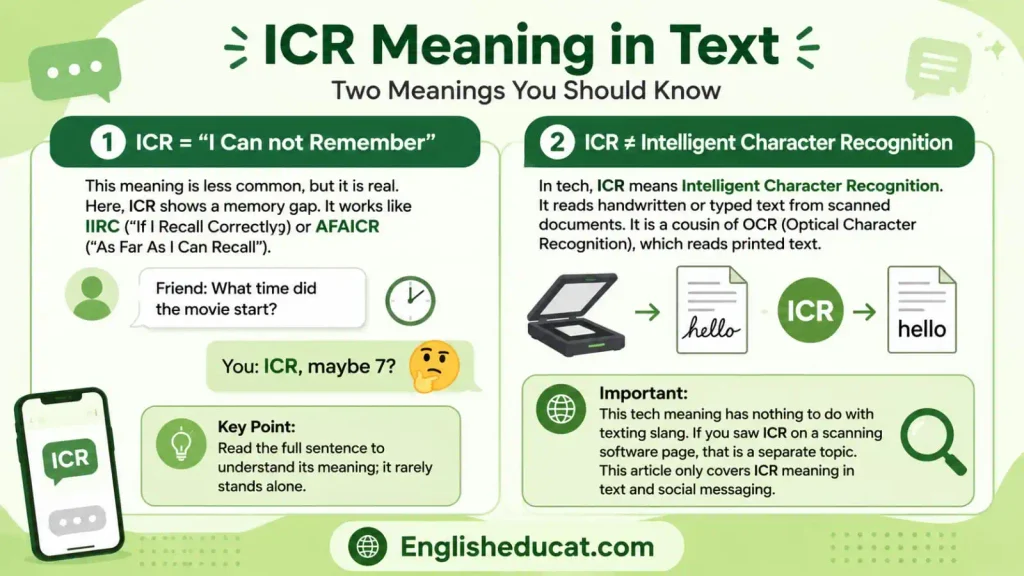
ICR ≠ Intelligent Character Recognition
ICR has a different job outside of texting. In tech, Intelligent Character Recognition reads handwritten or typed text from scanned documents. It is a cousin of OCR (Optical Character Recognition), which reads printed text.
This tech meaning has nothing to do with texting slang. If you saw ICR on a scanning software page, that is a separate topic. This article only covers ICR meaning in text and social messaging.
Where You Will See ICR: Instagram, Snapchat, TikTok, and Texting
The meaning stays almost the same across all apps, but each platform has its own flavor.
Instagram: ICR mostly appears in comments and captions. Someone posts a relatable photo, and a friend comments “ICR” to say they also feel the same way.
Snapchat: Conversations move fast here, so short slang like ICR fits right in. People send it in chats or as a reply to a Snap that feels familiar or funny.
TikTok: ICR often shows up under videos about everyday struggles or shared experiences. Viewers type it to tell the creator, “your video hit home.”
SMS and text messages: This is where the abbreviation started, and it is still common here. You will also see it in WhatsApp, Facebook Messenger, and in DMs.
Real Life Examples of ICR in Conversation
Seeing ICR used correctly in messaging makes it easier to remember.
“I Can Relate” examples:
- “My boss ignored my email again.” → “ICR, mine also does that.”
- “I am so nervous about tomorrow.” → “ICR fr, I could not sleep before my interview either.”
“I Can not Remember” examples:
- “Where did we park?” → “ICR honestly, let’s just walk around.”
- “What was that song called?” → “ICR, but it had a really catchy chorus.”
I edit texting slang content for a living, and I also once misread this word myself. A friend texted me, “ICR what he said in that meeting.” I replied with a long and sympathetic message about how awkward that must have felt. Turns out she just meant she had forgotten what her coworker said. We laughed about it later. It taught me something simple with ICR that the sentence around it decides the meaning. Drop the context, and you will guess wrong.
Is ICR Rude, Positive, or Just Casual?
ICR is mostly casual and friendly, not rude. A few details can still change how it comes across in messages.
Is it positive or negative? Usually positive or neutral. It shows support or a shared feeling, which most people appreciate. It only reads as negative if someone uses it sarcastically rare, and usually obvious from the joke around it.
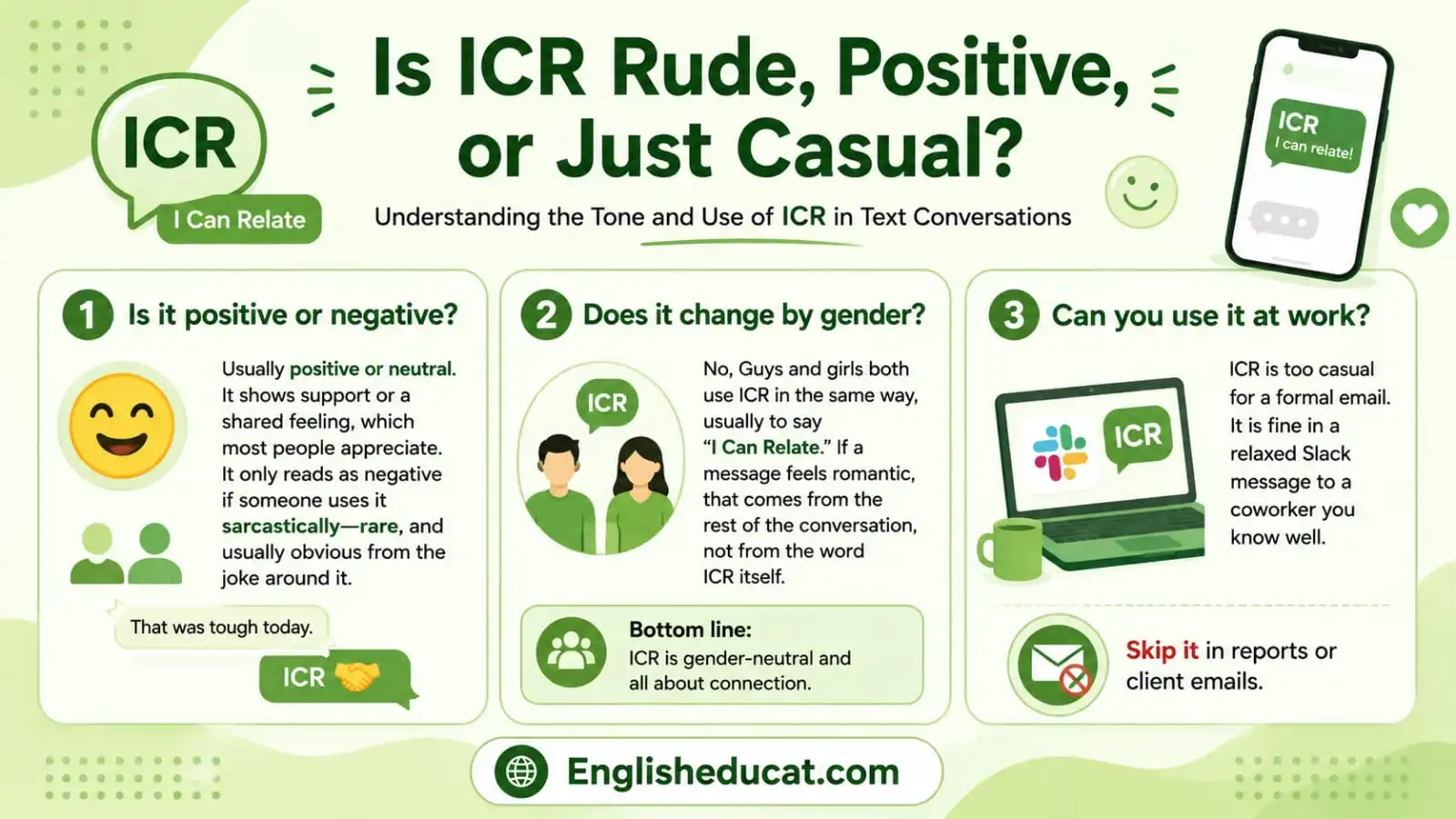
Does it change by gender? No, Guys and girls both use ICR in the same way, usually to say “I Can Relate.” If a message feels romantic, that comes from the rest of the conversation, not from the word ICR itself.
Can you use it at work? ICR is too casual for a formal email. It is fine in a relaxed Slack message to a coworker you know well. Skip it in reports or client emails.
How to Respond to ICR
- If it means “I Can Relate,” keep the conversation going. Try “Right? It is the worst,” or share more of your own story.
- If it means “I Can not Remember,” help jog their memory or just move on. No more explanation is expected.
A short “same” or a follow up question keeps the chat flowing, whether you use any of the meaning.
ICR vs. Similar Texting Abbreviations
| Abbreviation | Meaning | Tone | Example |
| SAME | “I feel the same way” | Casual, friendly | “SAME, I hate Mondays too.” |
| IMO | “In My Opinion” | Neutral, for opinions | “IMO, the movie was too long.” |
| TBH | “To Be Honest” | Neutral, adds honesty | “TBH, I didn’t like it either.” |
| IDC | “I Don’t Care” | Blunt or dismissive | “IDC where we eat.” |
| IIRC | “If I Recall Correctly” | Neutral, about memory | “IIRC, the store closes at 9.” |
ICR vs. SAME: Both show agreement or shared feeling. SAME is more direct. ICR softens it with an “I understand you” tone.
ICR vs. IMO and TBH: IMO and TBH share an opinion. ICR responds to a feeling or experience, not a viewpoint.
ICR vs. IDC: IDC shows a lack of interest. ICR does the opposite, and it shows connection.
ICR vs. IIRC / AFAICR: This pair matters most. When ICR means “I Can not Remember,” it works almost exactly like IIRC or AFAICR. Treat all three as close cousins in that sense.
Where Did ICR Come From?
Short abbreviations like ICR grew out of early texting. Character limits and slow typing pushed people to shorten everything. Gen Z and internet culture kept the habit alive by turning quick phrases into a daily habit.
Slang spreads when people see friends or influencers use it, then start using it themselves. Acronym tracking sites like Acronym Finder list many of the possible meanings for ICR across different fields and prove how flexible internet abbreviations become over time.
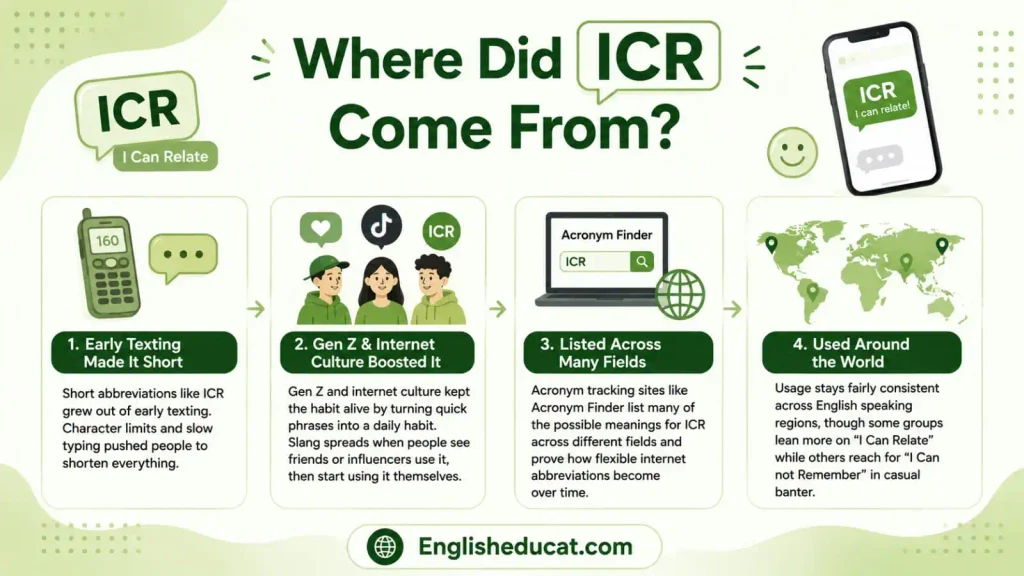
Usage stays fairly consistent across English speaking regions, though some groups lean more on “I Can Relate” while others reach for “I Can not Remember” in casual banter.
Frequently Asked Questions
What does ICR mean in a text message?
ICR most commonly means “I Can Relate” in text messages. People use it to show they share someone’s experience or feeling, often as a short, empathetic reply to a story or complaint.
Why do people say ICR?
People say ICR to express empathy or agreement quickly, without writing a full sentence. It fits naturally into fast-paced texting, DMs, and social media comments where speed matters most.
Is it rude to say ICR?
No, ICR is a casual, friendly abbreviation, not a rude one. It only feels off if someone uses it sarcastically, which is uncommon and usually clear from the surrounding conversation and tone.
How do you respond to ICR?
Reply with something like “right?” or share your own experience, since ICR often invites more conversation. If it means “I Can not Remember,” a quick follow-up or clarification works just fine.
Can you use ICR at work?
ICR is too casual for formal emails or reports. It works fine in relaxed workplace chats, like a Slack message between coworkers who talk informally, but skip it in professional writing.
Is ICR the same as “I Can not Remember”?
Yes, ICR can mean “I Can not Remember,” though this is less common than “I Can Relate.” Used this way, it works much like IIRC, short for “If I Recall Correctly.”
What does ICR mean on Instagram or Snapchat?
On Instagram and Snapchat, ICR is used the same way as in regular texting. It almost always means “I Can Relate,” appearing in comments, captions, and DMs to show shared experience.
Conlcusion
ICR meaning in text comes down to context. Most of the time, it means “I Can Relate,” which is a small word that carries real empathy. Once in a while, it means “I Can not Remember.” Outside of texting, it stands for something else entirely in tech circles.
Next time ICR shows up in your messages, you will know exactly which meaning fits. And if you mix it up as I did, then do not worry; a quick laugh and a follow up question fix it every time.

Senior English Content Editor
Sarah has over 10 years of experience teaching English as a Second Language in Chicago public schools. She specializes in vocabulary building and simplifying complex word meanings for everyday learners. Sarah holds a Master’s degree in English Education from the University of Illinois.