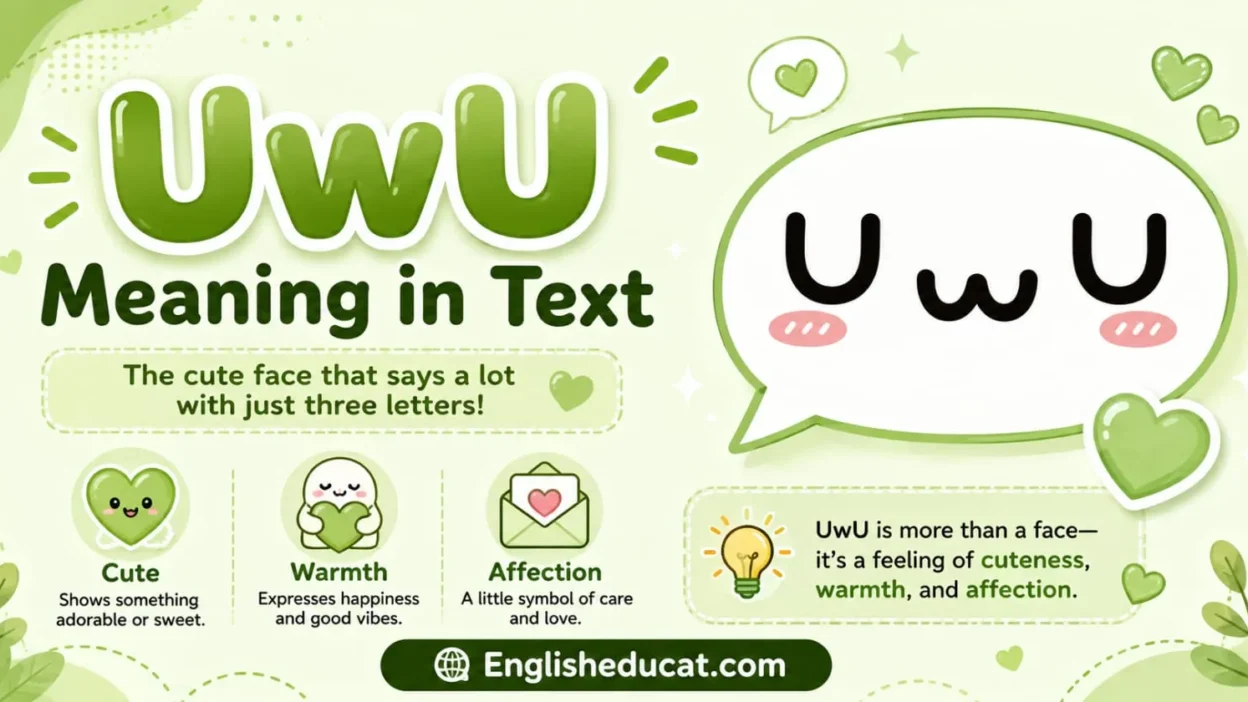
The uwu meaning in text is simple: it is an emoticon that shows something is cute, warm, or affectionate. It is not a crypto token, a company name, or a typo; it is a small face made of letters. People type it after a sweet or funny message to add a soft and happy feeling.
If you have ever gotten a text with “uwu” at the end and wondered what it meant, then you are not alone. This guide covers the full uwu meaning in text, where the term came from, and how to use it the right way. This guide will also cover some other meanings of uwu and how it differs from other slang terms.
What Does UwU Mean in Text? (Quick Answer)
The uwu meaning in text comes down to one thing: it is a cute face made from keyboard characters. It shows happiness, warmth, or “aww, that is adorable” feelings no words needed.
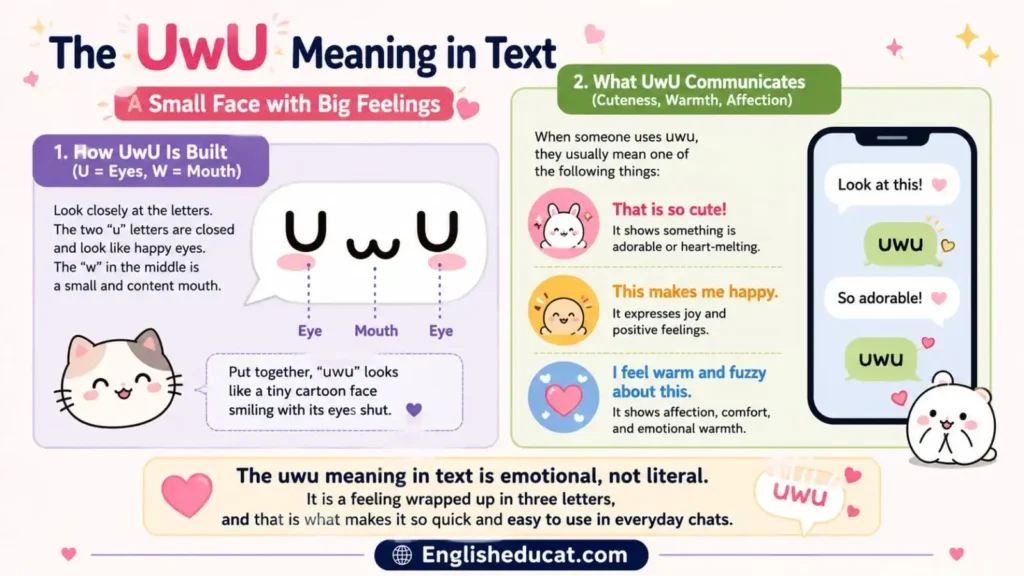
How UwU Is Built (U = Eyes, W = Mouth)
Look closely at the letters. The two “u” letters are closed and look like happy eyes. The “w” in the middle is a small and content mouth.
Put together, “uwu” looks like a tiny cartoon face smiling with its eyes shut. This is why the uwu meaning in text starts with seeing it as a picture, not as a word.
What UwU Communicates (Cuteness, Warmth, Affection)
When someone uses uwu, they usually mean one of the following things:
- That is so cute!
- This makes me happy.
- I feel warm and fuzzy about this.
The uwu meaning in text is emotional, not literal. It is a feeling wrapped up in three letters, and that is what makes it so quick and easy to use in everyday chats.
Where Does UwU Come From?
The uwu meaning in text has deep roots in internet fan culture. It did not appear overnight; it grew slowly over more than 20 years and then moved from small online spaces into everyday texting.
Origins in Anime, Manga & Kaomoji
UwU belongs to a family of text faces called kaomoji. Kaomoji are Japanese style emoticons read straight on, not sideways like classic Western emoticons (for example, the sideways smile :). Kaomoji became popular through anime and manga fan communities online.
Fans used these faces to show big emotions in just a small space. UwU fit right in with its cute and closed-eye look tied to kawaii, which is a Japanese word meaning “cute.”
How UwU Spread (Early Forums → Tumblr → Mainstream)
UwU started in niche anime and gaming forums in the early 2000s. From there, it spread to Tumblr, where fan communities shared art, stories, and slang.
Eventually, it reached Reddit, Discord, and mainstream texting. A well-known 2017 tweet from actor Mark Hamill using “uwu” helped push uwu further into the public eye, introducing it to people well outside of anime and gaming circles.
A Quick Note on the “Is UwU Japanese?” Misconception
Here is an important fact worth clearing up early: uwu is not a Japanese word. It is an English-internet creation inspired by Japanese kaomoji style, made by English speaking fans, not by Japanese speakers.
So while the uwu meaning in text is tied closely to anime culture, the term itself was born in Western fan spaces, not in Japan.
UwU vs OwO vs TwT: What’s the Difference?
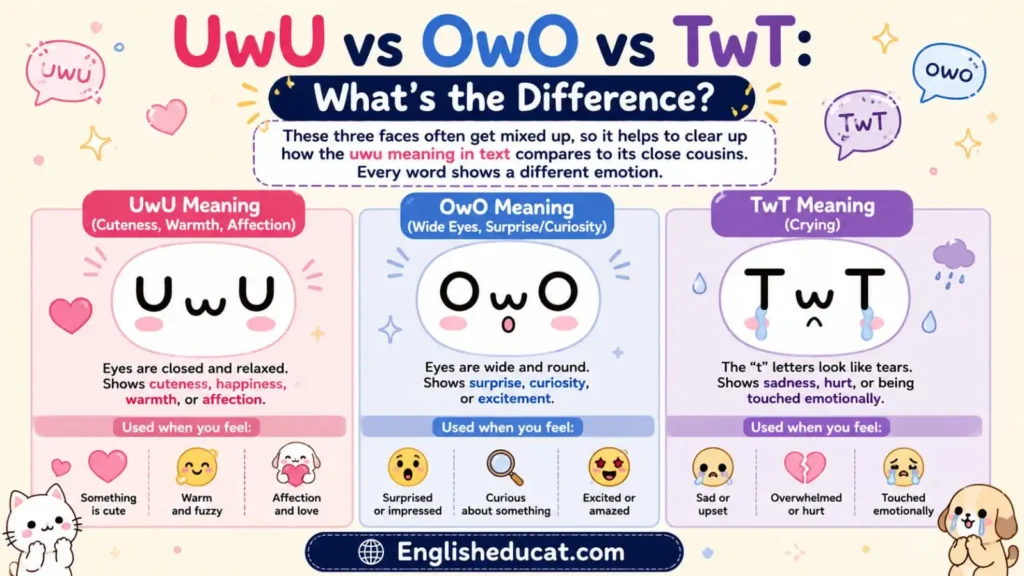
These three faces often get mixed up, so it helps to clear up how the uwu meaning in text compares to its close cousins. Every word shows a different emotion.
OwO Meaning (Wide Eyes, Surprise/Curiosity)
OwO has wide and round eyes instead of closed ones. It shows surprise, curiosity, or excitement, like a “whoa, what is that?” reaction.
TwT Meaning (Crying)
TwT shows a crying face, with the “t” letters standing in for tears running down. People often use it to show sadness or being touched emotionally.
Comparison Table: UwU vs OwO vs TwT
| Face | Eyes | Feeling | When to Use |
| UwU | Closed, happy | Cuteness, warmth | Something adorable happened |
| OwO | Wide, open | Surprise, curiosity | Something shocking or exciting happened |
| TwT | Crying | Sadness, being moved | Something sad or touching happened |
Knowing this table will help you see how uwu compares to similar faces you will see in the same chats.
Who Uses UwU? (Communities & Context)
The uwu meaning in text stays the same everywhere, but the communities using it are varied and specific.
Furry Fandom Usage
The furry fandom, a community centered on anthropomorphic animal characters, uses uwu often in art captions, chats, and social posts. It fits the fandom’s playful, expressive style, and many of its early adopters helped shape how uwu is used today.
Gaming Chats, Discord & Fandom Spaces
Uwu often appears as a quick reaction on Discord and in gaming chats. Someone might type it after a teammate does something funny or cute in-game, using it almost like a punctuation mark for warmth.
K-pop & Anime Fan Communities
K-pop and anime fans also use uwu a lot, especially when reacting to idols or characters they find adorable. It works as shorthand for “my heart just melted,” and it appears constantly in comment sections and fan edits.
TikTok, Instagram & Newer Platforms
More recently, the uwu meaning in text has traveled into TikTok captions, Instagram comments, and short-form video culture. Younger users often use it playfully and sometimes even ironically to poke fun at overly cute or dramatic moments.
Is UwU Informal? Formality & Appropriateness Guide
Yes, the uwu meaning in text is tied to casual and informal writing. It belongs in texts, chats, and social media, not formal documents.
Is UwU Offensive or a Bad Word?
No, uwu is not offensive. It is a harmless and playful emoticon with no rude or hurtful meaning behind it.
Is UwU Considered Cringe or Overused?
Some people do find uwu “cringe” or overused, especially outside its original fan communities. Like any slang, opinions on uwu vary by group and by how often it is used.
Can You Use UwU at Work or in Formal Writing?
No. Save uwu for texting friends, gaming chats, or casual social posts. It does not belong in emails to your boss, school papers, or business writing.
A Note for Non-Native English Speakers
If English is not your first language, then here is a simple rule: the uwu meaning in text is always casual and never a normal English word. Do not use it in tests, resumes, or formal letters; stick to texts and chats with friends.
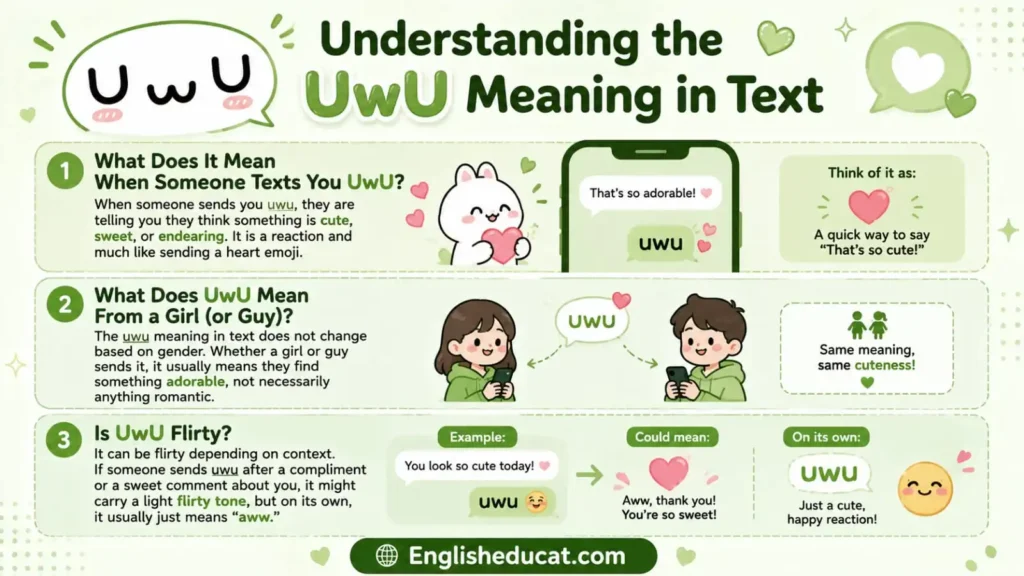
What Does It Mean When Someone Texts You UwU?
When someone sends you uwu, they are telling you they think something is cute, sweet, or endearing. It is a reaction and much like sending a heart emoji.
What Does UwU Mean From a Girl (or Guy)?
The uwu meaning in text does not change based on gender. Whether a girl or guy sends it, it usually means they find something adorable, not necessarily anything romantic.
Is UwU Flirty?
It can be flirty depending on context. If someone sends uwu after a compliment or a sweet comment about you, it might carry a light flirty tone, but on its own, it usually just means “aww.”
How to Use UwU: Examples & Emoji Equivalents
Now that you know the uwu meaning in text, here is how to actually use it in everyday conversations.
UwU in a Sentence (Examples)
- That puppy video was so cute, uwu.
- You remembered my birthday? uwu, thank you!
- My cat just fell asleep on my keyboard uwu.
Emojis That Mean the Same Thing (😊 🥰 😍 🥺)
If you would rather use an emoji, these carry a similar feeling to uwu:
- 😊 (soft happiness)
- 🥰 (warm affection)
- 😍 (adoring cuteness)
- 🥺 (pleading, sweet cuteness)
How to Respond to UwU
You can respond with another uwu, a matching cute emoji, or simply “aww” or “so cute!” There is no wrong way to reply; just match the warm and light tone the sender used.
Common Spelling Variations
You may also see “UwU,” “uwu,” or the exaggerated “UwUwU” in the wild. All of them carry the same core meaning; the capitalization and repetition just add extra emphasis or playfulness.
UwU in Memes and Pop Culture
Beyond one-on-one texting, uwu has become a recurring joke format across meme pages and video content. Creators sometimes exaggerate the uwu meaning in text on purpose and pair it with over the top “cute” voices or captions to poke fun at the trend itself rather than use it sincerely.
This ironic use does not cancel out the original meaning; it actually shows how flexible the term has become. A single “uwu” can now read as genuinely sweet and playfully sarcastic, or somewhere in between, depending entirely on the tone of the message around it.
Frequently Asked Questions
What does uwu mean in text?
The uwu meaning in text is an emoticon used to show that something is cute, warm, or affectionate. It is made from two u’s (closed eyes) and a w (a small, content mouth), forming a happy face shape.
Is uwu informal?
Yes. The uwu meaning in text is informal internet slang best suited to casual texting, social media, and gaming chats. It should not be used in professional emails or formal writing.
What does uwu mean from a girl?
When a girl texts uwu, it usually means she finds something cute, sweet, or endearing. It is not inherently flirty, though the surrounding context can shift its meaning.
What is the difference between uwu and owo?
UwU shows closed eyes and expresses contentment or cuteness. OwO shows wide-open eyes and expresses surprise or curiosity instead, so the two faces cover different emotional reactions.
Is uwu offensive or a bad word?
No, uwu is not offensive. It is a harmless emoticon, though some people find it overused or “cringe,” especially outside its original furry and anime-fan communities.
Where does uwu come from?
The uwu meaning in text originated in early-2000s anime and manga fan communities online. It later spread through Tumblr and other platforms into mainstream internet slang.
How do you use uwu in a sentence?
You can add uwu after a statement to signal you find it adorable. For example: “That puppy video was so cute, uwu.” It also works as a standalone reaction on its own.
Conclusion
At the end of the day, the uwu meaning in text is small but mighty: three letters that carry a whole feeling of cuteness and warmth. It grew out of anime fan spaces and then spread through Tumblr and Discord, and now shows up in texts and captions everywhere.
Next time you see uwu appearing in a chat, you will know exactly what it means: someone just found something adorable, and they wanted you to feel it too.

Linguistics Specialist
James is a linguist with a Ph.D. in Applied Linguistics from Boston University. His work focuses on word origins, synonyms, and how language evolves over time. He has contributed to several academic journals on English semantics.