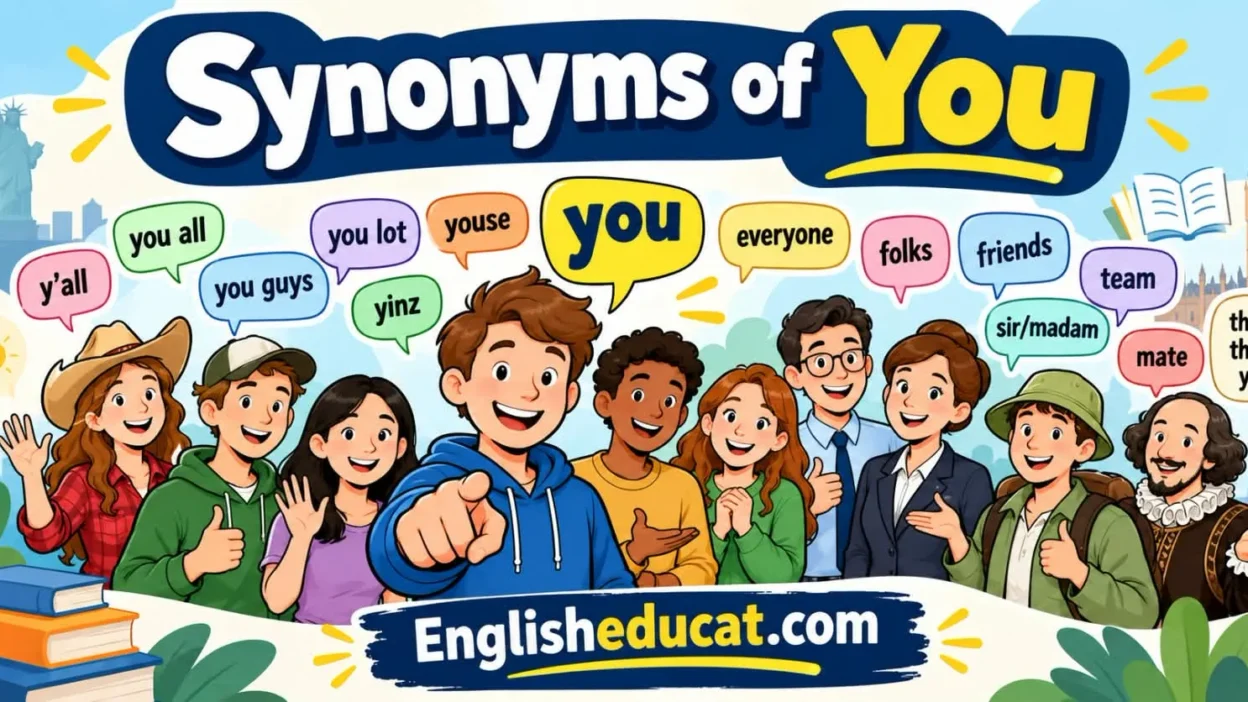
The best synonyms of you depend on who you are talking to. For a group, use y’all, you all, or you guys. For people in general, use one, anyone, or people. For old or poetic English, use thou, thee, or ye.
Strictly speaking, “you” has no perfect synonym, because it is a pronoun. Still, English gives us many useful substitutes. This guide shows what each one means, how it looks, and when to use it. If you are in a hurry, jump to the “How to Choose the Right Synonym” section.
Meaning of You
You is a second-person personal pronoun. It names the person or people you are speaking or writing to. It can be singular or plural, and it works as a subject (“You won”) or an object (“I called you”).
Pronunciation: It is pronounced as /juː/, said “yoo.” The word comes from Old English ēow, the object form of ġē (“ye”). Words such as “you,” “yourself,” and “one” can be used in different contexts to address someone, while wisdom helps express thoughts and advice more meaningfully. Over time, “you” replaced both “ye” and “thou” in everyday English. That is why modern English has one form for singular and plural, and why speakers created words like “y’all.”
Quick List of Synonyms of You
Here are the main synonyms of you that are grouped by situation. Some of them are true replacements. Others are address words or special forms, and the next sections explain the difference.
- Plural (talking to a group): y’all, you all, you guys, you lot (British), yous/youse (nonstandard), yinz (regional)
- Informal spelling: ya, u
- Old or literary: thou, thee, ye
- General “you” (any person): one, anyone, people, a person
- Reflexive: yourself, yourselves
- Address words: everyone, folks, friends, team, sir, madam, mate (British), dear reader
How we chose these synonyms of you: we kept words that can replace “you” in at least one real situation. We labeled archaic, regional, and nonstandard words, and we flagged words that are not true synonyms.
Synonyms by Sense and Context
Each group below answers a different question. Who are you talking to? How formal is the moment? These synonyms of you are not interchangeable, so read the nuance first before changing the word.
1. Plural “you” (more than one person)
Y’all/you all (pronoun, informal)
It is a friendly plural and common in the southern United States. “You all” sounds a little more neutral than “y’all.”
Examples: “Are y’all staying for dinner?” / “I’ll see you all on Monday.”
You guys (pronoun phrase, casual)
It is a relaxed plural in many parts of the U.S. It works for mixed groups, but some people avoid it in formal speech.
Examples: “Can you guys move your car?” / “Thanks, you guys. This meant a lot.”
you lot (pronoun phrase, British informal)
It can sound playful or slightly bossy, depending on tone.
Examples: “What are you lot up to tonight?” / “Right, you lot, quiet please.”
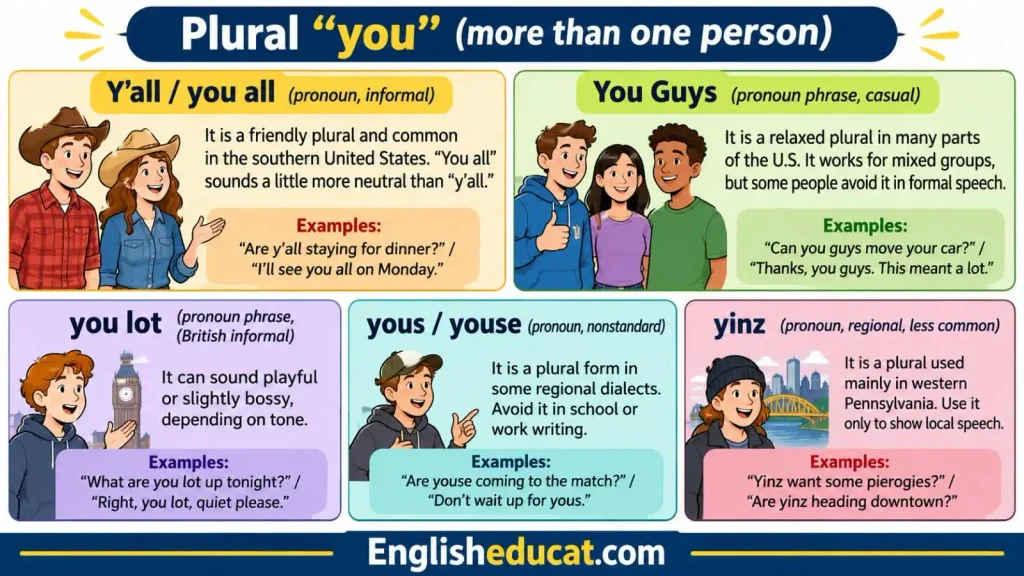
yous / youse (pronoun, nonstandard)
It is a plural form in some regional dialects. Avoid it in school or work writing.
Examples: “Are youse coming to the match?” / “Don’t wait up for yous.”
yinz (pronoun, regional, less common)
It is a plural used mainly in western Pennsylvania. Use it only to show local speech.
Examples: “Yinz want some pierogies?” / “Are yinz heading downtown?”
2. Old and literary “you”
Thou (pronoun, archaic)
It is the old singular subject form. It was once the casual, close form. Today it appears in history, religion, and fantasy.
Examples: “Thou art braver than I thought.” / “Hast thou eaten?”
Thee (pronoun, archaic)
It is the old singular object form. Learners often swap it with “thou,” but they play different grammatical roles.
Examples: “I give thee my word.” / “We will follow thee.”
Ye (pronoun, archaic or dialect)
It was the old plural subject form. In Irish English, “ye” still means “you” (plural).
Examples: “Be of good cheer, ye weary travelers.” / “Are ye coming to the pub?”
3. Informal spelling
Ya (pronoun, very informal)
It shows how “you” sounds in fast speech. You will see it in song lyrics and dialogue.
Examples: “See ya tomorrow!” / “What do ya want for lunch?”
U (Pronoun, text-message spelling)
Use it only with friends, never in formal writing.
Examples: “Can u call me later?” / “Thank u for the ride!”
4. General “you” (any person)
One (pronoun, formal)
It sounds stiff in American speech, but it fits careful writing, especially in British English.
Examples: “One cannot learn a language without practice.” / “One should read the contract first.”
Anyone (pronoun, neutral)
It is a simple and natural choice for rules and advice.
Examples: “Anyone who studies daily will improve.” / “Anyone can join the club.”
People (noun, neutral)
It is safe in essays and reports because it does not talk to the reader.
Examples: “People learn faster when they enjoy the lesson.” / “In this city, people walk everywhere.”
A person (noun phrase, slightly formal)
It keeps the sentence general and clear.
Examples: “A person can change habits at any age.” / “A person needs a visa to enter.”
5. Reflexive forms (not true synonyms)
Yourself / yourselves (pronouns)
They refer back to “you” and cannot be the subject of a sentence. Use them after a verb or preposition.
Examples: “Be kind to yourself.” / “Did you two build this yourselves?”
6. Address words (used when speaking to someone)
These are not true synonyms. They replace “you” when you call someone by role or relationship.
Everyone (pronoun, neutral)
It greets a whole group.
Examples: “Good morning, everyone.” / “Everyone, please take a seat.”
Folks (noun, informal and warm)
It feels friendly, not formal.
Examples: “Thanks for coming, folks.” / “Stay safe out there, folks.”
Friends (noun, warm)
It is good for speeches, videos, and blogs.
Examples: “Welcome back, friends.” / “Friends, I have news.”
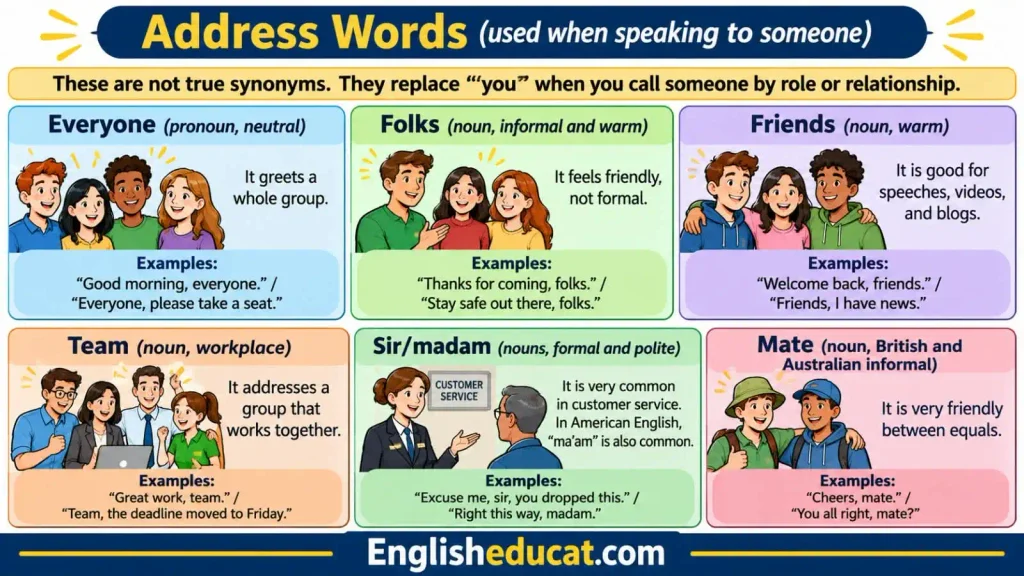
Team (noun, workplace)
It addresses a group that works together.
Examples: “Great work, team.” / “Team, the deadline moved to Friday.”
Sir/madam (nouns, formal and polite)
It is very common in customer service. In American English, “ma’am” is also common.
Examples: “Excuse me, sir, you dropped this.” / “Right this way, madam.”
Mate (noun, British and Australian informal)
It is very friendly between equals.
Examples: “Cheers, mate.” / “You all right, mate?”
Dear reader (noun phrase, literary)
It adds a personal and slightly old-fashioned tone to stories and blogs.
Examples: “Dear reader, you may guess what happened next.” / “Dear reader, be patient.”
Comparison Table: Which Word Fits?
The table below compares ten useful synonyms of you at a glance.
| Word | Meaning | Tone / register | Best used when | Example |
| y’all | you (plural) | Informal, friendly | Chatting with a group | Y’all did great today. |
| you guys | you (plural) | Casual | Talking to friends or coworkers | You guys picked a great spot. |
| you lot | you (plural) | British informal | Getting a group’s attention | Behave, you lot. |
| thou | you (singular, subject) | Archaic | Historical or fantasy writing | Thou hast a kind heart. |
| one | any person | Formal | Careful writing and rules | One must plan ahead. |
| anyone | any person | Neutral | Advice and general rules | Anyone can try this. |
| yourself | you (reflexive) | Neutral | After a verb or preposition | Treat yourself. |
| folks | people you address | Informal, warm | Speeches, videos, announcements | Welcome, folks! |
| sir / madam | polite address | Formal | Service and respectful speech | May I take your coat, madam? |
| ya | you | Very informal | Casual speech, lyrics, dialogue | Gotta go, love ya! |
You vs Confusable Words
Some words look almost similar to synonyms of you, but they play a different role. Here are the pairs learners mix up most.
- you vs your: “you” is a pronoun, “your” shows ownership. “Your bag is here.” Not “You bag.”
- you’re vs your: “you’re” means “you are.” “You’re late” is correct. “Your late” is not.
- you vs yourself: use “yourself” only when “you” is the actor and the receiver. “Help yourself,” not “Help you.”
- you vs one: both can mean “any person,” but “one” is more formal. Do not mix them in one sentence.
- ye vs the: in signs like “Ye Olde Shop,” “ye” is an old spelling of “the” and is read “the.” It is not the pronoun “ye.”
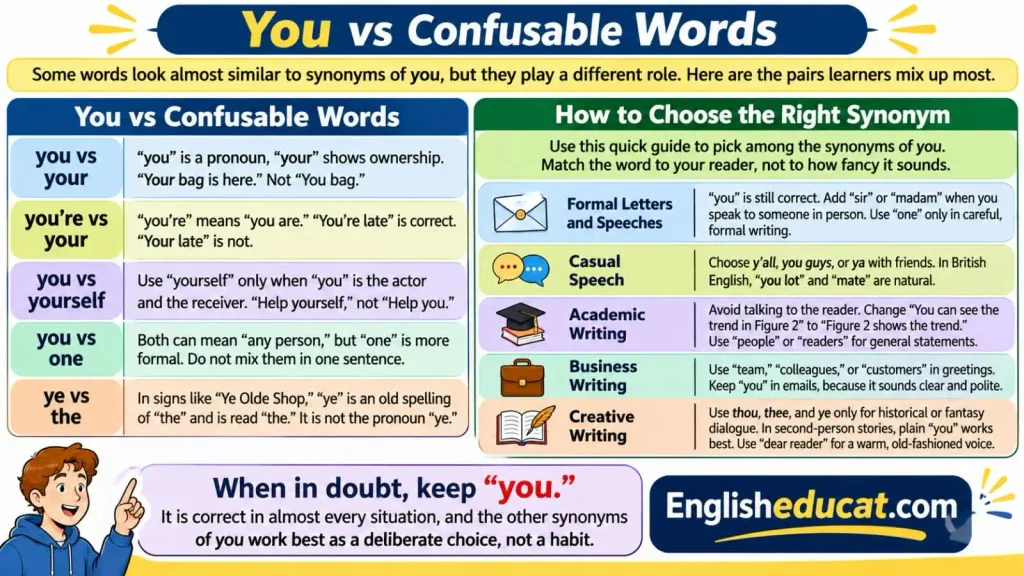
How to Choose the Right Synonym
Use this quick guide to pick among the synonyms of you. Match the word to your reader, not to how fancy it sounds.
Formal letters and speeches: “you” is still correct. Add “sir” or “madam” when you speak to someone in person. Use “one” only in careful, formal writing.
Casual speech: choose y’all, you guys, or ya with friends. In British English, “you lot” and “mate” are natural.
Academic writing: avoid talking to the reader. Change “You can see the trend in Figure 2” to “Figure 2 shows the trend.” Use “people” or “readers” for general statements.
Business writing: use “team,” “colleagues,” or “customers” in greetings. Keep “you” in emails, because it sounds clear and polite.
Creative writing: use thou, thee, and ye only for historical or fantasy dialogue. In second-person stories, plain “you” works best. Use “dear reader” for a warm, old-fashioned voice.
When in doubt, keep “you.” It is correct in almost every situation, and the other synonyms of you work best as a deliberate choice, not a habit.
Antonyms and Contrast Words for You
Because there are no perfect synonyms of you, there are no perfect antonyms either. English has no word that means “not you.” The words below are contrast words. They point to other people in a conversation.
I/me (pronouns). They refer to the speaker, while “you” refers to the listener.
Examples: “I will cook, and you can wash the dishes.” / “She asked me, not you.”
We (pronoun). It includes the speaker and often other people. Sometimes it includes “you,” so it is a contrast only when the listener is left out.
Example: “We finished early, but you stayed late.”
they (pronoun). It refers to other people who are not in the conversation.
Example: “They left at noon, but you were still working.”
he/she (pronouns). They refer to one person being talked about.
Example: “He called me, but I did not call you.”
Related Words, Idioms and Collocations
These related words often appear near synonyms of you in dictionaries and real speech.
- Word family: your (determiner), yours (pronoun), yourself, yourselves, you’re (you are)
- Common collocations: thank you, see you, bless you, you know, you and I
- Idioms: “you bet” (of course), “you name it” (anything at all), “you never know” (the future is uncertain), “between you and me” (this is private), “you can say that again” (I strongly agree)
- Phrasal verb: “see you off” means to go with someone to say goodbye. “I’ll see you off at the station.”
Common Mistakes Learners Make
In class, learners make the same errors with synonyms of you again and again. Here are the most common ones, with fixes.
- Wrong: “I love thou.” Right: “I love thee.” (Thee is the object form.)
- Wrong: “Yourself should go first.” Right: “You should go first.” (Yourself cannot be a subject.)
- Wrong: “If one studies, you will pass.” Right: “If one studies, one will pass.” (Do not mix one and you.)
- Wrong: “Dear Professor, can u check my essay?” Right: “Can you check my essay?” (Never use “u” in school or work writing.)
- Wrong: “Your welcome.” Right: “You’re welcome.” (You’re means you are.)
- Wrong: “Good morning, you guys,” to a client panel. Right: “Good morning, everyone.” (Use a neutral address word in formal settings.)
Classroom tip: if you are unsure, say the sentence with “you are” or “you” in place of the new word. If it still makes sense, the swap is probably safe.
Frequently Asked Questions
What is another word for “you”?
There is no exact match, but the closest options depend on the situation. For a group, use y’all, you all, or you guys. For people in general, use one, anyone, or people. The most useful synonyms of you in older English are thou, thee, and ye.
Is there a plural of “you”?
Standard English uses “you” for both one person and many. To make the plural clear, speakers say “you all,” “you two,” or “you guys.” Y’all, you lot, and yous are informal or regional plural forms. Use “you all” when you want a neutral tone.
What is the difference between thou and thee?
Thou is the subject form, and thee is the object form. You say “Thou art kind” but “I thank thee.” This matches the difference between “I” and “me.” Both words are archaic today, and you will mostly see them in older texts, poetry, and fantasy writing.
Can I use “one” instead of “you”?
Yes, but only for general statements, and the tone becomes formal. “One should rest after a long trip” sounds careful and polite. In everyday American speech, “you” sounds more natural. Do not use “one” to address a specific person.
How do I avoid “you” in academic writing?
Rewrite the sentence so it does not address the reader. Change “You can see the trend” to “The trend is clear,” or use general words like people, readers, or researchers. Among the synonyms of you, “one” is formal, but naming the group is often clearer.
Are all synonyms of you interchangeable?
No. Some words are plural only, such as y’all. Some are archaic, such as thou. Others are address words, such as folks and team. Yourself and yourselves cannot replace “you” as a subject. Always check register, number, and grammatical role before you swap a word.
Is “y’all” correct English?
Yes, in informal speech. Y’all is a standard feature of Southern U.S. English and is widely understood. It comes from “you all.” Avoid it in formal writing, exams, and business reports, where “you all” or “everyone” is the safer choice.
What is the opposite of “you”?
There is no exact antonym. Words like I, me, and we show the speaker’s side, and he, she, and they refer to other people. These are contrast words, not true opposites. Learners should treat them as different pronouns, not antonyms.
Conclusion
The best synonyms of you are not exact replacements. They are choices that match your audience, your tone, and your grammar. Use y’all or you guys for casual groups, one or people for general statements, and thou, thee, and ye for historical or fantasy writing. The Key takeaway is to keep “you” as your default, and switch only when the reader, the number of people, or the formality calls for a different word.

Linguistics Specialist
James is a linguist with a Ph.D. in Applied Linguistics from Boston University. His work focuses on word origins, synonyms, and how language evolves over time. He has contributed to several academic journals on English semantics.