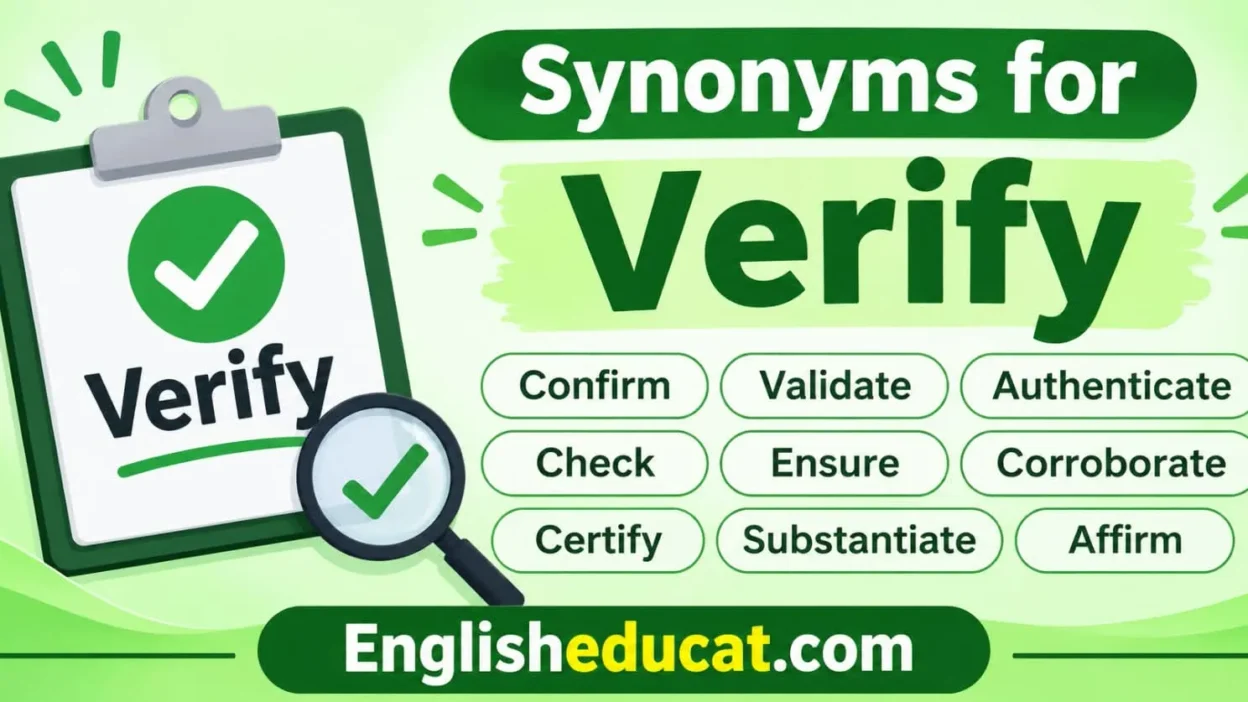
The best synonyms for verify are confirm, check, validate, authenticate, corroborate, substantiate, and prove. All of them mean only one thing: “make sure something is true”, but each one is used in a different situation.
Use check for quick everyday tasks, confirm to remove doubt, and authenticate to show something is genuine. This guide groups every synonym by meaning, with examples so that you can pick the right word fast.
What Does Verify Mean?
Verify is a verb by itself. It means to check or show that something is true, accurate, or real. Verifying information from reliable sources can help build confidence in the accuracy of what we know and believe. It looks very neutral to formal and is common in business, news, technology, and academic writing.
- Pronunciation: US /ˈvɛrəˌfaɪ/, UK /ˈvɛrɪfaɪ/.
- Word forms: verifies, verified, verifying; noun: verification; adjective: verifiable, unverified.
- Origin: from Medieval Latin verificare, built on Latin verus (“true”). The same root appears in very and verdict.
- Common collocations: verify your identity, verify a claim, verify an account, verify the information.
Example: Please verify your email address before you log in.
Quick List of Synonyms for Verify
- Check facts: check, double-check, cross-check, fact-check, ascertain, make sure.
- Many words are similar to true: confirm, validate, authenticate, certify, attest, corroborate, substantiate, bear out, back up.
- Prove or show: prove, demonstrate, establish
- Declare or guarantee: affirm, vouch for
How we chose these synonyms: We compared major dictionaries and thesauruses, kept only words that match a real sense of verify, and removed loose matches such as argue and justify.
Synonyms for Verify by Meaning and Situation
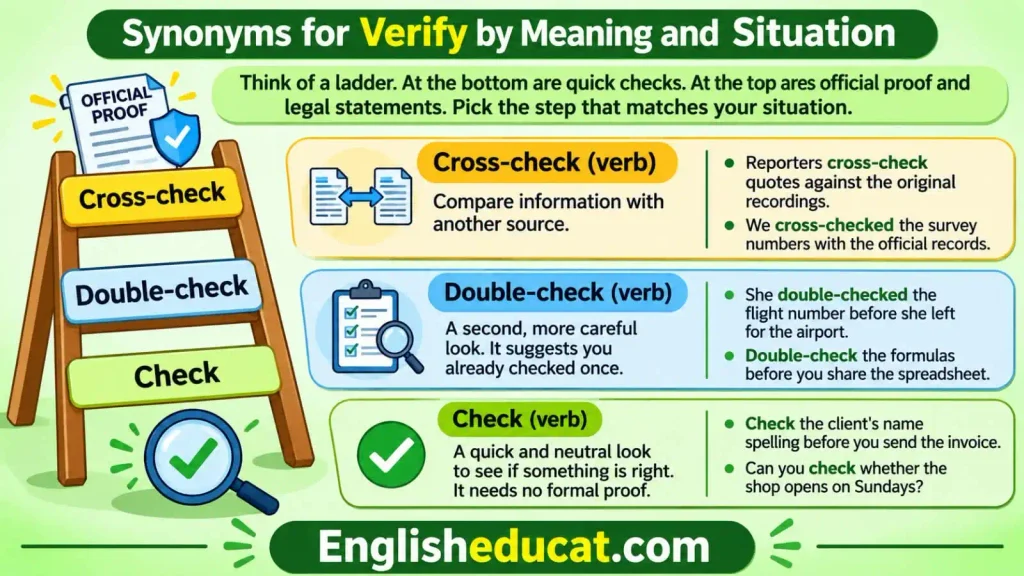
Think of a ladder. At the bottom are quick checks. At the top are official proof and legal statements. Pick the step that matches your situation.
1. Check Facts (the process)
Check (verb):
A quick and neutral look to see if something is right. It needs no formal proof. Just do the following checks:
- Check the client’s name spelling before you send the invoice.
- Can you check whether the shop opens on Sundays?
Double-check (verb):
A second, more careful look. It suggests you already checked once.
- She double-checked the flight number before she left for the airport.
- Double-check the formulas before you share the spreadsheet.
Cross-check (verb):
Compare information with another source.
- Reporters cross-check quotes against the original recordings.
- We cross-checked the survey numbers with the official records.
Fact-check (verb):
Test whether claims in news, speeches, or posts are true.
- The editor asked an intern to fact-check every date in the article.
- Fact-check viral posts before you share them.
Ascertain (verb):
It is a formal word. It means to find out something for certain.
- Police are trying to ascertain who owns the car.
- The auditor ascertained the exact cost of the repairs.
Make sure (phrase):
It is an informal word. It means to check so that nothing goes wrong.
- Make sure the door is locked before you leave.
- I called the hotel to make sure they had my booking.
2. Confirm Something Is True (the result)
Confirm (verb):
Remove doubt, often with an official statement or clear fact.
- The airline confirmed my seat by email.
- Lab results confirmed what the farmers suspected.
Validate (verb):
It is formal or technical. It means to check that data, results, or an idea is accurate and acceptable.
- The form validates your phone number before it saves it.
- Repeated tests validated the new teaching method.
Authenticate (verb):
Prove that a person, object, or document is genuine.
- Experts authenticated the painting as a work from the 1800s.
- Please authenticate with your fingerprint to open the app.
Certify (verb):
It is a formal word. An official body states that something is true or meets a standard.
- An inspector certified the elevator as safe to use.
- The school certified her results for the university.
Attest (verb):
It is formal or legal. It means to state or show that something is true.
- Several teachers attested to his honesty.
- The stamp attests that this copy is accurate.
Corroborate (verb):
It is a formal word. A second source strengthens something already claimed.
- Two witnesses corroborated her account of the accident.
- The security video corroborates his timeline.
Substantiate (verb):
It is a formal word. It means to give evidence for a claim or accusation.
- The company could not substantiate its claim that the battery lasts a week.
- Journalists need proof to substantiate serious allegations.
Bear out (phrasal verb):
Facts support a prediction, idea, or story.
- Last year’s sales bear out our forecast.
- Later events bore out her warning.
Back up (phrasal verb):
It is informal. It means to support a claim with proof.
- Can you back up your argument with real data?
- The photos back up his story.
3. Prove or Show
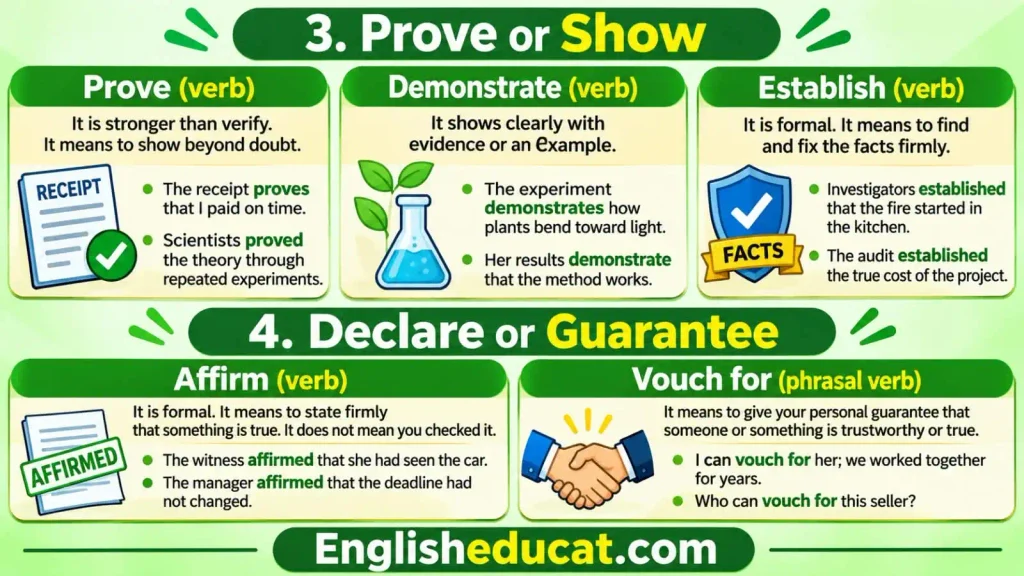
Prove (verb):
It is stronger than verify. It means to show beyond doubt.
- The receipt proves that I paid on time.
- Scientists proved the theory through repeated experiments.
Demonstrate (verb):
It shows clearly with evidence or an example.
- The experiment demonstrates how plants bend toward light.
- Her results demonstrate that the method works.
Establish (verb):
It is formal. It means to find and fix the facts firmly.
- Investigators established that the fire started in the kitchen.
- The audit established the true cost of the project.
4. Declare or Guarantee
Affirm (verb): f
It is formal. It means to state firmly that something is true. It does not mean you checked it.
- The witness affirmed that she had seen the car.
- The manager affirmed that the deadline had not changed.
Vouch for (phrasal verb):
It means to give your personal guarantee that someone or something is trustworthy or true.
- I can vouch for her; we worked together for years.
- Who can vouch for this seller?
Comparison Table: Verify Synonyms at a Glance
| check | look to see if it is right | Casual-neutral | quick everyday tasks | Check your bag before you leave. |
| confirm | remove doubt | Neutral | bookings, reports, news | The hotel confirmed our dates. |
| validate | check accuracy or validity | Formal/technical | data, software, research | The system validates each password. |
| authenticate | prove it is genuine | Formal/technical | identity, art, documents | The bank authenticates every login. |
| certify | officially declare true or approved | Formal/official | licenses, safety, grades | A doctor certified the form. |
| attest | formally state it is true | Formal/legal | testimony, signatures | She attested to the accuracy of the report. |
| corroborate | add support from a second source | Formal | stories, witness accounts | The emails corroborate his version. |
| substantiate | give evidence for a claim | Formal | allegations, bold claims | He could not substantiate the rumor. |
| prove | show beyond doubt | Neutral, strong | final, conclusive evidence | The video proves she was there. |
| demonstrate | show clearly | Neutral/academic | essays, science, teaching | The data demonstrate a clear trend. |
Verify vs Confusable Words
These words look very close to verify, but they do not mean the same thing.
- Ensure means “make sure something happens”, not “check if it is true”. Ensure the door is closed gives an order. Verify the door is closed asks for a check.
- Insure is about insurance. Do not use it for checking.
- Test means to try something out, often by experiment. You test a battery; you verify its warranty date.
- Justify gives reasons for a choice. It never means “check the facts”.
How to Choose the Right Synonym for Verify
Ask two questions to verify the synonyms for verify: How formal is the text? How strong is the proof? Then use this guide.
- Casual: check, double-check, make sure, back up.
- Business: confirm, validate, cross-check, certify.
- Academic: corroborate, substantiate, demonstrate, establish.
- Legal or official: attest, certify, authenticate, affirm.
- Creative writing: bear out, vouch for, prove. They sound natural in stories and speech.
Quick pick: need a fast look? Use check. Need to remove doubt? Use confirm. Need to prove it is genuine? Use authenticate. Need a second source? Use corroborate.
Antonyms of Verify
The opposite of verify is to show that something is false or to refuse to accept it. These words are given below:
- Disprove: The new data disproved the old theory.
- Refute: She refuted the rumor with clear evidence.
- Deny: He denied that he had sent the message.
- Contradict: The map contradicts what the guide told us.
- Dispute: The seller disputed the charge on the bill.
- Challenge: Readers challenged the writer’s numbers.
Related Words, Idioms and Collocations
- Some Related words are verification, verifiable, verified, unverified, verifier, and ascertain.
- Common sayings: “trust but verify”, “seeing is believing”, “get the facts straight”, “put it to the test”.
- Collocations: verify an account, verify a signature, verify a source, independently verified, cannot be verified.
Common Mistakes Learners Make
- Using “prove” for a simple check. Students often write “I proved the time” when they only looked at a clock. Use check or confirm.
- Adding “about”. Say “verify the address”, not “verify about the address”.
- Mixing up ensure and verify. Ensure makes something happen. Verify checks if it is true.
- Using “authenticate” for facts. It fits identity, art, and documents, not general information.
- Choosing “ascertain” in a casual message. It sounds stiff in a chat. Use find out or check.
- Using “certify” for a personal opinion. It needs an official body.
Frequently Asked Questions
What is the best synonym for verify?
Confirm is the best all-purpose synonym for verify. It works in most sentences, from emails to news reports. Use check for quick, casual tasks and validate for data or technical work. For proof of genuineness, choose authenticate instead. Pick the word that matches your situation.
What is another word for verify in formal writing?
Corroborate, substantiate, and validate suit formal writing. Use corroborate when a second source supports a claim, and substantiate when you give evidence for it. Choose validate for data, methods, or results. In legal contexts, attest and certify also sound appropriately formal and official.
What is a simple word for verify?
Check is the simplest word for verify. It works in everyday speech and writing, such as “Check your answers.” For slightly stronger meaning, use double-check or make sure. These simple options suit students, casual emails, and spoken English, where verify can sound too formal or stiff.
Is confirm the same as verify?
No, they are close but not identical. Verify means to check that something is true, while confirm means to remove doubt, often after someone has already checked. You verify a fact first, then you confirm it. In daily use, they overlap, so confirm is a safe replacement in most sentences.
What is the difference between verify and validate?
Verify checks that information is true, while validate checks that something is accurate, acceptable, or meets a rule. Validate is common in technology and research. For example, you verify the age of a person with an ID, and a form validates that the date has the correct format.
Can I use “prove” instead of “verify”?
Sometimes, but only when you have strong, final evidence. Prove means to show something is true beyond doubt, while verify can describe a simple check. Saying “I proved the address is correct” sounds too strong if you only looked at it. Use check or confirm for that situation instead.
Conclusion
The best synonyms for verify depend on how much proof you have and how formal your text is. Use check for quick looks, confirm to remove doubt, validate for data, authenticate for genuine items, and corroborate or substantiate for claims. Key takeaway: choose the synonym by the level of proof, not by how impressive it sounds.

Senior English Content Editor
Sarah has over 10 years of experience teaching English as a Second Language in Chicago public schools. She specializes in vocabulary building and simplifying complex word meanings for everyday learners. Sarah holds a Master’s degree in English Education from the University of Illinois.