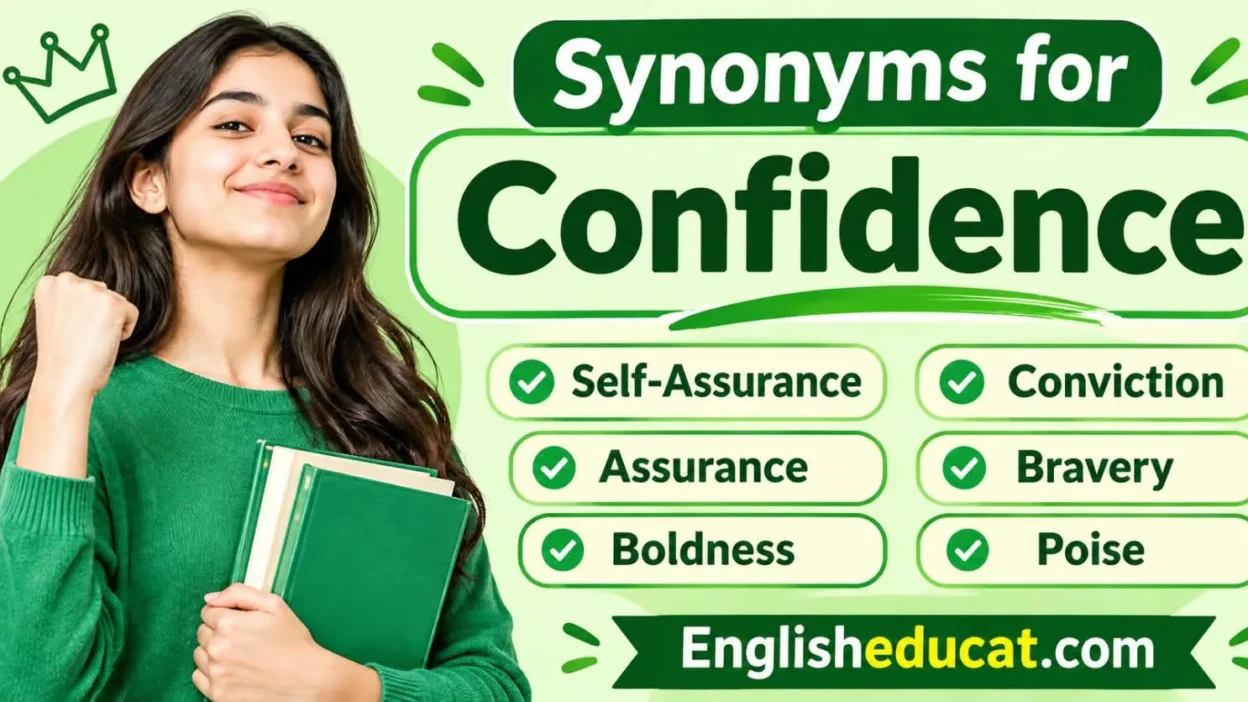
The best synonyms for confidence are self-assurance, self-belief, poise, assertiveness, trust, faith, certainty, and conviction. Which one fits usually depends on the sense: self-belief is usually about you, trust is about other people, and certainty is about facts.
This guide contains a group of 20 words by meaning, shows how each one feels in a sentence, and helps you pick the right word for essays, emails, and speaking tests.
What Does Confidence Mean? Synonyms for Confidence Explained
Confidence is a noun according to grammar. It has three main meanings that are given below:
- Belief in your own ability: She spoke with confidence.
- Trust in a person or thing: We have full confidence in our team.
- A feeling of certainty: I can say with confidence that the store is open.
It also has a smaller meaning: a secret you share with someone, as in He told me this in confidence.
Quick List of Synonyms for Confidence
Some quick synonyms for confidence are given below in groups:
Self-belief group: self-assurance, self-belief, poise, aplomb, assertiveness, boldness, swagger, cockiness, bravado
Trust group: trust, faith, belief
Certainty group: certainty, assurance, conviction, certitude
Secret sense (minor): confidentiality
Adjectives for “confident”: self-assured, assured, self-possessed
Synonyms for Confidence by Meaning
1. Belief in Yourself
Self-assurance
Self-assurance is a calm and natural belief in your own ability. It shows in how you act, not in how loudly you talk. The tone of this word is neutral to formal and positive.
- Her self-assurance helped the nervous interviewers relax.
- He answered every hard question with quiet self-assurance.
Self-belief
Self-belief is the inner feeling that you can succeed. It is common in sports, coaching, and education. The tone of this word is neutral and positive.
- After three straight wins, the team’s self-belief was obvious.
- Good teachers build self-belief by praising effort, not only results.
Poise
Poise is a calm and balanced confidence, especially in public or under pressure. The tone for this word is neutral to formal and positive.
- The young pianist walked on stage with poise.
- She answered the angry questions with poise and a smile.
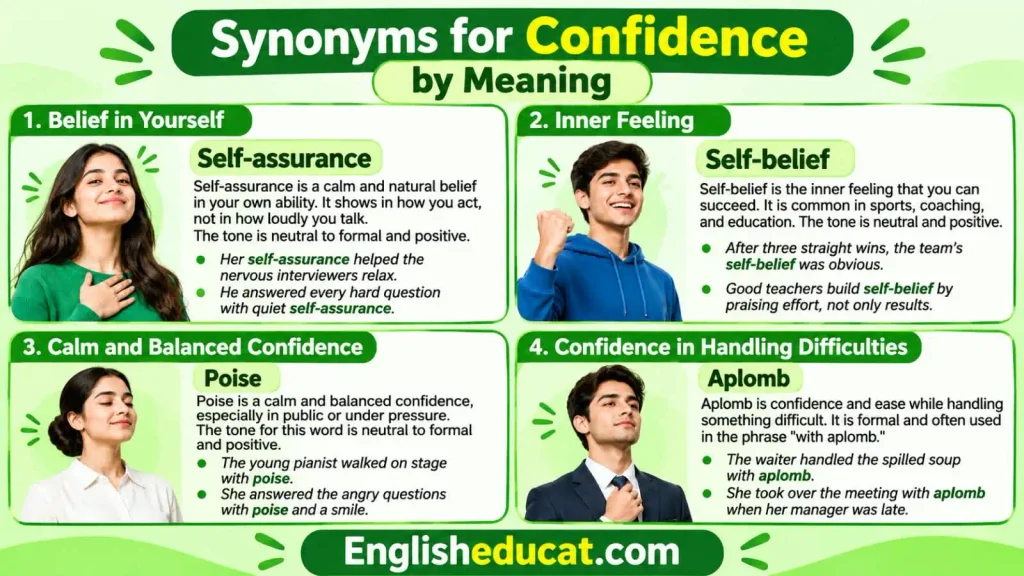
Aplomb
Aplomb is confidence and ease while handling something difficult. It is formal and often used in the phrase “with aplomb.” The tone is formal and literary.
- The waiter handled the spilled soup with aplomb.
- She took over the meeting with aplomb when her manager was late.
Assertiveness
Assertiveness is the confidence to state your needs and opinions clearly and politely. It is a skill, not just a feeling. The tone is neutral and common in business.
- Assertiveness training helped him say no to extra shifts.
- Her assertiveness in meetings got her ideas noticed.
Boldness
Boldness is the confidence to take risks. It is stronger than plain confidence because it includes action. The tone is neutral and sometimes positive.
- It took boldness to quit her job and open a bakery.
- The designer’s boldness paid off with a striking new logo.
Swagger
Swagger is showy confidence in the way you walk and talk. It can sound negative, but it can also describe style. The tone is informal and mixed.
- He walked in with a swagger that annoyed his classmates.
- The band’s swagger on stage won over the crowd.
Cockiness
Cockiness is overconfidence that disturbs other people. Avoid it in formal writing. The tone is informal and negative.
- His cockiness disappeared after he lost the first round.
- The coach warned that cockiness could cost them the final.
Bravado
Bravado is false confidence or bravery, shown to hide fear. The tone is neutral and negative.
- Behind his bravado, he was terrified of the exam.
- The boys’ bravado faded as soon as the dog barked.
2. Trust in Other People or Things
Trust
Trust is a firm belief that someone or something is reliable. It is the safest everyday synonym in this sense. The tone is neutral and positive.
- I have complete trust in my doctor.
- Trust takes years to build and seconds to lose.
Faith
Faith is strong trust, often without proof. It feels more emotional than “trust.” The tone is neutral and warm.
- The villagers had faith in their new teacher.
- She kept her faith in the plan even when sales fell.
Belief
Belief is the feeling that someone or something is good or true. It is a little softer than “faith.” The tone of this word is neutral.
- His belief in his students never changed.
- Her belief in the project convinced the investors.
3. Certainty About a Fact or Result
Certainty
Certainty is a complete confidence that something is true. The tone of this word is neutral and strong.
- I can say with certainty that the bus left at six.
- Nobody could speak about the result with any certainty.
Assurance
Assurance is confidence supported by experience, evidence, or a promise. Note that it also means “a promise.” The tone is neutral to formal.
- She spoke with the assurance of someone who had done the job for years.
- He gave his answer with quiet assurance.
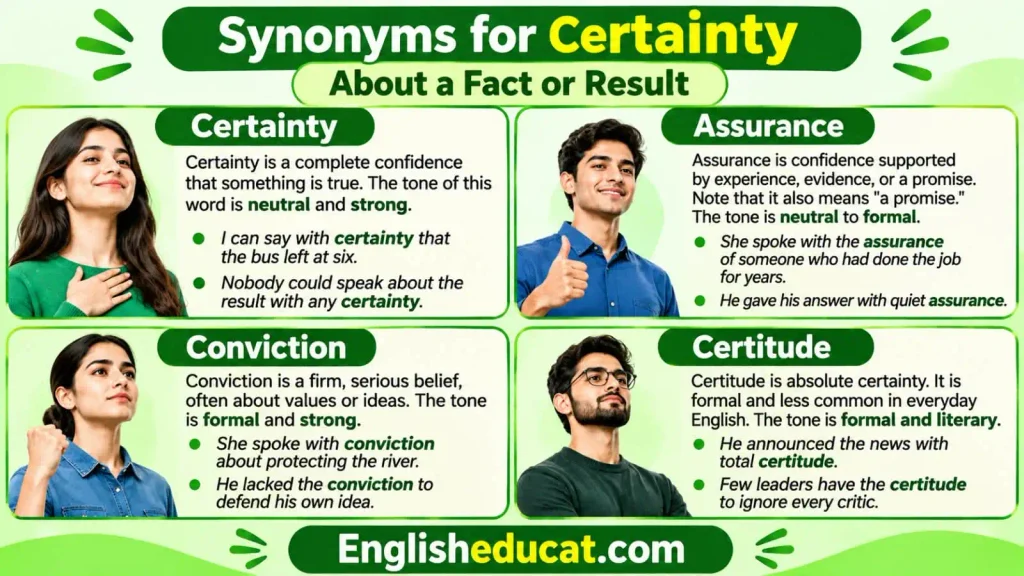
Conviction
Conviction is a firm, serious belief, often about values or ideas. The tone is formal and strong.
- She spoke with conviction about protecting the river.
- He lacked the conviction to defend his own idea.
Certitude
Certitude is absolute certainty. It is formal and less common in everyday English. The tone is formal and literary.
- He announced the news with total certitude.
- Few leaders have the certitude to ignore every critic.
4. The “In Confidence” Sense (Secrets)
Confidentiality
Confidentiality means keeping some information private. Having confidence in information often depends on how reliable it is. You can explore related vocabulary in our article about [synonyms of verify]. It fits only this minor sense, as in “in confidence.” It never replaces “self-confidence.”
- Doctors must protect patient confidentiality.
- The contract includes a clause on client confidentiality.
5. Adjectives You Can Use Instead of “Confident”
Self-assured
Self-assured describes someone calm and sure of themselves. The tone is neutral and positive.
- The self-assured speaker never needed her notes.
- A self-assured new manager took charge on day one.
Assured
Assured describes smooth and skilled confidence, often in a performance. It can also mean “guaranteed” (victory is assured). The tone is neutral to formal.
- The actor gave an assured performance on opening night.
- He sounded assured and clear during the presentation.
Self-possessed
Self-possessed describes someone who is calm and in control of their feelings. The tone of this word is formal.
- Even as a teenager, she was remarkably self-possessed.
- The self-possessed witness never raised her voice.
Comparison Table: Confidence Synonyms at a Glance
| self-assurance | calm belief in your ability | neutral-formal | describing a person’s manner | Her self-assurance impressed the panel. |
| self-belief | inner belief you can succeed | neutral | sports, school, coaching | Self-belief carried him through the final set. |
| poise | calm balance under pressure | neutral-formal | public or stressful moments | The host showed poise when the lights failed. |
| assertiveness | clear, polite expression of needs | neutral, business | work and teamwork | Assertiveness helps you set clear deadlines. |
| swagger | showy confidence | informal | style, attitude, character | The striker’s swagger made fans smile. |
| trust | belief someone is reliable | neutral | relationships and services | Customers place their trust in local shops. |
| faith | strong trust without proof | neutral, warm | hope and loyalty | We kept faith in the rescue team. |
| certainty | complete sureness about a fact | neutral | claims and results | There is no certainty that it will rain. |
| conviction | firm, serious belief | formal | speeches, values, essays | He argued with conviction for free libraries. |
| aplomb | ease in a hard situation | formal, literary | polished writing | The chef served 200 guests with aplomb. |
Confidence vs Confusable Words
Some words look almost similar to confidence but mean something different. Do not swap or confuse them.
- Self-esteem is how much you value yourself. Confidence is belief in your ability to do a task. You can have high self-esteem and still feel unsure before a driving test.
- Composure means staying calm. A person can keep composure and still doubt themselves.
- Courage means acting even when you are afraid. A courageous person may not feel confident at all.
- Optimism means expecting good results. It is about the future, not about your skill.
- Arrogance is an inflated view of yourself. Confidence is realistic; arrogance is not.
- Confidential means secret. It is not the adjective form of confidence; that is confident.
How to Choose the Right Synonym
- Formal writing: In formal writing, use self-assurance, conviction, aplomb, or certitude.
- Casual speech: In casual speech, use self-belief, swagger, or simply “being sure of yourself.”
- Academic essays: In academic essays, use conviction, certainty, or trust, and be precise about the sense.
- Business: In business, use assertiveness, assurance, or poise. Avoid cockiness.
- Creative writing: In creative writing, use swagger, bravado, or boldness to show character.
Quick-pick rule: When writing about yourself, choose self-assurance or self-belief. When writing about someone else, choose trust or faith. And when writing about a fact, choose certainty or conviction.
Antonyms of Confidence
The following are the antonyms for confidence:
- Doubt: She felt doubt about her answer until the results came.
- Insecurity: His insecurity made him avoid speaking in class.
- Self-doubt: Self-doubt kept her from applying for the job.
- Uncertainty: Uncertainty about the date delayed our plans.
- Timidity: The puppy’s timidity faded after a week at home.
- Diffidence: (formal) He spoke with diffidence, afraid to interrupt.
- Distrust: Years of broken promises created distrust between them.
Common Mistakes Learners Make
- Mixing nouns and adjectives. Wrong: She is very confidence. Right: She is very confident, or she has a lot of confidence.
- Wrong preposition. Say confidence in someone, not confidence on.
- Using “confidences” as a plural. In this sense, confidence is uncountable. “Confidences” means shared secrets.
- Confusing confident and confidential. A confident person is sure of themselves. A confidential file is private.
- Using cockiness or swagger in formal essays. Both sound informal and often negative.
- Forgetting the second meaning of conviction. It can also mean a guilty verdict in court. Context decides.
- Swapping assurance and insurance. They sound alike but are different words.
Classroom tip: learn each synonym with one collocation, such as speak with conviction or handle it with poise. A word that comes with its partner is much easier to use correctly.
Frequently Asked Questions
What is another word for confidence?
Another word for confidence is self-assurance. Other good choices are self-belief, poise, trust, faith, certainty, and conviction. The best one depends on meaning: use self-assurance or self-belief for belief in yourself, trust or faith for belief in others, and certainty for being sure about facts.
What is a formal synonym for confidence?
Aplomb, self-assurance, conviction, and certitude are formal options. Use aplomb for calm ease under pressure, as in “she handled the question with aplomb.” Use conviction for strong beliefs and certitude for absolute certainty. These words suit essays, speeches, and professional writing better than casual words like swagger.
What is the difference between confidence and arrogance?
Confidence is a realistic belief in your ability. Arrogance is an inflated belief that you are better than others. A confident person can listen and admit mistakes. An arrogant person usually cannot. Words like cockiness and swagger sit between the two, because they show confidence that others find annoying.
Is self-esteem a synonym of confidence?
Not exactly. Self-esteem is how much you value yourself as a person. Confidence is belief in your ability to do something. A person can have high self-esteem but feel unsure before a driving test. The two are related, but they are not interchangeable in careful writing.
What is a good synonym for confidence in a job interview or CV?
Use self-assurance, poise, or assertiveness. On a CV, show confidence with action words and results, not just the word itself. In an interview, “I speak with assurance about my work” sounds natural, and “I communicate with assertiveness” fits business settings. Avoid cockiness and swagger, which sound negative.
What is the opposite of confidence?
The opposite of confidence is doubt. Other antonyms are insecurity, self-doubt, uncertainty, timidity, and distrust. Choose by sense: self-doubt opposes belief in yourself, distrust opposes trust in others, and uncertainty opposes certainty about facts. Diffidence is a formal option.
Which synonym is best for IELTS or TOEFL writing?
Poise, assertiveness, conviction, and self-assurance work well because they are precise and natural. Learn each with its collocations, such as “speak with conviction” and “handle it with poise.” Do not replace confidence with a rare word just to sound advanced. A correct, simple word is safer than a wrong fancy one.
Conclusion
The best synonyms for confidence depend on the situation you want to use the word. Use self-assurance or self-belief for yourself, trust or faith for other people, and certainty or conviction for facts and values. The final takeaway is that “do not pick a synonym by sound. Pick it by sense, tone, and context”.

ESL Content Writer
Emily is a TESOL-certified writer who has taught English to international students for over 8 years. She loves breaking down idioms and everyday expressions into simple, relatable explanations that make sense to learners at any level.