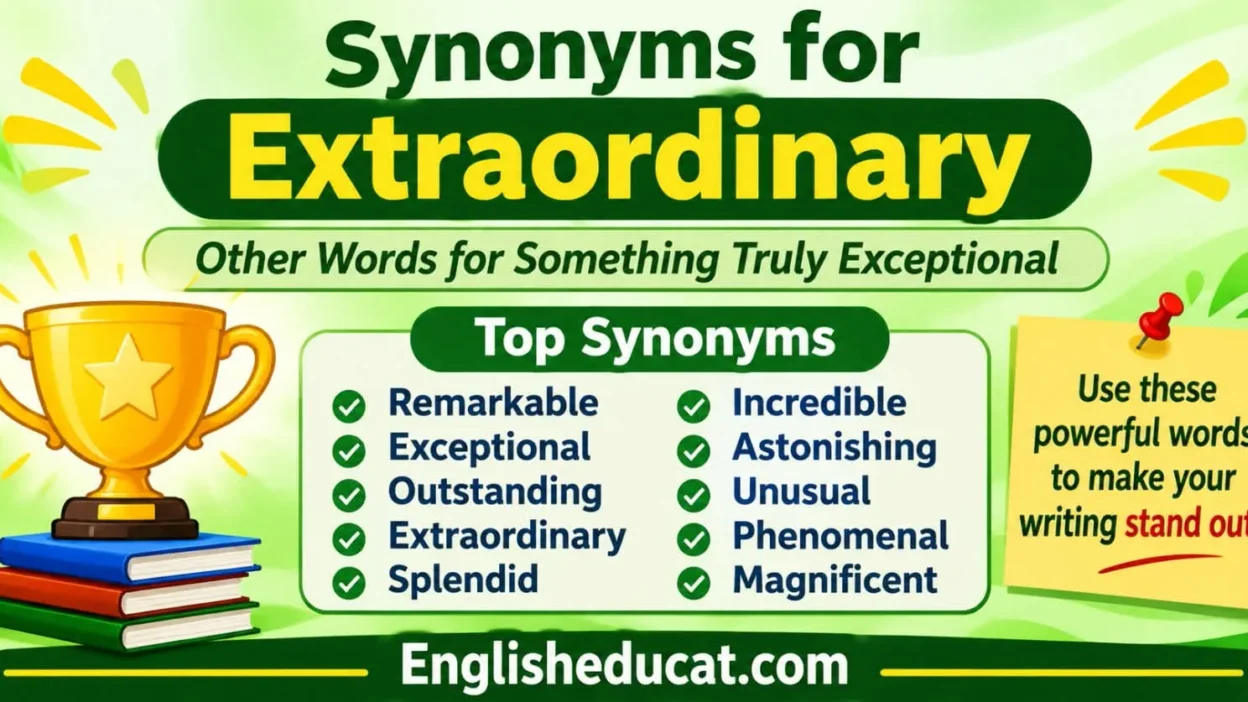
The best synonyms for extraordinary are exceptional, remarkable, outstanding, phenomenal, unusual, rare, and unprecedented. Which one you pick usually depends on your meaning: great quality, rarity, strangeness, or something never seen before.
This guide gives you 24 synonyms for extraordinary, grouped by meaning. Each word comes with its tone, its nuance, and two original examples, so you can choose with confidence.
What Does Extraordinary Mean?
Extraordinary is an adjective. It means that something is very unusual, or far beyond what is normal. It can describe something wonderful (an extraordinary talent), something very surprising (an extraordinary coincidence), or something very large (extraordinary heat).
Pronunciation hint: in American English, it is pronounced as ik-STROR-dn-air-ee. In British English, it is often shorter: ik-STROR-dn-ree.
Origin: the word comes from Latin extraordinarius, meaning “outside the usual order.” That idea is still the core of the word: something outside the ordinary. The word has a second, formal sense: “arranged for a special purpose,” as in an extraordinary meeting. Most synonyms for extraordinary do not cover this sense, so keep it in mind.
Quick List of Synonyms for Extraordinary
Here is the quick list at a glance before explaining each one in detail. We sorted the words by meaning, not by alphabet, because a flat list hides the differences.
- Excellent and impressive: exceptional, outstanding, remarkable, phenomenal, magnificent, fantastic, amazing, incredible, marvelous, terrific
- Rare and unusual: unusual, uncommon, rare, singular, unique, special, notable
- Strange: strange, odd, bizarre, peculiar, weird
- Never seen before, or very large: unprecedented, prodigious.
Synonyms for Extraordinary by Sense and Context
These synonyms for extraordinary fall into four groups. Words in the same group are close in meaning, but they are rarely perfectly interchangeable. An extraordinary achievement can sometimes have a vital impact on a person’s life or career. For more ways to describe importance, explore our article on [synonyms of vital]. Read the nuance notes before you replace the word in your own writing.
Group 1: Excellent and Impressive (Positive Meaning)
Use these when extraordinary means “much better than normal.”
Exceptional (adjective)
It means something is far above the usual standard. The tone is formal to neutral, and it works well in school and work writing.
- Her exceptional memory helped her pass the exam after one week of study.
- The hotel earned exceptional reviews for its friendly staff.
Outstanding (adjective)
It means better than others in the same group. It is the standard word for praise in reports, awards and references.
- The committee gave him an award for outstanding teaching.
- Her essay was so outstanding that the teacher read it to the class.
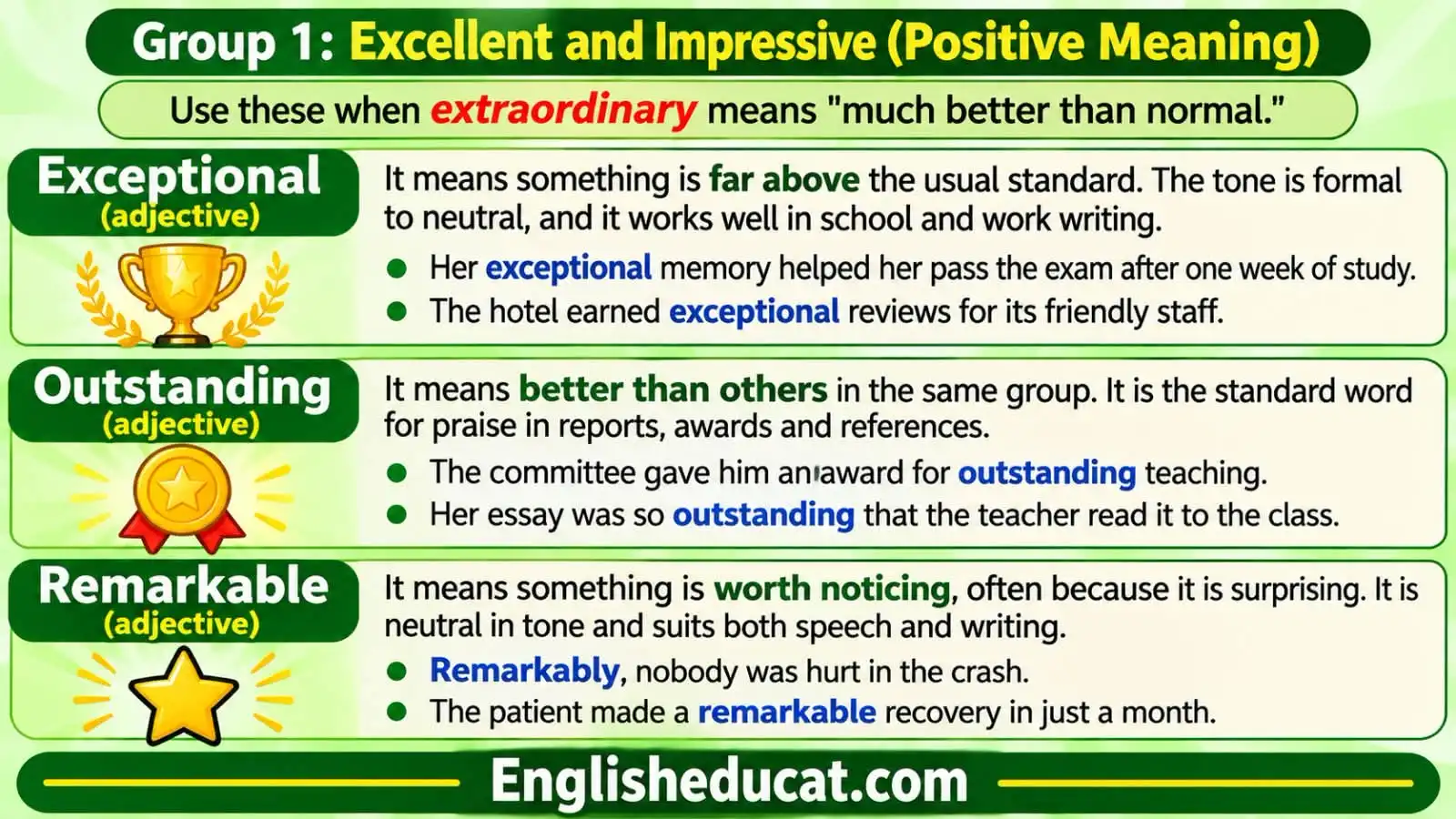
Remarkable (adjective)
It means something is worth noticing, often because it is surprising. It is neutral in tone and suits both speech and writing.
- Remarkably, nobody was hurt in the crash.
- The patient made a remarkable recovery in just a month.
Phenomenal (adjective)
It means something is extremely impressive, with a strong and energetic feel. It is common with results, growth and skill, and it sounds less formal than exceptional.
- Sales were phenomenal during the holiday week.
- That young pianist plays with phenomenal speed.
Magnificent (adjective)
It means something is grand, beautiful, and impressive. It suits views, buildings and performances.
- We watched the sun set behind a magnificent mountain range.
- The team played a magnificent game in the final.
Fantastic (adjective)
It means very good. It is informal and enthusiastic, so it fits speech and friendly emails better than formal reports.
- That was a fantastic idea, Sara!
- We had a fantastic time at the lake.
Amazing (adjective)
It means something so good that it surprises you. It is neutral to informal and one of the most common choices in everyday English.
- The view from the roof was amazing.
- It is amazing how quickly children pick up new languages.
Incredible (adjective)
So good, or so big, that it is hard to believe. It can describe quality or size.
- The chef cooked an incredible meal from five simple ingredients.
- She showed incredible patience with the noisy class.
Marvelous (adjective)
It means something is wonderful, with a warm and slightly old-fashioned feel. American spelling is marvelous; British spelling is marvellous.
- The garden looked marvelous after the rain.
- What a marvelous surprise to see you here!
Terrific (adjective)
Very good. It is informal and more common in American English. Learners should use it only for praise.
- You did a terrific job on the presentation.
- Her terrific cooking kept everyone at the table until midnight.
Group 2: Rare and Unusual (Neutral Meaning)
Use these when extraordinary means “not common,” without saying whether it is good or bad.
Unusual (adjective)
It means not common or not expected. It is the safest neutral synonym, and it works in every register.
- It is unusual for snow to fall in this city.
- He has an unusual hobby: he restores old clocks.
Uncommon (adjective)
It means not often found. It is more formal than neutral and sounds calmer than unusual.
- Blue eyes are uncommon in my family.
- An uncommon bird landed on our balcony this morning.
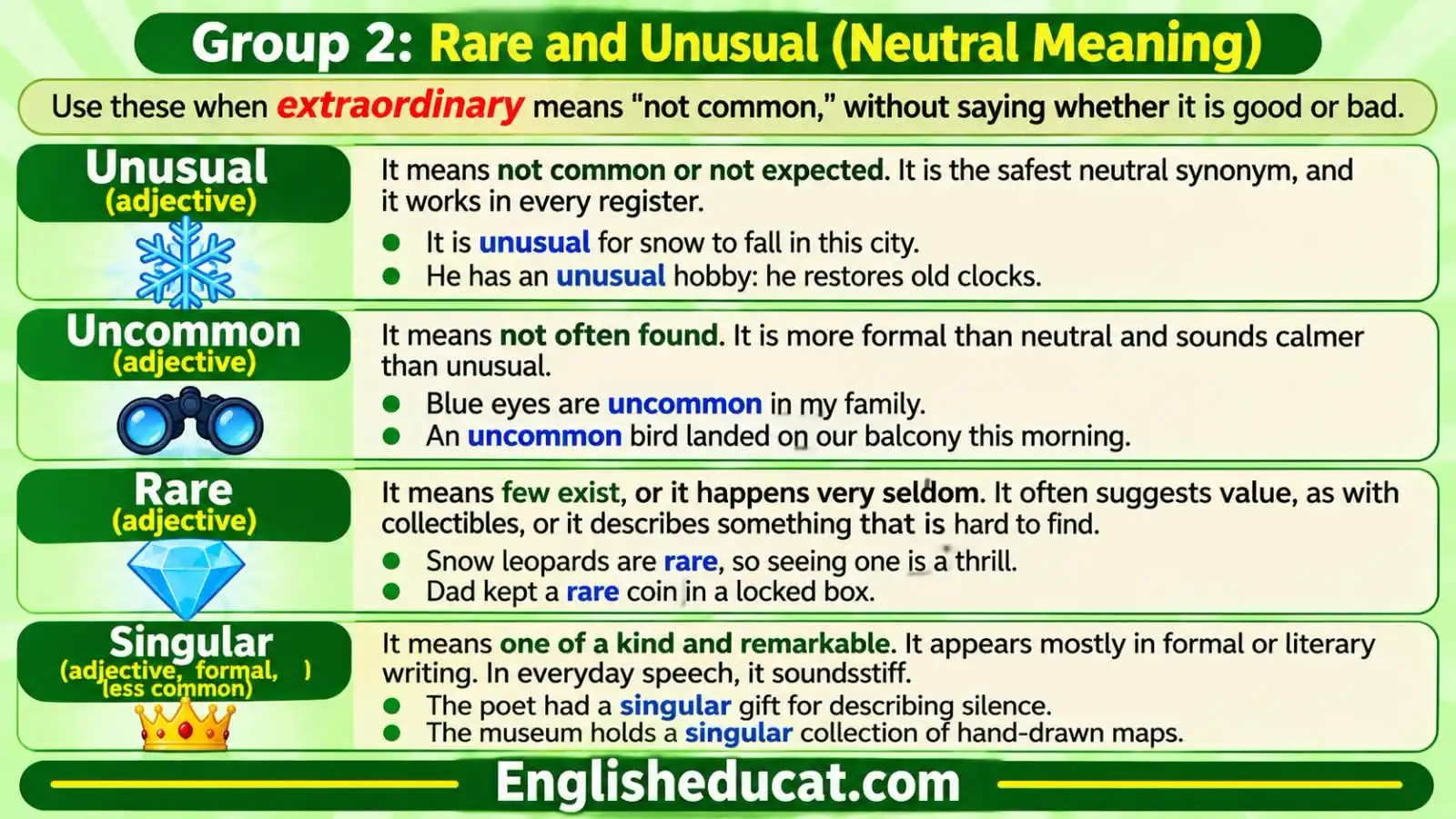
Rare (adjective)
It means few exist, or it happens very seldom. It often suggests value, as with collectibles, or it describes something that is hard to find.
- Snow leopards are rare, so seeing one is a thrill.
- Dad kept a rare coin in a locked box.
Singular (adjective, formal, less common)
It means one of a kind and remarkable. It appears mostly in formal or literary writing. In everyday speech, it sounds stiff.
- The poet had a singular gift for describing silence.
- The museum holds a singular collection of hand-drawn maps.
Unique (adjective)
The only one of its kind. This word is not a general swap for extraordinary, because it means “no other exists.” Avoid “very unique.”
- Every fingerprint is unique.
- The café has a unique design: the tables are made from old doors.
Special (adjective)
Set apart from the ordinary, often in a personal or emotional way. It is a lower-intensity word than extraordinary.
- Today is a special day for our family.
- The school held a special assembly for the winners.
Notable (adjective)
Worth attention or mention. It is formal and common in academic and business writing, but it is calmer than extraordinary.
- The most notable item in the museum is a 500-year-old map.
- Three notable changes appeared in the new edition of the textbook.
Group 3: Strange (Odd or Surprising Meaning)
Sometimes extraordinary means “strange.” These words are not praise, so do not use them to compliment someone. Some of these words are explained below:
Strange (adjective)
It means unfamiliar and a little uncomfortable. It is neutral in register.
- I heard a strange noise coming from the kitchen.
- It felt strange to walk through my old school again.
Odd (adjective)
It means mildly unusual in a way you notice. It is casual and less strong than strange.
- He wore one red sock and one blue sock, which looked odd.
- Oddly, the shop closes at noon on Fridays.
Bizarre (adjective)
It means very strange and hard to explain. It has a stronger, more dramatic feel than odd.
- The film had such a bizarre ending that nobody understood it.
- A bizarre rumor about the principal spread through the school.
Peculiar (adjective)
It means unusual in a way that feels slightly suspicious or funny. It is a little formal and often negative. Note that “peculiar to” means “found only in,” as in “a habit peculiar to this region.”
- The soup had a peculiar smell, so we did not finish it.
- She gave me a peculiar look when I mentioned the key.
Weird (adjective)
It means strange, often used in an informal and sometimes playful way. It is common in speech, but avoid it in formal essays.
- My dream last night was really weird.
- The weather has been weird all week: sunny, then hail.
Group 4: Never Seen Before, or Very Large
Use these when extraordinary means “beyond anything normal in size or history.” Some of these words are given below:
Unprecedented (adjective)
It means something never happened before. It is formal and very common in news and reports.
- The city faced unprecedented flooding last spring.
- The company reported unprecedented demand for its new phone.
Prodigious (adjective, formal, less common)
It means something is impressively large in amount, size, or ability. It sounds literary, so use it with care.
- He had a prodigious appetite for reading and finished a book every two days.
- The old oak tree grew to a prodigious height.
Comparison Table: Best Synonyms at a Glance
This table puts the most useful synonyms for extraordinary side by side, so you can compare tone and use them in seconds.
| exceptional | Far above a standard | Formal to neutral | Praising skill or quality | The exceptional service made us come back. |
| outstanding | Better than others | Formal to neutral | Awards, reviews, references | She earned an outstanding grade in physics. |
| phenomenal | Extremely impressive | Neutral to informal | Results, talent, growth | The band had a phenomenal first year. |
| unusual | Not common | All registers | Neutral description | It was an unusual request for a Monday. |
| unique | Only one exists | Neutral | One-of-a-kind things | Her handwriting is unique. |
| unprecedented | Never happened before | Formal, news style | Events and records | The heat wave was unprecedented here. |
Extraordinary vs. Confusable Words
There are also some words similar to extraordinary that are confusing:
Extraordinaire is a French word placed after a noun, usually in a playful way: “a baker extraordinaire.” It is not a general swap for extraordinary.
Unique means “only one exists.” A rare coin may be extraordinary, but only a one-of-a-kind coin is unique.
Exceptional compares something with a standard, as in exceptional grades. Extraordinary is broader and can describe people, events, or conditions.
How to Choose the Right Synonym for Each Situation
The right choice among synonyms for extraordinary depends on three things: your meaning, your reader and your tone. A simple classroom trick helps. Ask yourself first: do I mean good, rare, or strange? Then pick from the matching group above.
- Formal writing: the safest synonyms for extraordinary are exceptional, notable, remarkable and unprecedented.
- Casual speech: friendly messages call for synonyms for extraordinary with energy, such as amazing, fantastic and terrific.
- Academic writing (essays, IELTS, TOEFL): use remarkable, notable, uncommon, or unprecedented.
- Creative writing: use magnificent, singular, prodigious, bizarre or marvelous. Example: “A magnificent storm rolled across the bay.”
Antonyms of Extraordinary
Some antonyms for extraordinary are given below:
- ordinary: plain and not special. “It was an ordinary Tuesday.”
- normal: following the usual pattern. “Her temperature is normal.”
- typical: showing the usual features. “That is typical weather for April.”
- commonplace: seen everywhere. “Smartphones are commonplace in classrooms now.”
- unremarkable: not worth noticing. “The meal was unremarkable.”
- mediocre: only average, and the opposite of the “excellent” sense. “His grades were mediocre.”
Words like bad or poor oppose only the “excellent” sense, so we left them out.
Related Words, Idioms and Collocations
- Collocations: extraordinary talent, extraordinary courage, extraordinary measures, extraordinary circumstances.
- Formal uses: an extraordinary general meeting (a meeting held outside the regular schedule, common in British and Commonwealth business English) and “ambassador extraordinary.”
- Idioms: out of the ordinary, out of this world, one in a million, second to none, a cut above, once in a lifetime.
- Word family: extraordinarily (adverb), extraordinariness (noun), extraordinaire (loan word).
Frequently Asked Questions
What are the best synonyms for extraordinary?
The best options are exceptional, remarkable, outstanding, phenomenal, unusual, rare, and unprecedented. Choose by meaning: exceptional, outstanding and remarkable praise quality, unusual and rare describe things that are not common, and unprecedented means it never happened before. Strange fit: odd things, not praise.
What is a stronger word than extraordinary?
Phenomenal, magnificent, and incredible are stronger in feeling, and unprecedented is stronger in scale. Use phenomenal for results or skill, magnificent for grand beauty, and incredible when something is hard to believe. Save these words for real impact, because too many strong words make your writing sound exaggerated.
What are some informal synonyms for extraordinary?
Amazing, fantastic, and terrific are common informal choices, and weird works for strange things. They fit speech, texts, and friendly emails in everyday English. In formal essays or reports, switch to exceptional, remarkable, or outstanding, which sound more professional and carry less slang.
Is extraordinary a positive word?
Not always. Extraordinary usually sounds positive, as in an extraordinary talent, but it simply means far from ordinary. Context decides the tone. An extraordinary mistake or extraordinary heat is not praise. Look at the noun it describes, and pick a clearer synonym, such as outstanding or unusual, if the tone might confuse readers.
What is the opposite of extraordinary?
The most common opposites are ordinary, normal, typical, and usual. Commonplace, average, and unremarkable also work. Use ordinary when something is plain, normal when it follows the rule, and unremarkable when it fails to impress. For the excellent sense, mediocre is also a fair opposite.
What is the difference between extraordinary and exceptional?
Extraordinary means far beyond the ordinary; exceptional means far above a standard or rule. Exceptional is often used when you compare something to others, such as exceptional grades. Extraordinary is broader and can describe events, people, or conditions. In practice, the two often overlap.
Conclusion
Synonyms for extraordinary are not all the same. Some usually praise quality, some describe rarity, and some mean strange. Keep this list of synonyms for extraordinary nearby, and match each word to your meaning, your reader, and your tone. The final key takeaway is to decide whether you mean good, rare, or strange, then choose the word from that group.

ESL Content Writer
Emily is a TESOL-certified writer who has taught English to international students for over 8 years. She loves breaking down idioms and everyday expressions into simple, relatable explanations that make sense to learners at any level.