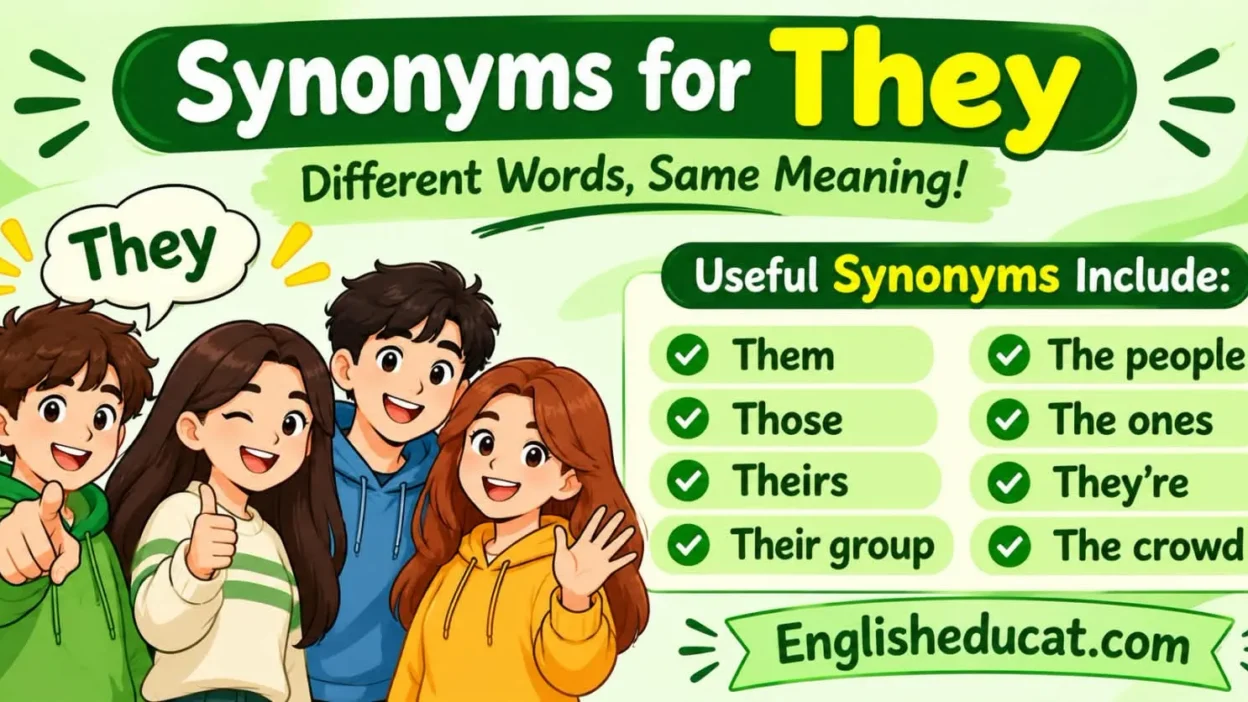
Looking for synonyms for they? The best replacements for this word are people, the group, those people, participants, individuals, both, all, and he or she. The right choice depends on whom the word “they” refers to and how formal your writing is.
“They” is a pronoun, so it has no perfect one-word twin. The synonyms for they in this guide work as substitutes in specific situations, and each section shows you which word fits which situation.
What Does “They” Mean?
They is a third-person personal pronoun. We use it instead of a noun we have already mentioned. It has four main jobs in the sentence:
- Plural: it points to more than one person, animal, or thing. The neighbors planted tulips, and they bloom every April.
- Singular, gender unknown or unimportant: Someone left their umbrella in the hall.
- Singular, a specific person who uses they/them pronouns: Jordan said they would join us later.
- People in general: They say the old library is haunted.
Pronunciation: /ðeɪ/ (rhymes with day and say).
Part of speech: pronoun, subject form. The other forms are them (object), their and theirs (possessive), and themselves (reflexive).
Origin: The word “they” comes from Old Norse þeir. It entered English in the Viking Age and slowly replaced the Old English word hīe. It is a neutral word. You can use it in speech, emails, essays, and reports. People often use pronouns like “they” when talking about individuals in relationships built on trust and loyalty.
Grammar tip: they always takes a plural verb, even for one person. We say they are and they were, just as we say you are for one person.
Quick List of Synonyms for They
Here are the synonyms for they, grouped by meaning. Each group is explained with examples in the next section.
A group of people
- people
- those people
- the group
- the team
- the committee
- participants
- respondents
- individuals
How many (a count or amount)
- all
- both
- some
One person, gender unknown
- he or she
- one
- the person
- the individual
People in general (“They say…”)
- people
- experts
- locals
- the authorities
How we chose these synonyms: we kept only words and phrases that can truly stand in for “they” in a sentence. We left out we, you, I, and it, because they change who is speaking or being spoken about.
Synonyms for They by Sense and Context
Choose the sense first, then the word. The wrong choice can change your meaning, not just your tone.
1. When “they” means a group of people
people (noun, plural)
It is the most neutral choice. It works in speech and in writing when the group is general. Examples are given below:
- Many people walk to work in this neighborhood.
- People remember a good story longer than a list of facts.
Those people (pronoun phrase)
It points to a specific group that both speaker and listener can identify. The tone can feel distant, and a sharp voice can make it sound unfriendly. Examples are given below:
- I have never met those people before today.
- Those people by the gate are waiting for the bus.
The group (noun)
It treats the people as one unit that acts together. In American English, the verb is singular. In British English, you may see either form. Examples are given below:
- The group decided to wait until morning.
- After a short vote, the group chose the cheaper hotel.
The team and the committee usually work in the same way. Use the team for people who work toward one goal, and the committee for an official body that makes decisions. Example: The committee approved the budget on Tuesday.
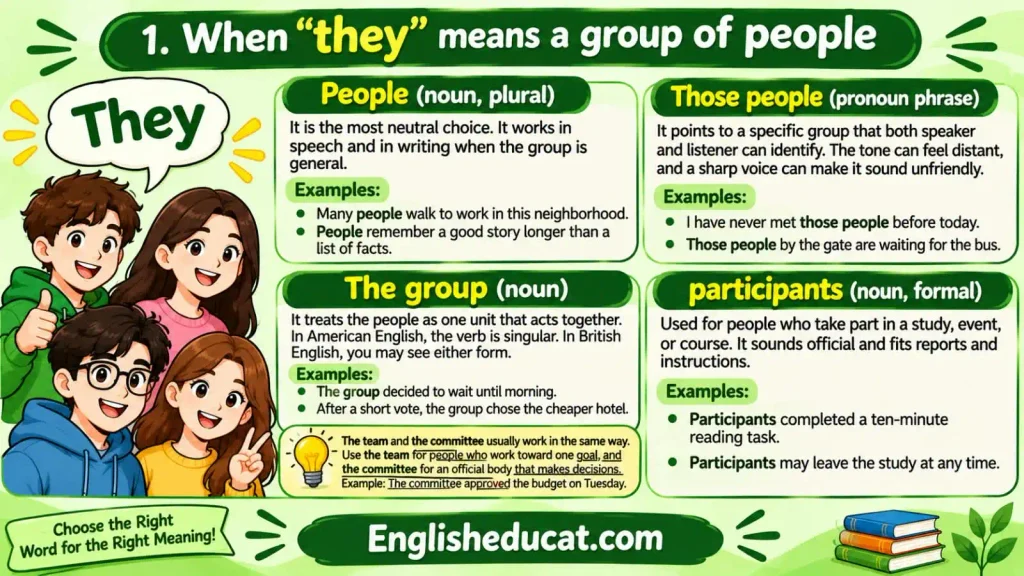
participants (noun, formal)
Used for people who take part in a study, event, or course. It sounds official and fits reports and instructions. Examples are given below:
- Participants completed a ten-minute reading task.
- Participants may leave the study at any time.
Respondents (noun, formal)
Used for people who answer a survey or a questionnaire. Do not use it for people who simply take part in an event. Examples are given below:
- Most respondents lived in large cities.
- The respondents were asked about their sleep habits.
Individuals (noun, formal)
It stresses that each person is separate, not part of a crowd. It can sound cold in casual talk. Examples are given below:
- Several individuals reported the same problem.
- The report treats customers as individuals, not as a crowd.
Classroom tip: learners often write “the peoples” for a normal group. Use people (no -s) in most cases. Peoples means separate nations or ethnic groups.
2. When “they” shows how many
All (pronoun)
It means every member of the group. On its own, as a subject, it sounds formal or literary. Examples are given below:
- All of the students passed the test.
- All were tired, but all were happy.
Both (pronoun)
It means exactly two. Never use it for three or more. Examples are given below:
- Both of my cousins study medicine.
- Both agreed to meet on Friday.
Some (pronoun)
It means only part of the group. It leaves the rest unnamed. Examples are given below:
- Some of the guests left early.
- Some prefer the mountains; others prefer the beach.
3. When “they” means one person of unknown gender
He or she (pronoun phrase, formal)
Clear and correct, but it can feel wordy and stiff. It also treats gender as only two options. Examples are given below:
- An absent student must bring a note when he or she returns.
- Each applicant should explain what he or she hopes to learn.
One (pronoun, very formal)
It is impersonal and common in academic or legal writing. In everyday American English, it can sound old-fashioned. Examples are given below:
- One should read the contract before signing it.
- If one is late, one must tell the manager.
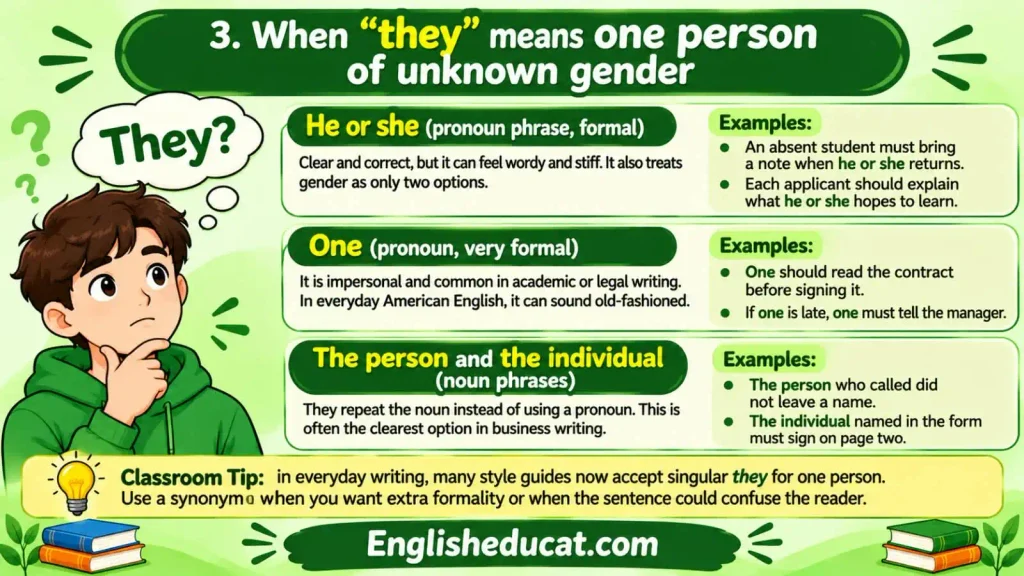
The person and the individual (noun phrases)
They repeat the noun instead of using a pronoun. This is often the clearest option in business writing. Examples are given below:
- The person who called did not leave a name.
- The individual named in the form must sign on page two.
Classroom tip: in everyday writing, many style guides now accept singular they for one person. Use a synonym when you want extra formality or when the sentence could confuse the reader.
4. When “they” means people in general
In phrases like They say it will rain, the word “they” has no clear owner. It means that it is not clear which people are meant by the word “they.” A specific noun is stronger.
Experts (noun)
It names people with knowledge, so your claim sounds more reliable.
- Experts advise drinking water before you feel thirsty.
Locals (noun, informal)
It names people who live in a place.
- Locals say the old bridge floods every spring.
The authorities (noun phrase, formal)
It names officials such as police or city leaders.
- The authorities have closed the road until Monday.
Quick fix: you can also remove “they” by using the passive voice. That house is said to be haunted has no “they” at all.
Comparison Table: Synonyms for They at a Glance
Use this table to compare the most useful synonyms for they in one place.
| Word | Meaning | Tone / register | Best used when | Example |
| people | a general group of persons | neutral | the group is broad | People often forget their umbrellas. |
| the group | persons acting as one unit | neutral | the group has one goal | The group meets every Monday. |
| those people | a specific, known group | neutral, can sound distant | you point to a group nearby | Who are those people by the gate? |
| participants | persons who take part | formal | studies, events, courses | Participants must sign a consent form. |
| individuals | separate persons | formal | each person matters alone | Several individuals reported the same problem. |
| all | every member | formal or literary | nobody is left out | All the players wore red. |
| both | exactly two | neutral | there are only two | Both teams trained in the rain. |
| some | part of a group | neutral | not everyone is included | Some neighbors brought food. |
| he or she | one person, gender unknown | formal, stiff | official forms and rules | Every driver must show his or her license. |
| one | any person in general | very formal | academic or legal writing | One cannot learn a language overnight. |
| the person | one specific person | neutral | clarity matters most | The person at the desk was helpful. |
| experts / locals / the authorities | people in general, named by role | varies | “They say…” sentences | Experts advise drinking more water. |
They vs Confusable Words
Some words look almost similar to synonyms for they, but they are not. Here is how to tell them apart.
- They vs them: they is the subject, and them is the object. They invited us, but we invited them.
- They’re vs their vs there: they’re means they are, their shows ownership, and there shows place. They are proud of their garden over there.
- They vs it: use it for one thing and they for more than one. The key is lost, but it will turn up. The keys are lost, so they may be in the car.
- They vs these and those: these and those point at things. They replace a noun. Those are mine; they are mine.
- They vs themselves and themself: themselves is the reflexive form. They taught themselves to code. Some writers use themself for one person, but it is less common.
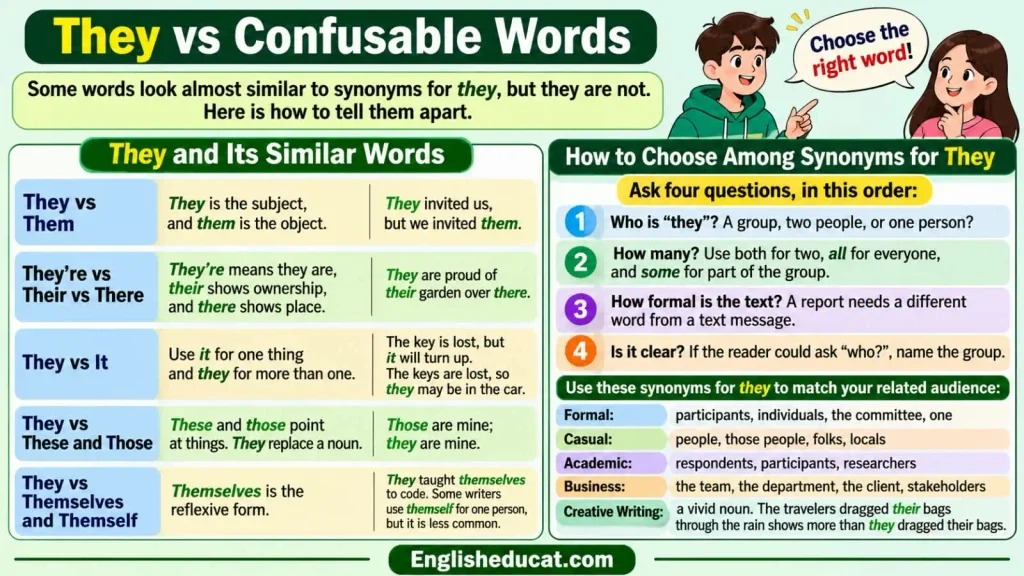
How to Choose Among Synonyms for They
Ask four questions, in this order:
- Who is “they”? A group, two people, or one person?
- How many? Use both for two, all for everyone, and some for part of the group.
- How formal is the text? A report needs a different word from a text message.
- Is it clear? If the reader could ask “who?”, name the group.
Use these synonyms for they to match your related audience:
- Formal: participants, individuals, the committee, one
- Casual: people, those people, folks, locals
- Academic: respondents, participants, researchers
- Business: the team, the department, the client, stakeholders
- Creative writing: a vivid noun. The travelers dragged their bags through the rain shows more than they dragged their bags.
Antonyms of “They” (With Examples)
“They” has no true antonym. Because synonyms for they are really situation-based substitutes, its opposites are also about situation. The closest contrasts are pronouns that include or address the speaker:
- we and I: They arrived late, but we arrived on time.
- you: They asked a question, and you answered it.
Use these only to show contrast. They do not mean the opposite of “they” in the way hot is the opposite of cold.
Related Words, Idioms and Collocations
Related words: them, their, theirs, themselves, themself. All of these are forms of the same pronoun. The word they belongs to the group of personal pronouns.
Idioms and phrases:
- They say… means “people in general believe or report.” They say practice makes perfect.
- As they say introduces a well-known saying. As they say, better late than never.
- Us and them describes two sides that feel separate. The new schedule created an us-and-them feeling.
- The powers that be means people in authority. It is a close cousin of the authorities.
Collocations: they both, they all, they themselves, they say, and contractions such as they are, they had, they will, they have. There are no phrasal verbs built on they.
Learn these phrases next to the synonyms for they above, and your sentences will sound more natural.
Frequently Asked Questions
What are the best synonyms for they?
The best replacements are people, the group, those people, participants, and individuals. There is no perfect one-word synonym, because the word they is a pronoun. Choose the word that matches who you mean and how formal your text is. Check the meaning first, then the tone.
What can I say instead of they in formal writing?
Use a specific noun, such as participants, respondents, the committee, or the authorities. A noun is clearer and sounds more professional than a pronoun. For one person, use the person, the individual, or he or she. Always name the group your reader expects.
Is they singular or plural?
Both. It is plural for groups, and it is singular for one person whose gender is unknown or who uses they/them pronouns. The verb stays plural in every case, such as they are and they were. Many style guides now accept singular they in formal writing.
What is the difference between they and them?
They is the subject form, and them is the object form. For example, they called me, but I called them. Them is not a synonym of they. It is another form of the same pronoun, so use it only when the word is the object.
Is we a synonym for they?
No. We includes the speaker, and they does not. Swapping they for we changes who you are talking about. Some thesauruses list we as a match, but it is a different pronoun, not a substitute. Use we only when you are part of the group.
What is the opposite of they?
There is no true antonym. The closest contrast is we or I, because they points to people other than the speaker. For groups, you can also contrast they with you, the people being addressed. Context decides which contrast makes sense.
Conclusion
Synonyms for they are not one-word twins. They are substitutes that fit a specific situation: a group, a count, one person, or people in general. The key takeaway: decide who you mean first, then pick the word to use in the sentence. Choose people for a neutral group, participants for formal research, both or all for counts, and a clear noun whenever the reader might ask “who?”. Practice with the synonyms for they in this guide, and your writing will be clearer and more varied.

ESL Content Writer
Emily is a TESOL-certified writer who has taught English to international students for over 8 years. She loves breaking down idioms and everyday expressions into simple, relatable explanations that make sense to learners at any level.