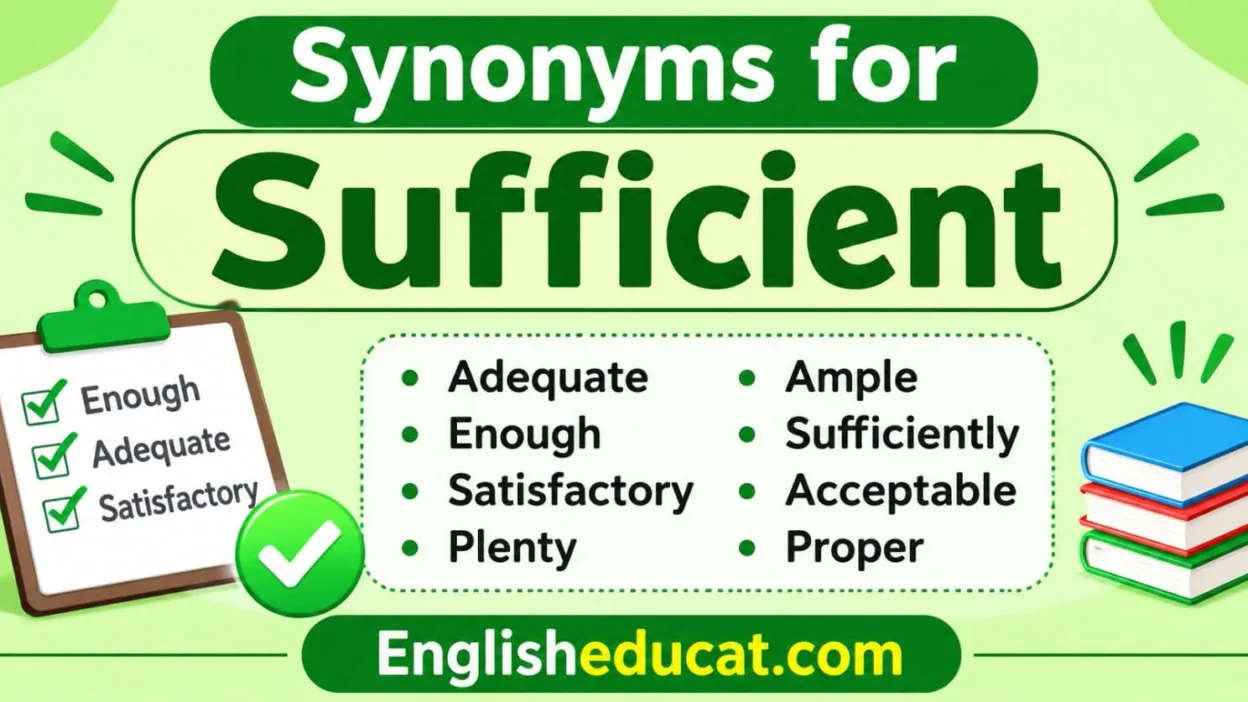
The best synonyms for sufficient are enough, adequate, ample, satisfactory, acceptable, and plentiful. All of them mean one thing: “as much as you need,” but they differ in strength and tone. Enough is usually casual, adequate is neutral, and ample means more than enough.
This guide gives you another word for sufficient in every situation: emails, essays, reviews, speaking tests, and everyday talk. Each word comes with its exact nuance and original examples, so you can pick the right one fast.
Quick List of Synonyms for Sufficient
Sufficient (adjective) means enough to meet a need or reach a goal. It does not suggest a surplus. It suggests the amount is right for the job. Scan this list first. Each group is explained in detail below.
Enough is used to meet the need. This word list is given below:
- enough
- adequate
- satisfactory
- acceptable
More than enough:
- ample
- plentiful
- abundant
- copious
- generous
Barely enough or “good enough”:
- tolerable
- passable
- decent
- reasonable
- fair
Formal: matching the need:
- commensurate
- proportionate
Verbs: to be enough:
- suffice
- do
- serve
Synonyms for Sufficient by Meaning and Context
Most lists give you one flat set of words. That causes mistakes, because these words usually sit at different points on a scale. Some mean “just enough.” Others mean “plenty.” Having sufficient skills and knowledge can help build confidence in your abilities. Explore our guide to [synonyms of confidence] to discover different ways to express self-belief and assurance. So we usually group them by sense and tell you when each one fits.
Sense 1: Enough to Meet the Need
Use these when the amount or quality of a sentence is right, no more and no less.
Enough:
Enough is the most common everyday word for sufficient. It is less exact and less formal, so it usually works best in speech and simple writing. It can act as an adjective, a pronoun, or an adverb.
- Do we have enough chairs for all the guests?
- Ten minutes was enough for her to sketch the whole room.
Adequate:
Adequate means good enough for the purpose, but nothing more. The tone is neutral, and in reviews it can look like faint praise. Typical collocations: adequate housing, adequate funding, adequate preparation.
- The hotel room was small but adequate for a one-night stay.
- Our current servers are adequate for now, but we will need more when the app grows.
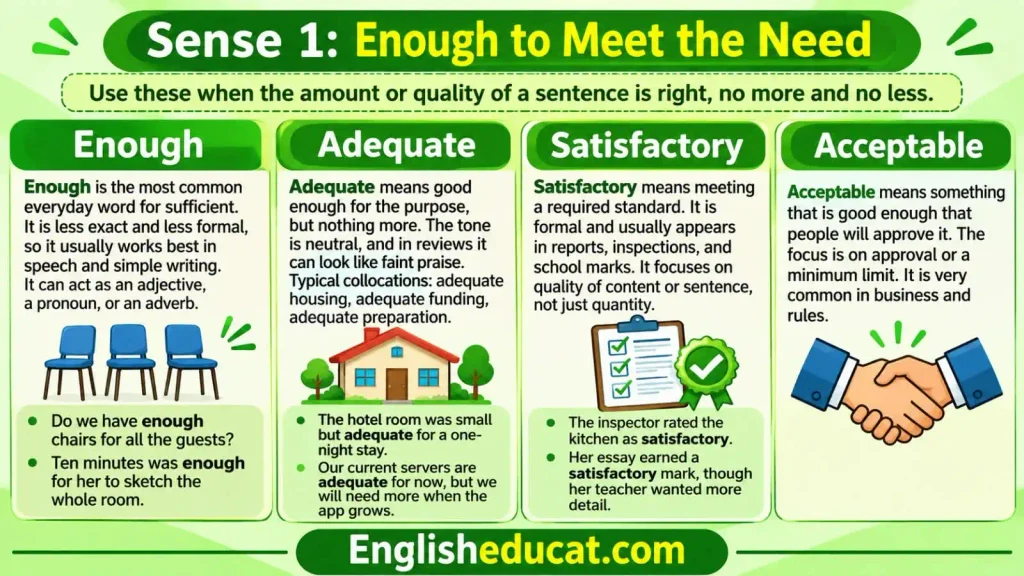
Satisfactory:
Satisfactory means meeting a required standard. It is formal and usually appears in reports, inspections, and school marks. It focuses on quality of content or sentence, not just quantity.
- The inspector rated the kitchen as satisfactory.
- Her essay earned a satisfactory mark, though her teacher wanted more detail.
Acceptable:
Acceptable means something that is good enough that people will approve it. The focus is on approval or a minimum limit. It is very common in business and rules.
- A one-day delay is acceptable if you warn the client first.
- The translation was acceptable, but a few phrases sounded unnatural.
Sense 2: More Than Enough
Use these when there is plenty, with room to spare. They are stronger than sufficient.
Ample:
Ample means more than enough, with space or time left over. The tone is positive and slightly formal in this word. Some typical collocations are: ample time, ample space, ample room, ample opportunity.
- The garage has ample space for two cars and a workbench.
- We left early, so there was ample time to find parking.
Plentiful:
Plentiful describes things that are available in large numbers, such as food, water, or jobs. It fits supplies and resources better than abstract ideas.
- Fresh fish is plentiful along this coast.
- Jobs were plentiful in the city that year.
Abundant:
Abundant means existing in very large quantities. It is slightly formal and often describes nature, light, or resources.
- Abundant rainfall helped the farmers this season.
- The forest offers abundant shade in summer.
Copious:
Copious means very large in amount. It is formal and usually works best with things you can write, pour, or produce: notes, tears, liquid, detail.
- He took copious notes during the lecture.
- The recipe calls for copious amounts of garlic.
Generous:
Generous means larger than usual or expected. Use it for portions, allowances, and margins. It also suggests kindness, so check the context.
- The restaurant serves generous portions.
- The contract gives us a generous deadline.
Sense 3: Good Enough, but Not Impressive
These words say the amount or quality is acceptable, not great. Tolerable and passable are the weakest. Decent, reasonable, and fair sound warmer. Some words similar to it are given below:
Tolerable:
Tolerable means bearable, but not good. The tone is lukewarm and often a little negative.
- The heat was tolerable in the shade.
- After the long flight, the airport coffee was tolerable.
Passable:
Passable means fairly good but not excellent. It often describes skills. It can also mean a road you can travel on.
- He speaks passable Spanish after one year of lessons.
- The mountain road is passable now that the snow has melted.
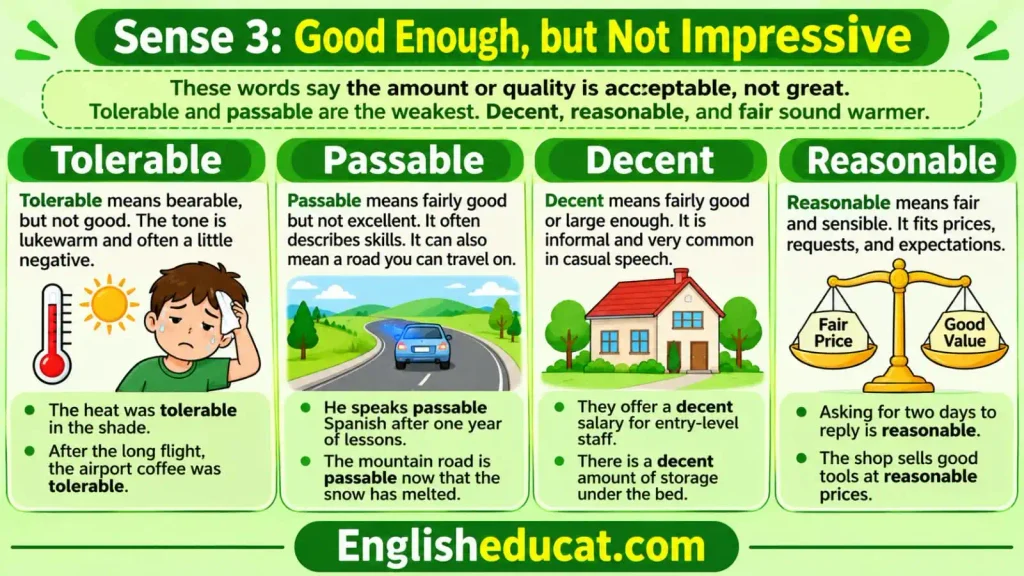
Decent:
Decent means fairly good or large enough. It is informal and very common in casual speech.
- They offer a decent salary for entry-level staff.
- There is a decent amount of storage under the bed.
Reasonable:
Reasonable means fair and sensible. It fits prices, requests, and expectations.
- Asking for two days to reply is reasonable.
- The shop sells good tools at reasonable prices.
Fair:
Fair works in phrases like “a fair amount,” which means quite a lot, more than a little. It is not a stand-alone replacement for sufficient.
- We still have a fair amount of work to finish.
- She has a fair chance of winning the prize.
Sense 4: Formal Words for Matching the Need
These words say that one thing matches with another in size or level. They are partial synonyms, so do not change them blindly. Some are given below:
Commensurate:
Commensurate means matching in size, level, or value. It is formal and mostly takes “with.”
- The job offers a salary commensurate with experience.
- Penalties should be commensurate with the offense.
Proportionate:
Proportionate means the right size compared with something else. It often takes “to” and appears in talk about responses, fines and rewards.
- The fine was proportionate to the damage.
- A proportionate reply to a small complaint is a short, polite note.
Sense 5: Verbs That Mean “Be Enough”
Suffice:
Suffice is a formal verb meaning to be enough. It often follows “will.”
- For a simple login page, a basic form will suffice.
- One page will suffice for this summary.
Do:
Do is a casual verb meaning to be good enough. You will hear it in speech all the time.
- We do not need a new table. This old one will do.
- Any pen will do for the form.
Serve:
Serve means to be good enough for a purpose, often in the pattern “serve as.”
- A large box can serve as a desk for now.
- This small tent will serve for one night.
Comparison Table: Sufficient and Its Synonyms
| Word | Meaning | Tone / register | Best used when | Example |
| sufficient | enough to meet a need | formal-neutral | reports, essays, rules | Sufficient data supports the claim. |
| enough | as much as needed | casual | speech, simple writing | There is enough soup for everyone. |
| adequate | good enough, no more | neutral | reviews, assessments | The lighting is adequate for reading. |
| satisfactory | meets a set standard | formal | grades, inspections | The test results were satisfactory. |
| acceptable | within approved limits | neutral, business | rules, quality checks | Small errors are acceptable in a first draft. |
| ample | more than enough | formal-neutral | time, space, evidence | The hall has ample seating. |
| plentiful | available in large numbers | neutral | food, water, jobs | Mangoes are plentiful in summer. |
| abundant | in very large quantity | formal | nature, light, resources | Wildflowers are abundant in spring. |
| copious | large in amount | formal | notes, tears, detail | She wrote copious comments on my draft. |
| generous | larger than expected | neutral | portions, allowances | We got a generous discount. |
| tolerable | bearable, not good | neutral | weather, noise | The noise was tolerable with the window shut. |
| decent | fairly good or large enough | informal | everyday talk | We found a decent hotel near the station. |
| reasonable | fair and sensible | neutral | prices, requests | A reasonable amount of sleep helps. |
| commensurate | matching in level | formal | pay, penalties | Rewards should be commensurate with effort. |
| suffice | be enough | formal verb | short replies | A brief email will suffice. |
Sufficient vs Confusable Words
Some words look or sound very close to sufficient but do not mean the same thing.
Sufficient vs. efficient:
The spelling is similar, but the meanings are not. Efficient means working well without waste. Sufficient means enough. An efficient heater uses little power. A sufficient heater gives enough heat.
Sufficient vs enough:
Both talk about amount, but they sit differently in a sentence. We say “sufficient time” or “enough time.” After an adjective, we say “warm enough” or “sufficiently warm,” never “sufficient warm.”
Sufficient vs adequate:
Sufficient leans toward amount. Adequate leans toward quality for a task. Adequate can also hint that a standard was only just met.
Sufficient vs competent:
Competent describes the skill of a person. We say “a competent nurse,” not “a sufficient nurse.”
How to Choose the Right Synonym for Sufficient
Ask two questions. How much is there? And who is reading? The table gives a quick pick.
| You want to say | Pick | Why |
| Exactly the amount needed | sufficient | exact, formal-neutral |
| Plenty, with room to spare | ample | positive, slightly formal |
| Barely enough | adequate or tolerable | low-key tone |
| It meets the standard | satisfactory | formal, quality focus |
| A natural spoken phrase | enough or a decent amount | friendly and simple |
| Large amounts in nature | abundant or plentiful | descriptive |
Words are used according to the situation. Some situations are given below:
- Casual talk: enough, plenty, decent
- Formal writing: adequate, satisfactory, sufficient
- Academic essays: sufficient evidence, ample evidence, adequate support
- Business emails: adequate resources, acceptable level, satisfactory performance
- Creative writing: abundant, plentiful, copious
- IELTS and TOEFL speaking: enough, plenty of, a decent amount of
Regional note: in everyday English, sufficient has the same meaning in American and British use. Spelling differences appear in antonyms: meager (US) and meagre (UK).
Antonyms of Sufficient
The main opposite is insufficient. The other antonyms show different kinds of shortage.
- insufficient: not enough. “The funds were insufficient to repair the roof.”
- inadequate: too small or too poor for the need. “The old pump is inadequate for a house this size.”
- deficient: missing something important. “Her diet was deficient in iron.”
- scarce: hard to find. “Clean water became scarce during the drought.”
- meager: very small in amount. “He lived on a meager income.”
- scant: barely any. “The report gave scant detail.”
- lacking: not having what is needed. “The plan is lacking a clear budget.”
There is also an opposite on the other side: too much. Words like excessive and surplus describe more than you need. Excellent is not an antonym of sufficient, because it describes quality, not amount.
Common Mistakes Learners Make
- Saying “very sufficient.” It sounds unnatural. Write “more than sufficient,” “ample,” or “quite enough.”
- Writing “sufficient large.” Use “sufficiently large” or “large enough.”
- Mixing up sufficient and efficient. One is about amount; the other is about working without waste.
- Using adequate as praise. In a review, “adequate” can sound like a mild complaint.
- Using commensurate without “with.” Write “commensurate with experience.”
- Using ample for a tiny amount. Ample means plenty, not just enough.
- Replacing sufficient with competent, valid, or efficient. These describe skill, truth, or performance, not amount.
Frequently Asked Questions
What is another word for sufficient?
The most common word for sufficient is enough. Other good choices are adequate, satisfactory, acceptable, and ample. Use enough in casual talk, adequate in neutral writing, and ample when you mean more than enough. Your choice depends on tone and on how much you want to say about the amount.
What is the difference between sufficient and enough?
Sufficient is more formal and exact, while enough is more casual and common. Both mean as much as needed. Use sufficient before in reports and essays (sufficient evidence). Use enough in speech and after adjectives (big enough). Both are correct in most sentences, so choose by tone.
Is adequate a good synonym for sufficient?
Yes, but adequate is often weaker. It means good enough for the purpose and nothing more. In a review, calling something adequate can sound like mild criticism. In reports, it is neutral and safe. Use ample if you want a more positive tone.
What is a formal synonym for sufficient?
Satisfactory, adequate, and ample suit formal writing, and suffice is the formal verb. Commensurate also fits, but only when something matches another thing, as in a salary commensurate with experience. Avoid casual words like decent or fair in academic essays. Use ample when you mean plenty.
Can I use sufficient in casual conversation?
Yes, but it can sound stiff. Most people say enough with friends and family. Sufficient fits emails, reports, essays, and exams better. For example, say I have enough time in a chat, but we have sufficient time in a project update. Both are correct.
What is the adverb of sufficient?
The adverb is sufficiently. It means to a degree that is enough, and it usually comes before an adjective, such as sufficiently large or sufficiently clear. Do not write sufficient large. A natural alternative is large enough. Another option is adequately, which sounds a little weaker.
What is the opposite of sufficient?
The main opposite is insufficient. Other antonyms are inadequate, deficient, scarce, meager, and lacking. Choose insufficient for a formal shortage, scarce for supplies that are hard to find, and inadequate when quality or size is too low. Excellent is not an antonym because it describes quality, not amount.
Which synonym is best for IELTS or TOEFL writing?
Adequate, ample, and satisfactory are strong, safe choices. Use ample when there is more than enough, as in ample evidence, and adequate when the level is just right. Pair them with natural partners such as adequate funding or ample time, because natural word pairs read better than rare words.
Conclusion
The best synonyms for sufficient depend on two things: how much there is, and how formal you need to sound. Use enough for everyday talk, adequate for neutral writing, satisfactory for standards, and ample when there is plenty. Final key takeaway: do not pick a synonym from a flat list. Match the word to the amount and the audience, and your writing will sound natural.

Linguistics Specialist
James is a linguist with a Ph.D. in Applied Linguistics from Boston University. His work focuses on word origins, synonyms, and how language evolves over time. He has contributed to several academic journals on English semantics.