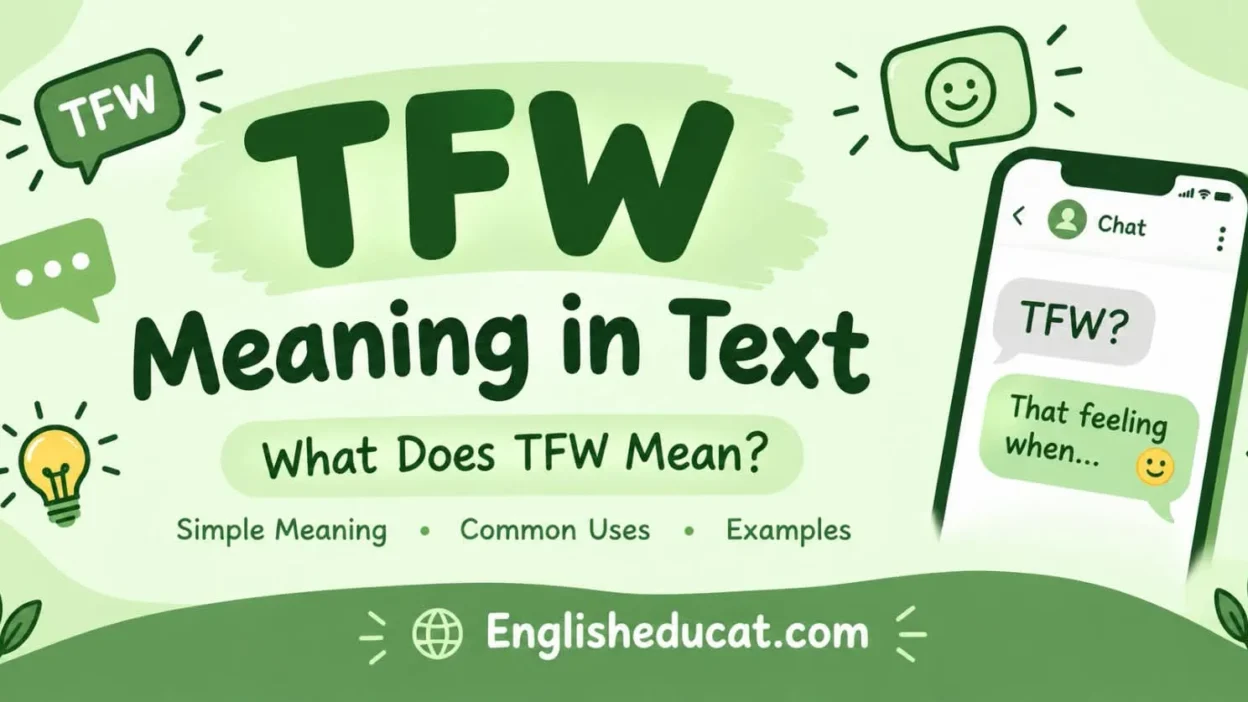
TFW usually stands for “that feeling when.” It is a short form people use in text messages and social posts to share a moment others know well, like “TFW your phone dies at 1%.” That is the full tfw meaning in text. This guide also shows how to use TFW, how to reply, and where it came from.
What Is the TFW Meaning in Text?
TFW mostly means “that feeling when.” It is an internet abbreviation, which is a short form of a phrase. It means the same thing on every phone and every app.
Here is how it works:
- What you see: TFW you find money in an old coat.
- What it means: That feeling when you find money in an old coat.
The word “text” covers two main things here. It covers text messages. It also covers short online posts and captions. In both cases, TFW starts a line about a feeling the reader can picture.
People often add a GIF, a meme, or a photo. The picture shows the feeling. The words name the moment. There are many other words like WYG and WY that are used in texting.
Merriam-Webster lists TFW as an abbreviation used on social media and the internet. It added the word in September 2023. So TFW is now part of standard reference books.
What Does TFW Stand For in Text?
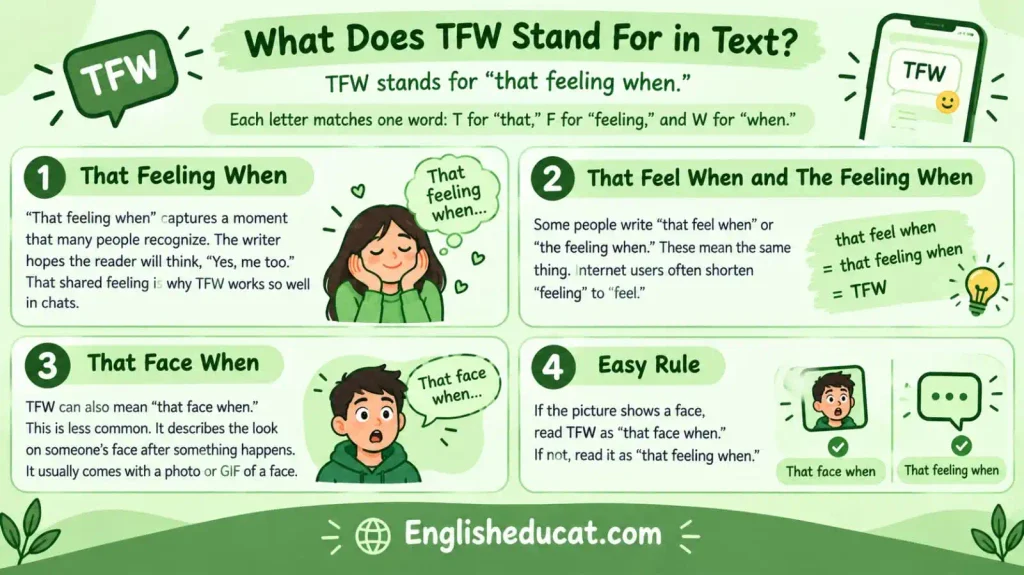
TFW stands for “that feeling when.” Each letter matches one word: T for “that,” F for “feeling,” and W for “when.”
That Feeling When
“That feeling when” captures a moment that many people recognize. The writer hopes the reader will think, “Yes, me too.” That shared feeling is why TFW works so well in chats.
That Feel When and The Feeling When
Some people write “that feel when” or “the feeling when.” These mean the same thing. Internet users often shorten “feeling” to “feel.”
That Face When
TFW can also mean “that face when.” This is less common. It describes the look on someone’s face after something happens. It usually comes with a photo or GIF of a face.
Here is an easy rule. If the picture shows a face, read TFW as “that face when.” If not, read it as “that feeling when.”
Why Is There a “When” If W Already Means When?
TFW already has “when” in it. Even so, many people type “TFW when your bus is late.” That adds a second “when.” It is not needed, but it is common. Merriam-Webster notes this repetition and treats it as fine for casual posts.
How to Use TFW in a Text Message
To use TFW, type TFW and then describe a short, relatable moment. Keep the line brief and clear.
The Basic Pattern
Most TFW messages follow one pattern: TFW plus a situation. The situation often starts with “you,” “your,” or “I.”
- TFW you wake up, and it is Saturday.
- TFW your favorite song comes on.
- TFW I forget my keys again.
Happy, Funny, and Sad Examples
TFW works for many moods. Here are three side by side.
- Happy: TFW your package arrives a day early.
- Funny: TFW you wave at someone who was not waving at you.
- Sad: TFW the show you love gets canceled.
Each line names a moment. The reader fills in the feeling.
Capital Letters and Punctuation
Both “TFW” and “tfw” are correct. Capital letters feel louder. Lowercase feels more relaxed. You do not need a period at the end.
Using TFW With a GIF or Meme
A GIF can make your message even clearer. Pick a picture that matches the feeling. A sad cat fits a sad moment. A dancing person fits good news.
How to Reply to a TFW Text
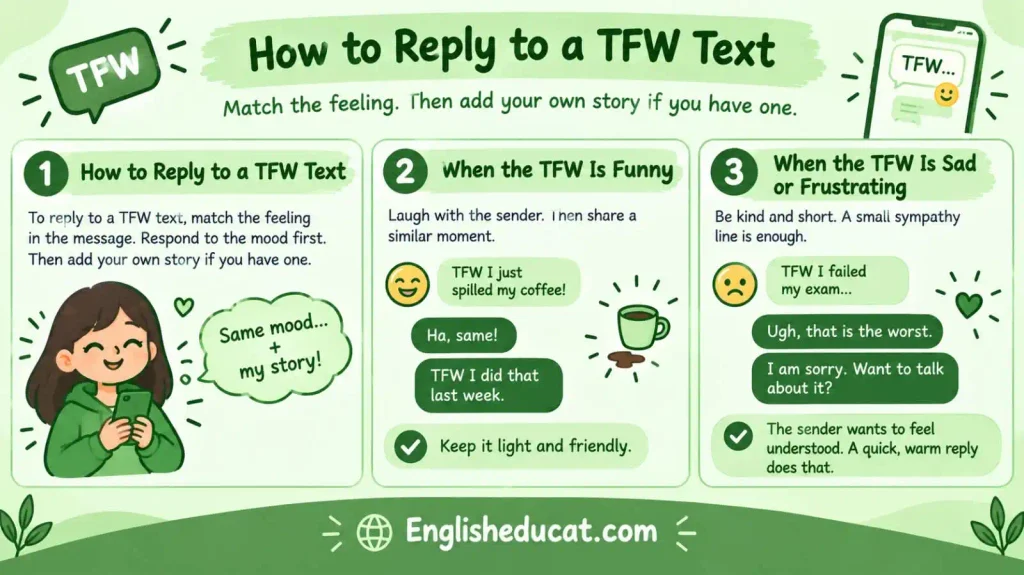
To reply to a TFW text, match the feeling in the message. Respond to the mood first. Then add your own story if you have one.
When the TFW Is Funny
Laugh with the sender. Then share a similar moment.
- Ha, same!
- TFW I did that last week.
When the TFW Is Sad or Frustrating
Be kind and short. A small sympathy line is enough.
- Ugh, that is the worst.
- I am sorry. Want to talk about it?
The sender wants to feel understood. A quick, warm reply does that.
Is TFW Okay to Use at Work or in Formal Messages?
No, TFW is not a good fit for work emails or formal writing. It is casual slang. It fits chats with friends and relaxed social posts.
For a formal message, write the full idea. For example, say “It is frustrating when a meeting runs late.” TFW is friendly and fun. That is exactly why it feels out of place in a business email.
TFW Meaning in Text vs MFW, MRW, and “Me When”
TFW means “that feeling when.” MFW means “my face when.” TFW focuses on a feeling, while MFW focuses on a look on the face. Parade notes that TFW is the more popular of the two.
| Abbreviation | Stands For | Best Used For |
| TFW | That feeling when | A relatable moment or emotion |
| MFW | My face when | A reaction shown on a face |
| MRW | My reaction when | A reaction, often shown with a GIF |
| Me when | Me when | A joke about your own behavior |
TFW vs MFW
TFW can name any feeling. MFW is for a face. If you send a selfie, MFW fits. If you describe a mood, TFW fits.
Where Did TFW Come From?
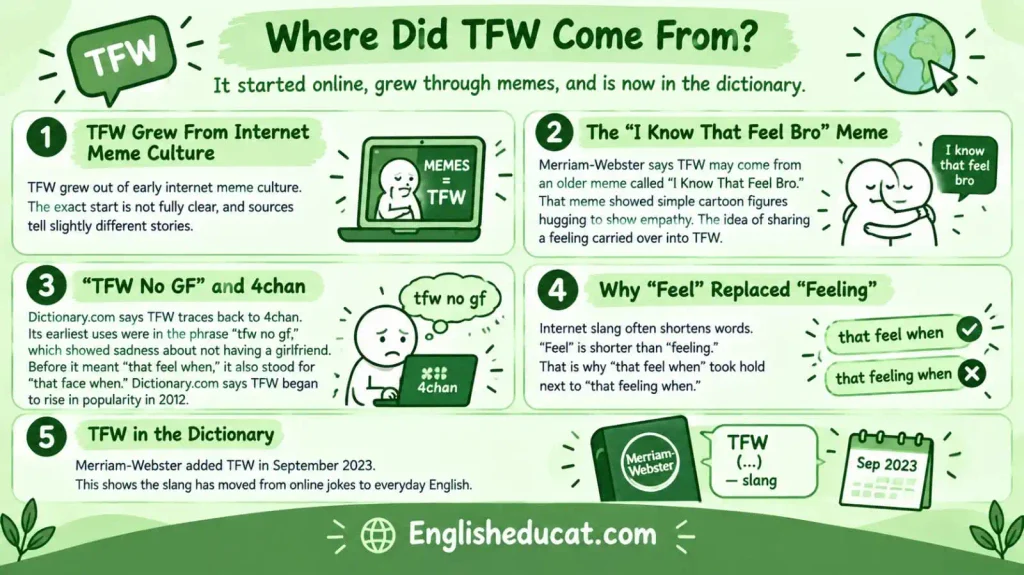
TFW grew out of early internet meme culture. The exact start is not fully clear, and sources tell slightly different stories.
The “I Know That Feel Bro” Meme
Merriam-Webster says TFW may come from an older meme called “I Know That Feel Bro.” That meme showed simple cartoon figures hugging to show empathy. The idea of sharing a feeling carried over into TFW.
“TFW No GF” and 4chan
Dictionary.com says TFW traces back to 4chan. Its earliest uses were in the phrase “tfw no gf,” which showed sadness about not having a girlfriend. Before it meant “that feel when,” it also stood for “that face when.” Dictionary.com says TFW began to rise in popularity in 2012.
Why “Feel” Replaced “Feeling”
Internet slang often shortens words. “Feel” is shorter than “feeling.” That is why “that feel when” took hold next to “that feeling when.”
TFW in the Dictionary
Merriam-Webster added TFW in September 2023. This shows the slang has moved from online jokes to everyday English.
TFW on Different Platforms
TFW means the same thing on every app. Only the style changes a little.
- TikTok and Instagram: TFW often sits in a caption over a video or photo.
- Snapchat: TFW fits short captions and quick chats.
- Discord: TFW appears in server chats, often with a reaction image.
- YouTube: TFW appears in comments.
- Messaging apps: TFW works in any chat, such as WhatsApp or iMessage.
Parade lists Instagram, TikTok, Discord, and YouTube as common places to see TFW. The same rule applies everywhere. Say the moment, and add a picture if it helps.
Related Slang You Might See Next to TFW
These short forms often appear in the same chats.
- POV: “Point of view.” Used to set a scene.
- SMH: “Shaking my head.” Shows disappointment.
- FOMO: “Fear of missing out.”
- IRL: “In real life.”
- Mood: A short way to say “I relate to this.”
They all work the same way. A few letters carry a whole feeling.
Frequently Asked Questions
What does TFW mean in text?
TFW means “that feeling when.” People use it in text messages and social posts to introduce a moment others can relate to. For example, “TFW your phone dies at 1%” means “that feeling when your phone dies at 1%.” It is casual slang and often comes with a GIF or meme.
What does TFW stand for?
TFW stands for “that feeling when.” The letters match the words: T for “that,” F for “feeling,” and W for “when.” It also appears as “that feel when.” Less often, it means “that face when,” usually with a photo of a face. All versions share the same goal: sharing a relatable moment.
What is the difference between TFW and MFW?
TFW means “that feeling when,” while MFW means “my face when.” TFW can describe any feeling or situation. MFW describes a facial reaction, so it often comes with a selfie or reaction picture. Both start a relatable moment, but MFW is narrower in what it covers.
Does TFW mean “that face when”?
Sometimes. TFW most often means “that feeling when.” It can mean “that face when” if the message describes a facial reaction and a photo of a face is attached. Merriam-Webster lists both meanings. Check the sentence and the picture to pick the right one.
How do I reply to a TFW text?
Match the mood of the message. For a funny TFW, reply with a laugh or your own story, like “Ha, same!” For a sad one, send a short, kind line such as “That is the worst.” Keep it brief. A GIF reply also works well and feels natural in casual chats.
Is TFW okay to use at work or in formal writing?
No. TFW is casual slang, so it fits chats with friends and relaxed social posts. It does not fit work emails or formal writing. In those cases, write the full idea instead, such as “It is frustrating when a meeting runs late.” This keeps your message clear and polite for the reader.
Where did TFW come from?
TFW grew out of early internet meme culture, and the exact start is not settled. Merriam-Webster says it may come from the “I Know That Feel Bro” meme. Dictionary.com traces it to 4chan and the phrase “tfw no gf,” and says it rose in popularity in 2012.
Conclusion
The tfw meaning in text is very simple: it turns a small moment into something shared. Now you know what TFW stands for, how to use it, and how to answer it. The next time a friend sends “TFW your phone dies at 1%,” you will know exactly what to say. Try writing one of your own.

Linguistics Specialist
James is a linguist with a Ph.D. in Applied Linguistics from Boston University. His work focuses on word origins, synonyms, and how language evolves over time. He has contributed to several academic journals on English semantics.