
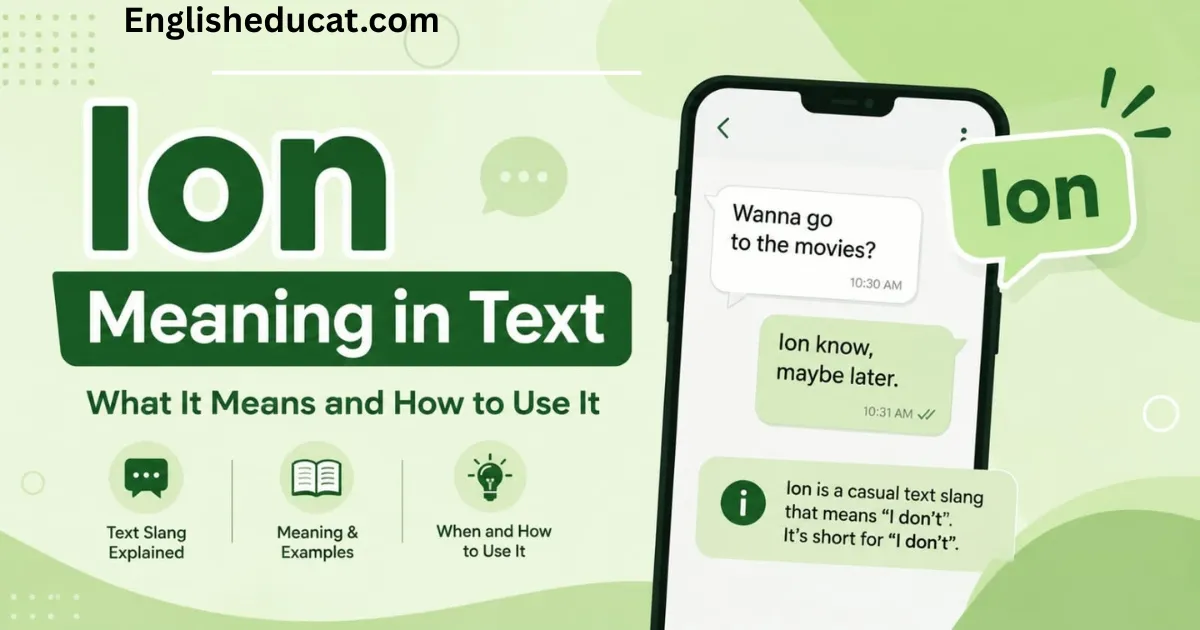
This context will break down every meaning of ion. It will also show how people use it on different apps, and will explain when it is okay to use it and when you should skip it.
Ion meaning in text is simple: it means “I don’t.” When it is written in all capital letters as ION, it usually means “In Other News” instead. This is different from the word “ion,” which means a charged atom or molecule; these two are not related to each other.
What Does Ion Mean in Text? (Quick Answer)
Here is the quick answer to ion meaning in text:
| ion (lowercase) | “I don’t” | “ion know” |
| ION (uppercase) | “In Other News” | “ION, did you see that?” |
The lowercase version is more common. Most of the time, when someone texts you “ion,” they mean “I don’t.”
This is not same as the scientific word “ion.” In chemistry, an ion is an atom or molecule with an electric charge, like a positive or negative ion. That word is not used in texting slang. We will come back to this mix-up later, because many people search for it.
The Two Meanings of “Ion” And How to Tell Them Apart
Ion meaning in text can change a little. It depends on how the word is written and where it appears in a sentence. Let’s look at both meanings closely.
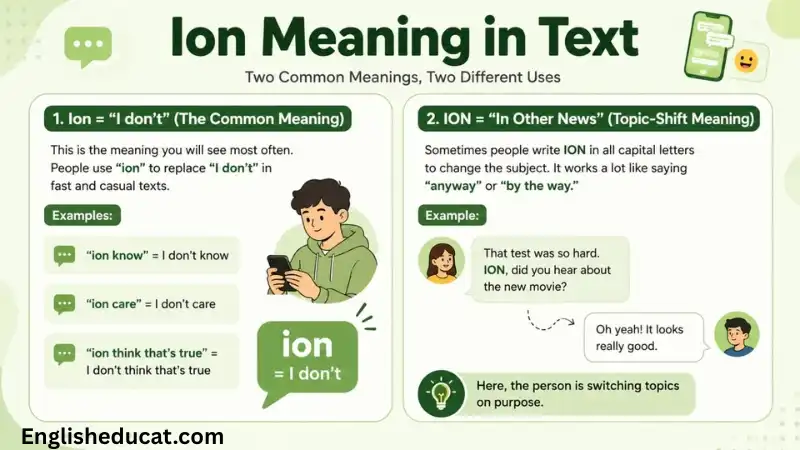
Ion = “I don’t” (the common meaning)
This is the meaning you will see most often. People use “ion” to replace “I don’t” in fast and casual texts.
Here are some real examples:
- “ion know” = I don’t know
- “ion care” = I don’t care
- “ion think that’s true” = I don’t think that’s true
ION = “In Other News” (the topic-shift meaning)
Sometimes people write ION in all capital letters to change the subject. It works a lot like saying “anyway” or “by the way.”
For example: “That test was so hard. ION, did you hear about the new movie?” Here, the person is switching topics on purpose.
The Capitalization Rule
This is the easiest way to find which meaning is used. Lowercase “ion” mostly means “I don’t.” Uppercase “ION” is likely to mean “In Other News,” especially when it starts a new sentence or thought.
Mobile autocorrect is not perfect. Autocapitalize can turn “ion” into “Ion” at the start of a sentence, even when the person means “I don’t.” So the safest way to know the true meaning is to read the whole sentence, not just the letters.
Where “Ion” Comes From (Origin & Linguistics)
Ion started as a way of writing how “I don’t” sounds when people say it quickly. Say “I don’t know” out loud, quickly. It often comes out sounding like “ion know.” That is the whole idea behind this slang term.
This speech pattern has deep roots in African American Vernacular English (AAVE). AAVE is known as English with its own grammar and sound patterns. Linguists who study AAVE have written about how it shapes casual speech and spoken English. Over time, that same speech pattern became internet slang too, especially through platforms popular with Gen Z, like TikTok and Twitter/X.
I first saw this word years ago, when my younger cousin texted me “ion know what time we’re leaving lol” about a family trip. I read it three times and thought it was a typo. I almost texted back to ask what she meant, but then I said the phrase out loud, and “ion know” sounded exactly like “I don’t know” said fast. That was the moment when I knew it.
This is a good example of how texting slang often isn ot random. It is usually just spoken language, written the same way it sounds.
Language researchers have documented similar patterns for years. The Linguistic Society of America has written about how casual speech texts change internet slang over time. Ion fits that same pattern; it is a written snapshot of how people actually talk, not a random invention.
Is “Ion” a Typo or Real Slang? (Common Misunderstanding)
No, ion is not a typo. It is a real and patterned piece of internet slang, not a spelling mistake.
Some people online make fun of this word. They call it “lazy” or say it means someone can not spell “don’t.” That view misses the point, though ion follows a clear sound pattern based on real speech. It is not a random letter.
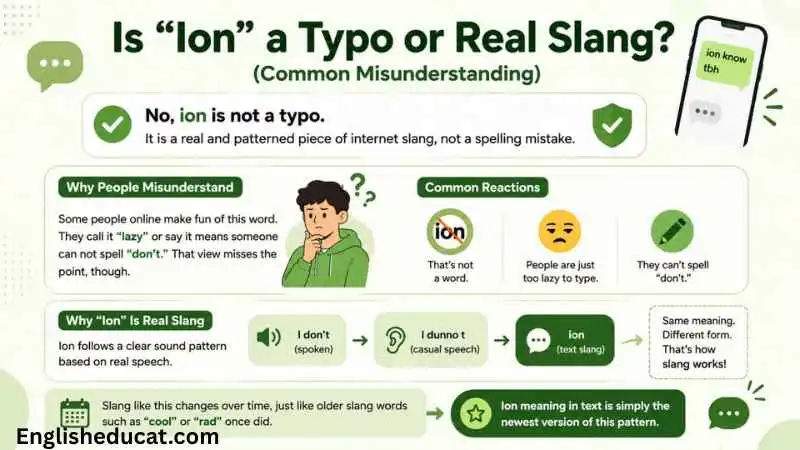
Slang like this changes over time, just like older slang words such as “cool” or “rad” once did. Ion meaning in text is simply the newest version of this pattern.
Ion Meaning in Text: How It is Used on Different Platforms
Ion’s meaning in text stays almost the same everywhere you see it. But how often it shows up and in what style can shift with apps.
Ion on Snapchat
Snapchat is one of the most common places to see “ion.” People use it in quick replies, like “ion wanna go out” or just a single “ion” as a short no.
Ion on TikTok
Ion often appears in comments and captions on TikTok. You might see something like “ion think this trend is real.”
Ion on Instagram
People use “ion” in DMs and comments the same way they use it in a text message on Instagram. It is common in casual replies to Stories.
Ion on Discord and in Group Chats
In Discord servers and group chats, speed matters. Gamers and friend groups often type “ion” instead of “I don’t” to keep the conversation moving fast.
Ion on Twitter/X
On Twitter/X, ion shows up in tweets and replies. You will often see it in short, punchy posts like “ion trust that at all.”
Ion in Different Tones: What It Sounds Like
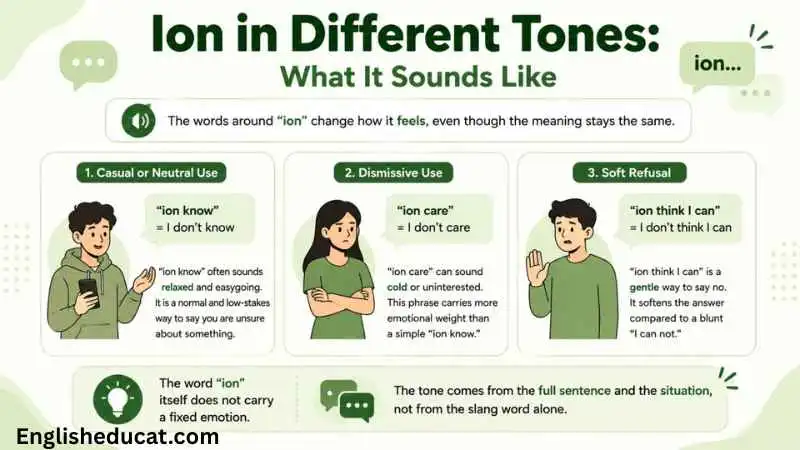
The words around “ion” change how it feels, even though the meaning stays the same.
Casual or neutral use
“ion know” often sounds relaxed and easygoing. It is a normal and low-stakes way to say you are unsure about something.
Dismissive use
“ion care” can sound cold or uninterested. This phrase carries more emotional weight than a simple “ion know.”
Soft refusal
“ion think I can” is a gentle way to say no. It softens the answer compared to a blunt “I can not.”
The word “ion” itself does not carry a fixed emotion. The tone comes from the full sentence and the situation, not from the slang word alone.
Is Ion Rude or Offensive?
No, ion is not rude or offensive on its own. It is considered casual and neutral slang.
That said, some phrases built with it, like “ion care what you think,” can come across as dismissive. This depends on the words around it and the relationship with the person who is texting you, not on the word “ion” itself.
Think about it like tone of voice. “I do not care,” said calmly, is very different from “I do not care!” said sharply. Ion works the same way as the surrounding words, and also situtuation carries the emotions, not the word itself.
When to Use (and Avoid) “Ion”
Knowing when to use this word matters just as much as knowing what it means.
Good contexts
- Texting close friends
- Casual group chats
- Comments or DMs on social media
Contexts to avoid
- Work emails or messages to a boss
- School assignments
- Customer service chats
Professional alternatives
If you are writing something formal, swap “ion” out for:
- “I don’t know”
- “I’m not sure”
- “I don’t think so”
These full phrases sound clear and professional in any setting.
Ion vs. Similar Texting Slang (Comparison Table)
Ion meaning in text is just one piece of texting shortcuts. Here is how it compares to other common terms.
| Ion | I don’t | Works in many sentence types |
| IDK | I don’t know | Stands alone, more specific |
| TBH | To be honest | Adds opinion, not negation |
| NGL | Not gonna lie | Signals honesty, not refusal |
| IMO | In my opinion | Shares a view, not a “no” |
| SMH | Shaking my head | Shows disappointment |
| FR | For real | Shows agreement or emphasis |
Ion stands out because it fits into full sentences naturally, like “ion care” or “ion think so.” Terms like IDK usually stand alone instead.
How to Respond When Someone Texts You “Ion”
If a friend texts you “ion,” here are some easy ways to reply:
- Casual: “Same, ion know either”
- Friendly: “No worries, take your time”
- Respectful: “That’s okay, thanks for being honest”
Matching their casual tone usually keeps the conversation flowing naturally.
Frequently Asked Questions
What does ion mean in text?
In texting, “ion” means “I don’t.” It’s a phonetic contraction that reflects how “I don’t” sounds when spoken quickly and casually. You’ll see it most often in phrases like “ion know” or “ion care,” used mainly in informal chats between friends rather than formal writing.
What does ion mean on Snapchat?
On Snapchat, “ion” is most commonly used as a contraction of “I don’t,” often in quick replies like “ion know” or “ion care.” The capitalized form, ION, can also mean “In Other News,” though this second meaning shows up far less often on Snapchat than the first.
Is ion the same as I don’t?
Yes, “ion” is simply a shortened, phonetic spelling of “I don’t.” It’s used in casual texting, social media comments, and group chats across most major platforms today. The two phrases mean the same thing; “ion” is just a faster way to type it out.
Does ion mean in other news?
When written in all caps as “ION,” it can mean “In Other News,” used to introduce a new or unrelated topic in conversation. Lowercase “ion” almost always means “I don’t” instead, so capitalization is the clearest clue to which meaning someone intends in a given message.
Is ion rude or offensive?
“Ion” itself is neutral slang and not considered rude or offensive on its own. Depending on the phrase and tone, like “ion care what you think,” it can sound dismissive or cold. That impression comes from the surrounding words and context, not from the shortcut itself.
Can I use ion at work or in professional messages?
No ion is strictly informal slang and should be avoided in professional emails, job applications, or formal writing. It can come across as too casual or unclear in serious settings. Use full phrases like “I don’t know” or “I’m not sure” instead for clarity and professionalism.
What’s the difference between ion and idk?
“Ion” is a contraction of “I don’t” and fits into many sentence types, such as “ion care” or “ion think that’s true.” “Idk” specifically means “I don’t know” and usually stands alone as a short reply, rather than blending into a longer sentence like “ion” does.
Quick reference
- Ion’s meaning in text is mainly “I don’t,” as in “ion know” or “ion care.”
- ION in all caps can mean “In Other News,” used to switch topics.
- It is not related to the scientific word “ion,” which means a charged atom.
- The slang comes from how “I don’t” sounds when spoken fast, with roots in AAVE.
- It is common on Snapchat, TikTok, Instagram, Discord, and Twitter/X.
- Use this word for casual chats, and skip it at work or in formal writing.
Texting slang moves fast, and understanding ion meaning in text is a good reminder that most of it is not random. It is just everyday speech, written the way people actually talk. Next time it appears in your messages, you will know exactly what it means and maybe even use it yourself.

Senior English Content Editor
Sarah has over 10 years of experience teaching English as a Second Language in Chicago public schools. She specializes in vocabulary building and simplifying complex word meanings for everyday learners. Sarah holds a Master’s degree in English Education from the University of Illinois.
[…] ION […]