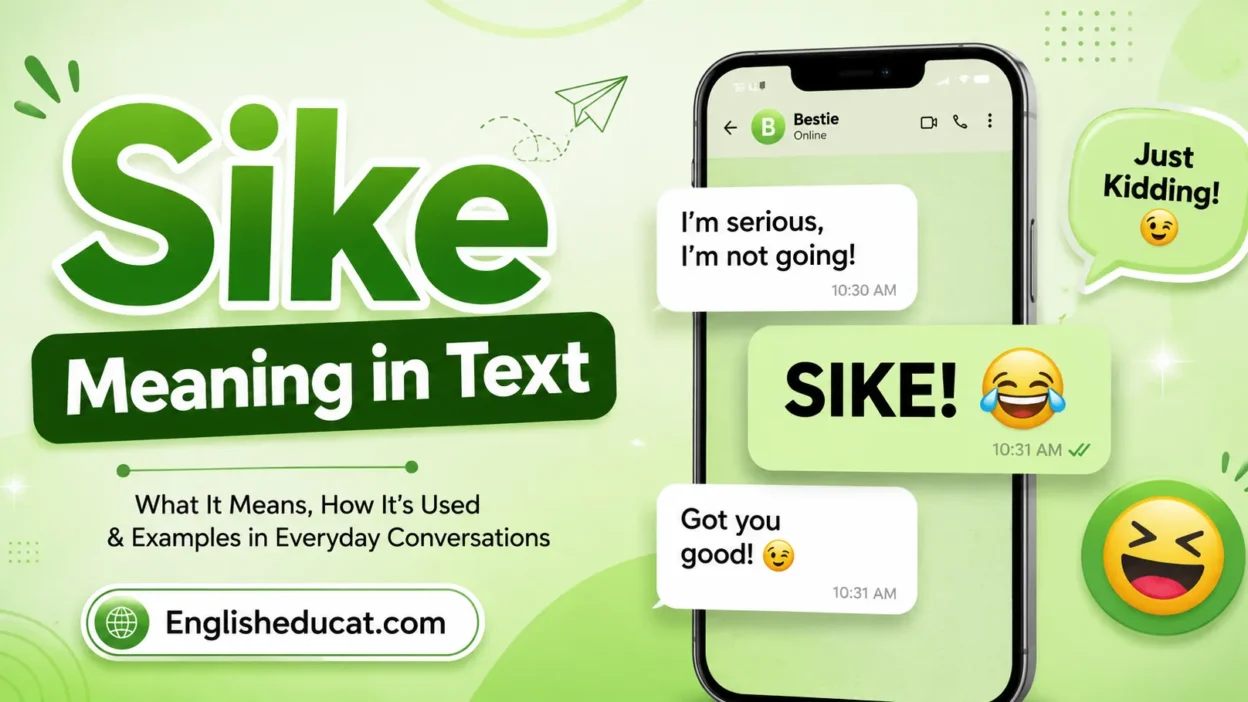
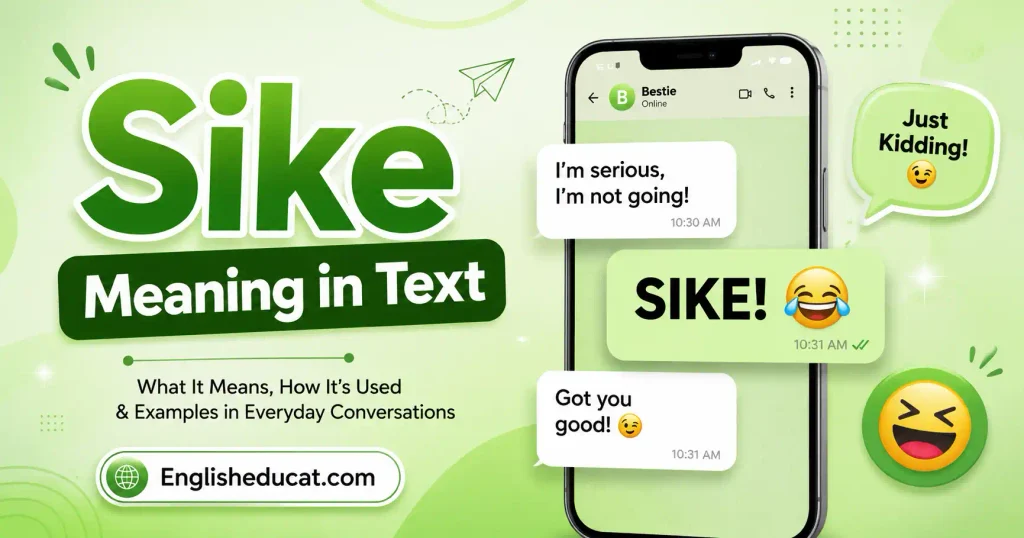
The sike meaning in text is simple: “sike” means “just kidding.” People type it right after a statement to show the statement was not true, or it was just fun. This is different from an older and unrelated word, “sike” used in British dialect. This guide covers the real definition, where the slang word came from, how to use it, and how it changes a little depending on the app you are using.
Sike Meaning in Text (Quick Answer)
“Sike” is a slang interjection that means “just kidding” or “I fooled you.” Someone says or writes something first. Then they add “sike” to reveal that it was not real and just fun. That is the full sike meaning in text, and it works the same way in speech.
“Sike” is a variant spelling of the older word “psych.” Nowadays both words mean the same thing.
Sike vs. Psych: Are They the Same Word?
Yes, “sike” and “psych” are the same word with two different spellings. Both are pronounced the same way: /saɪk/, rhyming with “bike.”
According to grammar “sike” is an interjection. An interjection is a short word or phrase that shows a sudden feeling or reaction, like “wow” or “oops.” “Sike” reacts to a joke by revealing it right away. Knowing this small grammar detail matters because it tells why the sike meaning in text only makes sense as a reaction. It can not stand alone as a full sentence with its own subject and verb.
Why “Sike” Became the More Common Spelling
“Psych” came first. As people nowadays started typing more than writing by hand, “sike” became the easier and more natural spelling to type out.
Text messages move fast. Spelling “psych” correctly takes a second longer, and “sike” just looks and sounds right to most people typing quickly. That small change is a big part of why the sike meaning in text today mostly appears spelled with an “i,” not a “y.”
Today, most young people online use “sike” more than “psych” in casual writing. Dictionary sites now list both spellings as accepted.
Where Does “Sike” Come From? (Origin & History)
The word “sike” grew out of “psych,” which is a much older slang term. Its etymology, or word history, will help you to explain the full sike meaning in text used today.
The 1990s Roots of “Psych!”
“Psych!” became popular slang in the 1990s. It was short for “I psyched you out,” meaning someone tricked another person into believing something false. Kids and teens used “Psych!” constantly in schoolyards and on playgrounds during this decade. It was a fast way to end a prank the moment it landed.
How “Sike” Took Over in 2000s to 2020s Slang
As texting and instant messaging grew in the 2000s, “sike” started appearing more often than “psych.” Fast typing and Gen Z slang trends pushed the shorter and simpler spelling forward.
By the 2010s and 2020s, “sike” had become the top version. It now appears more than “psych” across texts, DMs, and comment sections. Merriam-Webster now lists “sike” as a standard slang spelling next to “psych.” This shows how far the word has traveled from its schoolyard memories.
The older dialect word “sike” (the small stream meaning) barely appears in modern writing. Oxford English Dictionary data shows it appears less than 0.01 times per million words. That tiny number confirms one thing: almost every modern search for the sike meaning in text is about the joke, not about the stream.
How to Use “Sike” in a Text or Chat
The sike meaning in text only works with a specific pattern: setup and then reveal. First, someone sends a statement that looks true. Then they follow it with “sike” to show that it was just a joke.
Example Conversations
Example 1:
“I got us tickets to the concert tonight!” “Sike, we are staying home lol”
Example 2:
“I failed my math test.” “Sike, I got a 98.”
Example 3:
“Guess who just got engaged 👀” “Sike, still very single”
Example 4:
“I am not coming to your party.” “Sike, I would not miss it.”
Each example follows the same pattern. That pattern is the heart of the sike meaning in text, no matter what the actual joke is about.
What “Sike Nah” Means (and Other Related Phrases)
“Sike nah” combines “sike” with “nah” for extra emphasis. It confirms even more strongly that the earlier statement was not true. Some people also write it as “psynah,” a squished-together version popular in fast texting and comments. Both mean the same thing: a stronger and more playful version of plain “sike.”
Sike Meaning in Text by Platform
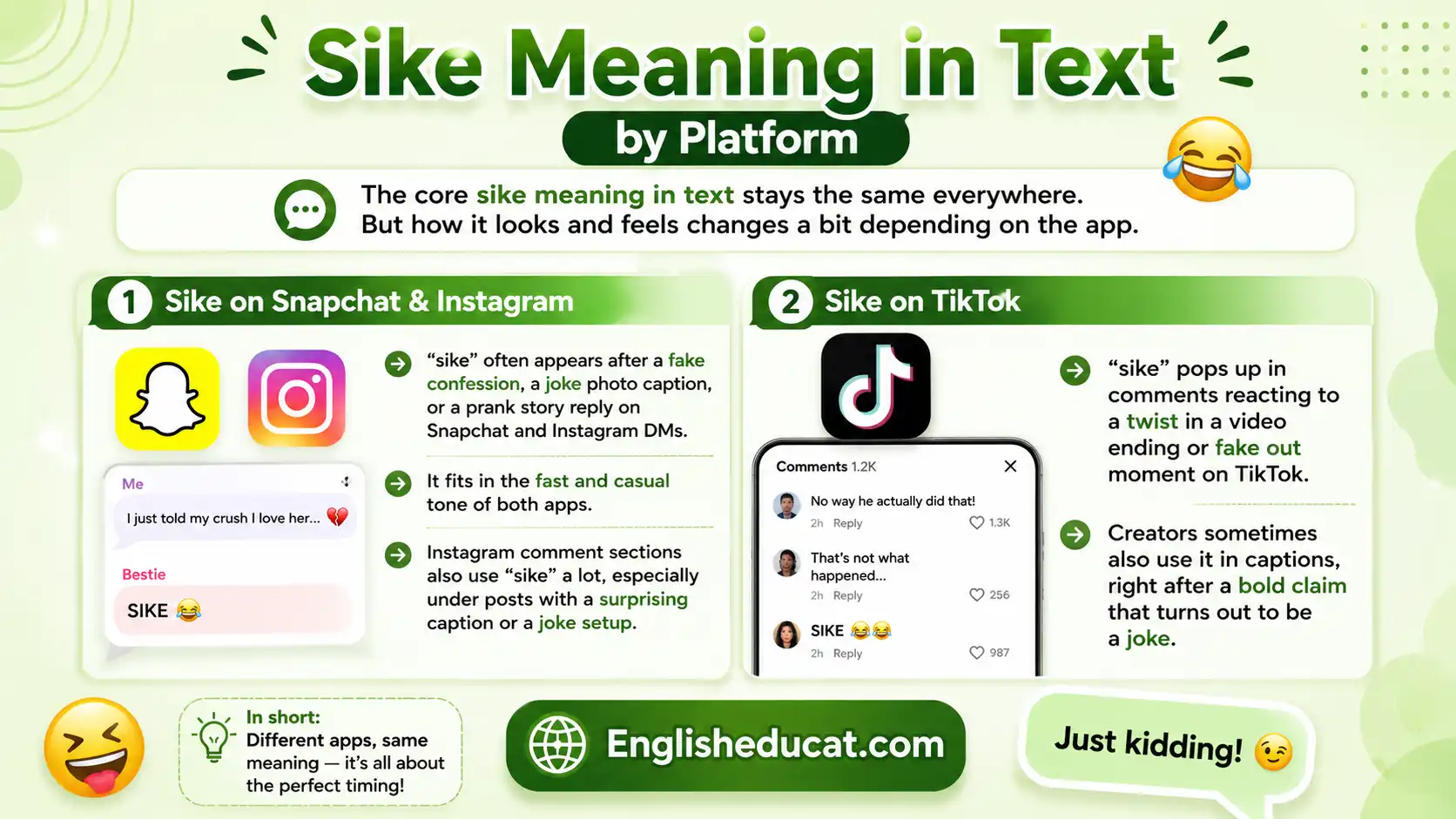
The core sike meaning in text stays the same everywhere. But how it looks and feels changes a bit depending on the app.
Sike on Snapchat & Instagram
“sike” often appears after a fake confession, a joke photo caption, or a prank story reply on Snapchat and Instagram DMs. It fits in the fast and casual tone of both apps. Instagram comment sections also use “sike” a lot, especially under posts with a surprising caption or a joke setup.
Sike on TikTok
“sike” pops up in comments reacting to a twist in a video ending or fake out moment on TikTok. Creators sometimes also use it in captions, right after a bold claim that turns out to be a joke.
Sike on WhatsApp & iMessage
“sike” tends to appear in one to one chats between friends in WhatsApp and iMessage conversations. It is used in the same way as any text: a joke first and then the reveal.
Group chats on these apps also use “sike” often, especially when one person tries to trick the whole group with fake news or a fake plan. Across every platform, the sike meaning in text never really changes; only the setting around it does.
Is Saying “Sike” Rude or Playful?
In most cases, the sike meaning in text is playful, not rude. It is meant to be a light and harmless joke between people who know each other well.
I learned this firsthand while managing comments on a TikTok account of a client last year. A follower asked a real question about a giveaway. I replied “sike,” thinking it clearly sounded like a joke. It did not land that way. The follower thought I was being dismissive. I had to reply again with a clear and kind explanation before they understood I was joking. That one comment taught me a simple lesson: tone in text does not always come across the way it looks in your head, and especially with someone who does not know your usual style.
When It is Totally Fine to Use
- Texting close friends or family
- Casual group chats
- Comment sections on funny or lighthearted posts
- Reacting to a harmless prank
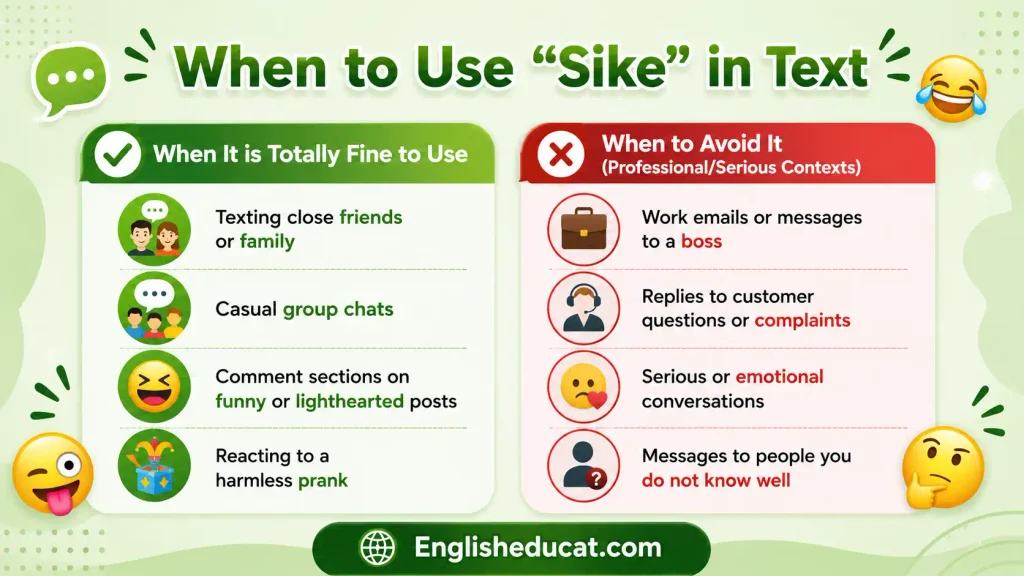
When to Avoid It (Professional/Serious Contexts)
- Work emails or messages to a boss
- Replies to customer questions or complaints
- Serious or emotional conversations
- Messages to people you do not know well
How to Reply to “Sike”
When someone sends you a message with “sike,” a short and natural reply keeps the joke going. Here are some common ways to reply:
- Lol you got me
- Not funny 😂
- I knew it
- Wow, rude
- Okay, that was good
These replies work in almost any chat and match the light tone that comes with the sike meaning in text.
Similar Slang Terms to “Sike”
Several other slang terms carry a similar meaning to “sike.” Here is a quick comparison:
| JK | Short for “just kidding” |
| Gotcha | Confirms someone was tricked |
| Not! | Older slang added after a fake statement |
| Prank | A playful trick or joke |
| Fooled ya | Direct way of saying someone was tricked |
Each of these words can stand in for “sike” depending on the mood of the conversation, though none capture the same playful snap as the real sike meaning in text.
Frequently Asked Questions
What does sike mean?
“Sike” is a slang interjection meaning “just kidding.” People say or type it right after a statement to reveal that the statement was not true. It is one of the most common ways to end a joke in casual conversation today.
What does sike mean in text?
In texting, the sike meaning in text works the same as in speech. Someone sends a message that sounds true, then follows it with “sike” to show they were joking. It is a quick, casual way to reveal a prank over text.
Is sike the same as psych?
Yes, “sike” is simply the more common modern spelling of “psych.” Both are used the exact same way, to mean “just kidding” or “I fooled you.” Over time, “sike” became more popular in texting and online chats than the original 1990s spelling.
What does “say sike right now” mean?
“Say sike right now” is a request for someone to admit they were joking. People usually say this in response to unwelcome, surprising, or shocking news they hope is not true. It is a way of demanding the reveal instead of waiting for it.
Is sike rude or polite?
“Sike” is generally playful, not rude, among friends and in casual settings. It can come across as inappropriate or confusing in serious, professional, or unfamiliar conversations. It works best with people who already know your sense of humor, so save it for casual chats.
What does sike nah mean?
“Sike nah” combines “sike” with “nah” to add extra emphasis. It confirms, more strongly and playfully, that the earlier statement was a joke or was not true. People often use it in texts and comments when they want the reveal to land harder.
Where does the word sike come from?
“Sike” comes from “psych,” a slang term that became popular in the 1990s. It was originally short for “I psyched you out,” meaning someone was tricked by a playful lie. Over time, “sike” became the more common spelling in texting and online writing.
Conclusion
The sike meaning in text is “just kidding,” which is used right after a joke statement to reveal it was not true. “Sike” is a modern spelling of the older word “psych,” and both are pronounced in the same way. The word traces back to 1990s slang and has grown into one of the most common joke reveal words online. It fits naturally on Snapchat, Instagram, TikTok, WhatsApp, and iMessage, though tone always depends on who you are talking to. Save it for friends and casual chats, and do not use it in professional or serious conversations.
Slang moves fast, but “sike” has barely changed in over thirty years. Only the spelling changed, from “psych” to what we see everywhere today. Whether you are texting a friend, replying to a comment, or just keeping up with online jokes, knowing the real sike meaning in text means you will never misread the moment. And next time someone says “sike” to you, you will know exactly how to reply with your own.

Linguistics Specialist
James is a linguist with a Ph.D. in Applied Linguistics from Boston University. His work focuses on word origins, synonyms, and how language evolves over time. He has contributed to several academic journals on English semantics.