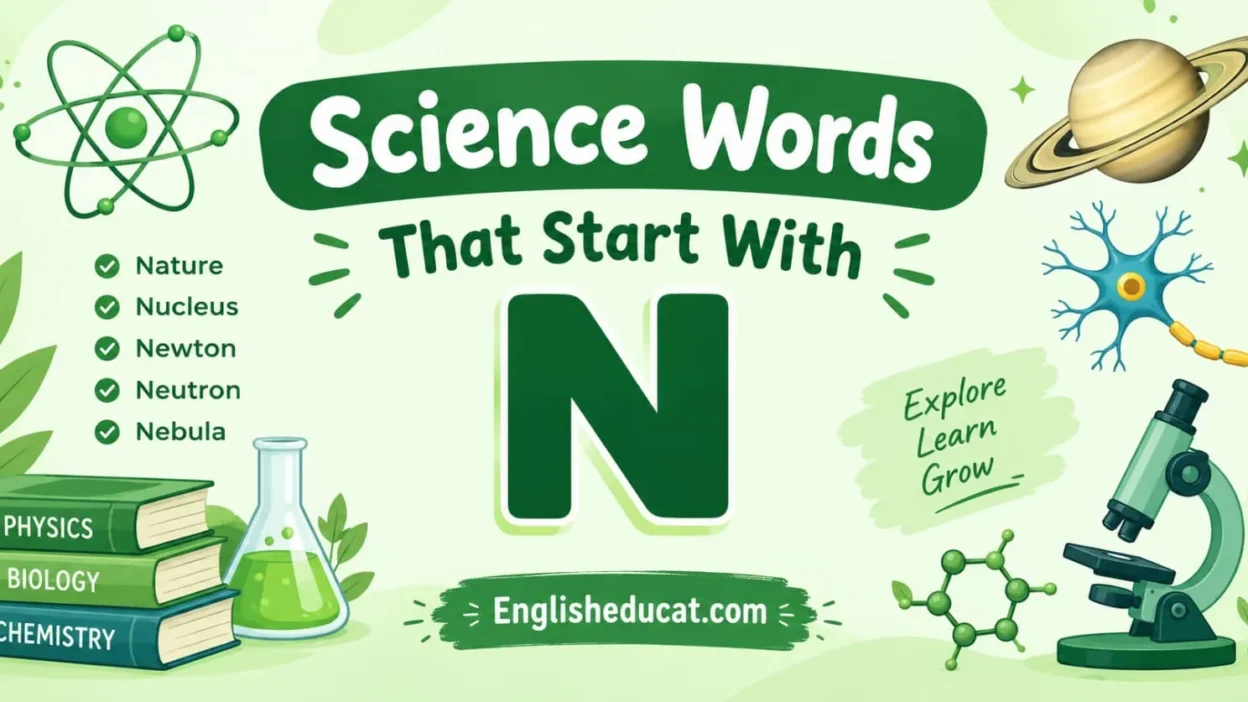
Science words that start with N cover an unusually wide stretch of the natural world. A single letter connects the neutron sitting inside every atom, the neuron firing inside your brain, and the nebula giving birth to new stars light-years away. Few letters of the alphabet pull double duty across so many disciplines at once, and that is likely why students, teachers, and curious readers keep searching for a clear and organized list of them.
This guide collects science words that start with N and divides them by branch biology, chemistry, physics, astronomy, and earth science so you can find what you need without wading through an unsorted glossary. Each term gets a plain definition and a sentence showing how it is actually used, the way a biology textbook or a NASA press release might use it.
Whether you are prepping for an exam, building your vocabulary, or simply wondering why so many scientific terms happen to start with N, you will find the full picture below, along with a short bonus list of advanced terms for readers who want more of a challenge. You should also learn other science words that start with O and P.
| Branch | Quick Example |
| Biology | Neuron, nucleus, natural selection |
| Chemistry | Nitrogen, neutralization, noble gas |
| Physics | Newton, neutron, nuclear fusion |
| Astronomy | Nebula, neutron star, nova |
| Earth Science | Natural resource, nor’easter, normal fault |
Why So Many Science Words Start With N
It is not a coincidence that N appears so often in scientific vocabulary. A handful of root words do most of the heavy lifting. The Greek neuron, meaning sinew or cord, gave rise to neuron, neurotransmitter, and neurobiology, an entire vocabulary describing how the nervous system works. Separately, the Latin nucleus, meaning kernel or small nut, spread into chemistry and physics as nucleus, neutron, and nuclear, then into astronomy through terms like nucleosynthesis, which is the stellar process that forges heavier elements.
That single root nucleus quietly links atomic physics, cell biology, and astrophysics under one letter. It is one reason science words that start with N feel so conceptually dense: learn what “nucleus” means once, and a working vocabulary across three entirely different fields comes with it.
Biology Words That Start With N
Biology contributes some of the most frequently used science words that start with N, largely because so much of biology is organized around cells and the nervous system. A neuron is a specialized nerve cell that transmits electrical and chemical signals throughout the body; neuroscientists study how neurons misfire during conditions like epilepsy. The nucleus houses the genetic material of the cell behind its own membrane and directs nearly every cellular process, from protein synthesis to division.
Close by, nucleic acids DNA and RNA are the molecules that carry hereditary information from one generation to the next, while a nucleotide is the basic building block those molecules are made from, combining a sugar, a phosphate group, and a nitrogenous base. Tucked inside the nucleus itself sits the nucleolus, a smaller structure responsible for assembling ribosomes.
Not every term on this list lives inside a single cell, though. Natural selection, the process Charles Darwin described in On the Origin of Species, favors organisms whose traits improve their odds of survival and reproduction. A niche is the specific ecological role a species occupies, and biologists often note that two species rarely share an identical niche for very long without one outcompeting the other. Natality, less commonly discussed outside population biology, refers to the birth rate within a given population and helps ecologists predict how quickly a species might grow.
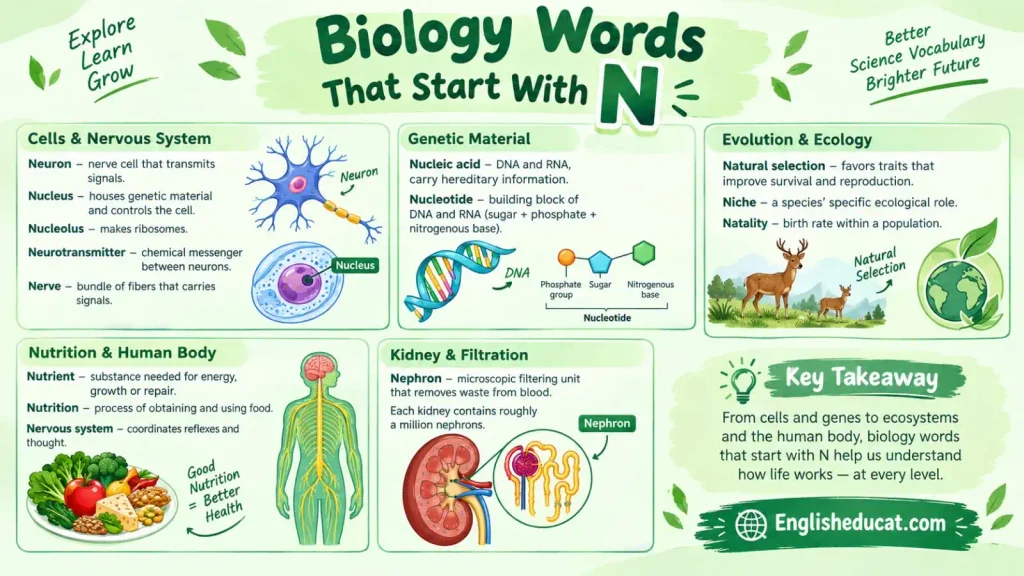
Inside the human body, N-words appear just as often. A nutrient is any substance an organism needs for energy, growth, or repair, and a shortage of key nutrients in soil can stunt plant growth for miles around. Nutrition describes the broader process of obtaining and using food, something dietitians study at a population level.
The nervous system coordinates everything from reflexes to conscious thought, relying on individual nerve bundles of fibers to carry signals between the brain and the rest of the body. Those signals often depend on a neurotransmitter, a chemical messenger like dopamine or serotonin that crosses the gap between neurons. In the kidney, a nephron is the microscopic filtering unit responsible for removing waste from blood, and each kidney contains roughly a million of them.
Some of these terms describe simpler, observable traits. A nematode is a slender, unsegmented roundworm found in nearly every habitat, from soil to deep-sea sediment. Animals that are nocturnal are active mainly at night, a trait shared by owls, bats, and many rodents. A nymph is the immature stage of certain insects, such as a dragonfly, before it grows wings.
Flowers produce nectar, the sugary fluid that draws in pollinators like bees and hummingbirds. In early vertebrate embryos, the notochord is a flexible rod that supports the body before becoming part of the spine. Plant biologists also use node, the point on a stem where a leaf or bud attaches, and nastic movement, a response of a plant to a stimulus unrelated to its direction; the fast closing of a Venus flytrap is a textbook example.
Three more deserve a mention despite showing up less in intro-level courses: neuroglia, the supportive cells that protect neurons; neurogenesis, the formation of new neurons; and necrosis, the death of cells or tissue after injury or disease. Together, these science words that start with N make up a meaningful share of any introductory biology course.
Chemistry Words That Start With N
Chemistry supplies a dense cluster of science words that start with N, partly because eight elements on the periodic table begin with the letter. Nitrogen, atomic number 7, makes up close to four-fifths of the air you are breathing right now and is essential to amino acids and proteins, though it must first pass through nitrogen fixation, a conversion process carried out by soil bacteria before plants can use it.
Nickel is a silvery-white transition metal commonly alloyed into stainless steel and rechargeable batteries, and neon, a noble gas, glows a distinctive reddish-orange when electrified, which is where neon signage gets its name. The rest of the N-elements are rarer, and most people only encounter them in a chemistry classroom:
| Element | Symbol | Known For |
| Nitrogen | N | Makes up most of Earth’s atmosphere; essential to proteins |
| Nickel | Ni | Alloyed into stainless steel and batteries |
| Neon | Ne | Noble gas used in glowing signage |
| Neodymium | Nd | Used in powerful permanent magnets |
| Niobium | Nb | Corrosion-resistant metal in jet engines and superconductors |
| Nobelium | No | Synthetic, radioactive, named after Alfred Nobel |
| Nihonium | Nh | Synthetic superheavy element discovered in Japan |
| Neptunium | Np | First transuranium element ever synthesized |
Composition is not the only angle chemistry takes on N-words; plenty describe how a substance behaves instead of what it is made of. A noble gas, such as helium or argon, resists forming chemical bonds because its outer shell already holds a full set of electrons, leaving nothing to trade. A nonmetal lacks the conductivity and malleability of metals, and a nonpolar molecule, like the fats found in cooking oil, has no separation of electrical charge, which is exactly why oil and water refuse to mix.
Neutralization is the reaction between an acid and a base that produces water and a salt, a process water treatment plants rely on to manage acidic runoff. A solution with a pH of exactly 7 is described as a neutral solution.
Head into organic and industrial chemistry, and the list keeps growing. Naphthalene, made of two fused benzene rings, gives traditional mothballs their sharp smell, while naphtha is a flammable liquid distilled from petroleum and used as fuel and industrial solvent.
A nucleophile is an electron-rich atom or molecule that donates a pair of electrons to form a new bond, a concept organic chemistry students meet constantly. Nucleation describes the first step in forming a new phase, such as when dust particles give water vapor a surface to condense on, forming raindrops. Chemists also use nuclide to describe an atom defined by its specific number of protons and neutrons, a concept central to radiocarbon dating.
Three more words sit at the edge of a typical syllabus: normality, a measure of solution concentration based on reactive capacity; nonelectrolyte, a substance like table sugar that would not conduct electricity once dissolved in water; and nascent, describing a substance in the instant it forms, when it is often unusually reactive. Even a quick scan of a general chemistry textbook shows how many science words that start with N show up in a single semester.
Physics Words That Start With N
Physics leans on N heavily, mostly because of one towering historical figure. A newton is the SI unit of force: the push needed to accelerate a one-kilogram mass by one meter per second, every second, and it is named after Sir Isaac Newton himself. His three laws of motion are foundational enough to deserve their own quick reference:
| Law | What It Says | Everyday Example |
| Newton’s First Law | An object resists changes to its motion unless a force acts on it | Passengers lurch forward when a car brakes suddenly |
| Newton’s Second Law | Force equals mass times acceleration (F = ma) | Engineers use it to calculate a rocket’s acceleration under thrust |
| Newton’s Third Law | Every action produces an equal, opposite reaction | A swimmer pushes water backward to propel themselves forward |
Zoom into the atom itself, and physics adds an entirely different layer of N-words. A neutron is the electrically neutral particle found inside the nucleus of an atom, working alongside protons to determine the isotope of an element. A neutrino is a nearly massless particle that barely interacts with ordinary matter at all; trillions produced by the sun pass through the human body every second without leaving a trace.
Nuclear fission splits a heavy atomic nucleus into smaller pieces and releases energy in the process, the reaction that powers conventional nuclear reactors, while nuclear fusion does the opposite, combining light nuclei into a heavier one, the same reaction that powers the sun. Nuclear binding energy is the energy required to hold protons and neutrons together inside a nucleus, and it explains why splitting a heavy atom releases so much usable energy.
Back on a more everyday scale, mechanics and wave physics contribute several more. A normal force is the support force a surface exerts perpendicular to an object resting on it, the reason a book does not fall straight through a table. A node, in the context of a standing wave, marks a point where displacement stays at zero, something you can see directly on a vibrating guitar string.
Every object has a natural frequency, the rate at which it vibrates without an outside push, and engineers design bridges carefully to avoid matching that frequency with wind or foot traffic. The net force on an object is the combined result of every force acting on it; when that net force equals zero, the object moves at constant velocity or stays perfectly still.
Two more belong on an advanced reading list: numerical aperture, a measure of how much light a lens can gather, and nodal analysis, a technique for calculating voltage throughout a circuit. Science words that start with N cluster especially thick around anything involving the atomic nucleus.
Astronomy and Space Words That Start With N
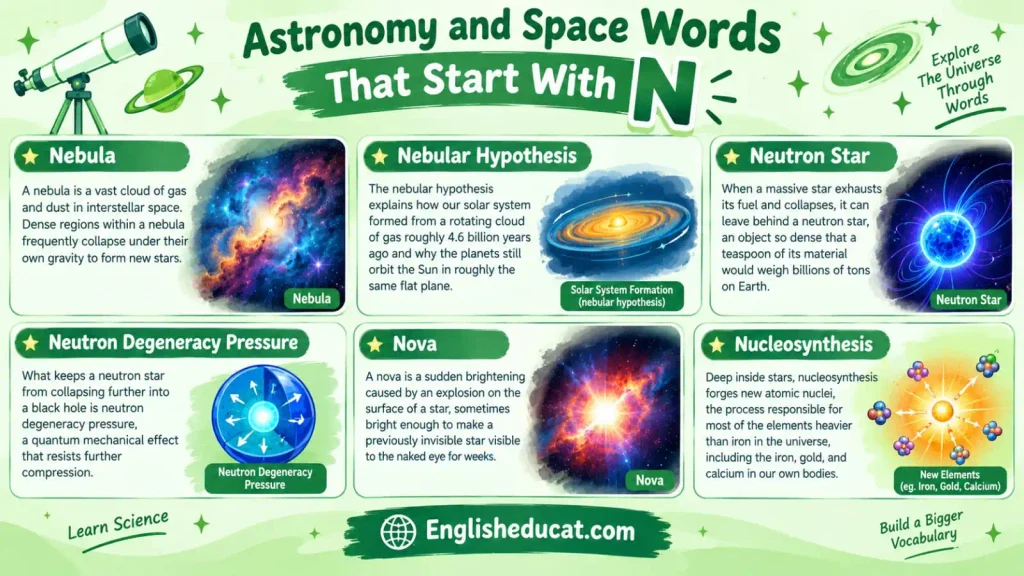
Astronomy offers some of the most visually striking science words that start with N. A nebula is a vast cloud of gas and dust in interstellar space, and dense regions within a nebula frequently collapse under their own gravity to form new stars. The nebular hypothesis explains how our solar system formed from just such a rotating cloud of gas roughly 4.6 billion years ago and why the planets still orbit the Sun in roughly the same flat plane.
When a massive star exhausts its fuel and collapses, it can leave behind a neutron star, an object so dense that a teaspoon of its material would weigh billions of tons on Earth. What keeps that neutron star from collapsing further into a black hole is neutron degeneracy pressure, a quantum mechanical effect that resists further compression.
Not every stellar event is as dramatic as a supernova, though some come close. A nova is a sudden brightening caused by an explosion on the surface of a star, sometimes bright enough to make a previously invisible star visible to the naked eye for weeks. Deep inside stars, nucleosynthesis forges new atomic nuclei, the process responsible for most of the elements heavier than iron in the universe, including the iron, gold, and calcium in our own bodies.
A separate set of terms belongs to observational astronomy and the practical side of watching the sky. The nadir is the point in the sky directly beneath an observer, exactly opposite the zenith overhead. A natural satellite, like the Moon of Earth, is any celestial body that orbits a planet. Astronomers closely track every known near-Earth object, an asteroid or comet whose orbit brings it uncomfortably close to our planet. Earth’s own axis experiences nutation, a small, irregular wobble layered on top of its larger precession cycle. On clear nights, the north celestial pole, marked closely by Polaris, offers a fixed point that navigators have relied on for centuries.
Earth and Environmental Science Words That Start With N
Earth science and environmental science round out the list of science words that start with N with terms tied to geology, weather, and natural resources. A natural resource is any material drawn directly from the environment for human use, and fresh water increasingly counts as one under growing global strain.
Natural gas, composed mainly of methane, remains a major fuel source for heating and electricity generation, while resources classified as nonrenewable, coal being the clearest example, can not be replaced within a human lifetime once they are used up. Pollution scientists label runoff from farms and city streets nonpoint source pollution, since it comes from diffuse sources rather than one identifiable pipe or outlet.
Underground, geology adds its own specialized vocabulary. A normal fault forms when tectonic forces stretch crust apart of Earth, causing one block of rock to slip downward relative to another. A nappe is a massive sheet of rock displaced over another layer, sometimes traveling kilometers during mountain-building events. Nivation describes the slow erosion caused by repeated freezing and thawing of snow and ice on mountain slopes. The Neogene refers to a geological period spanning roughly 23 to 2.6 million years ago, during which many familiar mammal groups diversified.
Above ground and out at sea, a final set rounds out the list. A nor’easter is a powerful storm system along the U.S. East Coast driven by northeasterly winds, often responsible for major winter snowfall. Nimbostratus clouds form a thick, gray layer associated with long stretches of steady rain or snow. In the ocean, North Atlantic Deep Water is a dense water mass that sinks and flows southward along the seafloor, playing a major role in global ocean circulation. Closer to shore, the neritic zone, shallow water stretching from the coastline to the edge of the continental shelf, supports an outsized share of marine life thanks to the sunlight that reaches it.
Advanced and Rare N-Words
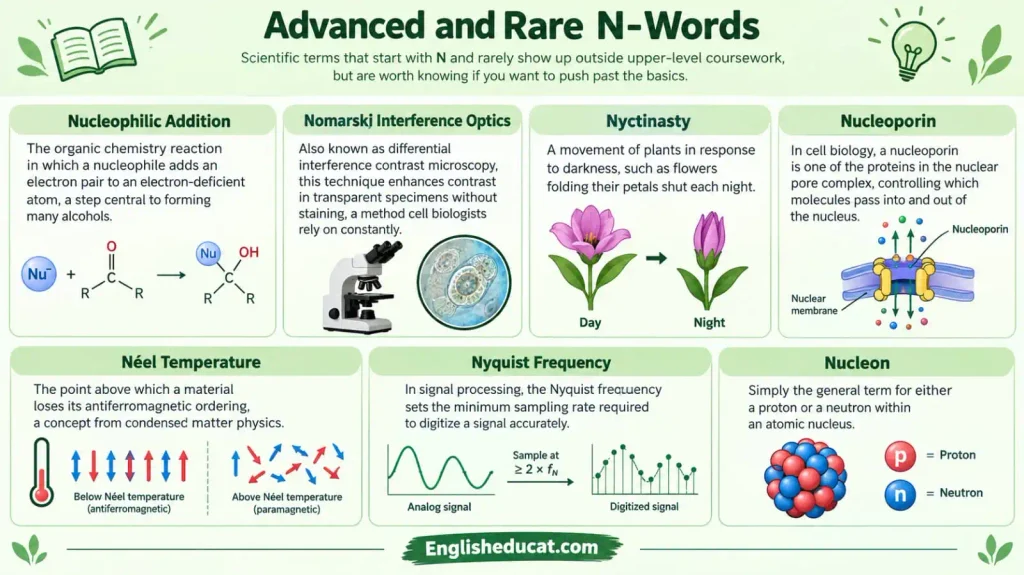
A handful of science words that start with N rarely show up outside upper-level coursework, but they are worth knowing if you want to push past the basics. Nucleophilic addition is the organic chemistry reaction in which a nucleophile adds an electron pair to an electron-deficient atom, a step central to forming many alcohols.
Nomarski interference optics, more formally known as differential interference contrast microscopy, enhances contrast in transparent specimens without staining, a technique cell biologists rely on constantly. Nyctinasty describes a movement of plants in response to darkness, such as flowers folding their petals shut each night. In cell biology, a nucleoporin is one of the proteins in the nuclear pore complex, controlling which molecules pass into and out of the nucleus.
Physics has its own advanced entries too. The Néel temperature marks the point above which a material loses its antiferromagnetic ordering, a concept from condensed matter physics. In signal processing, the Nyquist frequency sets the minimum sampling rate required to digitize a signal accurately. And a nucleon is simply the general term for either a proton or a neutron within an atomic nucleus.
Why Learn N Science Words?
Building a working vocabulary of science words that start with N pays off in a way that is easy to underestimate. Understanding what “neutron” means, for instance, does not just help you pass a chemistry quiz; it quietly opens the door to nuclear physics, radiometric dating, and stellar astrophysics all at once, since the same particle sits at the center of each field.
For students, this kind of vocabulary is often the difference between memorizing a fact and understanding the concept behind it. For teachers, a well-organized list like this one makes for a faster way to build a lesson plan or study guide. And for general readers, there is a simpler payoff: once you know what a nebula, a neuron, and a nucleus actually are, science headlines start to make more sense. If N-words have sparked your curiosity, the neighboring letters M and O are worth exploring next.
Frequently Asked Questions
What are the most common science words that start with N?
Neutron, nucleus, nitrogen, neuron, and nebula are the most frequently used science words that start with N. Each anchors a different field: physics, cell biology, chemistry, neuroscience, and astronomy, respectively.
What is a 5-letter science word that starts with N?
“Niche” and “nerve” are both common 5-letter science words starting with N. Both terms appear regularly in biology, particularly in ecology and the study of the nervous system.
Which science words that start with N are used in physics?
Newton, neutron, neutrino, and nuclear fusion are core physics terms beginning with N. Together they describe a unit of force, a subatomic particle, a nearly massless particle, and the reaction that powers the sun.
Why do so many science terms start with the letter N?
Many science words that start with N trace back to the Latin root “nucleus,” meaning kernel or core. That single root connects nucleus, nuclear, and nucleon across physics, chemistry, and biology alike.
What is an advanced or rare science word that starts with N?
“Nucleophilic addition” and “Néel temperature” are advanced science words that start with N. Both typically appear in college-level chemistry and physics coursework rather than introductory classes.
Which N words are commonly used in astronomy?
Nebula, neutron star, nova, and nucleosynthesis are key astronomy terms starting with N. They describe, in order, a stellar nursery, a collapsed stellar remnant, a sudden stellar brightening, and the process that forges heavy elements inside stars.
Conclusion
Twenty-six letters, and somehow N ended up carrying more scientific weight than almost any of them. Trace it back far enough and nearly every branch of science the atom in a physics lab, the cell under a microscope, the star through a telescope shares a single Latin root in “nucleus.” A neutron, a neuron, and a nebula have almost nothing in common on the surface, yet the same handful of syllables built the vocabulary for all three.
That is really the payoff of working through a list like this one. Science words that start with N are not just terms to memorize for a test; they are small keys that unlock entire fields at once. Learn “nucleus,” and chemistry, biology, and astronomy all get a little less intimidating in the same instant. So bookmark this page, come back to it before your next exam or late-night curiosity spiral, and let the N-words do what they have always done best: connect the smallest possible thing to the biggest.

Senior English Content Editor
Sarah has over 10 years of experience teaching English as a Second Language in Chicago public schools. She specializes in vocabulary building and simplifying complex word meanings for everyday learners. Sarah holds a Master’s degree in English Education from the University of Illinois.